
I attended my first ever UKOUG conference in Birmingham this week and it was a wonderful experience. Sadly I was only able to attend one day of the three, but I certainly made the most of it. I managed to squeeze in 1 key note, 5 sessions and also present my own paper! I reunited with old colleagues and contacts and made lots of new connections. I came home buzzing and looking forward to putting my new learnings into action.

I arrived on Monday morning just in time to hear the Opening Keynote where Leona Chauhan put questions to Jason Bowers and Jeremy Tricker from Oracle. It was really interesting to hear what their priorities are for 2025, particularly given my focus on Fusion, what Jeremy discussed really resonated with me. Customer Success is a fundamental part of Oracle’s plans for the next year. Jeremy and his relatively newly created team are ensuring that their customer’s success is at the heart of everything Oracle do. Unsurprisingly there was discussion on AI, and how Oracle are embedding Gen AI into all aspects of their applications, both On Premise and Cloud. The strength of data linked in with the use of AI are fundamental in allowing the use of Oracle products to develop.

The first session I attended was driven by my passion for all things ESG and my desire to know more about EPM Cloud. You might not know this, but I’m the Environmental Champion for my office location. I’ve been aware of the ESG reporting functionality within EPM, but didn’t know anything about it.

Imagine my delight to discover that the session was being presented by the Queen of ESG Reporting – Saloni Ramakrishna from Oracle. She walked us through all of the complexities of ESG reporting, for example individual country’s legislation; industry specific legislation; the different rating systems that are used. When organisations are operating within multiple legislations and / or industries, this becomes even more complex.

Saloni’s passion was infectious and her understanding of the balance of ESG within a business is difficult. The ethics within a business context is fundamentally different to ethics and sustainability within your personal life. Having a low carbon footprint etc is important, but it is redundant if the costs associated means the business can no longer operate.
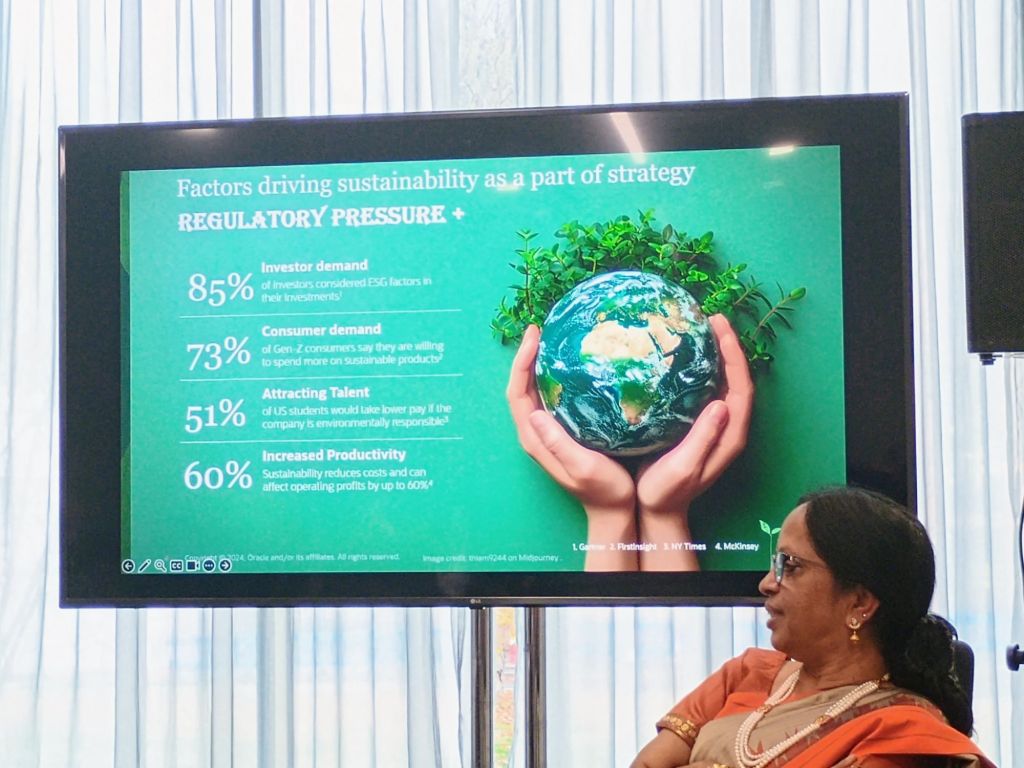
I found the factors that drive organisations to be more sustainable particularly interesting. In addition to the potential statutory requirements to achieve, there are other factors. The fact that it is being investor driven delighted me. Additionally consumer demand is a significant part. The key one was that over 50% of US students would take a lower salary to work for an organisation who prioritised sustainability.
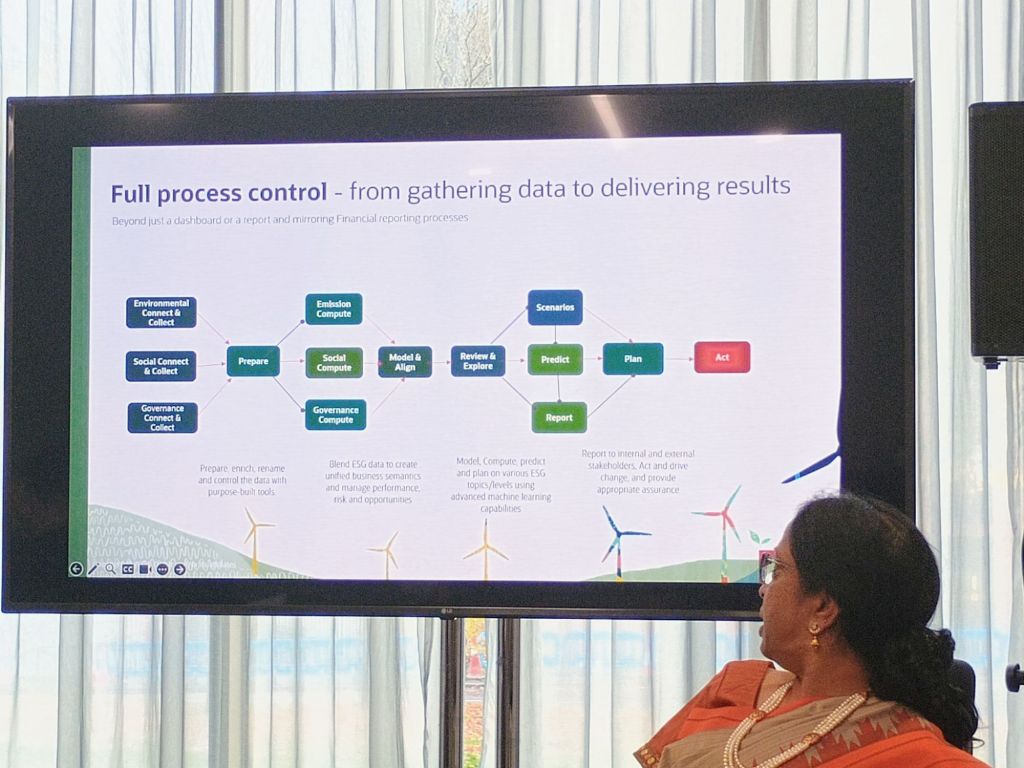
So what does Oracle provide? The ESG reporting part of EPM Cloud provides the full end to end process and is included in all EPM Cloud licences with no extra cost. The tool can help you gather your ESG data, blend this data to create a unified view of your data. It also incorporates statutory requirements to ensure that the required data is stored. The ESG reporting incorporates Machine Learning to model, predict and plan your ESG data. The final process is the production of both internal and external reports, which can be used to drive business change.

The final part of the session covered use cases for utilising Gen AI within ESG. Given the huge focus on Gen AI and the forward thinking ESG product within EPM Cloud, it’s not surprising the tool incorporated AI. The use cases showing the predictive tools for the maintenance of wind turbines, was particularly of interest. Being able to predict maintenance requirements and acting early has saved an energy company both money and downtime.

Saloni’s key takeaways were important for all businesses, irrelevant of whether they are using EPM Cloud or not. Firstly that ESG is not something that will only impact people in the future, it has a direct impact on people and businesses now. Those who ignore ESG might find their role or organisation ceases to be required. Secondly technology is at the heart of managing ESG, and particularly utilising Gen AI to predict changes that are coming will improve processes. The final point is that businesses shouldn’t just implement ESG policies because they have to, there are so many other benefits too.
I learned so much on Monday that it would be too long a post to cover in one. I’ll do a follow up to this blog shortly, so please keep an eye out for it.
About the Author:
Kate Mead is an Oracle-certified HCM Consultant and Solution Architect at Version 1 with 155 years of experience in Oracle HR and Payroll systems, including 8 years with Oracle HCM Cloud. She has worked across implementation projects and managed services, has a sound knowledge of UK Payroll legislation and — before becoming a consultant — was an HR Manager.
Please note all screenshots are the property of Oracle and are used according to their Copyright Guidelines.


 K8 Mead