A Day with Oracle: AI Success Navigator and Guided Learning Partner Enablement

Today I had the opportunity to attend and present at a partner enablement event hosted by the Oracle AI Success Navigator product team, focused on how partners like Version 1 can best use Oracle’s tooling to bring genuine, measurable value to our customers. The session brought together presentations, product demos, hands-on labs, and open discussion, covering Oracle Cloud Success Navigator and Oracle Guided Learning (OGL). It was a useful day, and I wanted to share some of the key takeaways while they’re fresh.

If you haven’t come across Cloud Success Navigator yet, it’s Oracle’s digital engagement platform, provided free to Oracle Fusion Cloud customers, designed to help organisations design, implement, and accelerate their cloud and AI roadmaps. It sits at the centre of Oracle’s broader AI Factory offering, which Oracle launched as a bundled set of partner and customer services aimed at speeding up AI adoption.

At its core, Cloud Success Navigator gives customers a single place to discover new features, plan adoption, track key milestones, and access Oracle Modern Best Practice (OMBP) guidance. The sunburst visualisation is particularly useful: it surfaces relevant features based on your production profile, so your team isn’t wading through capabilities that don’t apply to your configuration. You can tag features across Now, Next, and Later columns, which gives a clean, structured view of your innovation roadmap.
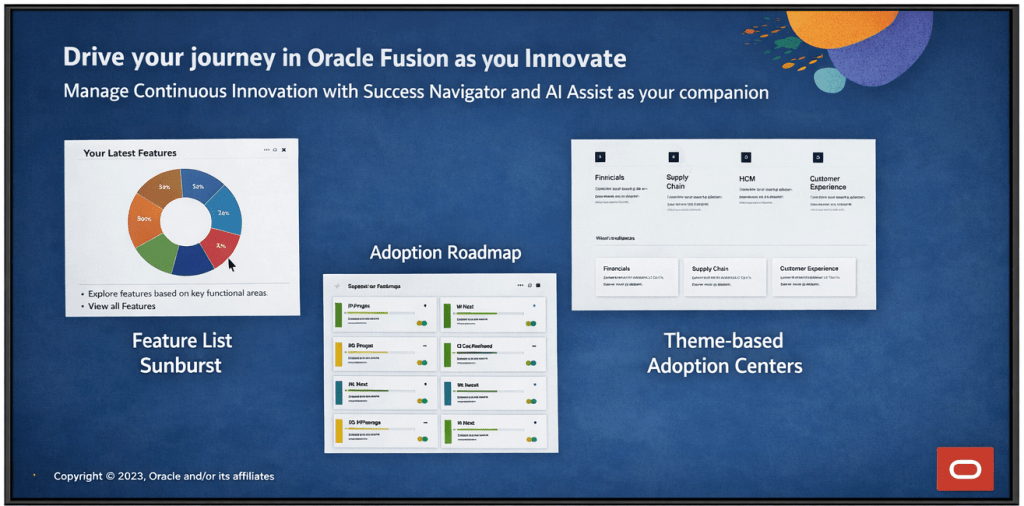
A significant addition to the platform is AI Assist, which was made generally available in late 2025. AI Assist is a generative AI-enabled assistant embedded throughout Navigator. It goes beyond a standard chatbot: it provides tailored recommendations, surfaces relevant documentation, highlights release roadmap changes based on your context, and flags project milestone risks. For partners, the practical implication is that our customers now have a self-service layer of intelligent guidance that can accelerate feature discovery and planning without always needing to raise a support request or wait for a consultant touchpoint.
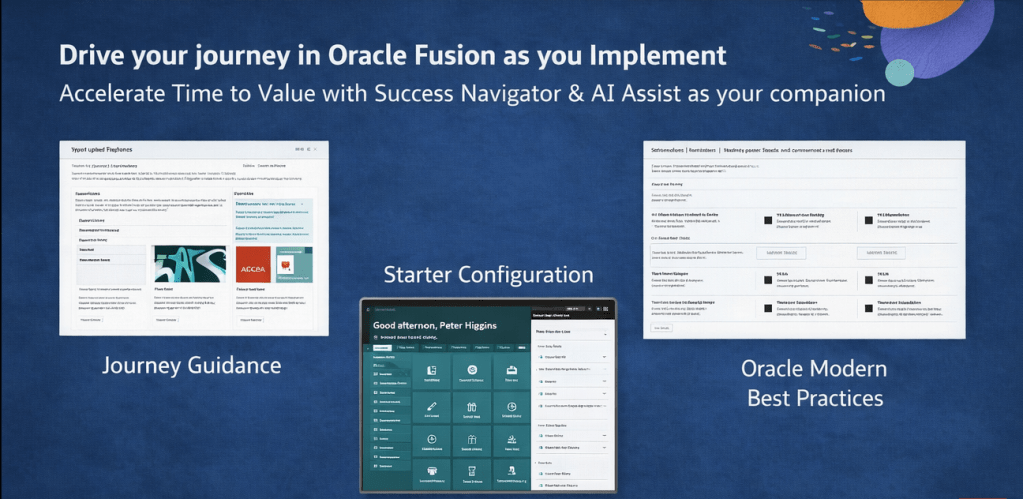
How should Partners be using Success Navigator? This was, for me, the most valuable part of the day. The Oracle product team was clear that Navigator is not just a tool for customers to log into independently. The expectation is that partners should be actively bringing Navigator into their delivery model, whether that’s during implementation, post go-live optimisation, or ongoing managed service.

In practice, that means a few things. During implementation, your partner should be walking you through Navigator as part of onboarding, not treating it as a nice-to-have that gets mentioned at the end of a project. Feature planning sessions are more productive when they’re anchored in Navigator’s release data and OMBP content, rather than relying on spreadsheets or static documentation that goes out of date.

Post go-live, Navigator becomes a continuous value tool. The AI Assist agents can help customer teams stay ahead of quarterly release content, plan for Redwood migration milestones, and identify AI features that fit their production profile. Partners who are actively guiding their customers through this ensure their customers are in a much stronger position than those who are leaving customers to self-serve without direction.

One thing to note: Oracle has indicated that the platform continues to evolve, with enhancements planned around streamlined account management for customers with multiple accounts and improved programme management views. It’s worth keeping an eye on the in-application release announcements for Navigator itself.

The second major focus of the day was Oracle Guided Learning (OGL), Oracle’s digital adoption platform (DAP) built natively for Oracle Cloud applications. OGL delivers in-application guidance, directly overlaid onto the Oracle Fusion interface, so users get real-time, contextual help without having to leave the system or refer to separate documentation. The core capabilities OGL brings to a customer environment are worth spelling out clearly, because I still encounter organisations that underestimate what the platform can do.

Process guides provide step-by-step walkthroughs for complex transactions, walking a user through the exact steps required to complete a task within the application. Smart tips and beacons offer contextual pop-up hints and visual cues at key points in the UI. The Help Panel gives users access to self-service guidance and documentation from within the application. In-app messaging allows administrators to send announcements, policy updates, and maintenance communications directly to users as they work, rather than relying on email campaigns that often go unread. Analytics then close the loop: OGL captures how users are engaging with content, where they’re dropping off, and which features or processes need additional guidance investment.
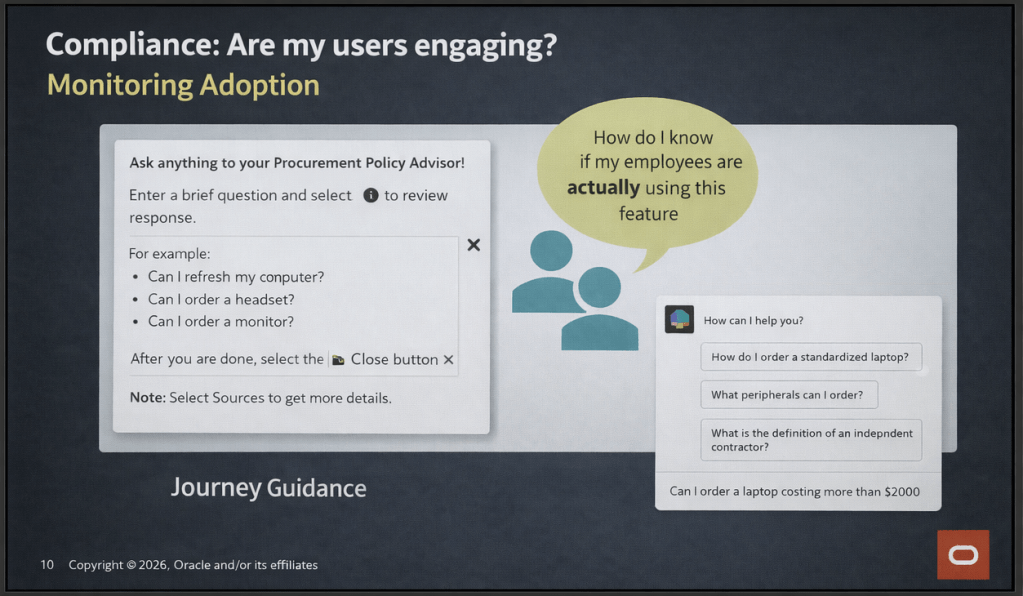
What’s particularly relevant for customers right now is the AI integration within OGL. The OGL 26A release introduced generative AI capabilities into the content authoring experience: content developers can use an AI assistant within the Full Editor to generate and rephrase step text for process guides, smart tips, beacons, and messages. This significantly reduces the time needed to build and maintain a library of guides, which has historically been a barrier to adoption on smaller or resource-constrained engagements.

OGL also extends beyond Oracle applications. It can be deployed across third-party applications including Salesforce, ServiceNow, Microsoft SharePoint, and others, which is useful context for customers running a mixed application estate.
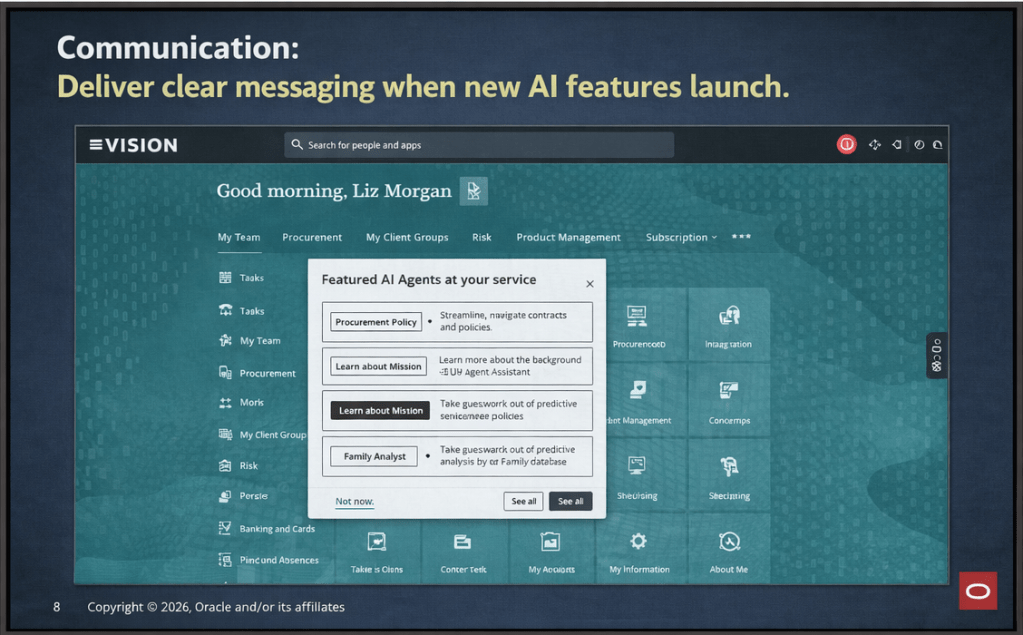
A thread running through both topics today was change management, and it’s one that I think partners sometimes treat as a soft add-on rather than a structural part of delivery. The reality is that both Navigator and OGL exist precisely because technology adoption is a change management problem as much as a technical one.

Navigator gives you the roadmap visibility and planning structure to keep customers engaged with what’s coming and why it matters. OGL gives you the in-application mechanism to reinforce new behaviours, communicate changes, and support users at the moment of need. Used together, they cover a significant portion of the adoption lifecycle: from feature discovery and prioritisation, through to in-system guidance and analytics-driven optimisation.

The enablement message from Oracle today was straightforward: partners who embed these tools into their delivery model are better placed to demonstrate continuous value to customers. Customers who have a structured adoption programme, supported by Navigator and OGL, tend to see higher feature utilisation and lower support overhead than those who treat go-live as the end of the engagement.

It was a practical and well-structured day. The Oracle AI Success Navigator product team clearly has a strong vision for how the platform should be used within the partner ecosystem, and the investment Oracle has made in AI Assist and the broader AI Factory infrastructure is evident. For those of us working in Oracle Fusion Cloud implementations and managed services, the message is clear: these tools are available, they’re free as part of the Oracle subscription, and using them well is increasingly a differentiator in how we position value to our customers.

If you’re currently working on an Oracle Fusion Cloud engagement and you haven’t had a detailed look at what Cloud Success Navigator and OGL can offer, now is a good time to start that conversation.

Please note all screenshots are the property of Oracle and are used according to their Copyright Guidelines
Oracle AI Success Navigator and OGL: A Partnership That’s Changing How We Adopt Oracle Fusion

Oracle has rebranded Oracle Cloud Success Navigator as Oracle AI Success Navigator, and while a name change might sound like a cosmetic exercise, what’s happening underneath is far more interesting. Oracle is actively strengthening the partnership between AI Success Navigator and Oracle Guided Learning (OGL), and for those of us who have long championed both products, this new direction is very exciting!

Oracle AI Success Navigator (formerly Oracle Cloud Success Navigator, or CSN) is Oracle’s platform for helping customers plan, implement, and continuously innovate with Oracle Cloud Applications. It’s included as part of your Oracle Cloud subscription, so if you’re not using it, you’re missing a trick to get more from your Fusion instance.

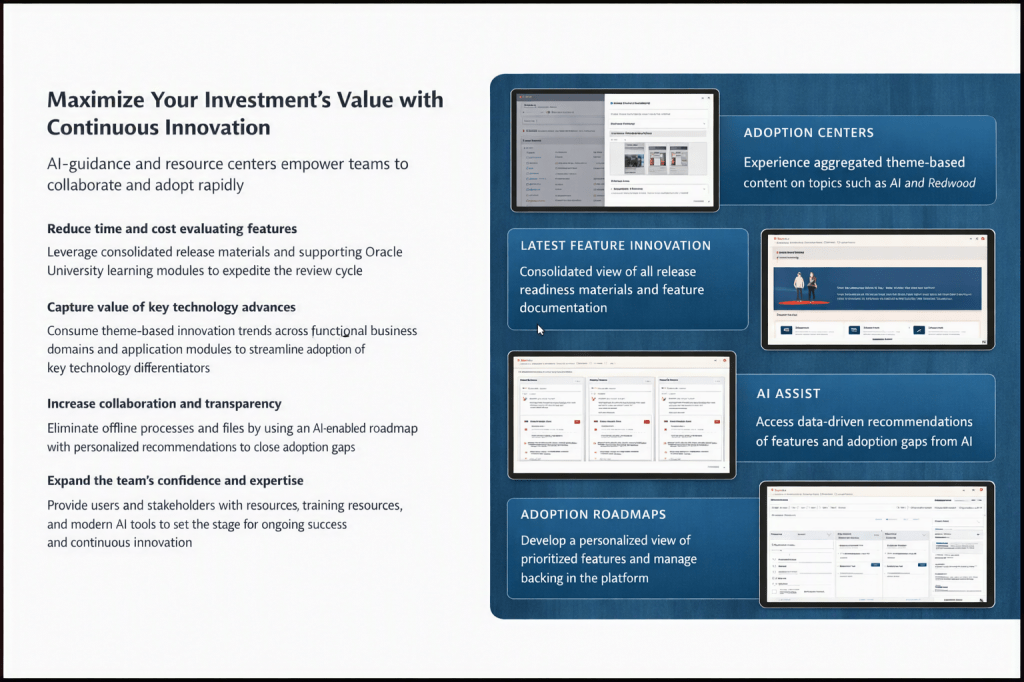
The AI Success Navigator platform gives you four key areas to work with: Latest Feature Innovation, a consolidated view of release readiness materials across your product pillars; Adoption Roadmaps, a personalised and prioritised feature backlog managed directly in the platform; Adoption Centres, theme-based content hubs covering topics like AI and Redwood; and AI Assist, an OCI Generative AI-powered chat interface that I’ll come back to in some detail.

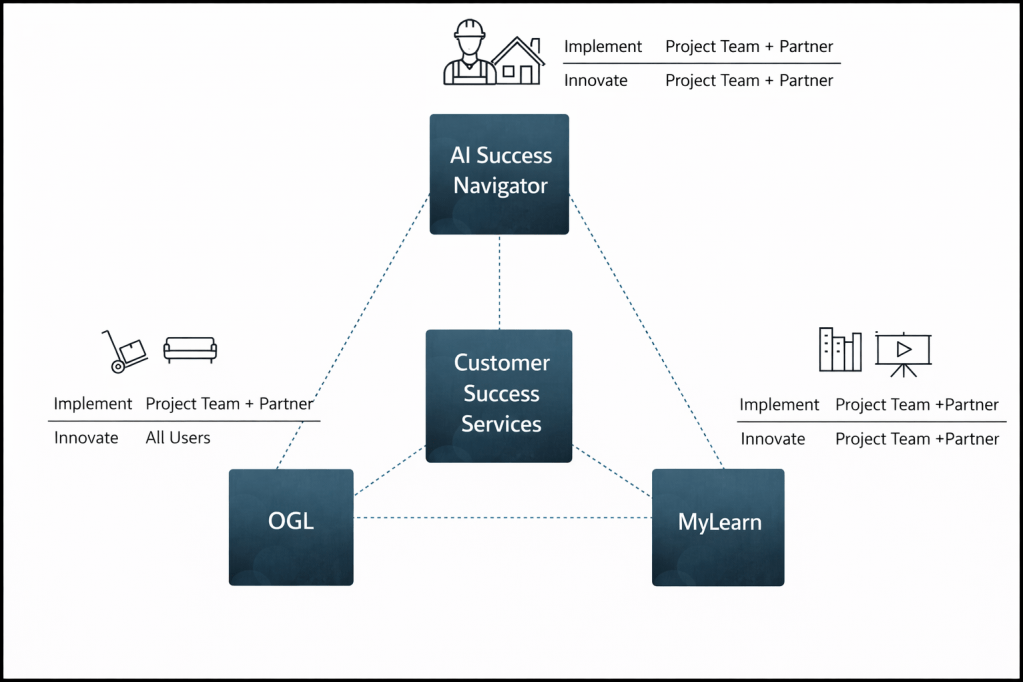
AI Success Navigator, OGL, and MyLearn are all interconnected and Oracle’s Customer Success Services sits in the middle of each. AI Success Navigator is the planning and intelligence layer and OGL is the point-of-need delivery mechanism inside the application. During implementation, OGL is primarily the concern of the project team and partner. Post-go-live, it becomes relevant to all users. MyLearn is the key mechanism for users to learn about Oracle Fusion and therefore is an important consideration.

What’s changing is that these products are no longer operating in isolation. OGL content is now surfaced within AI Success Navigator in the Oracle Modern Best Practice (OMBP) area as job aids, and within Starter Configuration. AI Assist is also being increasingly trained on OGL best practices and project success indicators, meaning the recommendations it produces are grounded in what good OGL adoption actually looks like.

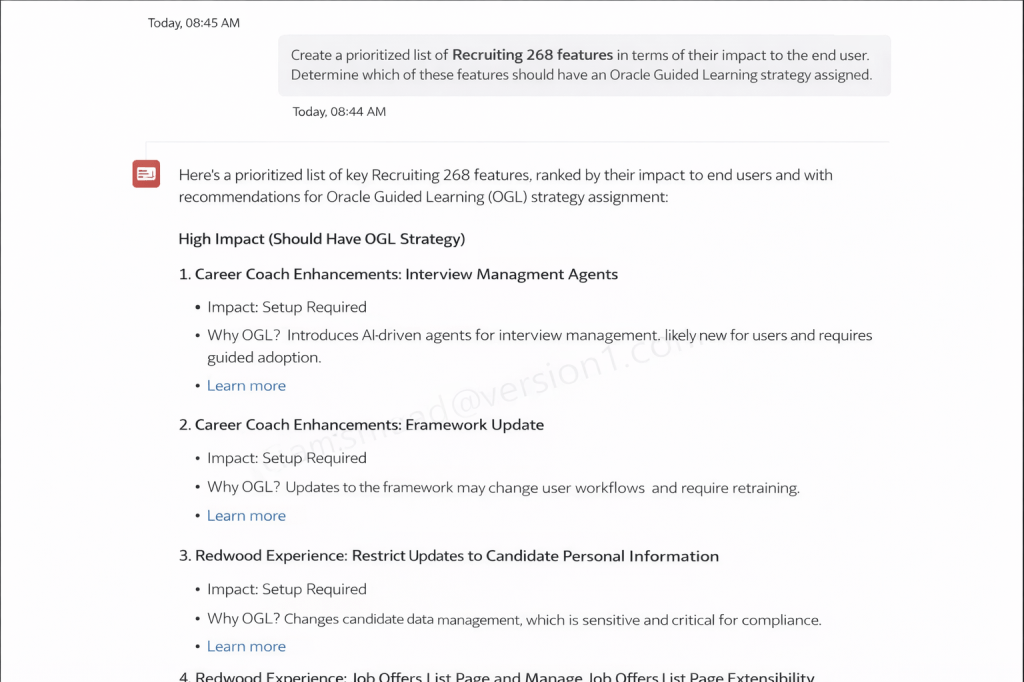
Are you aware of the opportunity to use Success Navigator’s AI Assist to help produce OGL Content? On a recent webinar the presenter asked AI Assist to produce a prioritised list of Recruiting 26B features ranked by end-user impact, with a recommendation on which should have an OGL strategy assigned. The output was a ranked list classifying features as high, medium, or low impact, with a clear rationale for each. Features like Career Coach Enhancements (Interview Management Agents) and the Redwood Experience changes to candidate data management were flagged as high impact, with specific reasoning around setup requirements and workflow changes for end users.

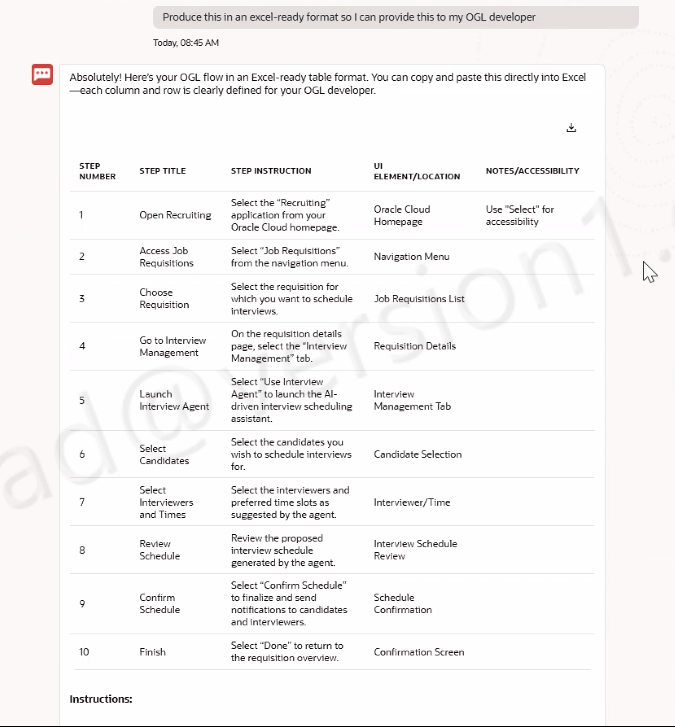
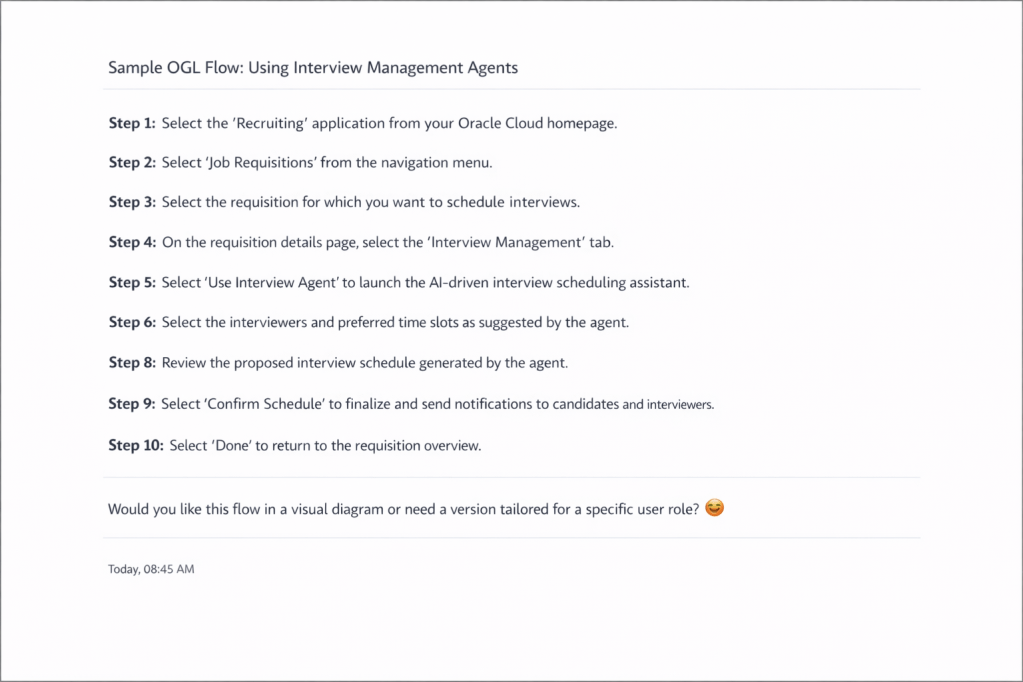
The next step was even more useful. Having identified that the Interview Management Agent feature needed OGL coverage, the presenter asked AI Assist to produce a sample OGL flow. The output was a structured, step-by-step guide covering navigation path, UI element locations, and accessibility notes. When the presenter asked for it in an Excel-ready format, AI Assist reformatted the output into a table with columns for Step Number, Step Title, Step Instruction, UI Element/Location, and Notes/Accessibility, ready for an OGL developer to pick up directly.

So what does this mean in practice? An OGL team no longer has to start from a blank page when a quarterly release drops. AI Success Navigator can triage features, identify which ones need OGL attention, and produce a first-draft flow that a developer can then validate and publish. That’s a material reduction in the time between a feature dropping and users having contextual guidance in the application.

One thing to note: AI-generated flows still need validation against the actual application UI and tailoring to your specific user roles and configuration. The AI is a starting point, not a finished product. But it’s a very good starting point.

The webinar also covered the Testing Agent, which I think gets overlooked. It lets you create test cases from scratch using AI, upload existing test scripts for conversion, and refine them through AI Assist. The connection to OGL is practical: well-structured test cases describe real user workflows, and those workflows are exactly the raw material you need to build accurate OGL guides. If your testing and OGL content creation are happening in silos today, AI Success Navigator gives you a way to bring them closer together.

I’ve always felt that AI Success Navigator and OGL were solving related problems without talking to each other enough. What Oracle is doing now is starting to close that gap, and it’s a direction I’m very happy about.

If you’re not already using Oracle AI Success Navigator and you have an Oracle Cloud subscription, start exploring it. If you’re an OGL practitioner, the AI Assist capability is worth your attention specifically. And if you want to understand how the two products can work together in your programme, now is a good time to start that conversation.

Please note all screenshots are the property of Oracle and are used according to their Copyright Guidelines
Are You Getting the Most from Oracle Guided Learning (OGL)?

Firstly, what is Oracle Guided Learning? OGL is part of Oracle’s Digital Adoption Platforms (DAP). It’s a highly configurable tool which allows organisations to use in-application guides within their Cloud instances to guide users to follow processes in their preferred way. The guiding includes in-app messages, process guides, step guides, smart tips and beacons. It can be utilised to help an organisation handle change with technology, processes or to help make decisions.

Image by StartupStockPhotos from Pixabay

Organisations have the flexibility to use the pre-defined Oracle guides or develop their own content. As with all seeded content from Oracle, it is also possible to copy the Oracle guides and modify them to meet the organisation’s needs for a hybrid approach to content development.

Examples of Features in OGL

In-app feature messages can be customised or displayed based on the user’s roles, the time of day or the specific content. Additionally, it is possible to measure users’ interaction with the messages, to monitor the effectiveness of the communication.

Example Prompt for OGL

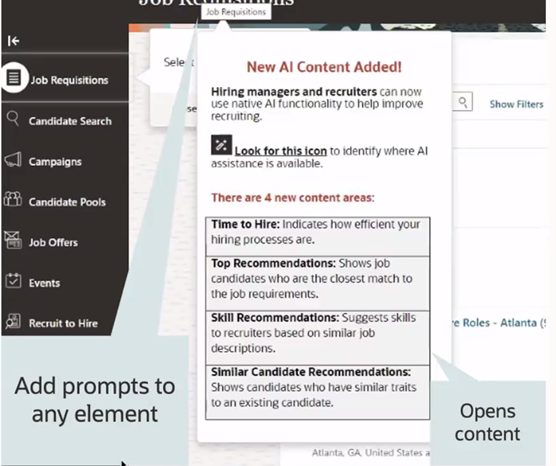
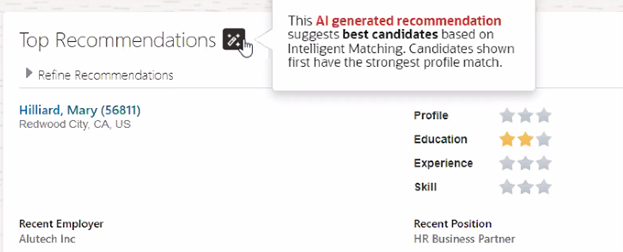
The use of prompts can help users navigate through the process. Prompts can be added to any element within a page. Within the content, it is possible to view any key information, including highlighting any AI content.

Example Use of AI within OGL

OGL is provided as part of the licence for organisations using Oracle HCM, ERP or EPM Cloud. As part of the licence, an organisation is allowed to have 15 individual OGL guides. If more than 15 are required, Oracle Guided Learning Premium will be required.

About the author:

Kate Mead is an Oracle-certified HCM Consultant and Solution Architect at Version 1 with 14 years of experience in Oracle HR and Payroll systems, including 7 years with Oracle HCM Cloud. She has worked across implementation projects and managed services, has a sound knowledge of UK Payroll legislation and — before becoming a consultant — was an HR Manager.

If you have any questions or would like more information on how Version 1 can help you realise the full potential of your Oracle HCM Cloud instances, please contact her at kate.mead@version1.com

Please note all screenshots are the property of Oracle and are used according to their Copyright Guidelines