Oracle’s HCM Professional Concierge: What It Is, How It Works, and Why It Matters for HR Teams

Oracle has been steadily building out its AI story in HCM Cloud, but the HCM Professional Concierge is one of the first examples that really feels tangible for HR teams. This is not AI added for the sake of it. It is a set of purpose-built, role-aware conversational agents, built directly into the HCM Redwood experience. For me, it stands out as one of the more considered uses of AI Agents in enterprise HR.

If you work in HR operations or as an HR Business Partner, the scenario will feel familiar. A manager wants to understand where their team sits on compensation ahead of a salary review. They open Employment Info, scroll through individual records, try to piece together performance data from one place, compensation history from another, and absence data from somewhere else. It is not a difficult task, but it is a fragmented one. Before long, ten minutes have passed just getting a basic view.

The HCM Professional Concierge simplifies this by bringing everything into a single conversational experience, embedded wherever the HR user is already working. Instead of navigating between screens, they ask a question. The agent brings together the relevant data, guides the next step, and in some cases can even trigger the action directly from the conversation.

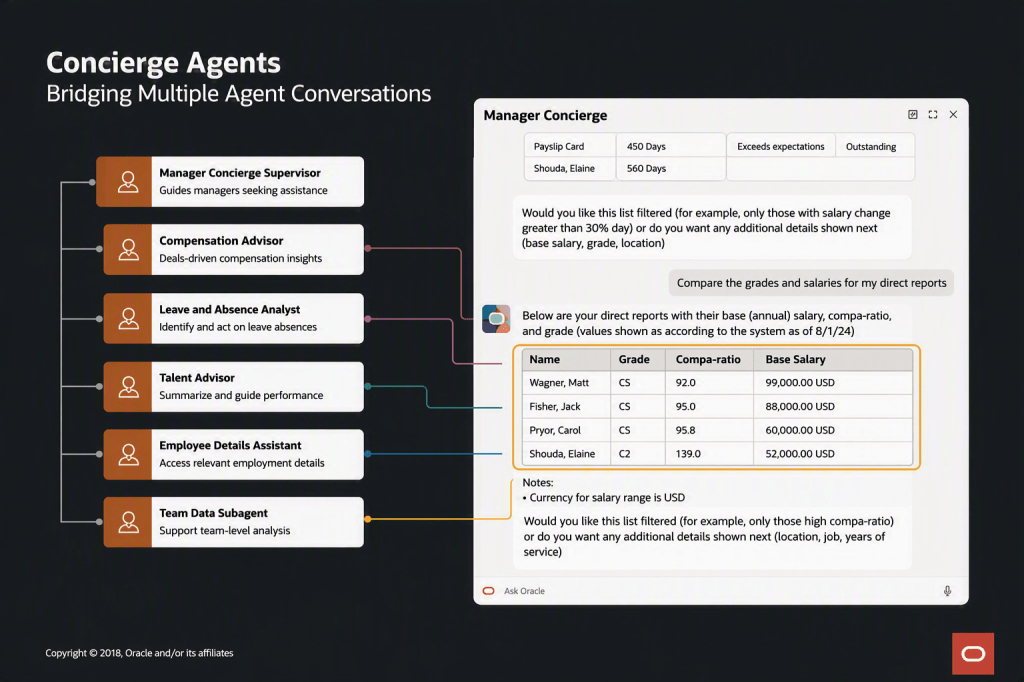
It is worth understanding that this is not a single AI agent working behind the scenes. Oracle has taken a supervisor and sub-agent approach, where a top-level Concierge Supervisor receives the user’s query, interprets the intent, and then routes it to the most appropriate specialist agent.
Within the HR Professional Concierge, those specialist agents each focus on a particular area of HR. For example, the Compensation Advisor brings together key information such as compensation data, compa‑ratios, time since the last salary change, and pay grade details for a manager’s direct reports. The Talent Advisor focuses on performance, helping to summarise ratings and support more informed performance conversations.

Other agents support core HR data and processes. The Employment Details Assistant provides access to employment history, assignment information and worker details, while the Leave and Absence Analyst helps identify and manage absence across a team. There is also support for understanding organisational design through the Workforce Structures agent.
In addition, the Concierge can surface policy and guidance through the Policy sub-agent, review personal worker data where needed, and launch reporting through the Reports sub-agent. For broader, team-level insight, the Team Data Hub helps bring data together to support analysis.

What this means in practice is that the user experiences a single, coherent conversation, even though multiple specialist agents may be working in the background to fulfil the request.

So when a manager asks, “show me the most recent performance rating and time since the last salary change for my direct reports”, the Manager Concierge Supervisor recognises that the query spans both compensation and talent data. It then coordinates across the Compensation Advisor and the Talent Advisor behind the scenes. What comes back is a single, joined-up view, rather than two separate outputs that the manager has to reconcile themselves.

That orchestration across multiple agents is where the real value starts to show. Conversational assistants in enterprise applications are not new in themselves. What is more interesting here is the ability to coordinate specialist agents within a single interaction, carry context across the conversation, and route requests intelligently based on both the topic and the data required.

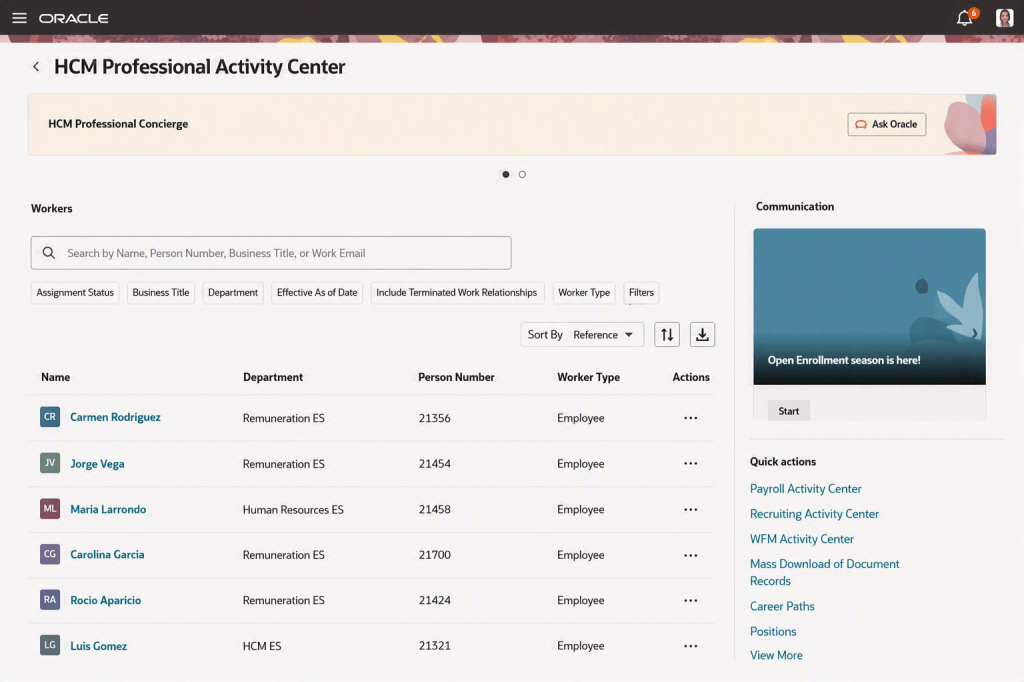
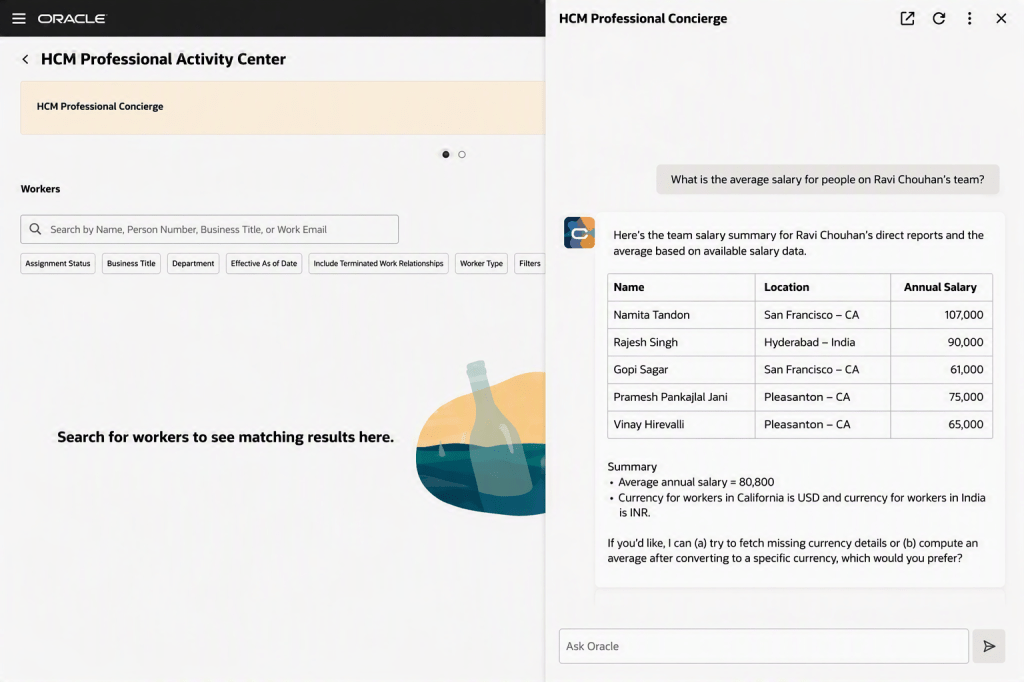
Oracle has introduced three distinct Concierge experiences, each designed around a specific user group and how they typically work. The HCM Professional Concierge is aimed at HR specialists and HR Business Partners. It sits within the HCM Professional Activity Centre, which has become the central workspace for HR service delivery, and supports the sort of queries an HR analyst would usually run. That includes pulling together workforce data for individuals or manager populations, reviewing compensation and employment history, running reports, looking up policies, and guiding HR actions within the flow of work.

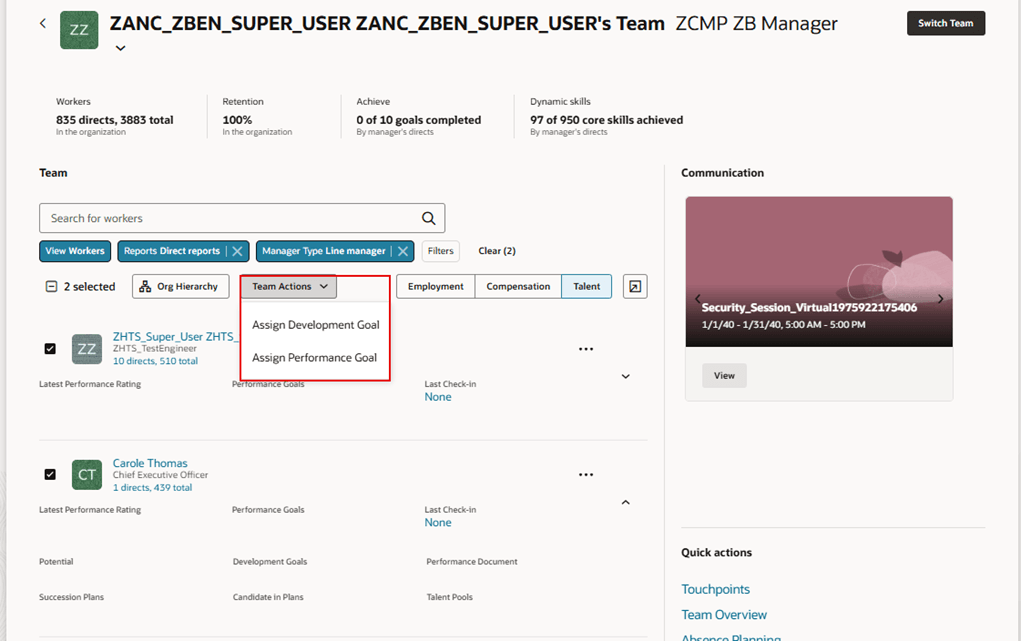
The Manager Concierge is focused on line managers who need quick, straightforward access to information about their teams. It brings together compensation, absence, talent and employment data without the need to navigate into individual worker records. The experience adapts based on both the question being asked and the context of the manager’s team, giving them a practical way to not only view information but also complete common HR tasks directly.

The Worker Concierge, meanwhile, is designed for employees themselves. It brings together support for areas such as leave, payroll, benefits and compensation into a single, consistent experience. Behind the scenes, it routes queries to the relevant specialist agent, whether that relates to absence, benefits, pay, or compensation, so the employee does not need to think about where to go to get the answer.

A simple scenario helps bring this to life. A line manager has been told that budget has been allocated for pay rises and promotions across the organisation. Before making any decisions, she wants a clear view of where her team currently stands. Using the Manager Concierge, she can ask a straightforward question in natural language, such as “how long has it been since my direct reports received a pay rise?” The Compensation Advisor returns the answer in a structured, easy-to-read format. She then follows up with a more specific question, “what is Elaine’s compa-ratio?”, and gets a direct response.

Within the same conversation, she can ask for performance ratings through the Talent Advisor and pull through grade information using the Employment Details Assistant. It all happens in one place, without needing to navigate between screens. Multiple specialist agents are working in the background, but from the manager’s perspective it feels like a single, joined-up interaction.

The HR specialist perspective is just as telling. If someone is working on an Employment Info page for a specific worker, they can open the Concierge panel and ask something like, “what is the salary history for Ravi?” or “where is Ravi located?” The response comes back as structured data pulled directly from HCM, without the need to navigate away or open multiple pages.

One question that comes up consistently when Oracle’s AI features are discussed is around data access and security. It is an important one, and the answer here is reassuring. The HCM Professional Concierge works within the same data and functional security model already applied across the HCM Redwood experience. If an HR specialist does not have permission to view a particular employee’s salary in the core application, they will not be able to access it through the Concierge either. There is no separate access layer being introduced. It simply operates within the role-based controls that are already in place.

For organisations working across multiple geographies, the same principle applies. The agent respects the existing configuration of Redwood pages, including any geography-specific policies and legislative requirements. There is also flexibility to tailor how the agent behaves by refining prompts to reflect your organisation’s terminology or local nuances.

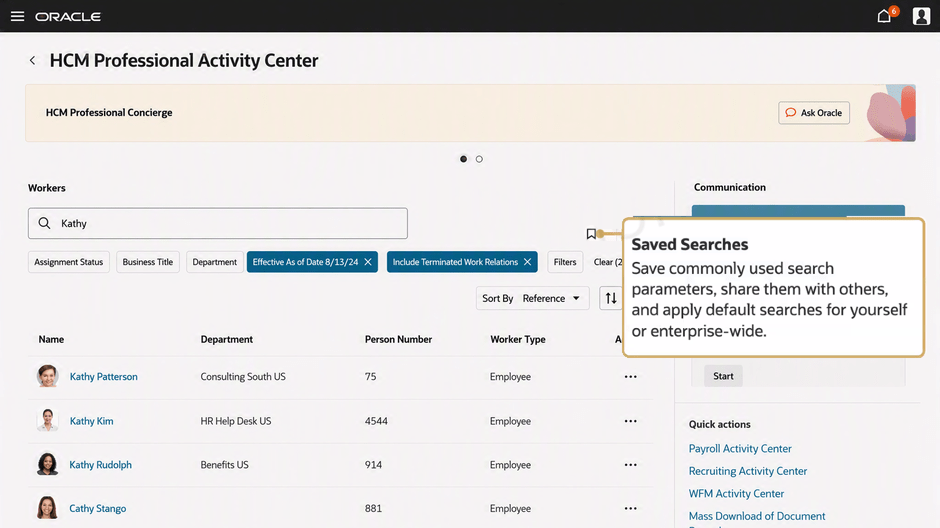
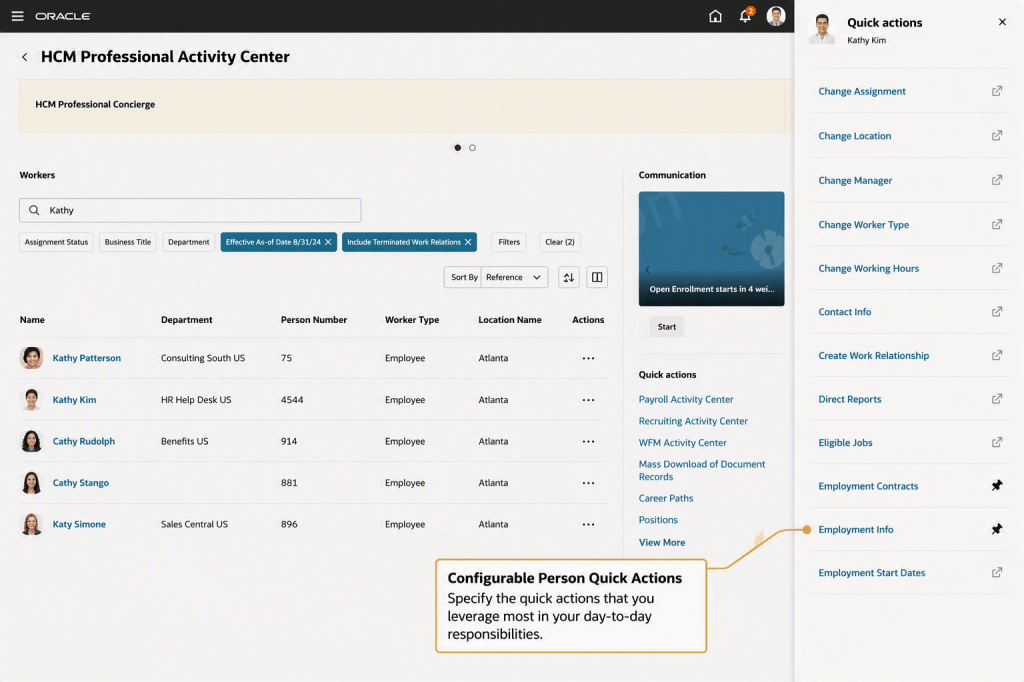
The Concierge also sits within a broader shift in how Oracle is shaping the HR user experience. It is alongside the HCM Professional Activity Centre, which acts as a unified Redwood workspace for HR administration. The Activity Centre brings together a more flexible approach to worker search, with filtering, saved views and personalised results. From there, HR specialists can move straight into transactions from a worker’s profile without switching to a separate area. Common actions are surfaced directly in the interface, including access to areas such as the Recruiting Activity Centre, Mass Assignment Change, Mass Legal Employer Change, Payroll Activity Centre and Attendance Violations, which makes it easier to act on information as soon as it is identified.

The Concierge is always present within the Activity Center, giving HR specialists access to conversational support in the context of the work they are already doing.

It also sits within a much broader direction Oracle is taking with role-based, agent-led HR applications. The HR Specialist Workspace is a good example of where this is heading. It builds on the same foundations, but moves towards a Redwood workspace where multiple specialist agents work together to surface relevant insights more proactively.

In that model, the workspace brings together a view of workforce priorities, potential restructuring impacts, compliance alerts, attrition risk and open HR cases. These are drawn from coordinated agent outputs across areas such as Workforce Management, Talent and Learning. The shift here is subtle but important. The agents are not just responding to questions, they are actively identifying what might need attention and presenting it to the user.

There is also a clear emphasis on governance. Audit trails, controls and human oversight are built into how actions are handed off. Oracle is quite deliberate in positioning this around measurable outcomes, with coordinated agent activity and clear decision points. That creates an important distinction from more autonomous AI models. Here, the agents surface and recommend, but people remain firmly in control of decisions and actions.

From an implementation perspective, the HCM Professional Concierge and its supporting agents are delivered as part of Oracle HCM Cloud Release 26C. There is no need to build these capabilities from the ground up. They are available out of the box, with the ability to adapt behaviour through prompt configuration so that it reflects your organisation’s terminology and ways of working.

As ever, I will keep a close eye on how this develops across the HCM suite and share updates as new capabilities emerge. If you are starting to think about how this fits into your wider HCM AI strategy, or you are planning for a 26C upgrade, now is a sensible point to begin that conversation.

Please note all screenshots are the property of Oracle and are used according to their Copyright Guidelines

Oracle HCM Cloud Compensation 26C

I realised recently that I have never actually written a post analysing a Compensation quarterly release. With 26D being the deadline for moving Compensation worksheets to Redwood, release 26C felt like the right time to change that. There is likely to be more to come over the next few weeks, but for now it is worth looking at what has been announced so far.

The feature many people have been waiting for to support that final move to Redwood is now here. The Redwood Workforce Compensation worksheet brings a much cleaner and more intuitive experience for managers, with everything presented in a single, streamlined view. From the landing page, managers can easily access their worksheets and use built-in capabilities such as audit trails, modelling and target application to review and adjust awards with greater confidence. Filtering, search and layout personalisation make it easier to focus on the right employees and the most relevant data. At the same time, guided information panels and simplified alerts help managers understand what needs attention without being overwhelmed. In practice, this reduces the time spent navigating the system and allows managers to focus on making informed compensation decisions.

The design also improves transparency and control. Managers can switch currencies, review how calculations have been derived, and access supporting information such as compensation history, notes and assignment details without leaving the worksheet. Key summary information remains visible while scrolling, so important totals and budgets are always in view. These changes make the process feel more straightforward and help reduce errors and rework, giving organisations greater confidence in the accuracy and consistency of outcomes.

Another interesting addition is the Workforce Compensation Manager Analyst agent, which introduces a more conversational way for managers to interact with their compensation plans. Rather than moving between multiple worksheets and pages, managers can ask questions in natural language and get immediate answers on areas such as budget position, approval status, due dates and manager-level overages. Because the agent works within the context of a specific compensation plan, the responses are relevant and focused, without the need to interpret multiple screens or reports.

From a manager’s perspective, this removes a lot of the friction from the compensation cycle. It cuts down the number of clicks and removes the need to search for information across the system. Managers can quickly sense-check budgets, track progress and identify issues as they arise, all from a single interaction. This supports faster and more confident decision making and helps keep compensation cycles on track.

The enhancements to Redwood Individual Compensation extensibility give organisations far greater control over how compensation changes are entered and managed. Values can now be defaulted not only when creating proposals, but also when correcting or updating them, using dedicated attributes for each scenario. When combined with the ability to apply validation rules to the same fields, this creates a more structured approach to managing individual compensation. These capabilities sit across key processes such as hiring and promotion, as well as within dedicated compensation pages, ensuring consistent behaviour wherever compensation decisions are made.

For users, this reduces manual effort and helps prevent errors before they happen. Defaulting removes the need to repeatedly enter common values, while validation ensures entries meet organisational policies from the outset. At the same time, visibility of who created or updated a record, along with timestamps, strengthens auditability. This makes it easier to track changes and supports a more controlled and reliable process overall.

Alerts within Workforce Compensation have also been simplified. Instead of a wide range of alert types and icons, everything is now grouped into three clear categories: Error, Warning and Information. Existing alert variations have been consolidated, with only genuinely blocking issues presented as errors. This removes much of the visual noise that previously made alerts harder to interpret, and presents information in a more structured way.

For managers, the benefit is immediate. It becomes much easier to distinguish between issues that require action and those that are simply informational. This helps with prioritisation during the compensation process, reduces the risk of missing something important, and supports smoother progression through the cycle.

The final feature is one that has been requested for some time and originates from a customer idea raised on the Ideas Lab. The new Total Compensation Statements Setup OTBI subject area allows organisations to report on how their total compensation statements have been configured. It provides visibility of key elements such as statement definitions, periods, categories and items, along with the relationships between them. With enriched folders and sub-folders, users can explore the structure in more detail and understand how statements are built, without relying on manual documentation or configuration reviews.

This brings greater transparency and control over statement setup. It becomes easier to answer common questions, such as how many items or categories exist, how they are structured, and how they are distributed. This supports better governance and quicker troubleshooting, particularly when reviewing or refining statement designs. By making configuration data more accessible, organisations can maintain consistency in how total rewards are presented and reduce the effort required to manage these statements over time.

As mentioned earlier, Oracle is expected to release additional updates later this month. If anything particularly impactful is introduced, I will share a further update with a more detailed view.

Please note all screenshots are the property of Oracle and are used according to their Copyright Guidelines

Oracle HCM Cloud Recruit 26C

With the final deadline for Redwood Recruiting having passed in 26B, the 26C release introduces further innovation, with a strong focus on AI alongside additional Redwood pages to improve the overall user experience. With that in mind, let’s take a look at what’s coming for Recruiting in 26C. As always, Oracle may introduce additional features as the quarter progresses, and if anything particularly notable appears, I’ll share a follow-up update.

The first feature I want to highlight introduces an AI-driven approach to initiating sourcing activity directly from the Recruiting Activity Centre. Oracle has provided a preconfigured agent template designed to sit within recruiting workflows and respond to key requisition activities. Once set up, the agent can automatically trigger when certain activity states are reached, such as when a requisition is awaiting submission, formatting, posting or approval. At that point, the agent can create candidate pools and, if activity slows, generate recruitment campaigns, for example where there have been no recent applications. This all runs in the background once the activity is assigned and the relevant scheduled process is running, removing the need for recruiters to step in manually.

The benefit here is removing friction at the start of the sourcing process and maintaining momentum without relying on manual intervention. Routine but essential tasks such as building candidate pools or launching campaigns are handled automatically and at the right time. This allows recruiters to focus on higher value activities such as engaging with candidates and hiring managers. It also introduces a more consistent approach to sourcing, with the same logic applied across requisitions. Over time, this should lead to faster pipeline creation, fewer delays in attracting candidates and a more proactive hiring approach, even when activity slows.

The next feature, Activity Centres: Automatically Launch AI Agents from Activities, builds on this by making AI agents a standard part of how Activity Centres operate across Recruiting, Sourcing and Interview processes. Organisations can configure published HCM workflow agents to respond automatically when activities are generated, carrying out actions or sending notifications without manual input. By assigning an agent to an activity through a simple configuration and running the scheduled process, the system can identify activities that require action and trigger the relevant agent. As the agent progresses, it updates its status so the system can track whether tasks are in progress, complete or need to be retried.

The value here is in keeping workflows moving without constant user involvement. Activities no longer sit waiting for someone to pick them up or remember the next step. Instead, the system helps move tasks forward and keeps stakeholders informed. This leads to quicker task completion and more consistent execution across recruitment stages, helping to reduce delays in the hiring process. It also improves coordination between recruiters, sourcing teams and interviewers by reducing the reliance on manual follow-ups and emails.

Another key update introduces a more structured and scalable way to support AI-driven content across the external candidate experience. Oracle has moved away from the earlier Prompt Lab approach and standardised on workflow agents that sit behind AI Assist capabilities on career site pages. These preconfigured agents, managed through AI Agent Studio, support a range of scenarios including generating job summaries for search, creating career site content, surfacing relevant assets on job descriptions and providing job fit insights to candidates. As these agents are designed to be reusable and channel agnostic, they can be applied consistently across the candidate journey while still allowing organisations to tailor them.

From a business perspective, this creates a more flexible and modern foundation for candidate engagement. Content generation becomes easier to manage and more consistent, reducing duplication and manual effort. Candidates benefit from richer and more relevant information, helping them better understand roles and suitability before applying. Importantly, this aligns with Oracle’s longer-term direction, giving customers a clearer path forward with a solution that is easier to extend, maintain and evolve as AI capabilities continue to mature.

Smart Search is another enhancement that improves the job search experience in a practical way. Rather than being limited to fixed locations, candidates can now search based on proximity to any location that matters to them, including their current position. The introduction of a search radius provides a more realistic view of available opportunities, helping candidates focus on roles within a reasonable commute. Features such as browser-based location detection also remove friction, making it quicker to find relevant roles.

This is likely to improve both candidate satisfaction and application quality. Candidates are more likely to find roles that genuinely fit their circumstances, while organisations benefit from more relevant applicants. As Smart Search is expected to become the default in a future release, it is worth reviewing your current configuration, particularly the use of fixed versus proximity-based search, to ensure it reflects how your workforce operates.

For organisations using ‘Apply with Indeed’, it is important to plan ahead as this functionality will be discontinued in 27A due to changes in Indeed’s integration model. Transitioning to Direct Apply will help avoid disruption and provides a more seamless and modern candidate experience while ensuring continuity as the legacy functionality is retired.

Turning to Redwood enhancements, the Generate Job Requisition Posting Description Using AI Agent feature brings AI-assisted job description creation directly into the Redwood experience. Using a workflow agent, content can be generated across key sections such as the summary, responsibilities and qualifications. For recruiters and hiring managers, this makes it quicker and easier to create clear and consistent job adverts without starting from scratch.

The shift to an agent-based approach also provides a more robust and future-ready foundation, replacing earlier prompt-based methods while maintaining a familiar experience. For organisations, this means reduced manual effort, greater consistency in how roles are presented and ultimately a stronger candidate experience through clearer, more engaging job descriptions.

Another update, driven by customer feedback through the Ideas Lab, is Bulk Candidate Creation by Uploading Resumes. This allows recruiters to upload multiple CVs at once, with AI extracting key information and automatically populating candidate profiles. Rather than manually entering details for each individual, recruiters can review and refine the extracted information within the candidate record, balancing efficiency with data quality.

The benefit here is a significant reduction in administrative effort and a faster turnaround from receiving CVs to having candidates ready in the system. It also helps teams manage higher volumes more effectively, particularly during peak recruitment periods, while ensuring consistency in how candidate records are created.

Finally, Bulk Actions on the Job Requisitions List makes it easier to manage large volumes of requisitions. Recruiters can now update multiple records in a single action rather than working through each one individually. This includes moving roles through the lifecycle, opening them for sourcing or updating hiring teams. The ability to update the hiring team across multiple requisitions is particularly useful when responsibilities change, removing repetitive manual updates.

For users, this delivers a clear improvement in efficiency and scalability. Bulk actions reduce time spent on administrative tasks and help teams keep pace during busy periods, while asynchronous processing allows larger updates to run smoothly in the background. The result is a more streamlined and consistent way of managing requisitions at scale.

Oracle often introduces additional features as the quarter progresses, so it is worth keeping an eye out for further updates. If anything particularly impactful emerges, I will share a follow-up. In the meantime, if you are planning your 26C adoption or want to explore the updates in more detail, take a look at my latest write-up covering the Core HR enhancements.

Please note all screenshots are the property of Oracle and are used according to their Copyright Guidelines

Oracle HCM Cloud Learn 26C

This is an exciting time for Oracle Learn. Release 26C is the last release before all Learn functionality becomes mandatory in Redwood, with the final switch happening in 26D. That deadline brings in the remaining Learning Admin tasks too. If you have not already made the move to Redwood for Learn, now really is the time to do it. In the meantime, here is a look at what is new in 26C.

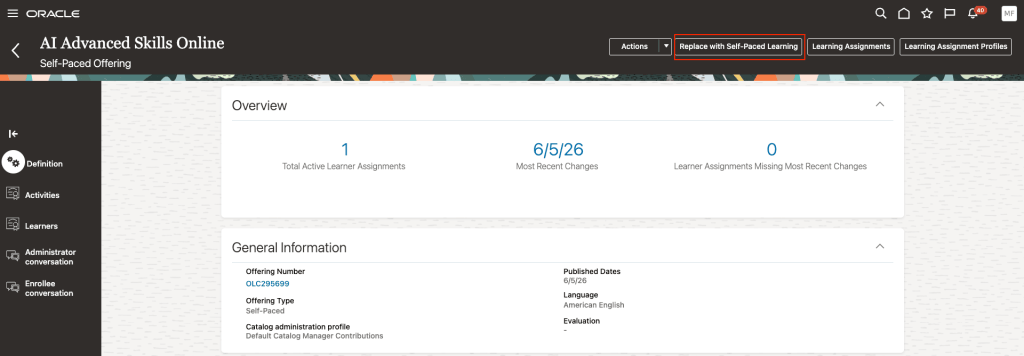
The first feature I want to highlight is not directly related to the Redwood deadline, but it is too interesting to leave until later. Oracle has introduced Agentic Courses, a new approach to self-paced learning that uses AI agents to guide learners through curated content in a far more interactive and responsive way. Instead of working through static material, learners are supported by an experience that adapts to their pace, checks their understanding as they go, and offers targeted support where it is needed.

The structure is still defined by learning designers, but each learner can move through the content in a way that suits them. That includes recap, reinforcement and extra support where required. What stands out here is the ability to deliver genuinely personalised learning at scale, without increasing the effort needed to design or administer it. Learning specialists can reuse templates and deploy them quickly, while the AI handles the day-to-day interaction with learners.

The end result is more effective training, faster progression to competency, and better use of employees’ time, all while keeping outcomes consistent. It is also worth noting that this is not an agentic application, so there is no requirement to purchase the Agentic App platform to use it.

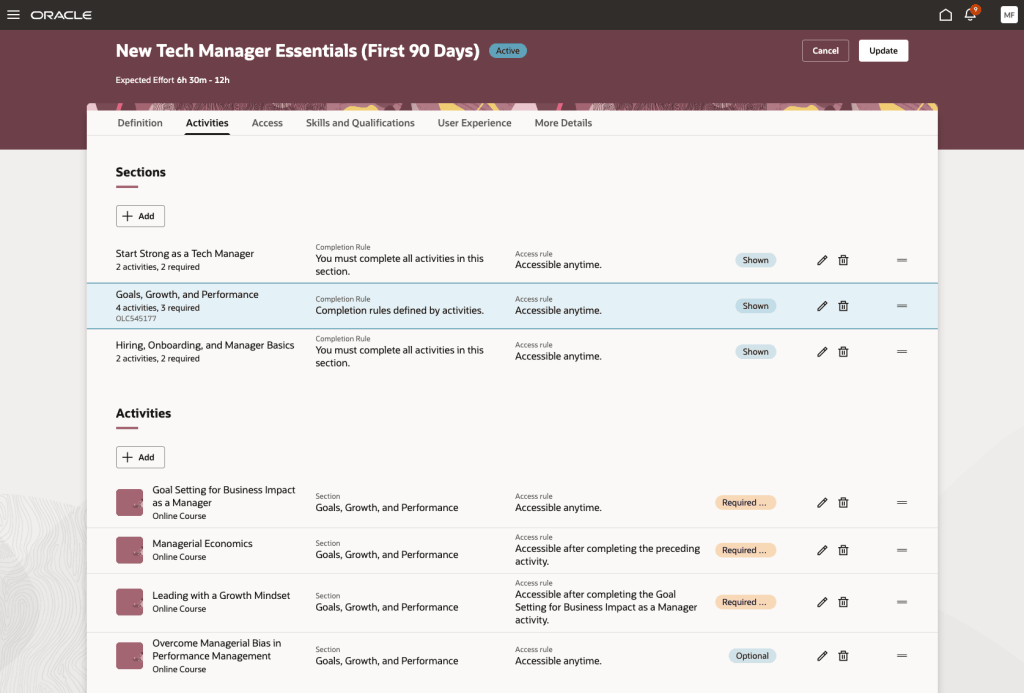
The next feature is the redesigned Redwood experience for specialisation management. This brings a much clearer and more visual approach to creating and managing learning paths. The new Activities tab pulls everything into a single interactive view, making it easier to understand the overall structure, see dependencies, and define completion and access rules. Alongside this, the Assignments tab gives a clear, near real-time view of learner progress, so administrators can track enrolments, monitor completion, and step in where needed.

The benefit here is both clarity and control. Learning specialists can build more structured and engaging learning journeys with less effort, while built-in checks help prevent common issues such as conflicting dependencies. For learners, it is much clearer what is expected and what comes next, which supports better engagement. For organisations, this means more effective delivery of training and stronger oversight of compliance and development programmes.

Another new page in Redwood is the updated experience for category and topic management. This gives learning teams a more straightforward way to organise and maintain their catalogue. The interface is built around tasks, with list, category and topic views supported by search, filtering and saved searches. Administrators can quickly create and update categories and topics, manage visibility and featured dates, and move easily between high-level structures and more detailed content.

The value here is in making catalogue management simpler and more consistent. Learning teams can organise content more effectively, which makes it easier for learners to find what they need. It also aligns with the wider Redwood experience, reducing the learning curve for administrators and helping improve productivity. In practice, this leads to a more organised and accessible catalogue that is easier to maintain over time.

Oracle has also introduced a set of enhancements to assignment status management. These give learning teams much tighter control over how assignments are handled, with expanded support for actions such as waitlisting, undoing completion, approving, withdrawing and allocating seats. There are also clearer rules around when each action can be applied.

In day-to-day terms, this means administrators can manage a wider range of scenarios directly within Redwood, without relying on workarounds. The improvement here is in both governance and day-to-day efficiency. By aligning actions to defined rules and adding more control, organisations can manage assignments more consistently and reduce the risk of error. It also becomes easier to handle exceptions and manage capacity, which supports a more reliable learner experience overall.

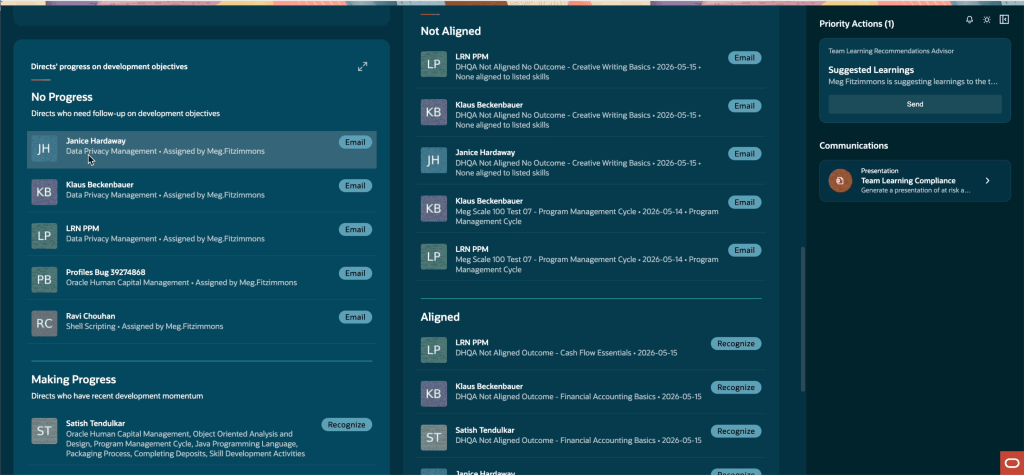
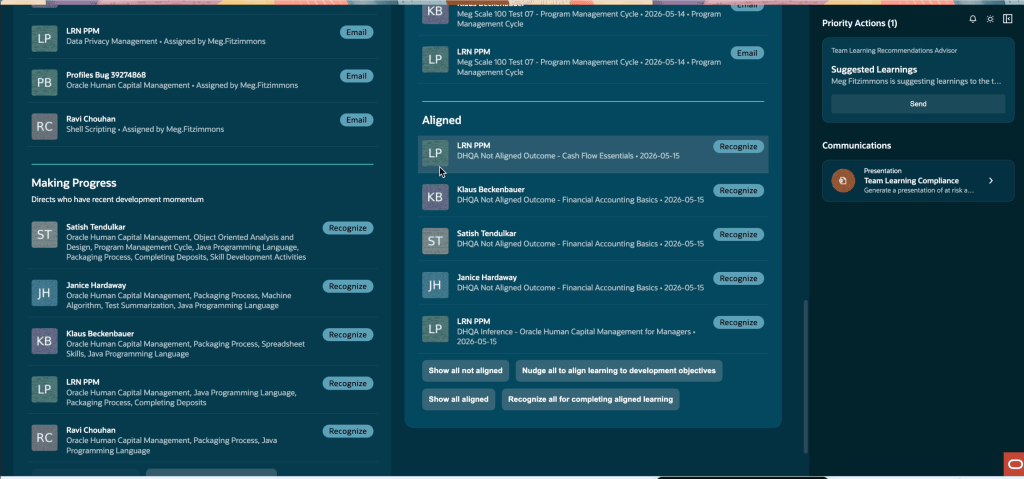
Another useful enhancement is within the Instructor Activity Center. The updated calendar now brings together teaching commitments and the instructor’s own learning calendar, making it easier to spot clashes and plan ahead. There is also a new seat availability filter, which highlights sessions that are low on enrolment, fully booked, or have waitlists.

This gives instructors a single, practical view of their schedule. They can manage their time more effectively, avoid conflicts, and take action where needed, for example by promoting under-enrolled sessions or adjusting plans. For organisations, this helps optimise class capacity and make better use of instructor time.

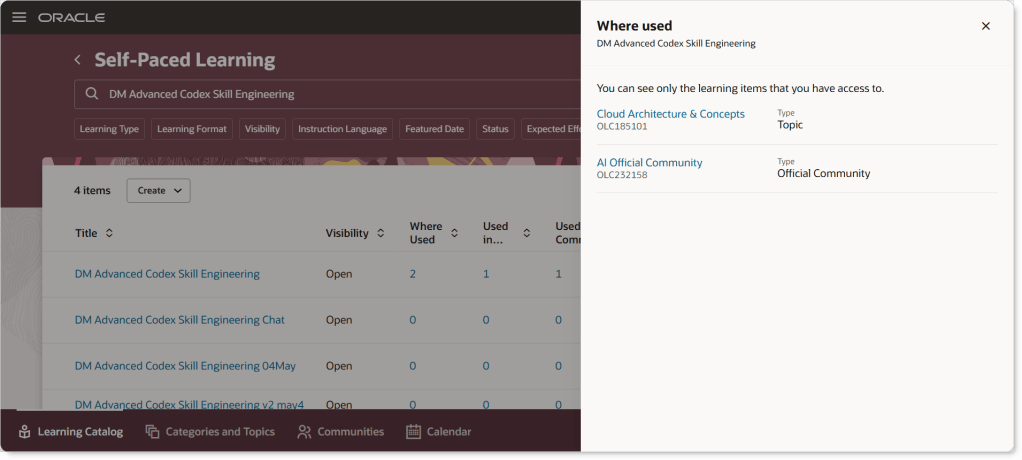
The final feature I want to call out is one that came directly from a customer idea. The Learning Catalog has been enhanced to give clearer visibility into how events, courses and learning paths are connected. The updated “Where Used” capability makes it much easier to explore these relationships, with clickable links that take you straight to related items. Supporting information is displayed in a structured way that mirrors the layout of the detail pages, making it easier to understand how everything fits together.

This improves transparency across the catalogue. Learning teams can see dependencies more clearly, which reduces the risk of unintended impact when making changes. It also supports more consistent management of learning structures, helping maintain a clean and well-organised catalogue over time.

As always, Oracle may introduce additional updates as the release cycle progresses, so it is worth keeping an eye out. If anything particularly interesting appears, I will share a follow-up to make sure you are fully up to date.

Please note all screenshots are the property of Oracle and are used according to their Copyright Guidelines

Oracle HCM Cloud Core HR 26C

It’s that time in the quarter again. Oracle has just shared what’s coming in Release 26C, and as you’d expect there is a clear emphasis on AI-driven enhancements, with plenty to take note of. More updates are likely to follow over the coming weeks, but for now it is worth taking a look at what has been announced so far.

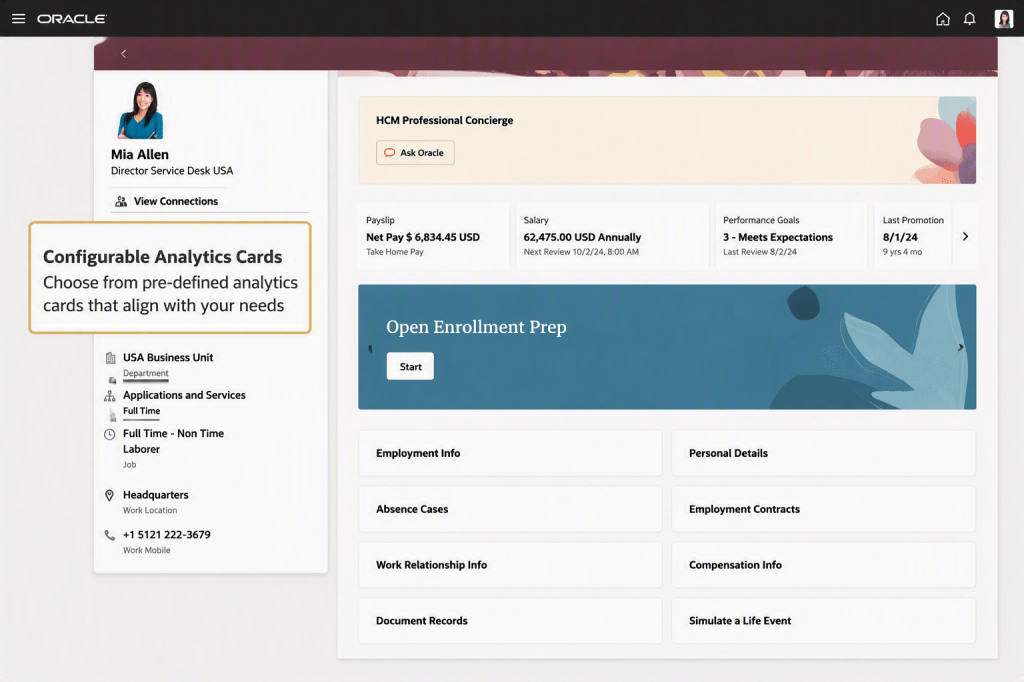
The first feature worth calling out is one many HR teams have been waiting for. Ever since the original Person Management page was effectively retired back in 2020, there has not really been a single, equivalent experience to replace it. What Oracle has delivered here is not a direct like-for-like replacement, and it is clear that is not the intention. Instead, this move aligns with the Redwood design approach and rethinks how users interact with person data. The result is a more modern, task-focused experience that brings together key information and actions in a way that feels far more consistent with the rest of the HCM suite.

In practical terms, it changes how users work day to day. Rather than navigating across multiple pages or relying on memory to find the right option, a HR user can open a worker’s record and see relevant insights alongside the actions they are most likely to take, whether that is updating employment details, reviewing assignments, or initiating changes. This reduces the need for constant clicking and context switching, making everyday tasks quicker and more intuitive. For those who have used the system for a long time, there may still be a sense that the original “one stop shop” is missing. However, this is a clear step forward. It signals a shift away from a single static page towards a more guided and contextual experience that better reflects how people actually work today. It may not replicate everything that Person Management once offered, but it goes a long way towards closing a gap that organisations have felt for some time.

The next feature worth highlighting is AI-led, the Positions Management Assistant. This builds on the Positions Assistant introduced in 25D but takes things a step further by broadening what can be done through a single experience. Rather than focusing only on creating or viewing positions, it now brings editing into the same flow, giving HR teams and line managers a more complete way to manage positions. It uses natural language to understand what the user is trying to do and responds with relevant actions and guidance, which fits with the wider move towards more conversational, AI-driven ways of working.

In practice, this simplifies what can often be a fragmented process. A manager can ask to see vacant positions within their team and the assistant will surface them, suggest next steps and provide a direct route to raise a requisition. If a new position is needed, it can guide the user through creating one, reusing existing information where possible to save time and reduce errors. This makes the experience far more intuitive, particularly for occasional users, while also helping to improve consistency and accuracy. The overall result is a smoother, more guided approach that reduces manual effort, speeds up position management activities and helps organisations move more quickly when filling roles.

The next feature builds on something we saw introduced in 25D. The Onboarding Agent has now evolved into a workflow agent, marking another step in Oracle’s move towards more intelligent, guided employee experiences. The new Onboard Assistant takes the earlier self-service capability and turns it into a more interactive, conversational experience for new hires. Rather than working through static checklists or searching for information, users can ask questions in plain language and receive clear, relevant answers tailored to their role, location and organisational policies.

In practice, this makes the onboarding journey feel far more straightforward. A new starter can ask what tasks still need to be completed, check for anything overdue and follow a direct link to take action. The assistant can also surface useful resources, provide reminders and guide users through more complex steps when needed. For anyone unfamiliar with the system, this removes much of the uncertainty that can come with getting started. Overall, it creates a more supported and personalised experience that helps new hires get up to speed more quickly, reduces confusion and ensures that key onboarding activities are completed on time.

There are a couple of notable updates in Document Records, particularly around the use of AI. The first is the Document Records Administration Assistant, which is a clear example of how Oracle is embedding AI into everyday HR administration. In this case, the focus is on simplifying how users retrieve document records. Rather than working through multiple screens and manually applying filters, users can describe what they need in plain language. The assistant interprets the request and submits the appropriate mass download action, removing much of the effort from what has traditionally been quite a manual process.

In practice, this makes a real difference. A HR user could ask to download all passports created in the past month or retrieve payslips generated in the last week, and the assistant will identify the document type, apply the relevant criteria and trigger the correct request. For infrequent users in particular, this removes the need to understand the underlying navigation. The process becomes far quicker and far more straightforward. Overall, it provides a more intuitive way to retrieve document records, reducing admin time, improving accuracy and helping users get to the right outcome first time.

The second update focuses on using AI to extract data from attachments and prefill document record attributes. It is a relatively simple enhancement, but one that addresses a very common pain point in HR administration. When creating document records, users often have to rekey information that already exists in the uploaded file. This feature reduces that effort by using AI to identify and extract key details from the attachment and populate the relevant fields automatically. It aligns closely with the Redwood approach of reducing manual input and making everyday tasks quicker and easier to complete.

In practice, when a user uploads something like a passport or certification, the system can pick up details such as the document number, issuing country and validity dates, and populate these directly into the record. The user can then review and amend the information before saving, rather than starting from scratch. This not only saves time but also reduces the likelihood of manual errors. Over time, capabilities like this can have a noticeable impact on data quality, while also making the process far more efficient for both HR teams and employees managing their own records.

There are a number of upcoming changes around Redwood pages, and the timelines are now starting to feel very close. From 26C, the Redwood person pages will be enabled by default, covering key areas such as Personal Details, Contact Information, Identification Details, Family and Emergency Contacts, Additional Person Information and Person Identifiers for External Applications. For many organisations, this is the point where the move to Redwood becomes unavoidable for core HR data.

This continues in 26D, with areas such as Jobs, Locations, Departments, Enterprise HCM Information, Grade Ladders and all Employment pages, including actions like Add Assignment and Employment Information, also switching to Redwood by default. The same pattern carries into 27A, where processes such as Resign from Employment, Mass Assignment Change and Terminate Employment will be automatically enabled.

If you have not already moved to these Redwood pages, now is the time to start planning. Leaving it until they are switched on by default means losing control over when the change happens and removes the option to step back if needed. Moving earlier gives you the opportunity to test properly, prepare your users and resolve any issues before the transition becomes mandatory.

As mentioned earlier, Oracle is expected to release additional Core HR updates later this month. If anything stands out as particularly impactful, I will share a further update with a more detailed view. In the meantime, keep an eye out for the upcoming posts in this series where we will explore other areas of Fusion as part of Release 26C. If you are reviewing your own roadmap or considering how these changes might affect your organisation, now is a good time to start the conversation.

Please note all screenshots are the property of Oracle and are used according to their Copyright Guidelines

Oracle HCM Cloud Learn 26B

Release 26B is now here and we’re edging closer to the final Redwood deadline for Learn in 26D. This final deadline incorporates the remainder of the Learning Admin tasks, but the key one is Assignment Management. This is going to be a key focus for Oracle in the next couple of releases.

The first feature is one that came from the Customer Idea Lab, which means a customer logged it and other customers voted for it. The enhanced Instructor Activity Center brings all instructor‑led event management into a single, intuitive calendar‑based workspace. Instructors can view and manage sessions in multiple calendar views, access event details and materials directly from the calendar, create or join sessions quickly, and easily manage learners, attendance and enrolments. By centralising scheduling, session management and learner engagement, the experience reduces administration and allows instructors to focus more on delivering high‑quality learning.

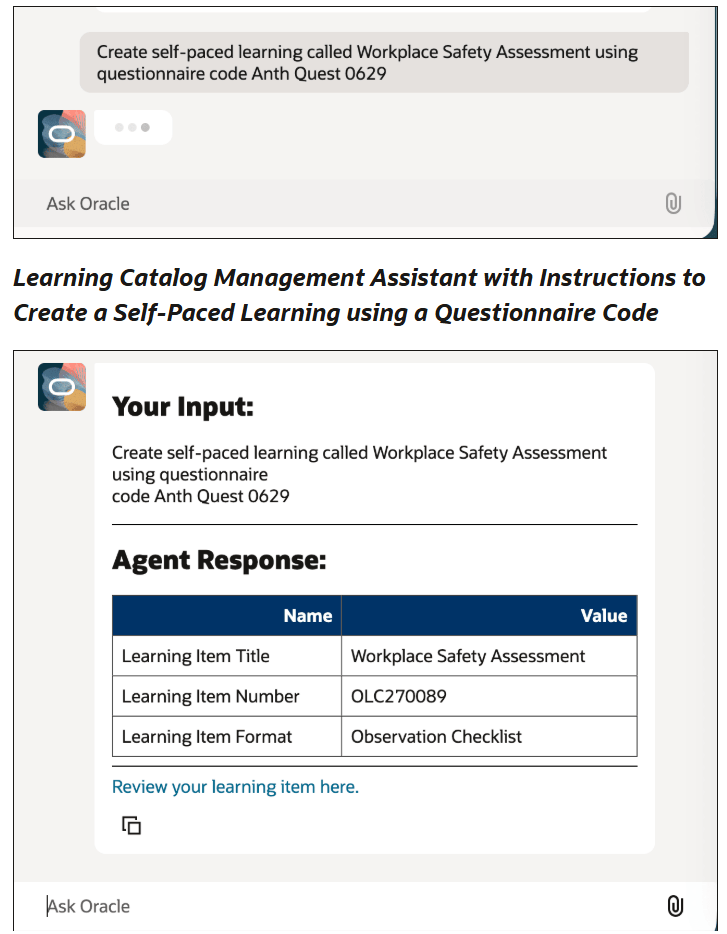
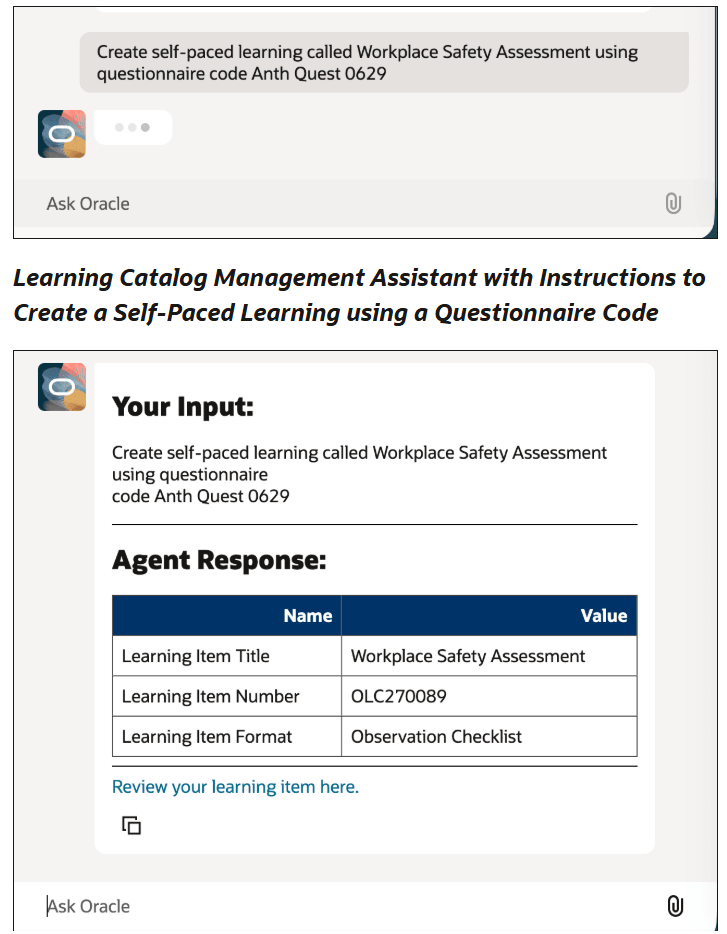
The enhanced Learning Creation Assistant now allows learning content to be created directly from email, making it faster and easier for instructors and learning teams to contribute new content. By simply sending instructions in the email body or as an attachment, users can generate a range of learning formats and receive a confirmation with a direct link to the draft item. This streamlined approach reduces administrative effort, removes reliance on complex workflows, and helps organisations accelerate knowledge sharing across the business.

The updated Redwood Record and Request Learning experience makes it easier to record, request and track learning activity across the organisation, whether it sits inside or outside the learning catalogue. Teams can record completions, request external learning, and manage assignments more flexibly, including setting initial statuses and creating profiles with past start dates. Together, these enhancements provide a more complete and accurate view of workforce learning, supporting compliance, personalised development and better‑informed decision‑making.

The enhanced support for online learning events makes it easier to deliver engaging, well‑managed virtual classrooms, including richer integration with Microsoft Teams. Instructors can use automated meeting creation, breakout rooms, attendance tracking and completion rules, while learners benefit from seamless access via notifications and calendar invites. Together, these improvements reduce manual effort for learning teams and create a smoother, more connected experience for both instructors and participants.

The final enhancements I want to highlight focus on third‑party learning content, specifically integrations with OpenSesame and Udemy. The OpenSesame integration makes it simple to bring high‑quality, third‑party content into Oracle Learning as self‑paced courses, with automated refreshes keeping the catalogue up to date and learner progress tracked seamlessly in a single transcript. Alongside this, the Udemy Business integration allows curated learning paths to be automatically imported and managed within Oracle Learning, giving learning teams clear visibility through xAPI tracking while providing learners with uninterrupted access to Udemy content. Together, these integrations reduce administration, improve catalogue visibility and broaden access to valuable learning resources real‑time tracking of learning outcomes.

Oracle often introduces a few additional features as the month progresses, so it’s always worth keeping an eye out. If anything particularly exciting appears, I’ll share a follow‑up blog to make sure you’re fully up to date. In the meantime, you can read my latest write‑up on the new Core HR features in Release 26B here.

Please note all screenshots are the property of Oracle and are used according to their Copyright Guidelines

Oracle HCM Cloud Recruit 26B

The final deadline to move to Recruit Redwood is the 26B release, so if you haven’t made the move yet, I’d strongly recommend doing so as soon as possible. With that in mind, let’s take a look at what’s coming up for Recruiting in 26B. As is often the case, Oracle may introduce additional features as the quarter progresses, and if any of those are particularly noteworthy, I’ll share a follow‑up update.

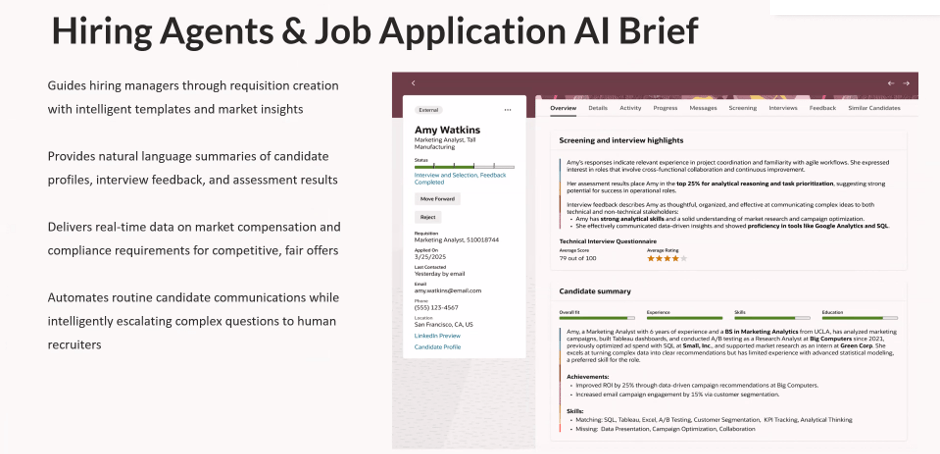
The Job Application Overview in the Redwood experience introduces an AI‑generated summary to help recruiters review applications more efficiently. When a candidate uploads a CV or adds further information after applying, the Overview tab automatically presents a concise summary across three key areas. This includes screening and interview highlights, showing the status of questionnaires, assessments and feedback; an AI‑driven candidate summary covering recent experience, education, skills, achievements and work preferences, with clear call‑outs where these align to the requisition; and a dedicated section for candidate attachments, bringing all supporting documents into one place.

The next feature will not surprise you to hear, is another AI one. The generative AI search capability in the Redwood Candidate Experience makes it quicker and easier to find the right candidates using natural language. By simply describing the type of candidate you’re looking for, the AI automatically translates your input into relevant search filters and values. The search intelligently matches your wording to structured candidate data, applying keywords and related synonyms, and can also include CV content if required. Clear aggregation counts show how many candidates match each filter, while synonym‑based suggestions highlight potential matches found within resumes. All filters remain fully editable, allowing you to refine or adjust the results further and quickly narrow down to the most relevant candidates.

The Interview Schedule Templates list has been rebuilt in the Redwood experience using Visual Builder Studio, making it quicker and easier for recruiters to manage interview scheduling at scale. When the relevant profile options are enabled, the list is accessed via My Client Groups > Hiring. The redesigned page is built to reduce clicks and save time, with intuitive search and filtering, the ability to save searches, flexible sorting, and customisable columns so recruiters can see the information that matters most to them. Templates can be opened, reviewed and actioned directly from the list, and new interview schedule templates can be created just as easily. By aligning interview schedule management with other Redwood list pages, this update delivers a more consistent and efficient experience, helping recruiters spend less time on administration and more time focusing on candidates.

I love an Activity Centre, they’re a one stop shop for all transactions relating to that area. The new Sourcing Activity Centre provides recruiters with a single place to manage all sourcing‑related activities across campaigns, candidates and events, helping them stay on top of priorities and reduce manual tracking. Users with the appropriate access can reach the Sourcing Activity Centre directly from Candidate Sourcing or via a Quick Action. The activity list gives clear visibility of everything requiring attention, with the ability to filter by activity type and quickly identify high‑priority items. Recruiters can open activities to view more detail and take action directly from the list, making it easier to keep sourcing work moving without switching between pages. Activities span campaigns, candidates and events, including follow‑up tasks, campaign status updates and event‑related actions such as registrations and capacity management. By bringing these into one central view, the Sourcing Activity Centre helps recruiters work more efficiently, respond faster, and maintain momentum across their sourcing activities.

Oracle often introduce additional features as the quarter progresses, so it’s worth keeping an eye out for further updates. If anything particularly impactful appears, I’ll share a follow‑up blog to make sure you’re fully up to date. In the meantime, you may also be interested in my latest write‑up on the new Core HR features in Release 26B, which you can find here.

Please note all screenshots are the property of Oracle and are used according to their Copyright Guidelines

Oracle HCM Cloud Core HR 26B

It’s my favourite point in the quarter: Oracle has just announced what’s coming in Release 26B. As you’d expect, this update brings a strong focus on AI‑led enhancements, with plenty to be excited about. While Oracle may add further features as the month goes on, let’s start by exploring what’s been announced so far.

The first thing I want to call out actually relates to Release 26C, but it’s important enough to flag now. For organisations that are a little behind in their move to Redwood, Oracle will be automatically enabling a number of pages in 26C. These include the Team Activity Center, Personal Details, Contact Information, Family and Emergency Contacts, Identification Information, Additional Person Information, Person Identifiers for External Applications, Grades, Grade Rates, Legal Entity HCM Information, Legal Reporting HCM Information and Reporting Establishments. While not all of these pages are end‑user facing, if you haven’t already enabled them, I’d strongly recommend completing your testing and switching them on as soon as possible. That way, you can be confident everything works as required for your organisation before Oracle enables them automatically.

Now let’s turn to AI, which is probably why you’re here. The Personal Information Assistant has been enhanced to go well beyond simply retrieving data, allowing users to create, update and delete selected personal information directly within the chat experience, all in line with existing role‑based access controls and approval rules. It supports key personal details such as demographic and biographical information, email addresses and phone numbers, validates entries where lists of values apply, and guides users through any required choices. The assistant can still view information for the user or others, search by name, email address or person number, and provide direct links to the relevant pages where a change needs to be completed in the application. Importantly, it fully respects your existing Fusion security configuration, so users will only ever see data they’re entitled to access, and where fields have been hidden using VBS, the agent prompt can be adjusted to ensure those fields remain restricted.

There are two new, closely related features in this release, both focused on Journeys. AI can now be used to trigger a workflow agent when a Journey task is completed or even when it’s saved, enabling key business actions to run automatically without manual follow‑up. As soon as a task is marked complete, the associated workflow agent executes the required logic, such as sending notifications or integrating with external systems, ensuring downstream processes are triggered immediately and consistently. For example, when a manager approves a badge request, the agent can notify the badging system, confirm approval to the employee and kick off badge creation straight away. The same applies when a Journey task is saved as a draft, allowing certain processes to start earlier, improving responsiveness and reducing unnecessary delays.

The Document Records Management Assistant has been further enhanced in Release 26B with the introduction of Document Records Management Assistant V2, extending the capabilities introduced in 26A beyond employee self‑service to support line managers and HR specialists. This new workflow agent uses natural‑language interaction and advanced language models to help users quickly find, create and manage document records across their teams, while the original 26A agent remains available for employee self‑service without disruption. By bringing document management into a single conversational experience, the assistant simplifies access to records, automatically understands user intent, guides users through record creation with the right metadata, and provides clear, policy‑aligned responses and direct links where needed, reducing training effort and making document management faster and more intuitive for everyone involved.

The final AI capability worth highlighting is the new AI Assistant for Managing Jobs. This AI‑powered companion for Oracle Cloud HCM Jobs enables HR teams to create, view, update and manage job data through a single conversational experience. Using natural‑language interaction and Oracle’s AI Agent framework, it provides clear, policy‑aligned responses, making it quicker and safer to work with job records without navigating multiple screens. The assistant highlights changes across job versions, generates helpful summaries and insights, guides users step by step through updates and validations, identifies missing or outdated information, and can also edit or delete jobs where appropriate. By reducing manual administration and minimising the risk of errors, it helps HR teams maintain accurate, compliant job data while freeing up time to focus on more strategic priorities.

I’d also like to highlight a number of updates in Release 26B that will be particularly relevant for UK public sector organisations. Enhancements to the HCM UK TPS Generic Setup Diagnostics report introduce more robust checks, making it easier to identify and resolve Teachers’ Pension setup issues, with additional validation highlighting mismatches in Annual Full‑Time Equivalent salary rate definitions and expanded balance feeds helping administrators spot missing or incorrect inputs that impact pension calculations. Updates have also been made to the Civil Service Pension Scheme interface to reflect new and revised validation rules introduced by Capita as scheme administrator, with many of these changes already supported within the existing extract logic, helping ensure submissions continue to meet current scheme requirements and removing remaining references to MyCSP from user‑facing text. Finally, support has been added for proportional TLR1 and TLR2 payments within the Teachers’ Pension Scheme, enabling awards to be calculated, reported and pensioned in line with updated guidance effective from September 2025, and ensuring full‑time and part‑time arrangements are treated accurately based on contract type.

As mentioned earlier, Oracle will be rolling out additional Core HR features later this month. If any of these updates prove particularly noteworthy, I’ll share a follow‑up blog with the details. In the meantime, keep an eye out for upcoming posts where we’ll take a closer look at other Fusion modules as part of Release 26B.

Please note all screenshots are the property of Oracle and are used according to their Copyright Guidelines

Oracle HCM Cloud Recruit 26A

Things are really heating up in the world of Recruit as we approach the final deadline to move the remaining Recruiting pages over to Redwood in 26B. This release is your last opportunity to make the switch. With the 25C deadline behind us, you should already be managing requisitions, job applications and candidates in Redwood. The next phase brings exciting updates around offers, interviews, campaigns, events and agency hiring. So, let’s dive in and see what’s new…

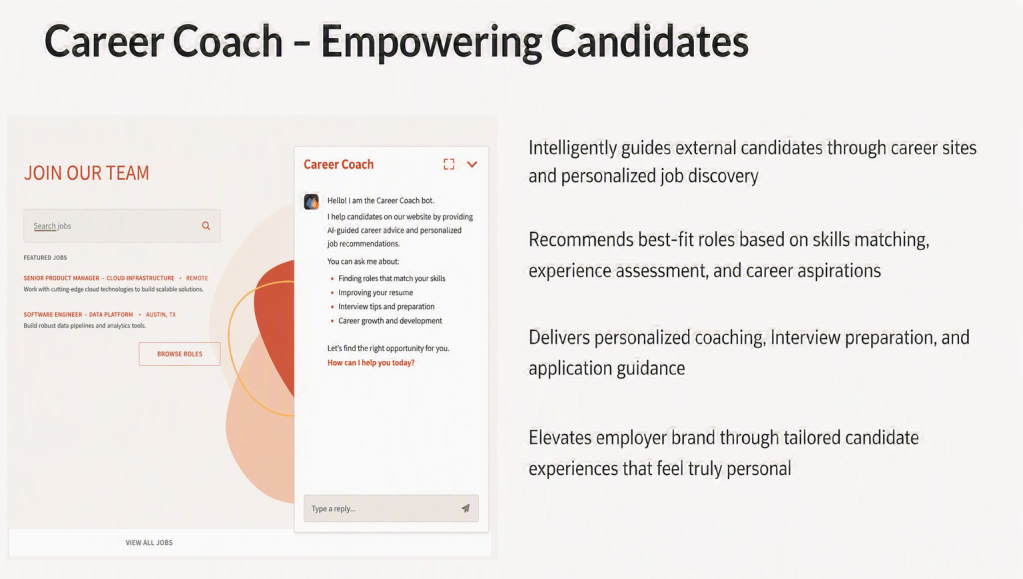
The AI Career Coach, first introduced in 25D to help candidates find roles that match their skills, has already been enhanced in 26A. The Career Coach now uses the Supervisor model, which brings all agents together under one umbrella, streamlining information sharing and removing redundancies. The agent is pre-seeded and ready to run, so there’s no need to create agents from templates. You can also choose to display the widget as an overlay, ideal for highly customised sites, rather than the default side panel, ensuring it doesn’t interfere with your design. For one-page application flows, the widget now displays correctly, and when shown as a side panel, the navigation menu is replaced with a horizontal progress bar. The fixer button appears on the page instead of the left-hand side, and a clickable Terms and Conditions link pulls content from the job application legal disclaimer in the Recruiting Content Library. If you’ve enabled CV parsing, candidate CVs will be parsed into the application flow when uploaded via the widget. From this release, any CV uploaded into the recommended jobs widget in the candidate experience will also be available to the agent.

As many of you know, I’m a big fan of AI, anything that makes life easier. The next update introduces an AI assistant for job requisition creation, working like a smart, on-page helper that answers both general and field-specific questions as you build a requisition. Because its guidance is driven entirely by the documents you upload and the prompt you configure, it’s easy to tailor to your organisation’s policies and practices. The agent helps users get it right first time, capturing the correct data, minimising downstream issues and boosting overall efficiency without interrupting the flow.

By 26B, the Job Offer process must be fully transitioned to Redwood, and Oracle has introduced a new AI agent to make this easier. Acting as an FAQ-style assistant, the agent helps users by answering both general and field-specific questions during job offer creation. Its guidance is based entirely on the documents you upload and the prompt you configure, making it simple to align with your organisation’s policies and practices. This smart assistant ensures job offers are created smoothly, reduces downstream issues by capturing accurate data, and boosts overall efficiency without disrupting the process.

Another useful Redwood Offer feature is the Initiate Job Offer Creation for Hiring Managers functionality. Hiring managers with the Initiate Job Offer privilege can now start the process and share notes with the recruiting team using the Create Job Offer action from the Redwood job applications list or details page. On the Create Job Offer page, they can add comments in the Notes to Recruiter field to provide context or instructions. Once they click Save and Close, the candidate’s application moves to Offer – Draft status and appears on the Redwood Job Offers list page. The recruiter receives a notification to complete the offer details using the Edit Offer action, with the manager’s notes displayed in a banner above the Details and Offer tabs. When ready, the recruiter can submit the job offer for approval or save it for further editing later.

The final feature worth mentioning is the new Redwood Interview Details page, which brings several improvements over the previous responsive version. A new Basic Info section now displays key interview details at a glance. In the Interviewers section, you can easily resend the Interview Scheduled notification, handy if someone says they haven’t received it. The Scheduled Candidates section allows you to click candidate and job requisition links to open a drawer with more information, and the Actions menu lets you manage candidates scheduled for the interview. Under Interview Resources, you’ll find interviewer guidelines, attachments and candidate notes added to the interview. If you’re an interviewer, you can respond directly to the invitation, accept, tentatively accept, decline or propose a new time. When proposing a new time, the drawer can even display your availability if calendar integration (Microsoft 365 or Google) is enabled.

Oracle often slip in new features during the month, so it’s worth keeping an eye out. If anything truly game-changing appears, I’ll share another blog post to keep you updated and make sure you don’t miss out. In the meantime, why not check out my latest write-up on the new Core HR features in Release 26A? You can find it here.

Please note all screenshots are the property of Oracle and are used according to their Copyright Guidelines

Oracle HCM Cloud Learn 26A

Release 26A has arrived, marking the start of the second phase of Recruitment for Learn becoming mandatory. This update sets the deadline for the first half of the required changes to Learning Admin pages, covering Resources, Recommendations, Self-Paced Learning and External Content. The remaining updates to Learn Admin pages will become mandatory with Release 26D. Let’s take a look at what is new!

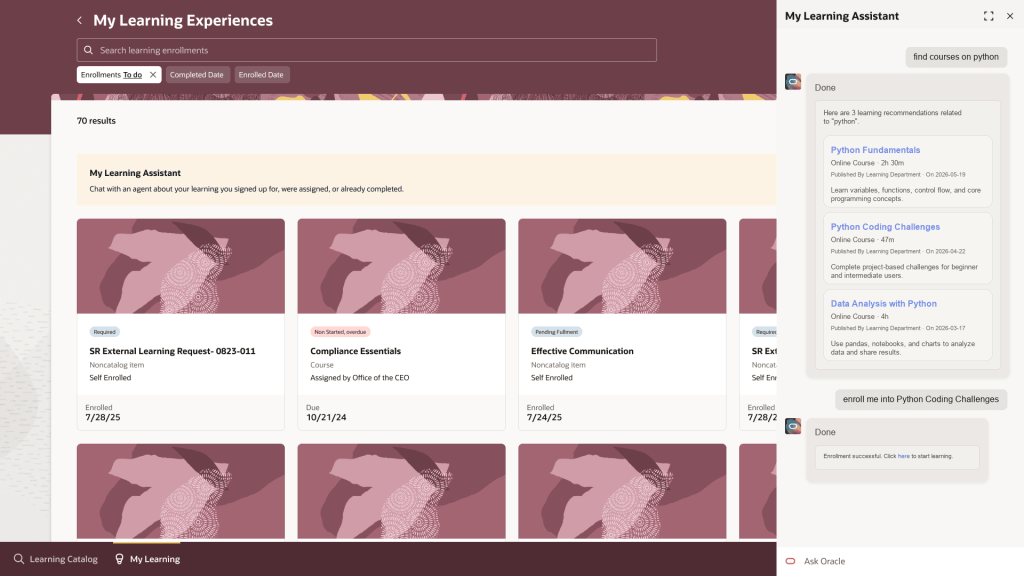
Before you can use this first feature, Dynamic Skills must be enabled. Oracle have updated the licensing for Dynamic Skills over the past year, so it may already be included in your Core HR licence. If you’re unsure, it’s worth checking with your Oracle Customer Success Manager. Once enabled, you can take advantage of the AI Learning Catalogue Smart Search Advisor. This clever tool lets you search the learning catalogue using questions rather than just keywords, delivering more focused and higher-quality results. The results are semantically relevant to your query and tailored to you, taking into account your work history, talent profile and learning record. When active, you’ll notice a new section on the learning catalogue page after you search. This section highlights up to five learning items the advisor has identified as most suitable for you and your request.

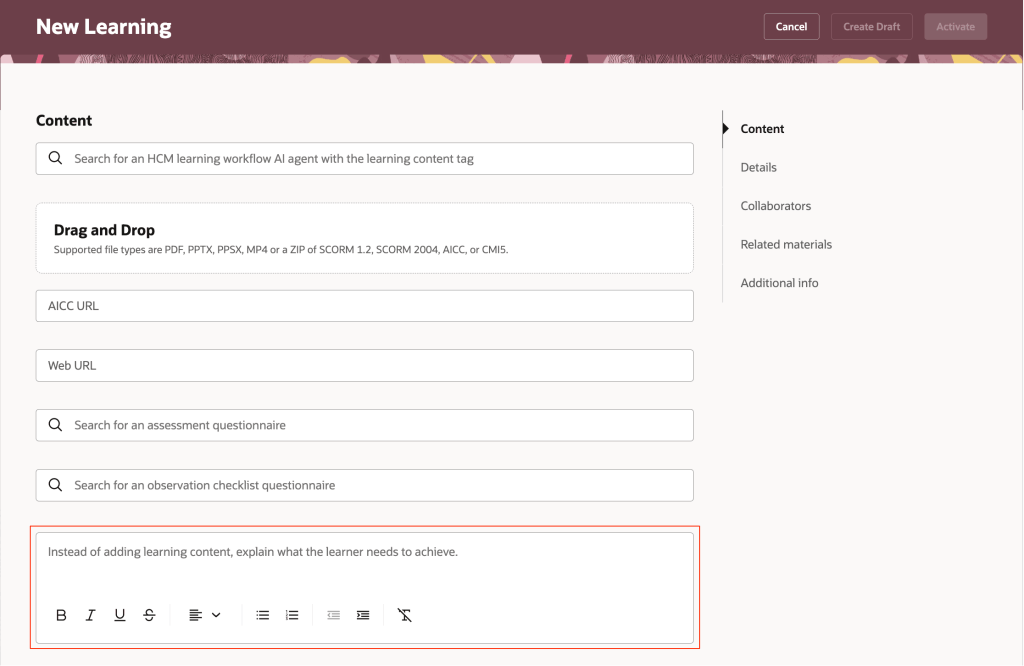
There are several new features for Self-Paced Learning, starting with Redwood functionality for enrolment forms, evaluations and feedback. You can now collect the information you need when learners enrol by requiring an enrolment form, a questionnaire, or both. The Learner Info Collection options available in the Self-Paced Learning configuration under the Rules tab in the Enrolment section, offering four choices: no extra information, a combined page with both questionnaire and request form, just the questionnaire, or just the request form, each leading to the Enrolment Details page. These options are controlled by a single setting within Self-Paced Learning.

Oracle has added support for two new content types in Self-Paced Learning: CMI5 and AICC URLs. You can now upload CMI5 .zip archive packages when creating self-paced courses. This format combines the structured approach of SCORM with the flexible, detailed tracking of xAPI, enabling richer data sharing between the learning item and the server. The result? Deeper insights into learner progress and engagement. In addition, you can create self-paced courses by adding an AICC URL as content. Once the page refreshes, the Learning Format field appears, defaulted to Online Course, alongside the Mastery Score field. You can adjust the format as needed and set a mastery score, which moves to its usual spot on the Rules tab under Completion when you create the draft. The score can be updated later if required.

Oracle has introduced a new Redwood Learning Events page, offering a streamlined way to publish instructor-led training directly to your learning catalogue. This update simplifies setup and adds flexibility, allowing events to be defined by formats such as In-Person, Webinar, or custom options tailored to your organisation. Events can be delivered as standalone offerings or included in a course for equivalency, with improved scheduling that supports multiday and overnight sessions and calculates effort automatically. You can specify dates and times via a calendar or manual entry, integrate feedback through evaluations and ratings, and control when learners provide it. Enrolment periods can now be configured separately from catalogue visibility, enabling early access via deep links, while enhanced withdrawal and waitlist options give greater control. Although events cannot yet be added to specialisations and pricing isn’t included in this release, both features are planned for future updates.

The final feature worth highlighting is the new Redwood Course Management page, which brings a modern, visually appealing interface to Oracle Learning. Learning Specialists can now enjoy a streamlined experience with grouped tabs for managing courses, Definitions, Defaults, Access, Skills and Qualifications, User Experience, and More Details, alongside a step-by-step creation process for organising core details, descriptions, visuals and settings. All course offerings, whether instructor-led, self-paced or blended, plus associated events, are accessible from a single Offerings tab for quicker navigation. Learners benefit from improved course detail pages with clearer layouts, showcasing included content, expected effort, acquired skills, instructors, outcomes, languages and celebratory completion notices. They can also engage through ratings, comments and lively discussions via dedicated interaction tabs.

Oracle often slip in a few extra features during the month, so it’s always worth keeping an eye out. If anything truly exciting comes along, I’ll share another blog post to keep you updated and ensure you don’t miss out. In the meantime, take a look at my latest write-up on the new Core HR features in Release 26A, you can find it here.

Please note all screenshots are the property of Oracle and are used according to their Copyright Guidelines