Beyond the Technology: Where Agentic Apps Could Take Oracle Fusion Next

Over the course of this series, I’ve explored how Oracle Fusion AI Agent Studio is changing, why the Builder Assistant matters, the building blocks that sit behind Agentic Apps, and some of the design principles that can help organisations create meaningful solutions. Throughout all of those discussions, one theme has consistently emerged. The technology itself is only part of the story. What’s really interesting is where this might lead.

Whenever a new technology appears, there’s a tendency to focus on what it can do today. That’s understandable. Organisations want to understand the practical use cases, the risks, the costs and the potential benefits before investing time and effort. But sometimes it’s worth stepping back and thinking about the broader direction of travel. When I look at Agentic Apps, I don’t see another reporting tool, dashboard framework or application development platform. I see the beginnings of a different way of interacting with enterprise software.

For most of the history of business applications, software has been built around transactions. An employee updates their details. A manager approves a request. A finance team processes an invoice. A procurement specialist creates a purchase order. Applications have traditionally been designed to help users complete specific tasks as efficiently as possible. There’s nothing wrong with that approach. In many cases, it’s highly effective.

However, organisations today are dealing with increasing levels of complexity. Decisions are rarely based on a single transaction. They often require information from multiple systems, multiple teams and multiple business processes. This is where I think Agentic Apps become particularly interesting. Rather than simply helping users complete a transaction, they have the potential to help users navigate an entire business outcome. That’s a very different objective.

One of the ideas I find most compelling is the shift from process-centred thinking to journey-centred thinking. Take something as common as onboarding a new employee. Traditionally, onboarding spans numerous activities across HR, IT, Facilities, Security, Payroll, Learning and line management. Each team plays an important role, but the overall experience is often fragmented because it spans multiple systems and processes. From the employee’s perspective, however, there is only one journey. The same principle applies to customer experiences, supplier management, project delivery and countless other business activities.

We tend to organise systems around organisational structures. People experience them as journeys. Agentic Apps have the potential to bridge that gap by bringing together information, actions and communications from across multiple processes into a single, outcome-focused experience. Instead of asking users to navigate organisational complexity, the technology could increasingly help manage that complexity on their behalf.

Many of today’s business challenges don’t fit neatly within departmental boundaries. Employee retention isn’t just an HR issue. Supplier performance isn’t just a procurement issue. Project success isn’t just a project management issue. The factors influencing those outcomes often span multiple teams, multiple data sources and multiple business processes. This is where traditional applications can sometimes struggle. Each application does its job well, but no individual application has visibility of the complete picture.

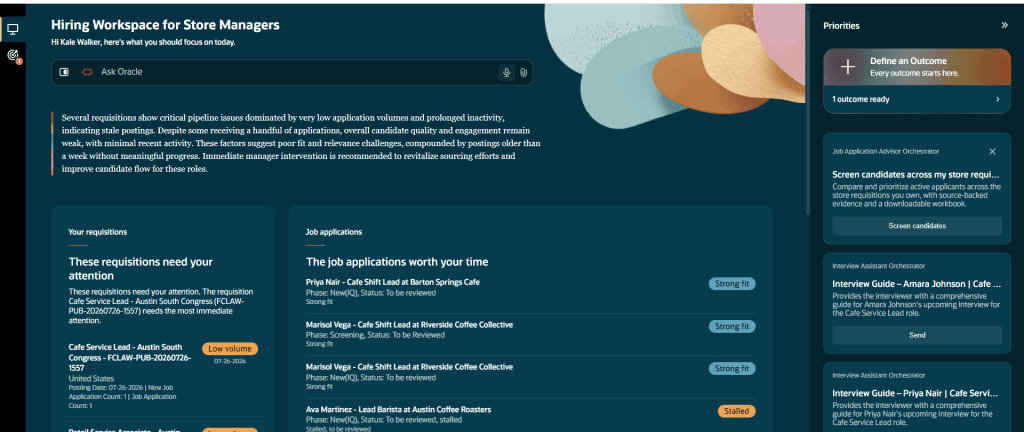
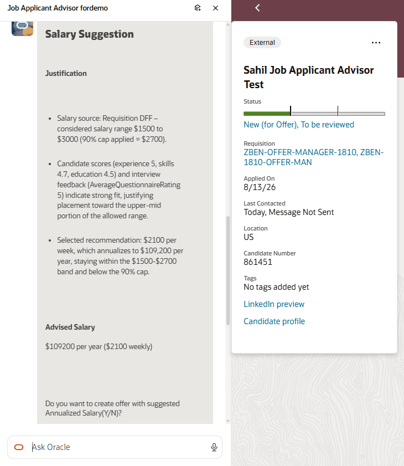
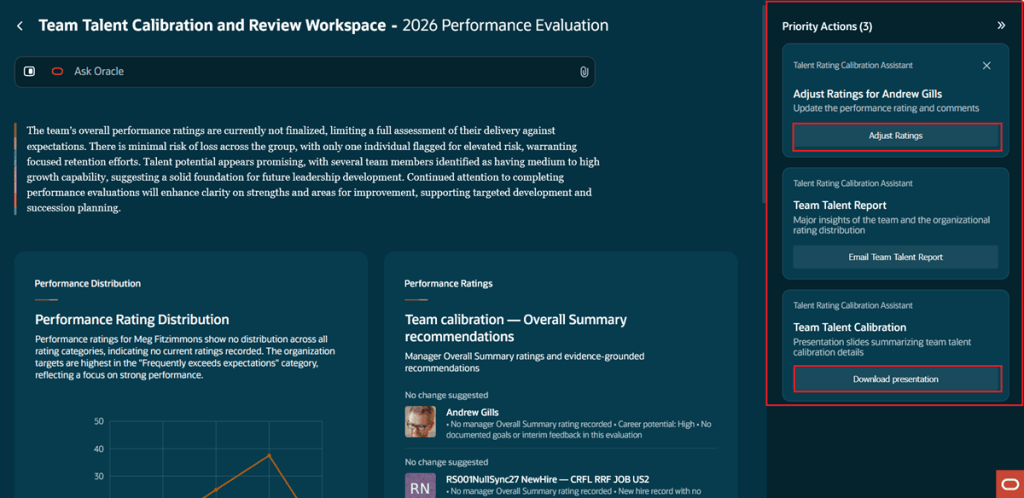
Agentic Apps offer the possibility of bringing those perspectives together. Imagine a manager being able to view workforce data, project commitments, learning progress and performance indicators in a single context when making a resourcing decision. Imagine procurement, finance and supply chain teams working from the same set of insights when managing a critical supplier issue. Imagine employees receiving support that reflects their entire journey rather than the individual processes sitting behind it. The technology is still evolving, but the direction feels increasingly clear.

One challenge I hear repeatedly from customers is that the pace of business continues to accelerate whilst organisational complexity continues to increase. There are more systems. More data. More regulations. More stakeholders. More expectations. The result is that people spend an increasing amount of time gathering information and coordinating activities rather than focusing on high-value decision making.

I don’t believe Agentic Apps will eliminate complexity. Business will always be complex. What they can potentially do is make that complexity easier to navigate. Rather than expecting individuals to manually bring together dozens of signals from across the organisation, an Agentic App can help surface what matters, explain why it matters and support the next action. In many ways, that feels like the natural evolution of enterprise software. For years we’ve focused on capturing information. The next phase may be helping organisations make better use of it.

Of course, technology alone isn’t enough. One thing I’ve learned from years of transformation programmes is that successful adoption rarely depends entirely on the software. Culture matters. Leadership matters. Governance matters. Trust matters.

Organisations exploring Agentic Apps should be thinking about these areas now. How much autonomy should agents have? Which decisions require human approval? How will recommendations be reviewed and governed? How will users understand and trust the outputs being generated? These questions are every bit as important as the technical architecture. In fact, I would argue they’re more important.

The organisations that achieve the greatest success with Agentic Apps are unlikely to be those with the most sophisticated technology. They’ll be the organisations with the clearest understanding of where AI can support people whilst maintaining appropriate governance and accountability.

Whenever discussions turn to AI, there is often concern that technology will replace human expertise. Personally, I don’t think that’s where the greatest opportunity lies. The most valuable decisions organisations make often require context, judgement, empathy and experience. These are qualities that remain fundamentally human.

What Agentic Apps can potentially do is reduce the amount of time spent gathering information, navigating systems and managing administrative tasks. That creates more time for the activities people are uniquely good at. Leading teams. Building relationships. Solving problems. Managing change. Making informed decisions. If organisations approach Agentic Apps with that mindset, the conversation becomes much more constructive. It stops being about replacing people and starts being about helping people be more effective.

Perhaps the thing that excites me most about the future of Agentic Apps isn’t a specific feature or capability. It’s the possibility of making enterprise software feel more human. For years, users have adapted to systems. They’ve learned processes, navigated menus, searched for information and worked around organisational boundaries. Agentic Apps have the potential to reverse that relationship. Instead of people adapting to software, software can increasingly adapt to people. It can understand context. It can bring together information. It can help guide users towards better outcomes. That’s a powerful idea. And whilst we’re still in the early stages of that journey, I think we’re beginning to see what that future could look like.

When I started exploring Oracle Fusion AI Agent Studio, I expected to spend most of my time learning about agents, prompts, workflows and integrations. Those things are important, and they will continue to evolve rapidly over the coming years.

But the more time I spend with these capabilities, the more convinced I become that the most important conversation isn’t about the technology itself. It’s about outcomes. It’s about helping organisations deal with increasing complexity. It’s about helping people make better decisions. And ultimately, it’s about creating experiences that feel less like software and more like support.

Whether you’re just starting to explore Agentic Apps or already experimenting with your first use cases, I think that’s the question worth keeping at the centre of the conversation. Not what the technology can do. But what outcomes it can help your organisation achieve.

Please note that all screenshots are the property of Oracle and are used in accordance with Oracle’s Copyright Guidelines.
What Makes a Good Agentic App?

Over the past few articles in this series, I’ve talked about how Oracle Fusion AI Agent Studio is shifting the conversation away from technology and towards business outcomes. I’ve explored how the Builder Assistant is helping reduce the gap between an idea and a working solution, and I’ve looked at the key building blocks that sit behind Agentic Apps.

But there’s another question that’s arguably even more important. Just because we can build an Agentic App, does that mean we should? As organisations begin exploring AI Agents, there’s a natural temptation to automate everything. Every process starts to look like a candidate for AI. Every challenge appears to need an Agent. Every requirement seems to demand its own intelligent assistant. In my experience, that’s rarely the right approach.

The most successful Agentic Apps aren’t the ones using the most sophisticated technology. They’re the ones solving a genuine business problem in a way that feels intuitive, useful and trustworthy. The technology matters, of course. But good design matters more.

One of the biggest mistakes organisations make when introducing new technology is trying to recreate existing processes in a new tool. We’ve all seen it happen. Paper forms became electronic forms. Manual approvals became digital approvals. Reports became dashboards. The underlying process remained largely unchanged. There’s a risk of doing exactly the same thing with Agentic Apps.

Instead of asking how AI can support an existing process, I think organisations should start by asking a different question. What business outcome are we trying to achieve? For example, an organisation might say they want an AI solution for employee retention. But employee retention isn’t really the outcome. The outcome is helping managers identify people who need support before they choose to leave. Similarly, a procurement team might think they need an AI solution for supplier management. In reality, the outcome is reducing the likelihood of supplier issues disrupting operations. When you focus on outcomes rather than processes, the design conversation changes completely. You stop asking how to automate existing steps and start asking how to help people make better decisions.

This might sound strange coming from someone writing a series about Agentic Apps, but not every business challenge requires an Agent. Sometimes a report is enough. Sometimes an alert is enough. Sometimes a workflow already works perfectly well. I think one of the most important design principles is understanding where an Agent adds genuine value.

Generally speaking, I see Agentic Apps delivering the greatest benefits when people need to combine information from multiple sources, understand a situation, make a decision and take action. Those are activities that often involve context, judgement and prioritisation. By contrast, simple and highly structured processes are often better handled through traditional automation. If the answer is always the same and the outcome is completely predictable, an Agent may simply introduce unnecessary complexity. The goal shouldn’t be to build more Agents. The goal should be to solve more problems.

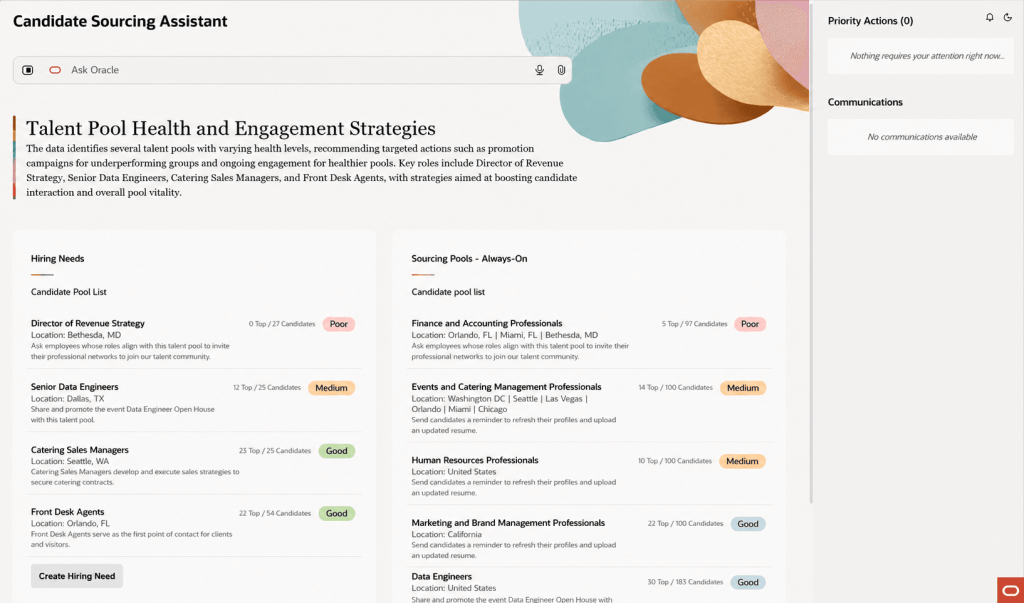
Most organisations don’t suffer from a lack of data. If anything, the opposite is true. The challenge is usually information overload. Managers have dashboards. Leaders have reports. Teams receive alerts. Yet people still struggle to know where to focus their attention. This is where I think many organisations can unlock the greatest value from Agentic Apps. A good Agentic App doesn’t simply surface more information. It helps users understand what matters.

Imagine two different approaches to workforce management. The first presents pages of employee data, engagement metrics, performance ratings, salary information and talent profiles. All the information is available, but the user still needs to interpret it and decide what to do next. The second identifies three employees who may require attention, explains why they have been highlighted and suggests possible next steps. The underlying data may be exactly the same. The experience is completely different. One focuses on information. The other focuses on decision-making. That’s where Agentic Apps should aim to deliver value.

Whenever AI becomes involved in business processes, governance inevitably becomes part of the conversation. And rightly so. The most successful implementations I’ve seen use AI to support decision-making rather than replace it. For example, if an Agent identifies that an employee’s visa is approaching expiry, it can highlight the issue, gather relevant information and even prepare a communication. But deciding whether to send that communication remains a human decision.

Similarly, if an Agent identifies a supplier risk, it can explain the concern and recommend an action, but accountability for the final decision remains with the person responsible for that supplier relationship. I think this balance is incredibly important. AI should help people make better decisions. It shouldn’t remove people from decisions that require judgement, accountability or context. The organisations that get this balance right are much more likely to build trust in their AI solutions.

One lesson I’ve learned from years of delivering technology projects is that users don’t adopt systems because they’re clever. They adopt systems because they’re useful and trustworthy. An Agent can generate incredibly sophisticated outputs, but if users don’t understand where the information came from or why a recommendation was made, trust quickly disappears. That’s why explainability matters. Users need confidence that recommendations are based on reliable information. They need to understand what data has been considered. They need to know when human review is required.

Most importantly, they need confidence that the system is helping them achieve better outcomes rather than creating additional work. A simple, transparent Agent that consistently provides useful guidance will almost always deliver more value than a complex Agent that nobody trusts.

One thing I’ve noticed when watching AI demonstrations is that they’re often designed to showcase what’s possible. Real business environments are different. The question isn’t whether an Agent can do something impressive. The question is whether people will use it on a busy Tuesday morning when they have ten competing priorities. That means designing experiences that fit naturally into the way people work. It means presenting recommendations in context. It means minimising unnecessary complexity. And it means ensuring users can act on insights quickly and confidently. The most successful Agentic Apps won’t necessarily be the most innovative. They’ll be the ones that people actually use.

Traditionally, technology projects have often been measured using delivery metrics. Did the system go live? Was it delivered on budget? Were the requirements completed? Whilst those measures remain important, I think Agentic Apps need additional measures of success. Are decisions being made more quickly? Are managers identifying issues earlier? Are employees receiving better support? Are risks being addressed before they become problems? Are users spending less time searching for information?

Ultimately, the value of an Agentic App isn’t determined by how many features it contains or how many AI models sit behind it. It’s determined by whether it helps people achieve better outcomes. That’s the measure that really matters.

As organisations continue exploring Agentic Apps, I believe the conversation will gradually move away from technology and towards design. The organisations that achieve the greatest success won’t necessarily have the most advanced AI. They’ll be the ones that understand the problems they’re trying to solve, focus on outcomes rather than processes and place people at the centre of the experience. Good Agentic Apps don’t exist because AI is available. They exist because there are business challenges worth solving. And that’s where every design conversation should begin.

In the final article in this series, I’ll look beyond today’s capabilities and explore where Agentic Apps could take Oracle Fusion next, along with some of the opportunities and challenges organisations should be thinking about as this technology continues to evolve.

Please note that all screenshots are the property of Oracle and are used in accordance with Oracle’s Copyright Guidelines.
Beyond the Prototype: Testing, Security and Trust in Enterprise AI

In the previous article, I talked about the importance of trust in enterprise AI and why capabilities such as human approvals and deterministic policy controls may ultimately prove just as important as the intelligence of the agents themselves. But even if an organisation is comfortable with how decisions are governed, another challenge remains. How do you know an agent will behave as expected when it reaches production? That’s where things become interesting.

Building an AI-powered prototype has become relatively straightforward. Building something that can operate reliably, safely and consistently within a complex enterprise environment is considerably harder. Traditional software development teams have spent decades refining processes for testing, quality assurance, security and governance. Those disciplines don’t disappear simply because AI is involved. If anything, they become even more important.

One of the things that has impressed me most about Oracle’s vision for AI Agent Studio is the amount of attention being given to the practical realities of operating enterprise AI at scale. The focus isn’t just on building agents. It’s on testing, validating, securing and improving them throughout their lifecycle.

When we think about testing traditional applications, the process is usually fairly straightforward. If I enter a specific value into a field, I expect a predictable result. If I click a button, I know which process should execute. If something changes unexpectedly, it’s usually possible to identify the source of the issue reasonably quickly.

Agentic applications are different. They may involve multiple agents, connectors, data sources, workflows and models. They may depend on information that changes daily, external services that evolve over time and AI responses that aren’t always identical from one execution to the next. This creates a new challenge. It’s no longer enough to test whether a workflow executes successfully. You also need confidence that the outcome remains appropriate.

Oracle describes this as one of the key challenges facing agentic applications and has introduced ATLAS, the Agentic Testing and Lifecycle Automation Suite, to address it. ATLAS is designed to validate workflow behaviour, generate and maintain test scenarios, assess output quality and support optimisation throughout the development lifecycle.

One of the limitations of traditional testing approaches is that they often assume a predictable environment. Enterprise AI doesn’t always operate in one. Data changes. Business processes change. Models improve. Users behave differently. Without effective testing, organisations can quickly lose confidence in the outputs being generated.

What I find particularly interesting about Oracle’s approach is that testing isn’t positioned as something you do at the end of a project. It’s presented as an ongoing discipline that supports the entire lifecycle of an agentic application. ATLAS can generate scenarios, replay real business data, evaluate workflow paths and assess whether outcomes remain aligned with expectations. It can also help organisations compare models, optimise performance and identify areas where improvements may be required. That feels less like traditional software testing and more like continuous validation. Given the pace at which AI technologies evolve, I think that’s exactly the right mindset.

Trust is difficult to establish when nobody understands how a system reached a particular conclusion. This has been one of the most common concerns surrounding AI since the earliest machine learning solutions. People are often willing to accept recommendations. They are far less willing to accept recommendations they cannot understand. This is where debugging and observability become incredibly important.

Oracle’s debugging capabilities allow builders to inspect workflow execution, pause processes, review variables, replay previous executions and compare the impact of changes made to prompts or configuration settings. Previous runs can be analysed and replayed, allowing organisations to investigate why a particular outcome occurred.

Whilst this might initially sound like a feature aimed at developers, its significance extends much further. If an employee questions a recommendation, you need to understand how it was generated. If a customer challenges an outcome, you need to explain the reasoning. If a process isn’t producing the expected results, you need to identify why. You can’t improve what you can’t see. And you can’t build trust in something that behaves like a black box.

Whenever I discuss AI with customers, security inevitably enters the conversation. And rightly so. AI systems frequently require access to business data, enterprise systems and organisational processes. The more valuable the AI becomes, the more important it is to ensure access remains appropriately controlled.

Oracle’s approach incorporates multiple layers of security and governance, including role-based access controls, instruction guardrails, detection mechanisms designed to identify unsafe inputs, encryption and enterprise identity management. Access to connectors, enterprise data and AI capabilities sits within the wider security model provided by Fusion Applications.

I think this is one of the biggest differences between consumer AI and enterprise AI. Consumer AI often focuses on capability. Enterprise AI must focus equally on control. The most useful AI in the world becomes a liability if organisations cannot manage who can access it, what it can see or how it behaves.

The word governance often sounds bureaucratic. It conjures images of policies, committees and governance meetings. In practice, good governance is simply about ensuring technology behaves in a way that organisations are comfortable with.

Oracle’s governance framework includes guardrails, policy enforcement, role-based security controls and centralised management capabilities designed to help organisations maintain oversight of their AI estate. AI can be constrained by rules, escalation paths, approved tools and runtime controls defined by the organisation.

What I particularly like about this approach is that governance isn’t being added after the fact. It’s part of the architecture. As organisations move from isolated AI experiments to broader adoption, I suspect governance will become one of the most important differentiators between successful and unsuccessful implementations. Not because it’s exciting. But because it enables scale.

One of the questions organisations increasingly ask is not just what happened, but how did it happen? If an AI recommendation influenced a business decision, could somebody review that decision six months later? If an agent triggered an action, can the organisation identify who initiated it, what information was used and what approvals were obtained? These questions are becoming increasingly important, particularly in regulated industries.

Oracle’s auditability and traceability capabilities are designed to address this challenge. Agent actions, tool invocations, data access, approvals and execution paths are captured automatically, allowing organisations to reconstruct historical activity and understand exactly how outcomes were reached. Audit information aligns with existing Fusion governance and retention approaches. For many organisations, this level of transparency will be essential. Trust isn’t simply about accuracy. It’s about accountability.

When AI demonstrations are shown at conferences or webinars, it’s easy to focus on the intelligence. The recommendations. The conversations. The automation. But real-world deployment requires something more. It requires confidence. Confidence that the solution behaves consistently. Confidence that it can be secured. Confidence that it can be governed. Confidence that it can be tested, monitored and improved over time.

That’s why I think capabilities such as testing, debugging, security, governance and auditability deserve far more attention than they often receive. They’re not the features that generate the loudest applause. They’re the features that make long-term adoption possible.

As AI Agent Studio continues to evolve, I think we’ll see increasing focus on the operational realities of enterprise AI. Not just how quickly agents can be built. But how effectively they can be managed. Not just how intelligent the outcome is. But how confidently organisations can depend upon it. Because ultimately, enterprise AI isn’t simply about creating capabilities. It’s about creating confidence. And in many cases, confidence will prove far more valuable than intelligence alone.

In the next article, I’ll return to the design of Agentic Apps themselves and explore what separates a genuinely useful Agentic App from one that simply showcases impressive technology.

Please note that all screenshots are the property of Oracle and are used in accordance with Oracle’s Copyright Guidelines.
Trust Before Intelligence: What Enterprise AI Really Needs

Whenever I speak to customers about AI, the conversation often follows a familiar pattern. We start by discussing possibilities. We explore use cases. We talk about the potential benefits. We look at how AI might streamline processes, surface insights or improve decision making. Then, sooner or later, somebody asks the question that matters most. “How do we know we can trust it?” It’s a fair question.

In fact, I would argue it’s the question organisations should be asking before they worry about models, prompts or agents. Because whilst intelligent systems can generate excitement, trust is what determines whether they ever make it into production.

Over the past few years, we’ve seen organisations experiment extensively with AI. Many have built prototypes. Others have run proofs of concept or adopted individual AI-powered features. The challenge isn’t generating interest. The challenge is moving from experimentation to everyday business use. That’s where Oracle’s approach to AI Agent Studio becomes particularly interesting.

The more time I spend exploring the platform, the more convinced I am that Oracle’s biggest investment isn’t in creating more intelligent agents. It’s in creating an environment where organisations can trust those agents to operate safely, consistently and responsibly. Trust, governance and enterprise controls are built into the platform from the outset rather than being treated as optional extras.

One of the misconceptions surrounding AI is that success means removing people from the process entirely. Personally, I don’t think that’s what most organisations want. There are certainly activities that can be automated. Administrative tasks, repetitive actions and routine processes are all obvious candidates. But many business decisions still require accountability, judgement and context. Approving a significant payment. Making a hiring decision. Authorising a contract change. Managing a supplier dispute. These are decisions people are expected to own.

Oracle’s Human Approval capability reflects that reality by allowing approval stages to be introduced directly into agentic workflows. Approvals can be routed through established business processes, delivered through multiple notification channels and paused until a decision has been made. Once approval is received, the workflow can continue without losing context or progress.

I see this less as a restriction and more as a confidence-building mechanism. The goal isn’t to remove people. The goal is to ensure people focus on the decisions that genuinely require human judgement whilst allowing automation to handle everything else. That’s a much more realistic vision of enterprise AI.

One of the challenges with generative AI is that it isn’t designed to be deterministic. Ask a large language model to summarise a document and you may receive slightly different wording each time. That’s perfectly acceptable in many situations. But not all business decisions fall into that category.

There are areas where organisations expect exactly the same answer every time. Benefits eligibility. Compensation calculations. Compliance rules. Financial policies. Contractual obligations. These are not decisions where approximation is acceptable.

This is where Oracle’s Policy Models become particularly interesting. Rather than relying solely on AI reasoning, organisations can define policies that execute as deterministic functions. These policies can be generated from business documents, validated through testing and reused across multiple workflows, helping ensure critical business rules are applied consistently.

I think this is one of the most important capabilities within AI Agent Studio. Not because it’s particularly exciting. But because it addresses one of the biggest concerns organisations have about AI. Consistency. Most business leaders are comfortable allowing AI to generate recommendations. They’re far less comfortable allowing AI to interpret policy differently from one situation to the next. Policy Models create a clear separation between reasoning and rules. The AI can help understand the situation. The policy ensures the organisation’s rules are applied correctly.

If there’s one theme that runs through almost every successful technology implementation I’ve experienced, it’s predictability. People trust systems when they understand how they behave. They trust systems when outcomes are consistent. And they trust systems when they know there are controls in place if something goes wrong. That’s why I find Oracle’s approach to approvals and policy enforcement so interesting.

Together, they acknowledge a simple reality: not every decision should be automated, and not every decision should rely entirely on AI. Some decisions benefit from human judgement. Some decisions require strict adherence to business rules. The most effective enterprise AI environments understand the difference.

Rather than forcing organisations to choose between complete automation and complete human control, Oracle appears to be creating a middle ground where AI can assist, recommend and accelerate, whilst governance mechanisms ensure oversight remains where it’s needed. For many organisations, I suspect this balance will prove critical to adoption.

When conversations about AI take place in boardrooms, they’re rarely centred around prompts, models or workflows. They’re centred around risk. Can we trust the recommendations? Can we explain the decisions? Can we maintain control? Can we govern the process? These questions are entirely reasonable. In fact, they’re probably more important than the technology itself. An incredibly intelligent system that nobody trusts will never deliver value.

A well-governed system that people are confident using can transform the way decisions are made. That’s why I think human oversight and deterministic controls deserve more attention than they’re often given. They’re not barriers to innovation. They’re enablers of adoption.

As organisations continue moving from AI experimentation to AI deployment, I believe we’ll see increasing focus on trust alongside intelligence. The organisations that gain the greatest value from AI won’t necessarily be those with the most advanced models. They’ll be the ones that strike the right balance between automation, governance and human judgement. Because ultimately, enterprise AI isn’t really about replacing decisions. It’s about helping people make better ones.

In the next article, I’ll look at another essential piece of the puzzle: how organisations can test, validate and secure AI solutions before they reach production, and why capabilities such as simulation, debugging, auditability and governance may prove just as important as the intelligence itself.

Please note that all screenshots are the property of Oracle and are used in accordance with Oracle’s Copyright Guidelines.
Beyond the Agent: What Really Powers AI Agent Studio

One of the challenges with talking about AI Agent Studio is that the name can be slightly misleading. People hear the word agent and immediately picture a chatbot, a large language model, or an automated assistant. Whilst those are certainly part of the story, they’re only a small part of it. After spending time exploring Oracle’s latest AI Agent Studio capabilities, I’ve become increasingly convinced that the most important thing Oracle is building isn’t actually the agents themselves. It’s everything around them.

Enterprise AI isn’t difficult because AI models are difficult. Enterprise AI is difficult because organisations need systems that are secure, governed, reliable, testable and capable of operating at scale. Oracle’s latest vision for Agentic Applications reflects this, positioning agents as just one layer within a much broader framework that includes orchestration, security, governance, testing, approvals, connectors and enterprise context. That’s a very different proposition from simply deploying a chatbot.

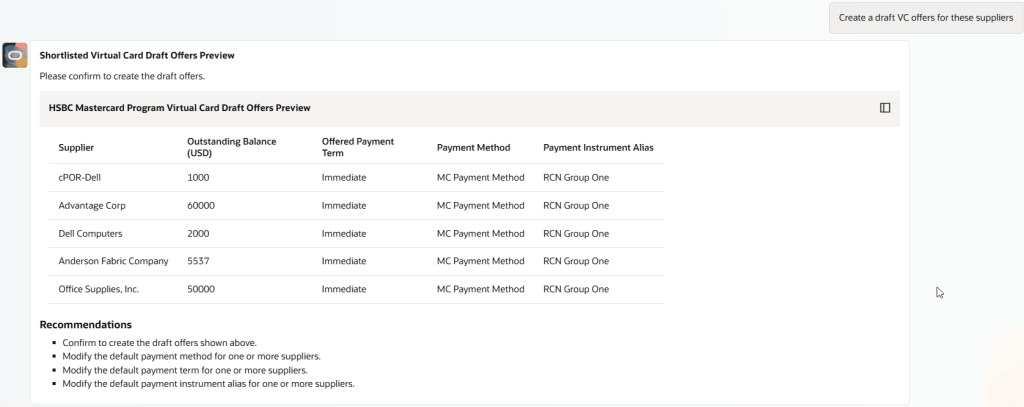
One of the concepts Oracle talks about repeatedly is the idea of Agentic Applications rather than individual agents. An individual agent can reason, recommend and generate content. An Agentic Application brings together agents, workflows, data, approvals, security controls and user experiences to deliver a specific business outcome. Oracle describes these applications as teams of specialised agents working together to achieve business objectives and deliver measurable outcomes. I think that’s an important distinction.

Most business challenges aren’t solved by a single person working alone. A recruitment process doesn’t rely entirely on HR. A supplier issue isn’t owned solely by Procurement. A financial review often involves multiple stakeholders bringing different expertise and perspectives. The same principle applies here.

Rather than building one all-knowing agent that attempts to handle everything, organisations can create specialist agents focused on particular domains, responsibilities or business processes. Oracle’s architecture explicitly supports specialised agents working as coordinated teams, allowing organisations to break complex business challenges into smaller, more manageable areas of expertise. That may sound like a technical design choice, but it’s actually a business one. The clearer an agent’s purpose, the easier it becomes to build trust, establish accountability and continuously improve performance.

Whenever I speak to customers about AI, I often encounter the assumption that there are only two types of people involved: business users and developers. The reality is far more nuanced. Oracle’s latest AI Agent Studio experience recognises this by providing a spectrum of builder experiences, ranging from no-code and conversational design through to full pro-code development using tools such as VS Code, command-line interfaces and source-controlled development workflows.

Business users can describe outcomes in natural language, whilst developers retain full control when required. I think this approach reflects how successful transformation projects actually work. The people closest to a business challenge are often best positioned to understand the outcome they’re trying to achieve. The people responsible for architecture, security, integrations and governance are best positioned to ensure solutions can operate safely and reliably at enterprise scale. Neither group can solve the problem effectively in isolation. By supporting different types of builders, Oracle appears to be acknowledging that enterprise AI is as much about collaboration as it is about technology.

One of the biggest differences between consumer AI and enterprise AI is context. Public AI tools are incredibly capable, but they generally know very little about your organisation. They don’t understand your policies, your data, your approval processes or your business rules. Enterprise AI becomes valuable when it can work within the context of the organisation it serves.

Oracle’s architecture places significant emphasis on enterprise knowledge, business objects, connectors, policies and organisational context. Agents can be grounded in enterprise content, connected to external systems, and informed by the processes and data that already exist within Fusion Applications.

Why does that matter? Because business decisions rarely rely on a single source of truth. An HR recommendation might depend on employee records, compensation history, learning activity and organisational policy. A procurement recommendation could depend on supplier performance, contract information, delivery schedules and financial exposure. A project management decision may require information from staffing, budget, risk and operational systems. The more context an agent can access responsibly, the more useful it becomes. Without context, intelligence quickly loses value.

One of the most interesting additions to AI Agent Studio is the introduction of Policy Models. This capability addresses a challenge that many organisations have been struggling with since generative AI entered the mainstream. What happens when a decision must be correct every single time? There are many situations where approximation simply isn’t acceptable. Benefits eligibility. Financial calculations. Regulatory compliance. Contractual obligations. Compensation rules.

Oracle’s answer is Policy Models. These allow organisations to upload source policy documents, generate executable policy functions, validate them using test cases and then invoke them within workflows as deterministic decision-making components. Policy logic becomes reusable, consistent and centrally managed rather than being recreated repeatedly across multiple workflows.

Personally, I think this is one of the most significant capabilities Oracle has introduced. Not because it’s particularly exciting. But because it addresses one of the most common concerns organisations have about AI. Trust. Many business leaders are comfortable allowing AI to summarise information or suggest recommendations. They’re less comfortable allowing AI to interpret regulatory rules or apply financial calculations inconsistently.

Policy Models create a clear separation between reasoning and rules. The AI can help understand the situation. The policy ensures the decision follows the organisation’s defined rules. I suspect that distinction will become increasingly important as organisations move from experimentation to production use cases.

One message came through strongly when reviewing Oracle’s latest direction for AI Agent Studio. Enterprise AI is moving beyond experimentation. Oracle talks about AI Agents becoming operational centres within deployable business applications, supported by trust, governance, integration, reliability and business context.

The focus is shifting from individual AI capabilities towards complete systems that can safely execute work and deliver outcomes. I think that’s exactly where the industry needs to go. Most organisations aren’t looking for another AI demonstration. They’re looking for solutions to real business problems. They want to improve employee experiences. Reduce risk. Accelerate decision-making. Increase efficiency. Improve service delivery. That’s not achieved through agents alone.

It’s achieved through combining intelligence, governance, data, approvals, security and business processes into a cohesive solution. And that’s what makes Oracle’s current direction particularly interesting. The conversation is no longer about whether AI can generate a response. It’s about whether AI can operate responsibly within the realities of an enterprise environment. For me, that’s where the real story begins.

In the next article, I’ll explore another critical aspect of enterprise AI: trust. Specifically, how testing, approvals, governance, security and auditability are helping organisations move from AI experimentation to AI they can confidently rely on every day.

Please note that all screenshots are the property of Oracle and are used in accordance with Oracle’s Copyright Guidelines.
Oracle Payables Agent: The Licensing and Security Questions Everyone Is Asking

When Oracle talks about the future of touchless Accounts Payable, most of the attention naturally goes to AI-powered invoice processing, anomaly detection and automation. What I’m finding in customer conversations, though, is that the first questions are rarely about functionality. They’re usually much more practical.

Is Payables Agent included in my existing licence? Do I need additional subscriptions for Document IO? Will this consume AI Units? How do I secure it? And how will all of this fit alongside the Agentic Apps Oracle keeps talking about?

The answers aren’t always obvious, particularly now that Oracle has introduced Document IO, Compliance and Control, new Redwood experiences and an expanding portfolio of AI services. In this article, I’ll walk through the areas that seem to generate the most confusion and explain what customers should understand before they start implementing Payables Agent.

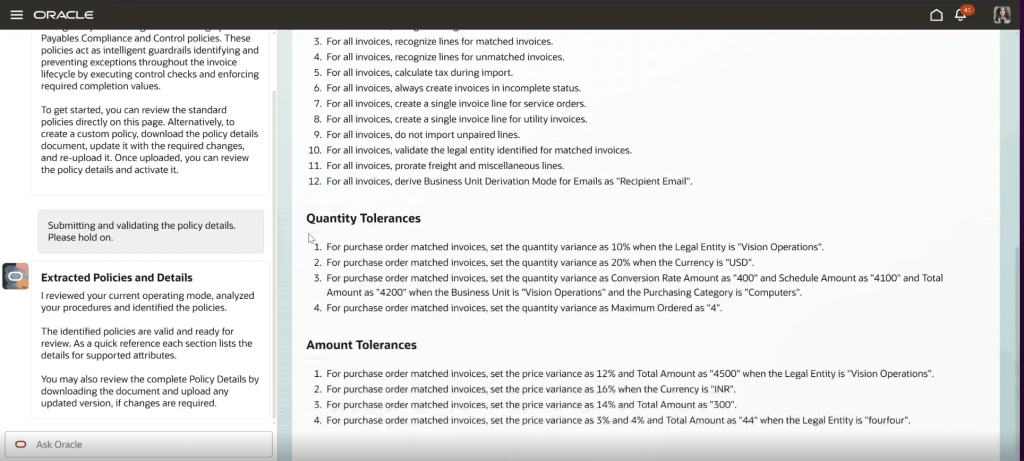
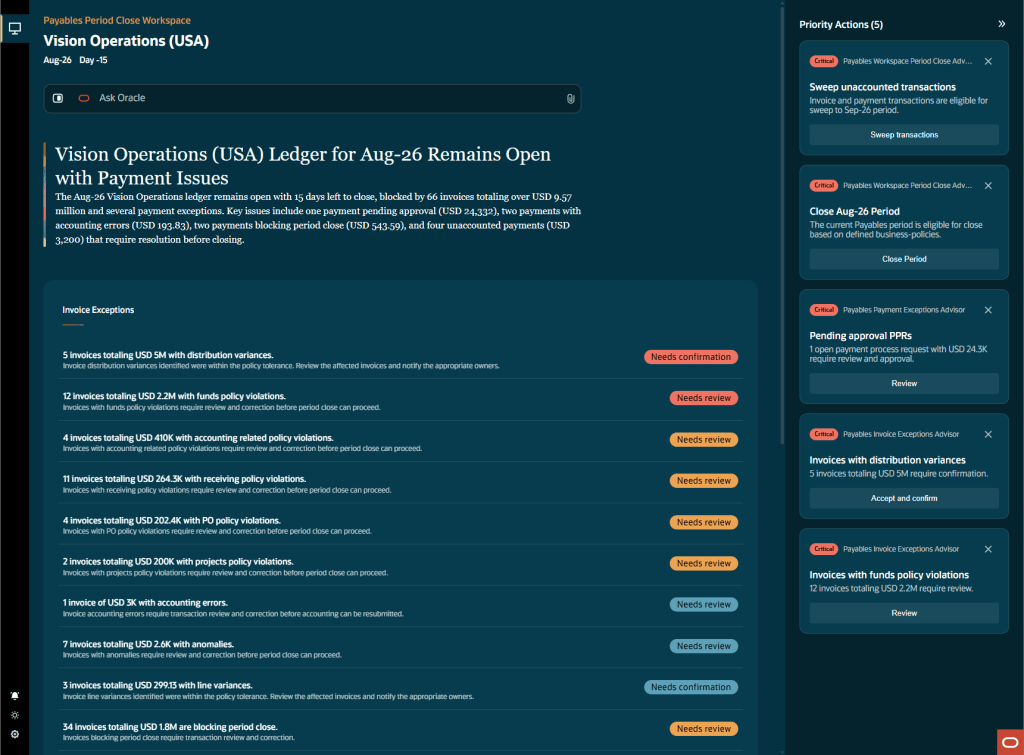
One of the biggest misconceptions is that Payables Agent is somehow the same thing as Oracle’s broader Agentic AI strategy. It isn’t. Payables Agent is focused on invoice processing. Its purpose is to extract information from invoices, identify exceptions, apply controls and help AP teams move towards exception-based processing. The Agentic Apps Oracle has been demonstrating are designed to tackle a different problem, helping users make decisions and drive business outcomes rather than simply automating transaction processing.

That distinction matters because customers are often concerned that adopting Payables Agent today could mean investing in something that will soon be replaced. Oracle’s messaging has been fairly consistent here. Payables Agent remains part of the Fusion roadmap and sits alongside, rather than underneath, the broader Agentic Apps strategy.

The second area that causes confusion is Document IO. For organisations using invoice imaging, Document IO is now the default invoice recognition engine. The functionality itself is straightforward enough, but the licensing position is something worth validating before implementation begins.

I’ve already seen customers assume that because Payables Agent is part of their Fusion estate, everything associated with invoice recognition must be included too. That isn’t necessarily the case. Depending on your commercial arrangement and the services you’re using, additional subscriptions may be required for document recognition and imaging workloads.

My advice is simple: don’t leave this conversation until go-live. Confirm your position early, particularly if PDF invoice processing forms a significant part of your AP operation. It’s much easier to address licensing questions during design than during deployment.

Whenever Oracle introduces a new AI capability, the next question is almost always about consumption and cost. The good news is that Payables Agent isn’t currently positioned as a major AI Unit consumer. Document IO and invoice processing use Oracle’s basic AI capabilities rather than the enhanced models that drive some of Oracle’s more advanced AI services.

That’s reassuring for customers who are trying to understand and manage AI Unit consumption across multiple Fusion modules. However, Oracle’s licensing documentation continues to evolve, so it remains important to validate assumptions against the current service descriptions rather than relying on historic guidance.

The most successful implementations I’ve seen tend to treat security as a design activity rather than a technical task completed at the end of a project. Payables Agent introduces new capabilities around document training, compliance configuration, exception management and operational monitoring. Not every user should have access to all of those functions.

For example, the people responsible for training document extraction models may not be the same people who maintain compliance policies. Similarly, those investigating invoice exceptions may not need access to the controls that govern how anomalies are detected in the first place. Oracle’s newer Redwood experience and consolidated duty roles make this easier than it has been in previous releases, but organisations still need to think carefully about who should own each responsibility.

What I find particularly interesting is that AI governance often becomes more important than technical configuration. Giving someone access to train extraction models sounds relatively harmless until you realise they’re influencing how future invoices will be interpreted. Allowing users to modify compliance policies sounds straightforward until those policies begin driving accounting decisions, tax determinations or project coding.

As organisations adopt more AI-enabled functionality within Fusion, governance becomes increasingly important. Who approves changes? Who reviews model performance? Who monitors recognition accuracy? And who is accountable when exceptions occur? Those questions are often more difficult than the technical implementation itself.

Another reason to get security right now is that Payables Agent is unlikely to be the final stop on Oracle’s AI journey. As Agentic Apps become available across Fusion, many organisations will find themselves managing multiple AI-enabled services with different responsibilities, different user communities and potentially different control requirements. Building a strong governance model today gives organisations a foundation they can reuse as those additional capabilities arrive.

The technology behind Payables Agent is impressive, but most implementation challenges won’t come from invoice recognition or anomaly detection. They’ll come from licensing assumptions, security design and governance decisions. Customers that take the time to understand those areas early tend to have a smoother implementation experience and a clearer path towards the touchless AP model Oracle is aiming for.

If you’re planning a Payables Agent implementation, I would spend as much time understanding the licensing and security model as you do exploring the functionality itself. Both are essential if you want to move from a successful proof of concept to a production-ready solution.

Please note that all screenshots are the property of Oracle and are used in accordance with Oracle’s Copyright Guidelines.
Oracle Payables Agent: Is Touchless AP Finally Becoming Reality?

Most finance teams have heard the promise for years: invoices arrive, the system processes them automatically, and AP teams focus on exceptions rather than data entry. The reality has often been different. Supplier formats vary, invoice data is inconsistent, and teams still spend significant time correcting, validating and chasing issues before invoices can be paid.

Oracle’s latest Payables Agent capabilities feel like a more realistic attempt to solve that problem. What makes this release interesting isn’t a single AI feature. It’s how Oracle has combined document recognition, compliance controls and operational monitoring into a single process.

One of the biggest changes is Oracle’s move from Intelligent Document Recognition (IDR) to Document IO. For customers, the important point isn’t the technology change. It’s the outcome. Oracle can now recognise a broader range of invoice formats, including handwritten invoices, while continuing to benefit from existing IDR learning.

When new supplier formats arrive, users can map fields once and allow future invoices to be processed automatically. Functional teams can manage this themselves without relying on technical development. That has the potential to reduce one of the most common bottlenecks in invoice processing: onboarding new suppliers.

What interested me most wasn’t document recognition. It’s Oracle’s shift towards exception-based processing. Rather than asking AP teams to review every invoice, Oracle is attempting to surface only the transactions that genuinely need attention. That includes duplicate detection, policy validation, account coding checks and anomaly identification before invoices reach the payment stage. For organisations with high invoice volumes, that’s where the real efficiency gains are likely to be found.

One capability that may be overlooked is Compliance and Control. This sits alongside existing Oracle defaulting rules rather than replacing them. It helps fill gaps by completing missing information and continuously assessing invoices against defined policies. The result is fewer manual reviews and more consistent application of controls.

For finance leaders focused on auditability and compliance, this could prove just as valuable as the AI-powered document recognition itself. The success of Payables Agent won’t be determined by how impressive the technology sounds. It will depend on three things:

  • The quality of the document training.
  • How well compliance policies are configured.
  • Whether teams embrace exception-based working practices.

Get those right and AP teams can spend less time entering data and more time resolving issues that genuinely need human judgement.

What Oracle is building here feels less like another AI announcement and more like a practical evolution of Accounts Payable automation. The combination of Document IO, Compliance and Control, and the Payables Operations Workspace gives organisations a clearer path towards touchless invoice processing than we’ve seen before. It’s not completely hands-off, and it still requires thoughtful configuration. But for organisations looking to reduce manual effort while improving control and visibility, there’s plenty here worth exploring.

Please note that all screenshots are the property of Oracle and are used in accordance with Oracle’s Copyright Guidelines.
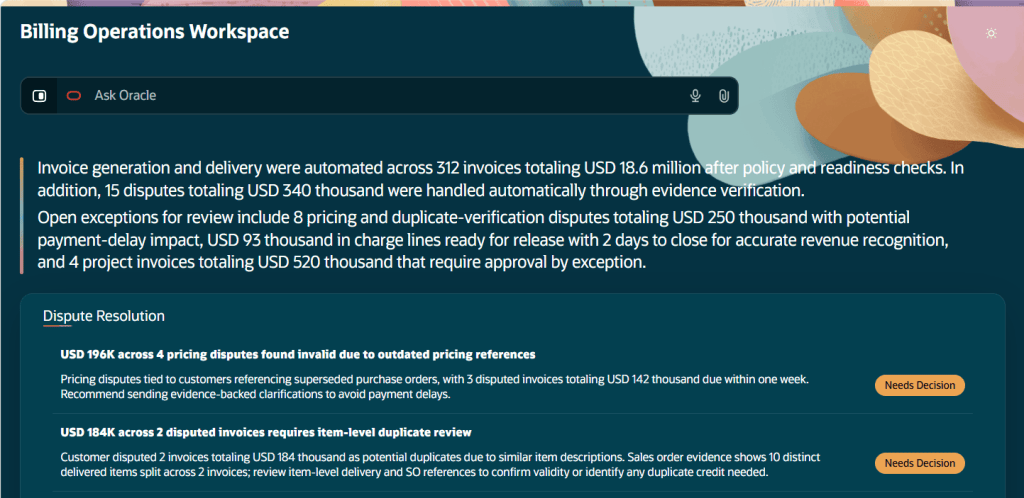
Understanding the Building Blocks of an Agentic App

In the first article in this series, I talked about how Oracle Fusion AI Agent Studio appears to be shifting the conversation away from technology and towards business outcomes. In the second article, I explored Oracle’s Builder Assistant and how it helps close the gap between an idea and a working solution. But at some point, it’s worth understanding what actually sits behind an Agentic App. Not because you need to become a developer or learn every technical detail. Quite the opposite. Understanding the building blocks helps explain why Agentic Apps have the potential to deliver value in a way that traditional dashboards, reports and workflows often struggle to achieve.

One of the biggest misconceptions I encounter is that an Agentic App is simply a chatbot with a different interface. After spending time working with Oracle AI Agent Studio, I don’t think that’s an accurate description at all. A well-designed Agentic App is more like a digital team. Different components contribute different capabilities, each performing a specific role whilst working together towards a common outcome. When you look at it through that lens, the architecture starts to make much more sense.

At the heart of every Agentic App are one or more agents. Oracle refers to these as workflow agents, but I think it’s easier to think of them as specialists. In any organisation, complex decisions rarely rely on a single person. Different experts contribute different perspectives. A manager dealing with an employee issue might seek input from HR, Payroll and Learning teams. A finance director reviewing project performance might need information from project managers, procurement specialists and budget owners. Agentic Apps work in a similar way.

Instead of trying to create one agent that knows everything, Oracle encourages organisations to build focused agents with clearly defined responsibilities. One agent might specialise in workforce compliance, another in employee retention, another in supplier risk and another in project performance. That may sound like a technical decision, but it’s actually a business one. The clearer an agent’s purpose, the easier it becomes to trust its recommendations, govern its behaviour and improve its effectiveness over time.

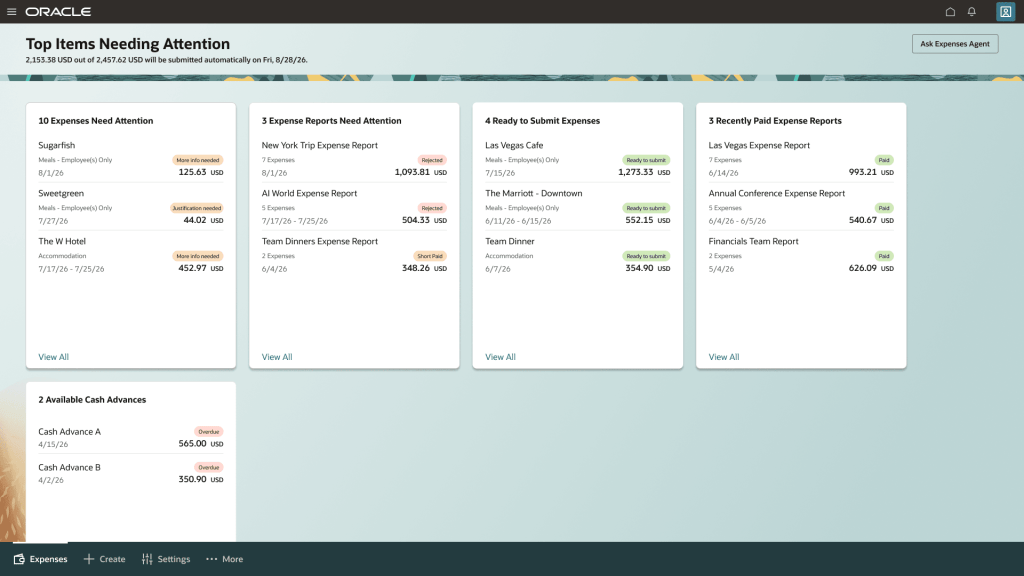
Most people don’t open business applications because they enjoy looking at data. They open them because they need answers. This is why insights are such an important part of the Agentic App experience. Rather than requiring users to navigate through reports, dashboards and transactions, agents can analyse information from multiple sources and surface the things that genuinely matter.

Think about an HR manager responsible for hundreds of employees. What they typically need isn’t more data. They need help identifying which individuals require attention today. Perhaps a valued employee is showing signs of disengagement. Perhaps a professional certification is about to expire. Perhaps a new starter hasn’t completed mandatory onboarding activities. An insight helps bring those situations to the surface before they become bigger problems.

The same principle applies across Finance, Procurement, Supply Chain and Customer Operations. The objective isn’t simply to provide information. It’s to help people focus their limited time and attention where it will have the greatest impact. That’s where the real value starts to emerge.

One of the challenges with traditional reporting is that the report often becomes the end of the process. A manager discovers there’s a problem. They make a note. They send an email. They open another application. They create a task. Eventually, something happens. Agentic Apps are designed to shorten that journey.

In Oracle’s architecture, agents can surface actions alongside the insights they generate. Rather than simply highlighting an issue, they can help the user decide what to do next and initiate the appropriate process. Imagine receiving an alert that an employee’s work permit is due to expire. The application could simply notify you. Or it could help initiate the follow-up activity, prepare communications, gather supporting information and guide you through the next steps.

Similarly, if a procurement agent identifies a supplier at risk of missing a key delivery commitment, the application could help trigger supplier engagement activities before the issue starts affecting customers. The outcome is the same. The difference is the amount of effort required to get there. I think that’s one of the most important distinctions between traditional productivity tools and agentic applications. They don’t just help people understand what needs attention. They help people move towards resolution.

Whenever I talk to customers about AI, one concern inevitably comes up. What happens when the system starts communicating on behalf of people? It’s a valid question. Most organisations want AI assistance, not AI acting independently without oversight.

What I particularly like about Oracle’s approach is that communications are designed to support people rather than replace them. AI can help draft content, prepare messages and bring together relevant information, but the human remains responsible for reviewing, approving and ultimately deciding whether communication should be sent.

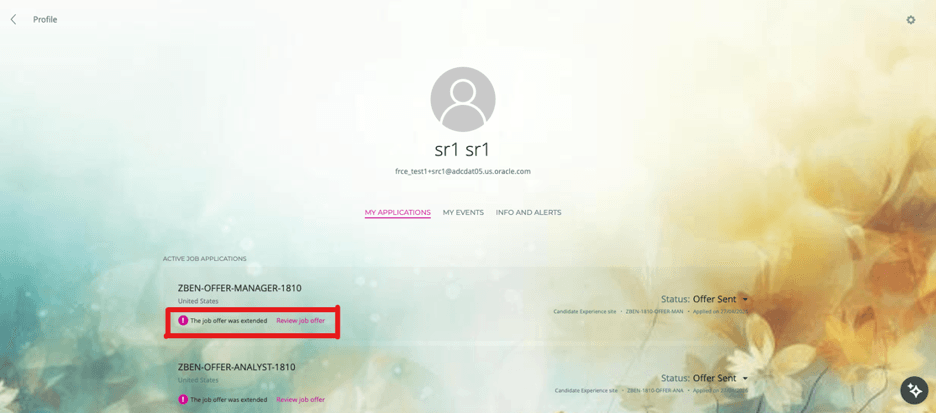
Think about an HR team responsible for monitoring expiring visas or certifications. Creating individual communications can be time-consuming, especially when managing large populations. An agent can help prepare that content using the information already available, allowing HR professionals to focus on quality and decision-making rather than administration. The same principle could apply to supplier communications, project updates, audit notifications or customer engagement activities. The technology handles the repetitive work. People retain ownership of the decision. That feels like the right balance.

Data Still Matters. None of this works without data. However sophisticated the AI might be, the quality of the outcome will always depend on the quality of the information available. This is where Oracle’s business objects, integrations and data access capabilities play such an important role. Agents need access to information before they can generate meaningful insights, recommendations or actions.

The good news for Oracle Fusion customers is that much of that information already exists within the applications they use every day. Employee data. Talent information. Financial transactions. Supplier records. Projects. Learning activities. Procurement spend. The opportunity isn’t necessarily creating new information. It’s bringing existing information together in a way that helps people make better decisions.

Individually, agents, insights, actions, communications and data capabilities are all useful. Collectively, they become something more powerful. An insight identifies an issue. An action helps drive resolution. A communication engages the right people. An agent orchestrates the process. Underlying data provides the necessary context. Together, they create an experience focused on outcomes rather than transactions. And I think that’s really the key message behind Agentic Apps.

They’re not trying to replace Oracle Fusion. They’re not trying to replace employees. They’re not even trying to replace existing processes. Instead, they’re helping organisations navigate increasing levels of complexity by bringing together information, recommendations and actions in a more intelligent way. That’s a challenge every organisation faces, regardless of industry.

As organisations begin experimenting with Agentic Apps, it can be tempting to focus on the technology itself. Which model should be used? Which integrations are required? Which features should be enabled? Those questions are important, but they’re not the first questions I would ask. I’d start with the business outcome. What decision are we trying to improve? What problem are we trying to solve? What experience are we trying to create? Once those answers are clear, the building blocks start to fall naturally into place.

By now, we have explored the core building blocks that make Agentic Apps possible. However, if you’ve ever wondered what separates an interesting AI demonstration from something that can genuinely be trusted in a production business environment, that’s where the story becomes even more interesting. In the next article, I’ll look beyond the agents themselves and explore the capabilities that make enterprise AI possible at scale, from policy models and human approvals to enterprise integrations, governance and control.

Please note that all screenshots are the property of Oracle and are used in accordance with Oracle’s Copyright Guidelines.
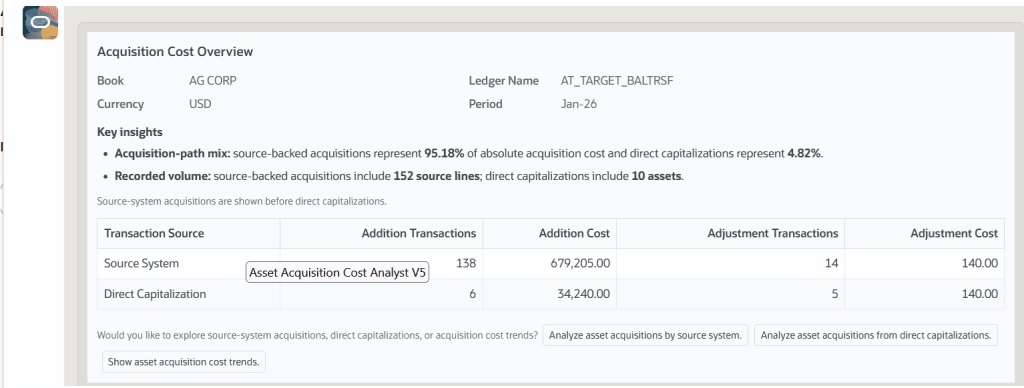
From Idea to Agent: How Oracle is Redefining Application Design

In my previous article, I talked about how Oracle Fusion AI Agent Studio feels different from many of the AI platforms that have emerged over the last few years. The shift isn’t really about a new feature or a new model. It’s about moving away from technology-first thinking and focusing instead on business outcomes.

One capability in particular stands out as an example of that shift: the Builder Assistant. On the surface, the Builder Assistant looks like another AI-powered assistant. You describe what you want, it helps generate the building blocks, and you continue refining the solution through conversation. But I think the significance runs deeper than that.

For years, we’ve accepted that creating applications requires a detailed understanding of how technology works. We capture requirements, design workflows, build integrations and configure business logic, often translating the same business need several times before reaching a finished solution.

The Builder Assistant starts to challenge that assumption. Rather than asking users to begin with the technical design, it encourages them to start with what they are trying to achieve. That might seem obvious, but it’s a meaningful change in how applications are conceived and created.

When organisations begin any transformation programme, they rarely describe their challenges in technical terms. An HR Director doesn’t typically ask for a workflow containing multiple nodes, integrations and business objects. They might say: “We need to identify employees who may be at risk of leaving.” A Procurement Manager might say: “We need earlier warning when suppliers are likely to miss critical deadlines.” A Finance Director might say: “We want to focus our team’s attention on unusual spending patterns before they become a problem.” These are business challenges, not technical requirements.

Traditionally, there has been a considerable gap between those conversations and the resulting application design. Someone has to translate the business need into technical specifications before any development can begin. What Oracle appears to be doing with the Builder Assistant is helping to narrow that gap. Instead of immediately thinking about workflows, integrations and data structures, users can start by describing the outcome they want to achieve. The platform then helps build the underlying components needed to support that outcome. The complexity hasn’t disappeared, but it has become less of a barrier to getting started.

A common misconception about AI is that its primary purpose is automation. Whilst automation is certainly part of the story, I think one of the biggest opportunities lies elsewhere. AI can help organisations capture expertise more effectively. Every organisation has people who understand its processes, challenges and priorities exceptionally well. They know which risks matter, which decisions take too long and where valuable time is lost. What they often lack is the ability to translate those ideas into working applications. Historically, that has required specialist technical skills.

As tools like the Builder Assistant evolve, we’re starting to see a world where business experts can contribute much more directly to the solution design process. Imagine an HR specialist describing the characteristics of employees who may require additional support and seeing a prototype solution emerge. Imagine a compliance team defining the type of risks they need to monitor without having to understand every technical object behind the scenes. That doesn’t remove the need for governance, technical review or implementation expertise. But it does allow the people closest to the problem to become much more involved in shaping the solution. For many organisations, that could prove transformational.

One of the things that interests me most about Agentic Apps is that they encourage organisations to think differently about applications altogether. Traditionally, software has been designed around transactions and processes. Users navigate through screens. They search for information. They run reports. They review dashboards. Then they decide what action to take. Agentic applications take a different approach. They start with the question: “What does the user actually need to accomplish?”

A manager may not care about navigating between multiple screens to gather workforce information. They care about whether someone on their team requires support or intervention. A procurement leader may not care about reviewing dozens of supplier records. They care about understanding where the next potential supply chain issue is likely to emerge. A finance manager may not want another dashboard. They want confidence that significant risks or unusual patterns will be highlighted before they become larger problems. This shift from information-centred design to outcome-centred design is one of the most interesting aspects of the agentic journey. The Builder Assistant feels like an important step in enabling that change.

One challenge I hear repeatedly from customers is that they have far more ideas than they have capacity to deliver. Every organisation can identify opportunities to improve employee experiences, streamline processes or make better use of data. The difficulty is often turning those ideas into reality. Development backlogs grow. Priorities compete for attention. Useful ideas can remain stuck in planning documents for months or even years.

By reducing some of the complexity involved in creating solutions, tools like the Builder Assistant have the potential to accelerate innovation. That doesn’t mean every idea should become an application. Nor does it mean every solution should be built without proper governance or oversight. What it does mean is that organisations can spend more time evaluating whether an idea delivers value and less time struggling with the mechanics of getting started. That feels like a much healthier place to focus effort.

Whenever AI enters the conversation, there is often concern about replacing human expertise. Personally, I see the opposite happening here. The value of the Builder Assistant isn’t that it removes people from the process. It’s that it allows people to contribute in different ways. Business specialists can focus on outcomes. Functional consultants can focus on user experience, process design and governance. Technical teams can concentrate on architecture, security and enterprise integration. Each group can spend more time applying their expertise where it adds the greatest value. The technology becomes an enabler rather than the centre of attention. And that’s exactly how it should be.

We’re still at the beginning of this journey. The Builder Assistant is not going to eliminate the need for solution design, implementation expertise or governance. Complex enterprise applications will always require careful planning and oversight. But the direction of travel is becoming increasingly clear. The gap between having an idea and creating a working solution is reducing. The ability to express business intent is becoming just as important as technical skill. And organisations are starting to gain tools that help them focus on outcomes rather than implementation details. For me, that’s a far more interesting conversation than discussing individual AI features.

In the next article in this series, I’ll look at the building blocks that sit behind Agentic Apps and explore how agents, actions, communications and insights work together to deliver meaningful business outcomes.

Please note that all screenshots are the property of Oracle and are used in accordance with Oracle’s Copyright Guidelines.
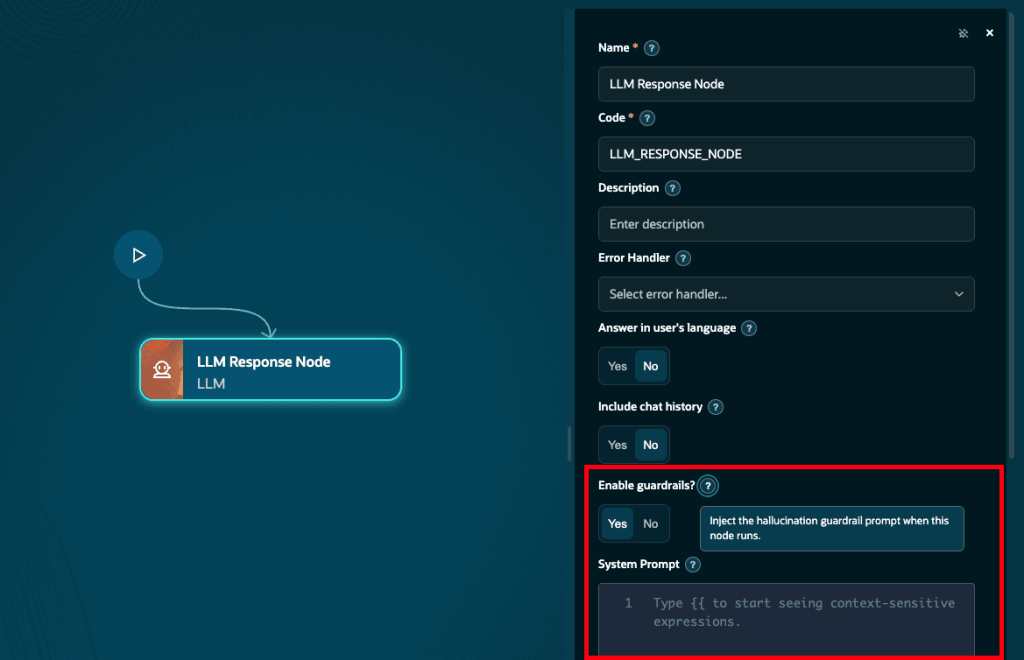
Oracle Fusion AI Agent Studio Has Changed. Here’s Why That Matters

I’ve spent quite a lot of time exploring Oracle Fusion AI Agent Studio over the past few months. Like many new Oracle capabilities, it’s evolved quickly. Features have appeared, interfaces have changed, and new possibilities seem to arrive with every release.

What struck me recently wasn’t a new large language model, agent type or connector. It was the user experience itself. The latest version of AI Agent Studio feels fundamentally different from where it started. That matters because one of the biggest challenges with enterprise AI has never really been the technology. It’s been accessibility.

For years, we’ve talked about empowering business users, citizen developers and functional consultants, yet many AI platforms still require specialist knowledge before you can create anything useful. Understanding prompts is one thing. Understanding workflows, orchestration, APIs and integrations is quite another. Oracle appears to be addressing that challenge head on.

Historically, building applications has required people to translate business requirements into technical specifications. A business leader explains the problem, a consultant documents the requirements, and a developer builds the solution. The process works, but it introduces delays, complexity and the possibility that something gets lost in translation along the way.

What’s interesting about the latest AI Agent Studio experience is that Oracle is increasingly allowing people to describe what they want to achieve rather than focusing on how every component should be configured. Instead of starting with technical objects, workflows and integrations, users are encouraged to start with an outcome.

  • What problem are you trying to solve?
  • What decision are you trying to support?
  • What action should happen next?

That might sound like a subtle change, but I think it’s one of the most significant developments we’ve seen in enterprise software for some time.

For example, an HR team might want to identify employees at risk of leaving and ensure managers take proactive action before valuable talent is lost. A procurement team might want to highlight suppliers that are showing signs of delivery risk before those issues impact customers. A finance team might want to focus attention on unusual transactions that warrant further investigation. The desired business outcome is clear, even if the technology required to achieve it is complex. The technology still matters, of course, but it increasingly sits behind the outcome rather than being the starting point.

One of the themes I keep hearing from customers is that traditional applications were designed around processes. Employees complete forms, managers review transactions, reports provide information and dashboards highlight exceptions. While these tools are valuable, there is often a gap between understanding what requires attention and actually taking action. This is where agentic applications become interesting. Rather than simply presenting information, they can help identify issues, prioritise actions and guide users towards the next step.

Think about a manager reviewing their team. Traditionally, they might need to examine performance ratings, compensation information, employee engagement scores, absence trends and talent data separately before deciding where intervention is needed. An agentic application takes a different approach. It brings those signals together, highlights where attention may be required and presents recommendations in context.

Imagine opening an application and immediately seeing that a high-performing employee has received below-market compensation, has recently missed development opportunities and is showing signs of declining engagement. Instead of spending time gathering information from multiple sources, the manager can focus on deciding what action to take.

Similarly, a procurement leader could be alerted that a critical supplier has missed key milestones and may be putting future deliveries at risk. A finance manager might receive an early warning that project spending is trending above expectations long before budget thresholds are breached. An HR team could be notified about work permits, professional certifications or compliance training that are approaching expiry, giving them time to act before they become a business risk.

The value isn’t simply that AI has identified something unusual. It’s that the information has been brought together in a way that supports quicker, more informed decisions. The goal isn’t to replace human judgement. The goal is to reduce the effort required to reach an informed decision. That’s a very different proposition from simply adding AI to an existing screen.

Many organisations are already struggling with a familiar challenge. They have more data than ever before, but less time to interpret it. The problem isn’t access to information. The problem is finding the right information at the right moment and understanding what to do with it. This is particularly true across HR, Finance, Procurement and Supply Chain functions where managers are expected to make decisions quickly whilst balancing increasing levels of complexity. The promise of AI has always been to help address that challenge. The reality, however, is that many AI solutions still require significant effort to implement and maintain.

What I find encouraging about the direction Oracle is taking with AI Agent Studio is that it appears focused on practical business outcomes rather than technology for technology’s sake. The emphasis is increasingly on helping organisations build targeted applications that solve real business problems. Not generic AI. Not experimental pilots. Applications designed around specific outcomes.

That might mean reducing the time it takes to onboard a new employee. It might mean helping managers identify retention risks earlier, ensuring expiring certifications are proactively managed, accelerating supplier issue resolution or helping finance teams focus on the transactions that genuinely require attention. The common thread is that the technology becomes a means to an end rather than the end itself.

One of the misconceptions I still hear is that AI Agent Studio is aimed primarily at developers. Having spent time working with the latest experience, I don’t think that’s the case. Technical skills are still valuable. Understanding integrations, security, governance and architecture remains important. But the barriers to entry are reducing significantly. Functional consultants can contribute more directly. Business specialists can participate more actively in the design process. Subject matter experts can help shape solutions using the language of the business rather than the language of software development. I think that’s where the real opportunity lies. The people who understand organisational challenges are often best placed to identify opportunities for AI. Giving those people better tools to express their ideas is just as important as improving the underlying technology itself.

We’re still in the early stages of the agentic journey. Most organisations are exploring use cases, experimenting with ideas and trying to understand where AI can deliver genuine value. There will undoubtedly be lessons learned along the way. There will be successful projects and others that don’t deliver the expected outcomes. But when I look at the direction Oracle is taking with AI Agent Studio, what stands out is the shift from building technology to enabling outcomes. The conversation is gradually moving away from prompts, models and technical configuration. Instead, we’re starting to talk about decisions, actions and business value. For me, that’s the most important change of all.

In the next article in this series, I’ll take a closer look at Oracle’s Builder Assistant and explore what it tells us about the future of application design in Oracle Fusion. After all, if AI can help us describe what we want to achieve rather than how to build it, perhaps we’re closer than ever to closing the gap between business ideas and working solutions.

Please note that all screenshots are the property of Oracle and are used in accordance with Oracle’s Copyright Guidelines.