Oracle HCM Cloud Recruit 26A

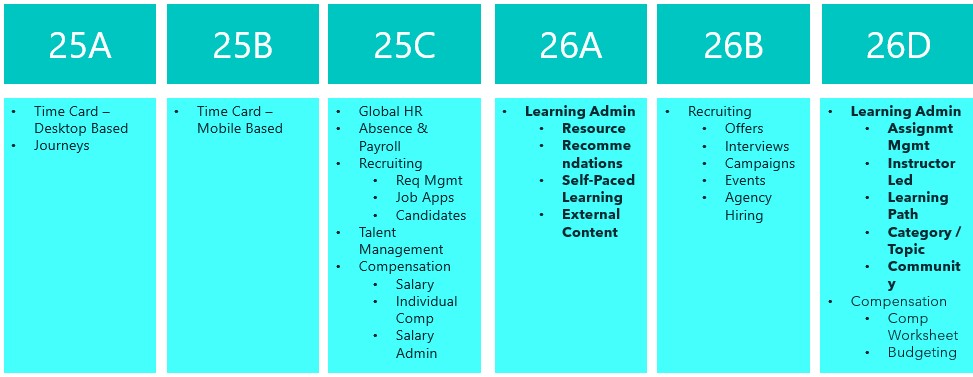
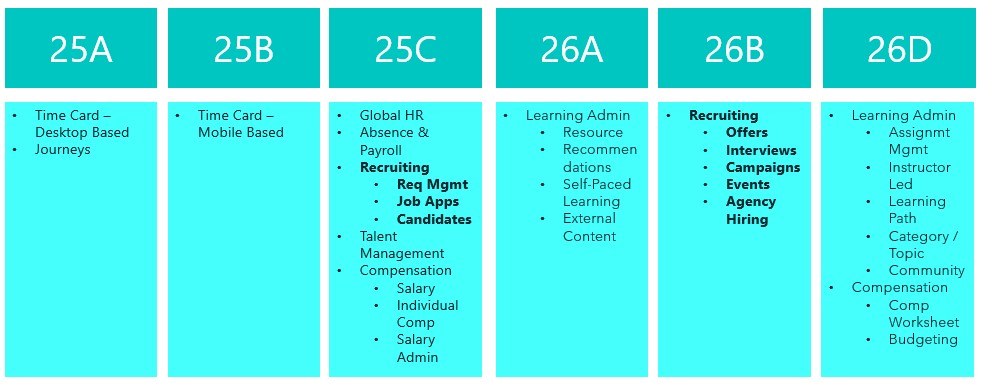
Things are really heating up in the world of Recruit as we approach the final deadline to move the remaining Recruiting pages over to Redwood in 26B. This release is your last opportunity to make the switch. With the 25C deadline behind us, you should already be managing requisitions, job applications and candidates in Redwood. The next phase brings exciting updates around offers, interviews, campaigns, events and agency hiring. So, let’s dive in and see what’s new…

The AI Career Coach, first introduced in 25D to help candidates find roles that match their skills, has already been enhanced in 26A. The Career Coach now uses the Supervisor model, which brings all agents together under one umbrella, streamlining information sharing and removing redundancies. The agent is pre-seeded and ready to run, so there’s no need to create agents from templates. You can also choose to display the widget as an overlay, ideal for highly customised sites, rather than the default side panel, ensuring it doesn’t interfere with your design. For one-page application flows, the widget now displays correctly, and when shown as a side panel, the navigation menu is replaced with a horizontal progress bar. The fixer button appears on the page instead of the left-hand side, and a clickable Terms and Conditions link pulls content from the job application legal disclaimer in the Recruiting Content Library. If you’ve enabled CV parsing, candidate CVs will be parsed into the application flow when uploaded via the widget. From this release, any CV uploaded into the recommended jobs widget in the candidate experience will also be available to the agent.

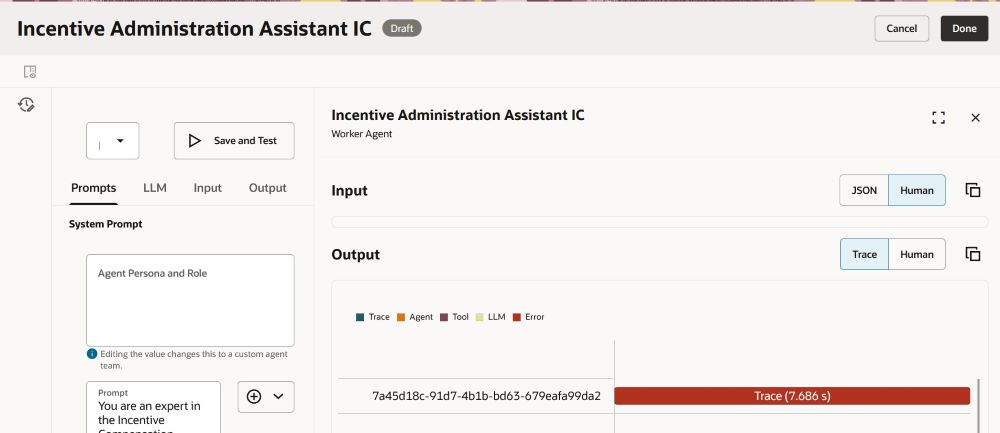
As many of you know, I’m a big fan of AI, anything that makes life easier. The next update introduces an AI assistant for job requisition creation, working like a smart, on-page helper that answers both general and field-specific questions as you build a requisition. Because its guidance is driven entirely by the documents you upload and the prompt you configure, it’s easy to tailor to your organisation’s policies and practices. The agent helps users get it right first time, capturing the correct data, minimising downstream issues and boosting overall efficiency without interrupting the flow.

By 26B, the Job Offer process must be fully transitioned to Redwood, and Oracle has introduced a new AI agent to make this easier. Acting as an FAQ-style assistant, the agent helps users by answering both general and field-specific questions during job offer creation. Its guidance is based entirely on the documents you upload and the prompt you configure, making it simple to align with your organisation’s policies and practices. This smart assistant ensures job offers are created smoothly, reduces downstream issues by capturing accurate data, and boosts overall efficiency without disrupting the process.

Another useful Redwood Offer feature is the Initiate Job Offer Creation for Hiring Managers functionality. Hiring managers with the Initiate Job Offer privilege can now start the process and share notes with the recruiting team using the Create Job Offer action from the Redwood job applications list or details page. On the Create Job Offer page, they can add comments in the Notes to Recruiter field to provide context or instructions. Once they click Save and Close, the candidate’s application moves to Offer – Draft status and appears on the Redwood Job Offers list page. The recruiter receives a notification to complete the offer details using the Edit Offer action, with the manager’s notes displayed in a banner above the Details and Offer tabs. When ready, the recruiter can submit the job offer for approval or save it for further editing later.

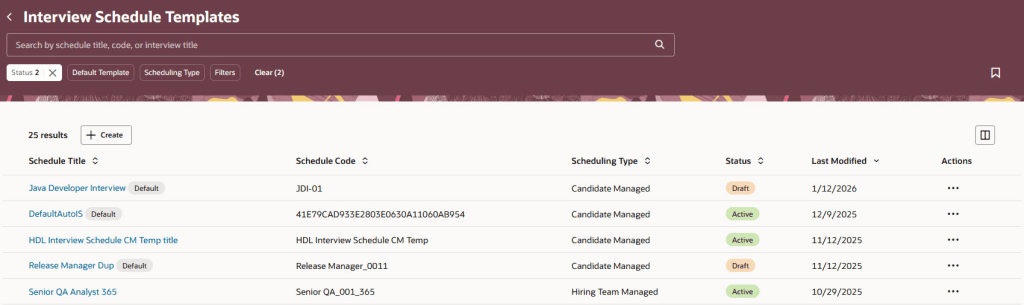
The final feature worth mentioning is the new Redwood Interview Details page, which brings several improvements over the previous responsive version. A new Basic Info section now displays key interview details at a glance. In the Interviewers section, you can easily resend the Interview Scheduled notification, handy if someone says they haven’t received it. The Scheduled Candidates section allows you to click candidate and job requisition links to open a drawer with more information, and the Actions menu lets you manage candidates scheduled for the interview. Under Interview Resources, you’ll find interviewer guidelines, attachments and candidate notes added to the interview. If you’re an interviewer, you can respond directly to the invitation, accept, tentatively accept, decline or propose a new time. When proposing a new time, the drawer can even display your availability if calendar integration (Microsoft 365 or Google) is enabled.

Oracle often slip in new features during the month, so it’s worth keeping an eye out. If anything truly game-changing appears, I’ll share another blog post to keep you updated and make sure you don’t miss out. In the meantime, why not check out my latest write-up on the new Core HR features in Release 26A? You can find it here.

Please note all screenshots are the property of Oracle and are used according to their Copyright Guidelines

Oracle HCM Cloud Learn 26A

Release 26A has arrived, marking the start of the second phase of Recruitment for Learn becoming mandatory. This update sets the deadline for the first half of the required changes to Learning Admin pages, covering Resources, Recommendations, Self-Paced Learning and External Content. The remaining updates to Learn Admin pages will become mandatory with Release 26D. Let’s take a look at what is new!

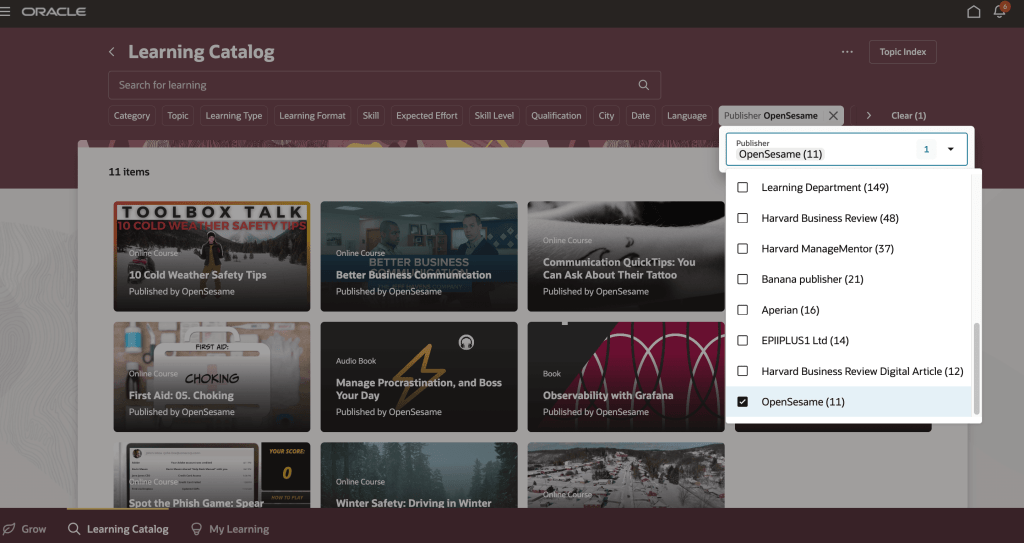
Before you can use this first feature, Dynamic Skills must be enabled. Oracle have updated the licensing for Dynamic Skills over the past year, so it may already be included in your Core HR licence. If you’re unsure, it’s worth checking with your Oracle Customer Success Manager. Once enabled, you can take advantage of the AI Learning Catalogue Smart Search Advisor. This clever tool lets you search the learning catalogue using questions rather than just keywords, delivering more focused and higher-quality results. The results are semantically relevant to your query and tailored to you, taking into account your work history, talent profile and learning record. When active, you’ll notice a new section on the learning catalogue page after you search. This section highlights up to five learning items the advisor has identified as most suitable for you and your request.

There are several new features for Self-Paced Learning, starting with Redwood functionality for enrolment forms, evaluations and feedback. You can now collect the information you need when learners enrol by requiring an enrolment form, a questionnaire, or both. The Learner Info Collection options available in the Self-Paced Learning configuration under the Rules tab in the Enrolment section, offering four choices: no extra information, a combined page with both questionnaire and request form, just the questionnaire, or just the request form, each leading to the Enrolment Details page. These options are controlled by a single setting within Self-Paced Learning.

Oracle has added support for two new content types in Self-Paced Learning: CMI5 and AICC URLs. You can now upload CMI5 .zip archive packages when creating self-paced courses. This format combines the structured approach of SCORM with the flexible, detailed tracking of xAPI, enabling richer data sharing between the learning item and the server. The result? Deeper insights into learner progress and engagement. In addition, you can create self-paced courses by adding an AICC URL as content. Once the page refreshes, the Learning Format field appears, defaulted to Online Course, alongside the Mastery Score field. You can adjust the format as needed and set a mastery score, which moves to its usual spot on the Rules tab under Completion when you create the draft. The score can be updated later if required.

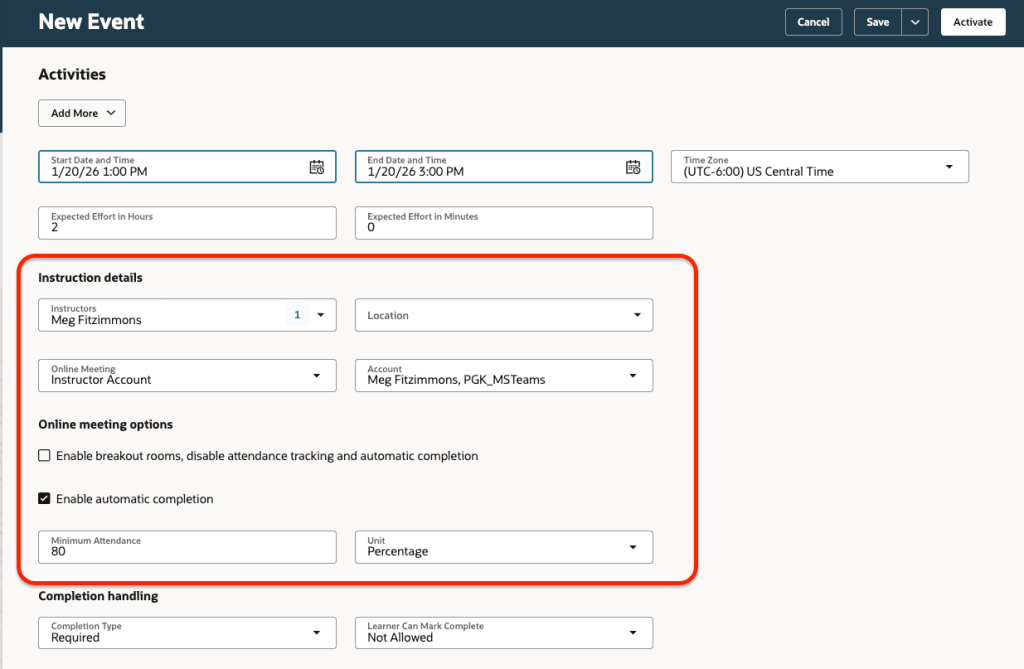
Oracle has introduced a new Redwood Learning Events page, offering a streamlined way to publish instructor-led training directly to your learning catalogue. This update simplifies setup and adds flexibility, allowing events to be defined by formats such as In-Person, Webinar, or custom options tailored to your organisation. Events can be delivered as standalone offerings or included in a course for equivalency, with improved scheduling that supports multiday and overnight sessions and calculates effort automatically. You can specify dates and times via a calendar or manual entry, integrate feedback through evaluations and ratings, and control when learners provide it. Enrolment periods can now be configured separately from catalogue visibility, enabling early access via deep links, while enhanced withdrawal and waitlist options give greater control. Although events cannot yet be added to specialisations and pricing isn’t included in this release, both features are planned for future updates.

The final feature worth highlighting is the new Redwood Course Management page, which brings a modern, visually appealing interface to Oracle Learning. Learning Specialists can now enjoy a streamlined experience with grouped tabs for managing courses, Definitions, Defaults, Access, Skills and Qualifications, User Experience, and More Details, alongside a step-by-step creation process for organising core details, descriptions, visuals and settings. All course offerings, whether instructor-led, self-paced or blended, plus associated events, are accessible from a single Offerings tab for quicker navigation. Learners benefit from improved course detail pages with clearer layouts, showcasing included content, expected effort, acquired skills, instructors, outcomes, languages and celebratory completion notices. They can also engage through ratings, comments and lively discussions via dedicated interaction tabs.

Oracle often slip in a few extra features during the month, so it’s always worth keeping an eye out. If anything truly exciting comes along, I’ll share another blog post to keep you updated and ensure you don’t miss out. In the meantime, take a look at my latest write-up on the new Core HR features in Release 26A, you can find it here.

Please note all screenshots are the property of Oracle and are used according to their Copyright Guidelines

Oracle HCM Cloud Payroll 26A

It’s that time again, quarterly release time, and there’s plenty to look forward to! With Oracle’s strong focus on AI, Release 26A promises some exciting updates. Oracle often adds extra features throughout the month, so keep an eye out for more enhancements as they arrive. This release is especially important for UK Payroll customers, as it includes all the new tax year functionality.
Global Payroll introduces an exciting new AI-powered tool, the Payroll Administrator Troubleshooting Agent. Known as the Payroll Run Analyst, this assistant helps payroll administrators validate employee payroll results directly from the Payroll Results page, including reviewing statements of earnings. Built on Oracle’s AI Agent framework, it delivers secure, role-based information within your permissions and significantly reduces manual effort during payroll reconciliation. It also streamlines corrective actions with deep links to related HCM pages, such as earnings and deductions, for quick updates. Best of all, it requires no extra setup and is ready to use immediately, with a chat experience coming in a future release.
Another feature worth highlighting is the redesign of payslip templates using the Redwood toolkit. The new Redwood Payslip offers a far better experience than the previous responsive version, but until now it only worked with the seeded payslip, which most organisations don’t use. With this update, the Redwood payslip can be viewed online or downloaded, and the PDF/UA templates are fully accessible while meeting all legislative requirements for payslip reporting. To stay compliant with local regulations, Oracle recommend adopting the Redwood payslip template as soon as possible.
As mentioned earlier, this release includes the UK legislative updates for the new tax year. Please note that a monthly patch may be required to incorporate any additional changes announced by the UK Government closer to April. One key update relates to the Full Payment Submission (FPS). You can now choose whether employee addresses are reported for all employees or only new starters. This option applies to the FPS processes for tax years ending April 2025 and April 2026. To set this, use the new field Employee Address on FPS from Tax Year 2024–25 on the organisation-level Statutory Deductions calculation card. By default, this is set to All Employees.

There’s also an update to the P60 template for the 2025/26 tax year. A new Statutory Neonatal Payment field has been added to the Statutory Payments section of the P60, along with a corresponding balance in the UK Balances for the End-of-Year Archive group. To generate and issue P60 End-of-Year Statements to employees, use the updated templates for 2025/26: Type LE(P), eP60 – Online and Plain Paper.

New payroll attributes have been introduced to help organisations set up adoption, maternity, and paternity absences for calculating benefit payments or offsets. Detailed steps are provided to guide you through creating the necessary elements, entitlement formula result rules, balance feeds, and validation formulas based on delivered templates. You’ll also find instructions for setting up entitlement formulas, certificates, absence plans, and absence types, ensuring a smooth and compliant process.

Oracle has now introduced Advance Pay for Irish legislation, giving employees the option to request payment before going on holiday. The amount is then recovered over a set period, such as weekly, bi-weekly, or lunar cycles, as needed. Before processing Advance Pay, make sure all other earnings and deductions have been completed. You’ll also need to configure Advance Pay usage and ensure that earnings are correctly processed during the holiday period.

Enhanced Reporting Revenue (ERR) Requests are now available, making compliance easier. After payroll runs and prepayments that include ERR element entries, use the Run Enhanced Reporting Submission Request. You can also run this process for a specific time period to report on unprocessed ERR entries, such as Travel and Subsistence, Remote Working Daily Allowance, and Small Benefit Exemption. The process generates three outputs: an ERR Audit Report showing archived employee and element details, an Errors and Warnings report, and a JSON file for Revenue submission via the Send File Submission process. For corrections, use the Run Enhanced Reporting Correction Request on previously submitted ERR files. This creates a revised JSON file, an ERC Audit Report, and an Errors and Warnings report—ready to send to Revenue.

As I mentioned earlier, Oracle usually drops extra features throughout the month, so keep an eye out! If anything really exciting comes along, I’ll post an update to make sure you’re in the loop. In the meantime, why not check out my latest blog on the new Core HR features in Release 26A? You can find it here.

Please note all screenshots are the property of Oracle and are used according to their Copyright Guidelines

Oracle HCM Cloud Core HR 26A

It’s the most wonderful time of the quarter! Sorry, I just put up my Christmas tree and now I’m feeling festive. Oracle have just announced the latest features that will be coming in release 26A. As you would expect, it’s an AI heavy one! As usual, additional features may follow later this month. In the meantime, let’s review what’s been introduced so far.

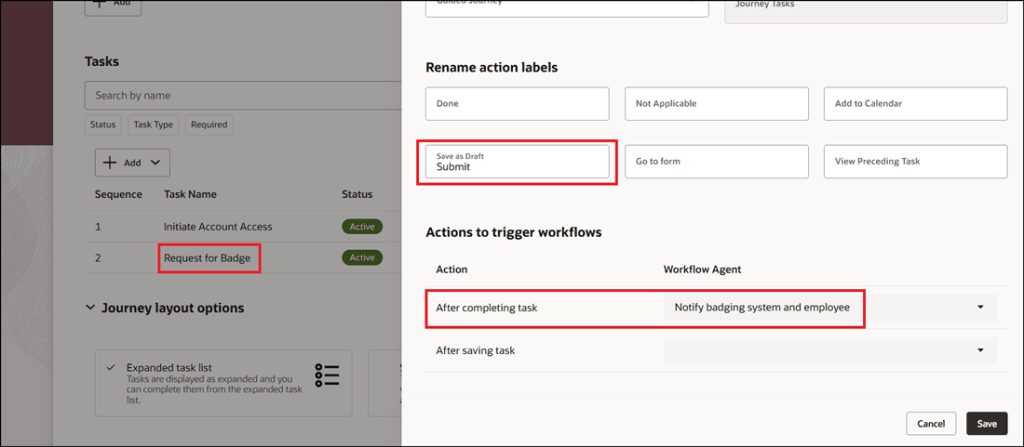
The first feature is one I saw at AI World in October and I thought it was great, so I’m glad it’s here now. The new Manage Journeys with AI Assistant makes managing employee journeys so easy. Powered by Oracle’s AI, it understands your everyday questions and gives you clear answers that fit your organisation’s rules. Need to check overdue tasks, see onboarding progress, or jump straight to the right page? Just ask. It cuts through the clutter, saves you time, and means less training for your team. Managers and HR can quickly get the info they need without digging through menus, so you can spend less time clicking and more time supporting your people.

Everyone loves a good dashboard, and now there’s the new Redwood View Legal Employer Changes Dashboard. It’s your one-stop shop for reviewing and keeping track of all global transfers, but only those that you have access to. The dashboard gives you a clear summary of each worker’s transfer details, making it easy to stay on top of changes. One thing to note: even if the Change Legal Employer dashboard is enabled for Redwood, the deep links on this page still follow their own product-specific profile settings. For example, if you click the Compensation Info link, it will open the Compensation page based on its profile option. It will only open in Redwood if that page’s Redwood setting is enabled, otherwise it will open in the responsive view.

HR teams already have plenty on their plate, so there’s a growing shift towards employees taking ownership of their own data and using self-service wherever possible. The new Request My Assignment Change feature makes this easier than ever, allowing employees to update their own assignment details through a simple Redwood process. From the self-service interface, employees can now request changes to update their work location or adjust their working hours, without any HR involvement. The Request My Assignment Change process uses the existing assignment approval framework. To customise approvals for this request type, configure rules with:
sensorDataReferenceCode = "RequestMyAssignmentChange".

Two new AI features are now available in Workforce Structures: the Job Assistant and the Workforce Structures Insight Analyst. The Job Assistant speeds up creating roles by asking a few simple questions and setting up the job with minimal details like name and code – quick, straightforward, done. The Workforce Structures Insight Analyst is where things get really powerful. Acting as an intelligent companion, it gives you instant access to workforce structure data without the need to build custom reports or navigate complex analytics. You can ask natural language questions and receive clear, actionable answers tailored to your organisation’s policies. Managers can quickly get summaries of job families, positions, and organisational hierarchies; compare structures across teams; and even analyse areas that aren’t covered by standard reporting tools. It’s designed to save time, reduce complexity, and provide insights that help you make informed decisions faster, all from a single, intuitive interface.

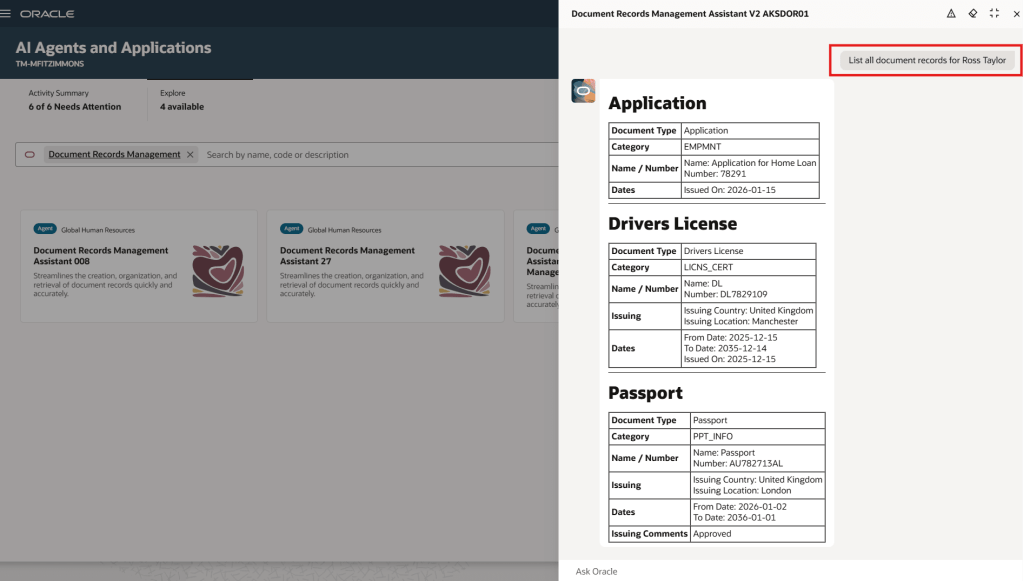
The Document Records Management Assistant brings AI to one of the most essential yet often overlooked areas, document records. This smart assistant makes creating, organising, and finding records quick and effortless. Using advanced language models, it understands the context of each document type and offers helpful suggestions, so you can capture records accurately, categorise them correctly, and retrieve them when needed. With natural language interaction, direct links, and intuitive guidance, it removes complexity, reduces training, and even anticipates intent, such as fetching the latest passport record. In short, it streamlines document management into a simple, conversational experience.

As mentioned earlier, Oracle will be rolling out new Core HR features later this month. If any of these updates turn out to be particularly significant, I’ll share an updated blog post with the details. In the meantime, keep an eye out for upcoming posts where we’ll dive into other Fusion modules as part of Release 26A.

Please note all screenshots are the property of Oracle and are used according to their Copyright Guidelines

Oracle AIWorld – Day 1

Day 1 was a completely different experience to Day 0. The crowds descended, and to be honest, it was a bit overwhelming. On Day 0, I had the freedom to drop into any session I fancied; by Day 1, everything was packed and sessions were full to the brim. Rather than resting on my laurels, I took the opportunity to explore the exhibition stands, chat with Oracle Product Managers, and get a sneak peek at what’s coming soon in the Fusion product line.

My background is in HCM, so I really appreciated the chance to speak with the ERP and SCM Product Owners and watch their demos, which, unsurprisingly, centred around AI Agents. There’s been a fair bit of frustration among customers over the limited AI functionality in the ERP space, so I’m genuinely pleased to see how much is now in the pipeline. There are some brilliant AI Agents on the horizon, and it’s clear that ERP customers have a lot to look forward to.

The big Key Note of Day 0 was Larry Ellison! Sadly he wasn’t able to join us in the room, but his presence was still very much felt! The key points that I immediately think of are the innovations that Larry and Oracle have been involved in, but might not directly impact our work in Fusion, but actually listening back to it, there were a number of changes covered that actually are relevant to us all.

I think this slide is particularly significant. It highlights that Oracle isn’t just focused on training AI models, but also on developing AI Reasoning. If, like me, you weren’t familiar with the term, AI Reasoning refers to the ability of AI systems to apply logic to analyse information, draw inferences, and reach conclusions, essentially mimicking human thought processes. It goes beyond basic pattern recognition by using structured logic and knowledge to solve problems, make decisions, and deliver transparent, explainable outputs. This approach will enhance the quality of AI Agents and, in turn, improve the experience for all Oracle Fusion users.

This is another crucial point. Many organisations are understandably concerned about how their data is handled when using AI. It’s reassuring to know that not only is your organisation’s data not shared, but it’s also not used to train Oracle’s AI models. Another exciting development is the flexibility around which AI models can be used. You’re no longer limited to a single provider, Fusion AI Agents now support models from OpenAI, Claude, Gemini, xAI and Meta. So, if your organisation has a preferred or approved model, there’s a much greater chance it can be integrated seamlessly.

This slide really captures the essence of Larry’s announcements. Oracle stands out by offering a complete stack, infrastructure, database, and applications, all from a single provider. On top of that, there are industry-specific solutions, such as those tailored for healthcare. By choosing a fully integrated Oracle solution, organisations can ensure they’re getting the most out of the available AI functionality. It’s a exciting proposition for customers looking to maximise value and innovation.

Larry’s passion was unmistakable throughout his keynote, but I’ve aimed to keep this focused on the key takeaways that matter most to Oracle users. If you get the chance, I’d highly recommend watching the keynote back online, the future really is here. Keep an eye out over the next few days, as I’ll be sharing write-ups from the remaining two days of the event. There’s plenty more insight and innovation still to come.

Oracle AI World – Day 0 Part 2

Following on from my previous blog covering Day 0 of Oracle AI World (do give it a read if you haven’t already), this post shifts the focus to the afternoon’s Partner Success Summit. Day 0 served as the partner-focused launch for Oracle AI World, and while my earlier piece explored the morning sessions, this one dives into the insights and highlights from the summit itself.

The session was hosted by Leah Yomtovian and featured insights from Oracle’s new CEOs, Clay Magouyrk and Mike Sicilia, alongside Steve Miranda, Executive Vice President of Applications Development. It was genuinely refreshing to hear directly from such senior leaders about Oracle’s strategic direction and, importantly, how Partners are being positioned within that vision.

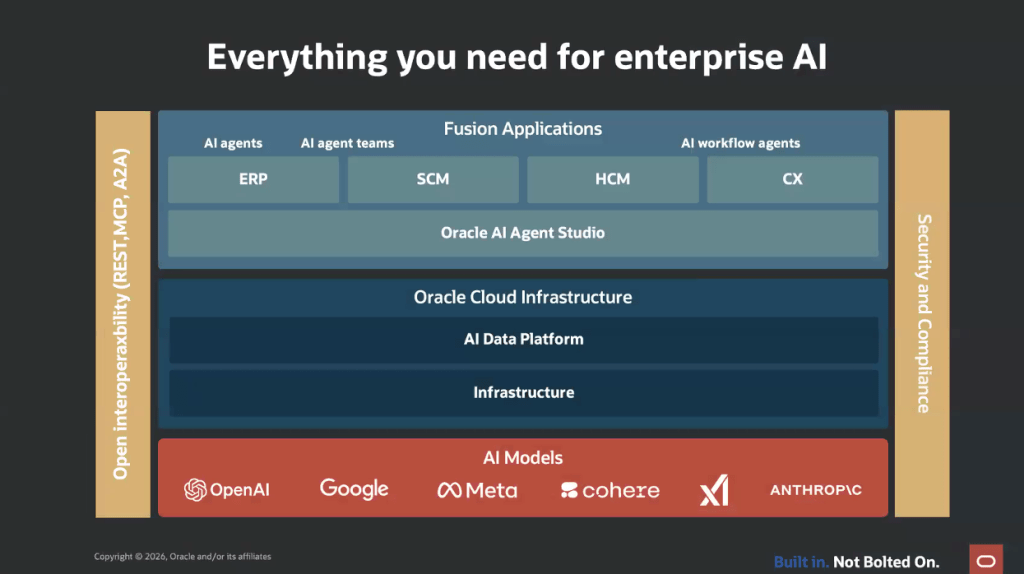
What truly sets Oracle apart from other providers is its comprehensive suite of solutions – spanning Applications, Database, and Infrastructure. For Fusion Apps customers, this means we benefit from the best of all three. The platform is powered by OCI and leverages Oracle’s database technology, all of which is designed to scale seamlessly for AI. This enables customers to access cutting-edge innovation straight out of the box, without the need for complex integrations or custom builds.

I’m already a big fan of AI Agent Studio, it offers our customers the flexibility to use out-of-the-box AI Agents or to copy and tailor the seeded ones to suit their needs. I’m also proud to be among the 32,000 individuals who’ve successfully earned their AI Agent Studio certification.

The slide below summarises the impressive functionality that makes up AI Agent Studio. The features shown in white boxes are all new additions since its initial launch in release 25C, highlighting the rapid pace of development Oracle is driving.

One standout capability is Agent Teams, which allow multiple niche AI Agents to be linked together to deliver complex, end-to-end solutions, which is a real game changer. The ability to call REST APIs opens the door to integrating data from third-party systems directly into the AI Agent, creating exciting opportunities for broader integration.

The introduction of a Prompt Library is another brilliant enhancement. It empowers users to be more creative by browsing, copying and tweaking prompts to meet business needs, all without requiring deep coding expertise.

Support for OpenAI, Anthropic, Google, and xAI means users can now work with their preferred Large Language Models (LLMs), offering even more flexibility for tailored solutions.

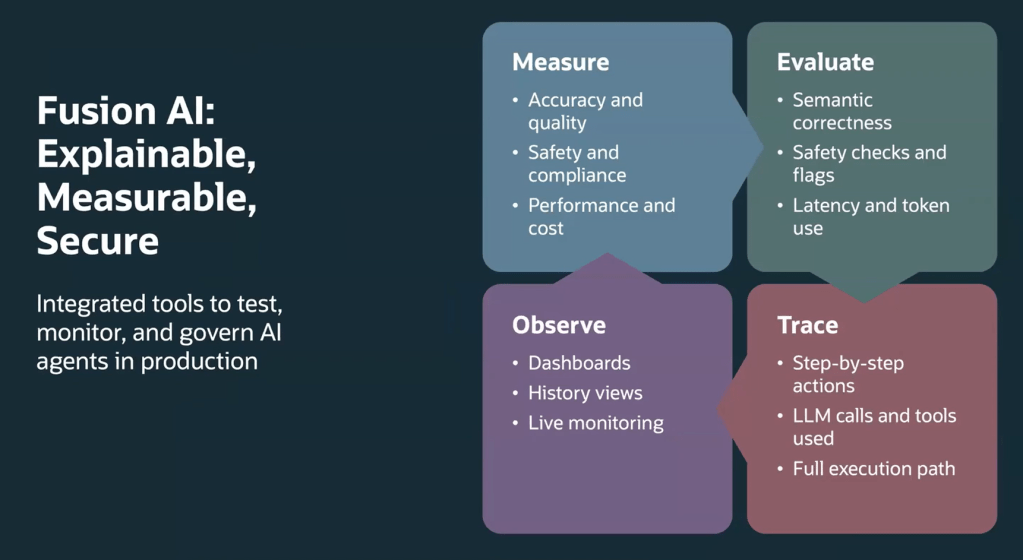
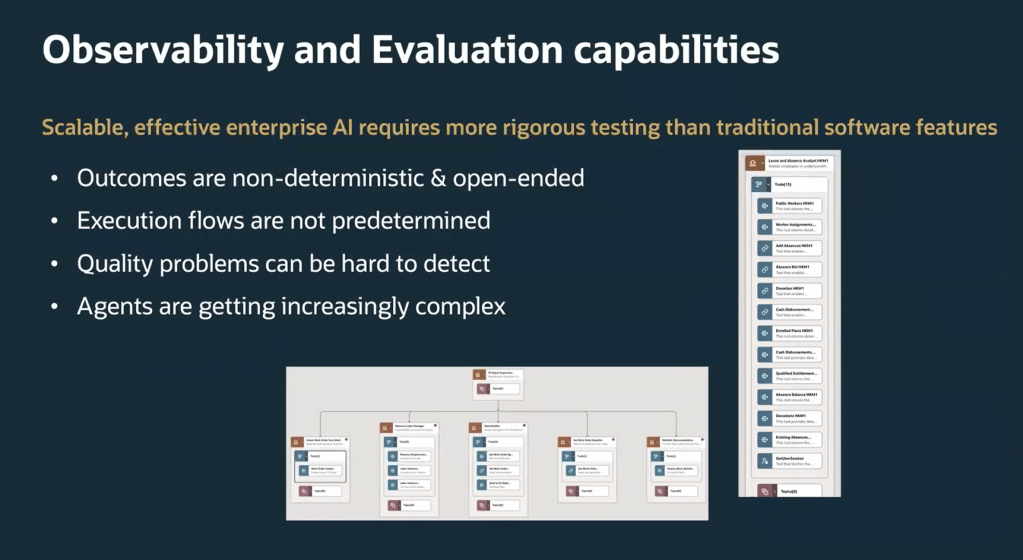
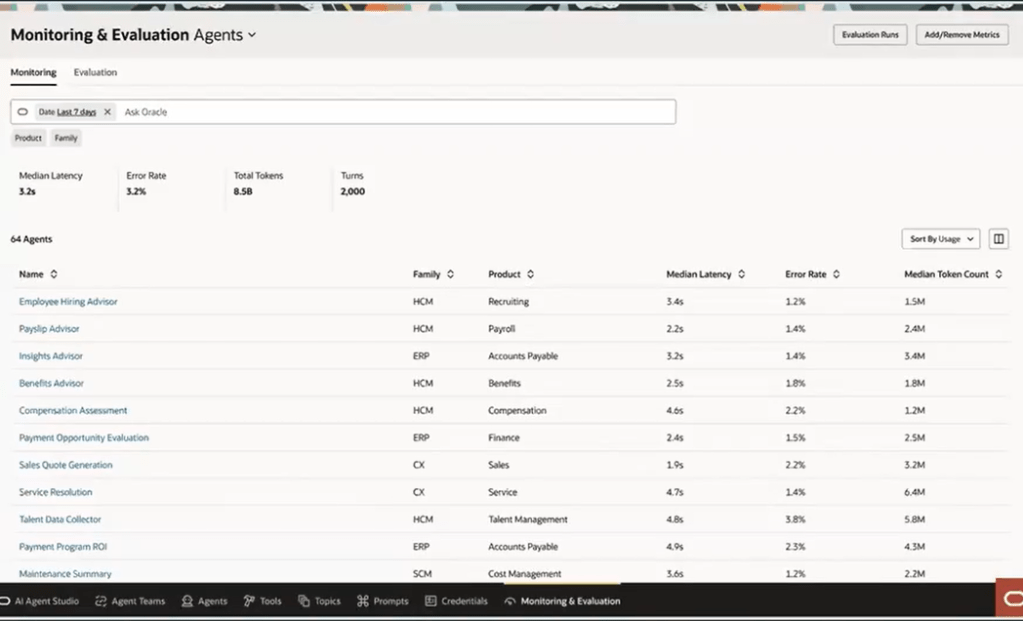
Finally, the monitoring tools introduced in release 25D give organisations clear visibility into how AI Agents are performing. This not only ensures optimal usage but also provides senior leadership with confidence in the value of their AI investment.

Oracle is actively exploring how AI can enhance processes across Finance, HR, Supply Chain and Customer Experience, alongside broader innovation in the development space. These advancements are all aimed at boosting productivity, speeding up processing and freeing people from repetitive tasks so they can focus on more strategic work. Since announcing a target of 100 AI Agents in the first year at Oracle CloudWorld London in March 2025, Oracle has far exceeded expectations, with over 600 AI Agents already released. The launch of the AI Agent Marketplace, where third parties can showcase and promote their custom-built AI Agents, adds even more depth to the ecosystem. Combined with the powerful capabilities of OCI AI Services and the Oracle AI Database, the opportunities for innovation and integration are truly phenomenal.

That wraps up my summary of Day 0 at Oracle AI World in Las Vegas 2025. Keep an eye out over the coming days, as I’ll be sharing write-ups from the remaining three days of the event, there’s plenty more insight and innovation to come.

Please note all screenshots are the property of Oracle and are used according to their Copyright Guidelines

Oracle AI World – Day 0 Part 1

I’d never been to Vegas before, so I wasn’t entirely sure what to expect. It’s a city that’s often described in extremes, and I was curious to see how it would all unfold. Thankfully, Oracle made the transition smooth with their Partner-focused Day 0 sessions, which offered a relaxed and informative start to what promised to be a busy and exciting week.

The first session was a brilliant way to kick things off, featuring none other than the AI legend himself, Chris Leone. If you’ve even a passing interest in how AI is being used within Fusion Apps, you’ll know exactly who Chris is. I was incredibly fortunate to hear him speak in an small setting alongside a group of fellow partners, where he shared insights, which led to lots of interesting discussions afterwards.

The big announcement from Oracle AI World for Fusion Applications was the launch of the AI Agent Studio Marketplace. Chris gave us an early preview ahead of the official reveal later in the week. In essence, it’s an App Store for Fusion AI Agents, allowing third parties to showcase and share the agents they’ve developed, while customers can browse and purchase those that meet their needs. This opens up exciting possibilities for organisations to access ready-made AI Agents for use cases where Oracle hasn’t yet built a native solution.

One statement that really stood out for me was: “2026 is the year to operationalise AI.” It struck a chord, especially as so many organisations have told me they’re keen to adopt AI but struggle to justify it with a clear business case. Often, the ‘why’ hasn’t been considered — it’s simply a case of needing AI because senior leadership says so. What’s exciting about AI within Oracle Fusion Applications is that it changes this narrative entirely. The AI isn’t bolted on as an afterthought; it’s embedded within the core applications, designed to enhance everyday business processes seamlessly. With Oracle’s quarterly release cycle, there’s no room to rest on your laurels — innovation is constant. The AI functionality is a key driver in this ongoing cycle of continuous improvement.

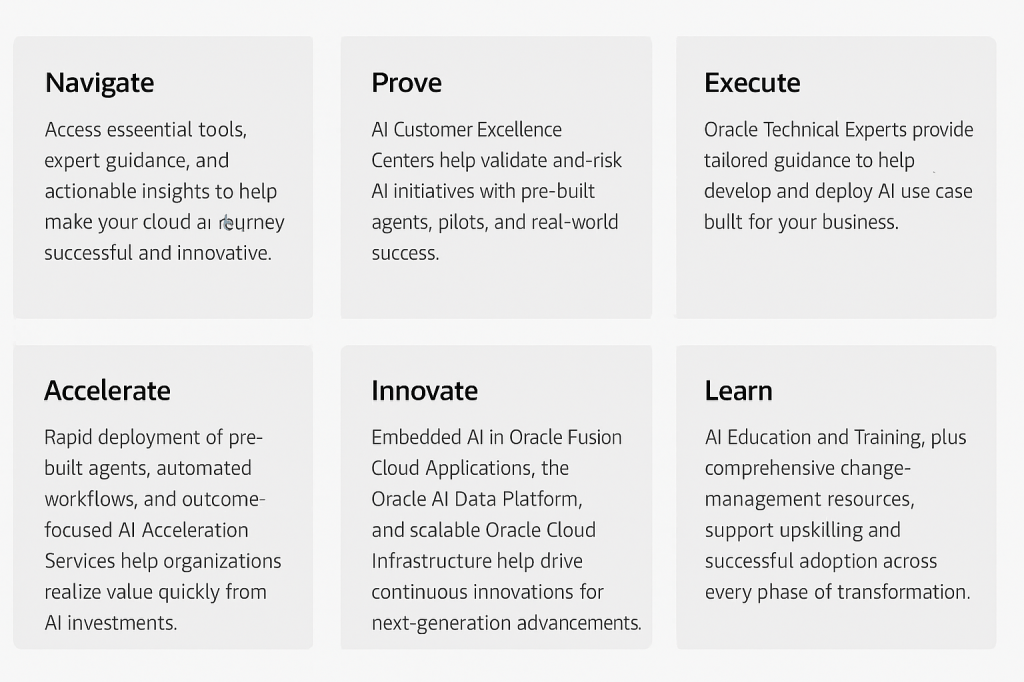
The second session of the morning was a long one, but packed with valuable insights. As soon as I saw that it included the Cloud Success Navigator, I knew I was in the right place! I even persuaded my colleague Marc to join me so he could see just how brilliant the tool is. It was also a real pleasure to finally meet Lorin Bookout in person, after having exchanged messages with her for so long — putting a face to the name made the experience all the more rewarding.

The core focus of the session was on how Oracle Customer Success Services can collaborate with Partners to deliver the best possible outcomes for our customers. The Cloud Success Navigator has played a pivotal role in enabling this three-way success, so it was encouraging to hear that Oracle Customer Success Services are embedding this collaborative approach across everything they do. It’s a clear sign that the commitment to partnership and customer value isn’t just a talking point — it’s being actively put into practice.

The introduction to Cloud Success Navigator was very well received in the room. Having been involved since the pilot phase and watching it grow into such a powerful tool has been genuinely rewarding. That said, I was quite surprised by how many organisations admitted they weren’t using it yet. It’s clear there’s still work to be done in raising awareness and helping teams understand the value it can bring.

The demo of Success Navigator was very well received by the audience, but the real highlight was the new AI functionality that went live just a few weeks ago. Rather than having to trawl through Oracle documentation or Cloud Customer Connect to find answers, you can now simply enter your query into Success Navigator’s chatbot and get an instant response, complete with links to the source material. What’s more, this functionality is available to customers in the UK Gov Cage, who don’t yet have access to the full suite of Oracle AI features within Fusion Applications, as it operates as a standalone tool. This means UK Gov Cage customers can begin exploring Oracle’s AI capabilities sooner than they might have expected, giving them a valuable head start.

All in all, it was a brilliant start to my first AI World experience. If you enjoyed this, do keep an eye out for my second blog from Day 0, coming soon! I’ll be covering the key takeaways from the Partner Summit held that afternoon — definitely not one to miss.

Please note all screenshots are the property of Oracle and are used according to their Copyright Guidelines

AI Use in HCM Cloud

Oracle has just introduced a new set of AI agents within its Fusion Cloud Applications, and they’re set to make a real difference for HR teams. These agents are designed to support HR leaders throughout the entire employee journey—from hiring to retirement—by streamlining processes, improving the employee experience, and freeing up time for more strategic work. Whether you’re in recruitment, management, or part of the wider workforce, these tools are here to make everyday tasks easier and more efficient.

Built into Oracle Fusion Applications and running on Oracle Cloud Infrastructure, the AI agents are secure, fast, and included at no extra cost. They’re designed to work seamlessly within your existing workflows, so there’s no need to learn a new system. From helping employees discover internal job opportunities to assisting recruiters with interview scheduling, these agents are all about making HR more intuitive and responsive.

When it comes to career development, Oracle’s new agents offer some genuinely helpful features. Managers can get support with setting and tracking team goals, while employees receive tailored advice on roles that match their skills and aspirations. There’s even a Learning Tutor agent to help employees get more out of training courses, and a Talent Advisor agent that helps managers plan promotions and career growth using real performance data.

Core HR tasks are also getting a boost. Employees can quickly get answers to questions about pay, leave, or benefits through the Employee Concierge agent, while managers have their own version to help with team-related queries. There’s also a Positions Assistant agent that helps HR leaders make smarter staffing decisions by analysing organisational data and policies.

Finally, the agents support the full employee lifecycle, including onboarding, development, and offboarding. The Succession Planning Advisor helps HR teams stay ahead of leadership gaps, and the Payroll Run Analyst keeps payroll running smoothly by flagging anomalies and explaining any issues. Altogether, these AI agents mark a big step forward in making HR more proactive, personalised, and data-driven.

Please note all screenshots are the property of Oracle and are used according to their Copyright Guidelines

Oracle HCM Cloud Learn 25D

Release 25D has landed, and Oracle are gearing up for phase 2 of Redwood for Learn—this time turning the spotlight on Learn Admin pages, which are mandatory by release 26A. The focus is on making things smoother and smarter when it comes to resources, recommendations, self-paced learning, and external content. With the deadline fast approaching, it’s no surprise there’s a whole bunch of handy features to help you make the switch. Let’s dive in and see what’s new!

If you’re someone who often forgets to reconcile learning assignments, this new feature is for you. With just a quick tweak to a profile value, any course, offering, specialisation, or self-paced learning you kick off will now automatically trigger the reconciliation process. That means all your linked learning assignments stay up to date, saving you from the hassle of mismatched or outdated info.

25D is bringing with it a new unified catalogue listing page, which will be your central location for all your Learn admin tasks. This new feature changes how admin access works for courses, specialisations, and offerings. Once you switch to the single learning catalogue view, courses, offerings, and specialisations will show up on the Learning Catalogue page. Just a heads-up: the old data security rules won’t apply anymore for the following tasks: viewing, managing courses, offerings, or specialisations in the catalogue. If your admins already have full access, there’s nothing you need to do. If you’ve been limiting access to certain items, now’s a great time to simplify things using catalogue administration profiles. Just set up profiles that define who can manage what, replacing the old security roles. Then, link your courses, offerings, and specialisations to the right profile—HCM Data Loader (CourseV3, OfferingV3, and SpecializationV3) can help with bulk updates.

If your organisation uses external learning content, you can now set default visibility rules for each provider, deciding who gets access and how the content shows up in topics and communities. It’s a great way to make sure the right people see the right stuff in the right places, all while keeping things aligned with your learning strategy. This update gives you more control over how third-party content is delivered, helps avoid misuse, and lets you manage licensing costs more efficiently. To get started, just head to My Client Groups > Learning and Development > Configure External Provider and tweak the audience and catalogue settings for any providers whose content is imported as self-paced learning.

With learning content getting better and richer, it’s no surprise the file sizes are growing too. Oracle’s on the ball, they’ve upped the max file size for Self Paced Learning, so you can now upload videos, SCORM packages (1.2 and 2004), AICC ZIPs, and presentations up to a whopping 2GB. PDFs are still capped at 1GB, but that should cover most needs. If you’ve already got Self Paced Learning switched on, there’s nothing you need to do—just enjoy the extra space!

The final feature I want to highlight, is one that has been a frustration for many people and now it has been resolved. You can now clear out old self-paced learning from your Oracle Learning catalogue—whether it’s inactive or has missing content. Just click the new Delete button and you’ll see how many people completed it. You can choose to keep those completions by moving them to a legacy item, note down a reason for deleting it, and add a quick comment if you like. Once you confirm, the system runs a scheduled process that permanently removes the learning and all its links—like specialisations, communities, recommendations, initiatives, HCM goals and journeys. If you’ve chosen to keep completions, they’ll be safely moved so learner history isn’t lost. Just make sure self-paced learning is switched on and that you’ve added the new security privilege: WLF_DELETE_LEARNING_CATALOG_ITEM_PRIV.

Oracle often slip in a few extra new features throughout the month, so it’s always worth keeping an eye out. If anything truly exciting drops, I’ll put up another blog post to keep you in the know and make sure you’re not missing out. In the meantime, please check out my latest write-up on the new Core HR features in Release 25D, you can find it here.

Please note all screenshots are the property of Oracle and are used according to their Copyright Guidelines

Oracle HCM Cloud Recruit 25D

Great news – 25D has landed! Unlike most modules, Recruit has a two-step journey to Redwood, and 26B is the big one to focus on to make sure users stay compliant and fully switched over for core Recruit tasks. If you’ve already got 25C, you should be handling requisitions, job applications and candidates in Redwood by now. The next wave is all about offers, interviews, campaigns, events and agency hiring. While 25C gave us a few Redwood features for offers, 25D really ramps things up to help you stay on track for the 26B deadline, but even more excitingly, it’s full of AI features to make your lives easier! So let’s dive in and explore what’s new….

This first feature isn’t actually a Redwood specific one, but it’s a great one that I’m very excited about! Given Oracle’s push to embed AI into Fusion, wherever it is relevant, this feature is a great use case for it! The new AI Agent for Candidate Experience introduces an AI Chatbot called Career Coach directly onto the Career Site. It will be much easier for candidates to search for a new role with the Job Recommendations Agent and Job Fit Agent, as they get tailored suggestions based on their experience and skills. The candidate just need to upload their CV, answer a couple of questions and then the Job Recommendations Agent will highlight roles that match their profile, while the Job Fit Agent helps them figure out if a particular job is the right fit and answers any questions. Both agents can even use uploaded documents to give more personalised advice, making the whole process smoother and more relevant.

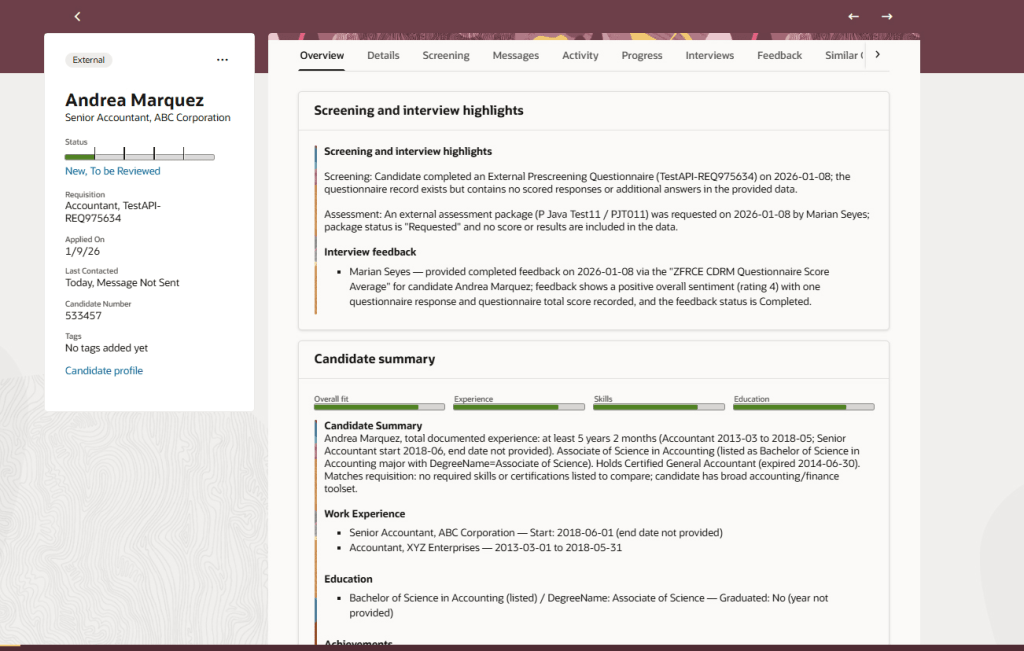
There’s another AI feature I’m excited about. This was shown at CloudWorld London and customers have been asking me about it ever since! The Job Applicant Screening Agent Template lets you create a handy agent team in AI Agent Studio, which Recruiters can get to straight from the Job Application page. It’s a super helpful “ask me anything” assistant that can dig up all sorts of info, including feedback scores, background checks, recent updates, and what’s happened over the past few weeks. You can ask things like “What’s going on with this application?” or “Give me the full lowdown,” and it’ll even suggest things like interview feedback, timelines, assessments, and offer details. It’s a real time-saver, especially for people who don’t use the system much and just want quick answers without the faff.

If you’re anything like me and find creating job offers a bit laborious, you’ll definitely want to check out the new Job Offer Creation Agent in AI Agent Studio. It’s like having a helpful friend on hand, it’s ready to answer all your questions, whether they’re general or specific to certain fields. You can customise it with your own documents and prompts, so it fits your organisation’s policies perfectly. Wondering if you can tweak the start date after sending an offer? Not sure about the typical job grade for a Chief of Staff? Curious about salary differences between cities, or what to do if a candidate already has another offer? This agent’s got your back. It helps you breeze through the offer process smoothly, fills in the right info, and cuts down on errors, so you can focus on getting the right people on board, faster.

The final Recruit AI Agent I want to highlight is one I particularly love, the new Job Requisition Creation Agent to help speed up the process of creating Job Reqs. Think of it as your go-to FAQ buddy, it answers all sorts of questions, whether you’re wondering about salary grades, attachments, or who’s recruiting in a specific location. It works entirely off the documents you upload and the prompts you set, so it’s easy to tailor to your company’s policies and ways of working. Whether you’re asking if you can change job grades later or need to know the salary range for consultants in Dallas, this assistant helps you get it right first time, no interruptions, fewer downstream issues, and a smoother, more efficient experience all round.

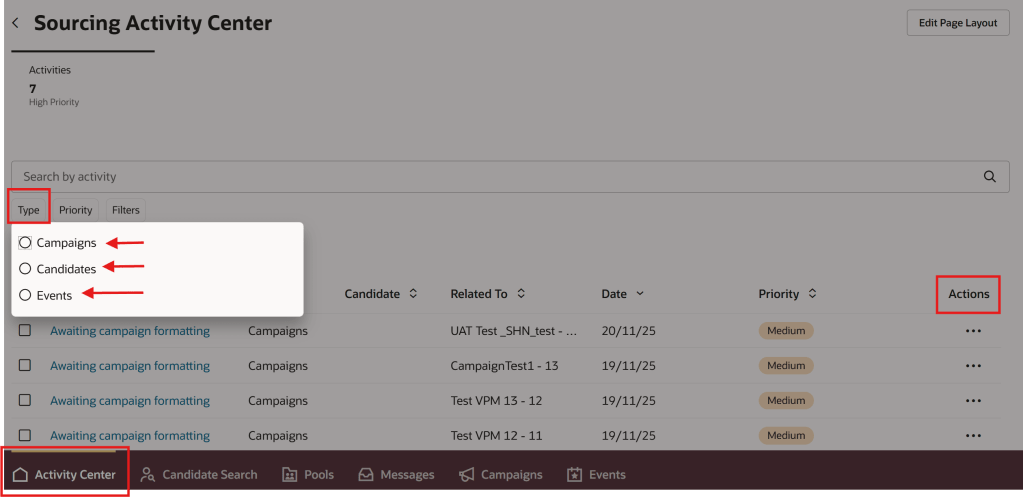
In 25C, the Candidate Sourcing tile was added. In 25D, the Campaigns and Events tabs are no longer under Hiring, but moved to Candidate Sourcing. When you head into the Candidate Sourcing tab, you’ll find everything you need to start building your talent pipeline – from Candidate Search and Pools to Messages, Campaigns, and Events. Over in the Hiring tile, you’ve got quick access to the Activity Centre, Messages, Requisitions, Offers, and you’ll spot Candidate Search and Pools again here too, so you’re never far from the tools that help you keep hiring on track.

Oracle often sneak in new features throughout the month, so it’s worth keeping an eye out. If anything truly game-changing drops, I’ll write up another blog post to keep you posted and make sure you’re not missing out. In the meantime, feel free to check out my latest write-up on the new Core HR features in Release 25D, you can find it here.

Please note all screenshots are the property of Oracle and are used according to their Copyright Guidelines