Oracle Enterprise Data Management Cloud: Where AI Readiness Actually Starts

If you’ve been working in Oracle Cloud for any length of time, you’ll know that data governance quality determines the quality of everything downstream. Reports, forecasts, consolidations, AI outputs: they’re all only as good as the master data behind them. Following the EDM London Spotlight I attended, here’s where the product stands and where it’s heading.

What EDM is (and isn’t)

The naming matters. EDM is “Enterprise Data” Management, not Enterprise “Data Management.” It’s not a database tool or storage layer. It’s a governed system of reference for managing the data that describes your enterprise: hierarchies, dimensions, master data, reference data, data maps, taxonomies, reporting structures.

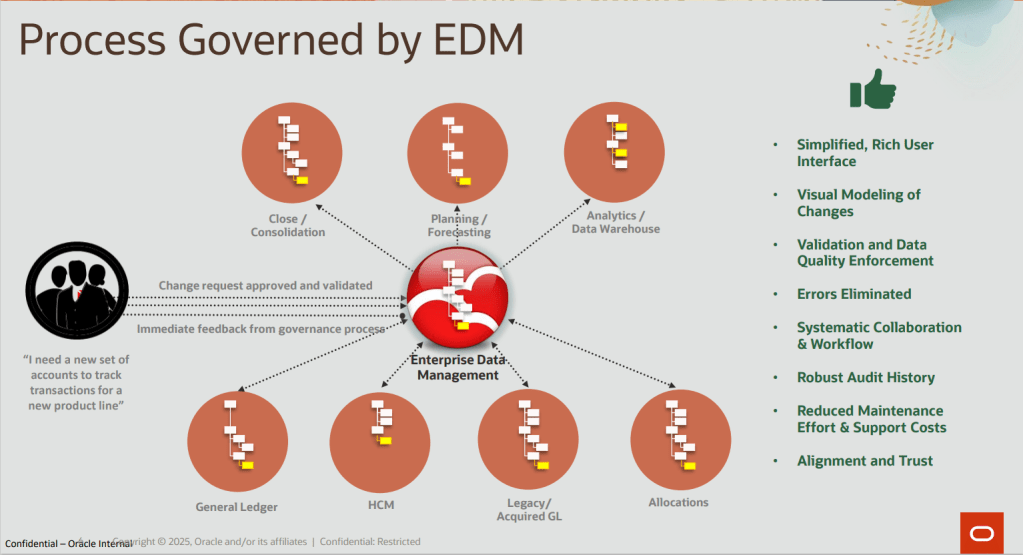
The problem it solves is one most Oracle customers will recognise. Without EDM, a chart of accounts change request starts with an email to IT, fans out to half a dozen application admins, and ends somewhere between a hierarchy mismatch in Planning and a data kickout in Financial Consolidation and Close (FCC). No audit trail, no systematic workflow, no single point of control. EDM replaces that with a governed, collaborative process where changes are requested, validated, approved, and propagated in a controlled sequence.
EDM versus Oracle DRM

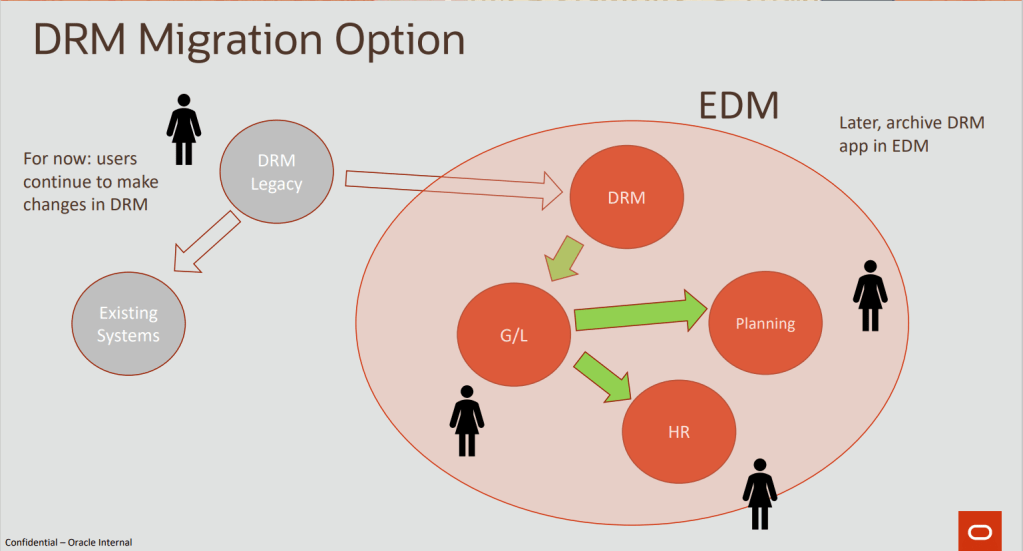
DRM was built for waterfall implementation: gather requirements, build the model, deliver, train, repeat. EDM is designed for an agile, incremental approach. Turn it on, start using it, add rules and policies as they become evident. The traditional MDM big-bang approach has a well-documented failure rate, and EDM’s application-centric model sidesteps it. You start with one application, demonstrate value, and grow from there. New applications are onboarded incrementally without disrupting what’s already in place. For organisations still on DRM, the migration path is practical: users continue in DRM while it’s registered inside EDM as an application, and the legacy system is archived once the transition is complete.
Implementation design patterns

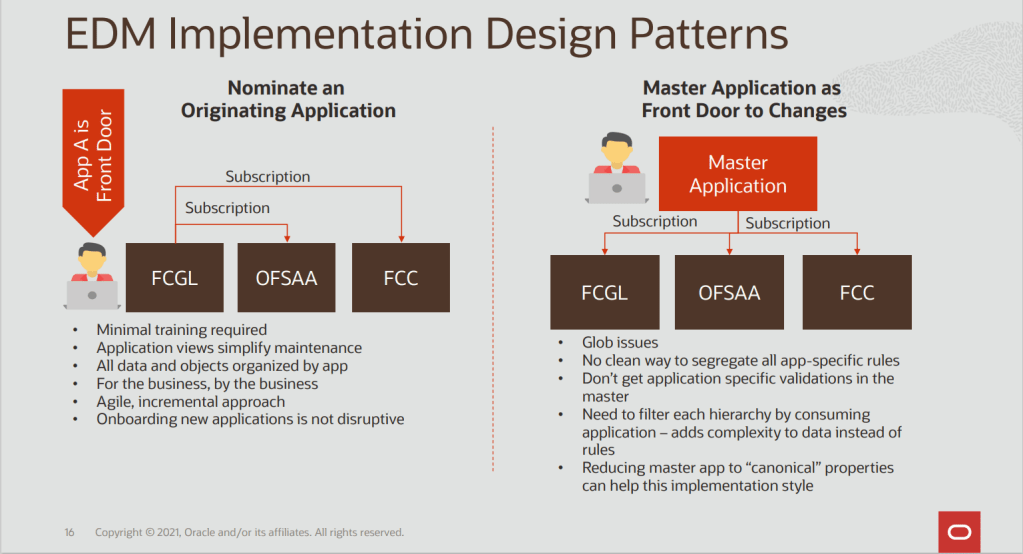
The London session was clear on which pattern works best. Nominate an originating application rather than using a master application as the front door to all changes. The originating application pattern keeps data, objects, and validations scoped to the application that owns them. Downstream applications subscribe to changes. This avoids the problem where a single undifferentiated data model makes it impossible to isolate which rules belong to which application. The master application pattern can work if you reduce it to canonical properties only, but it adds complexity and makes onboarding new applications more disruptive.
EDM and AI

Oracle’s AI approach in EDM operates at two levels.

Internal assistants work within EDM’s existing request and approval model. The Registration Assistant (25.12) generates application metadata and configuration artefacts from a sample data file, accelerating new application setup considerably. The Conversational Request Assistant lets users query master data in natural language, ask questions about existing requests, and generate bulk update actions, all within normal governance controls. Future internal assistants on the roadmap include a Data Profiling Assistant and a Data Matching Assistant using hybrid string, fuzzy, and semantic match rules.

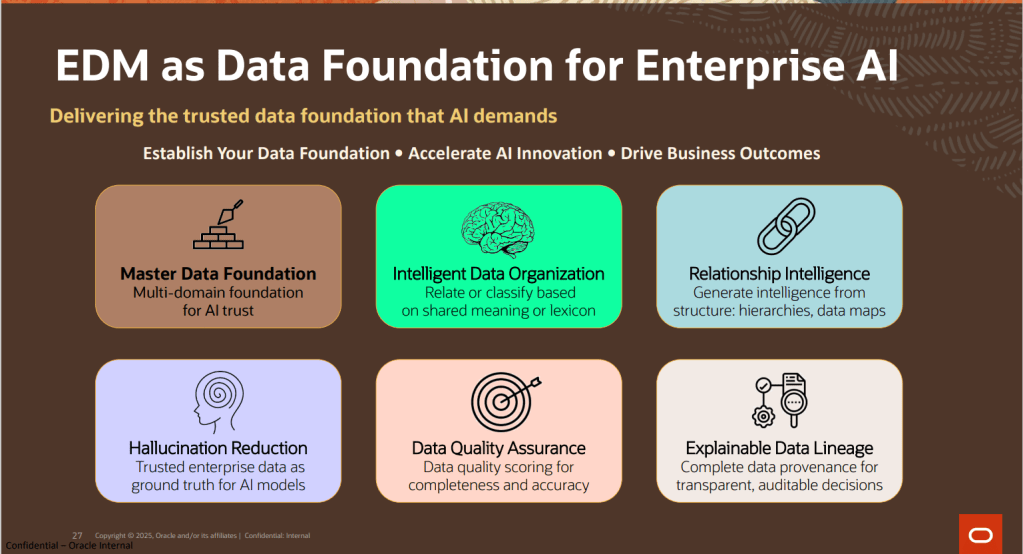
Foundational data governance for AI is arguably the most consequential angle. When enterprise data objects lack clear intent in their descriptions, AI models infer incorrectly. Conflicting hierarchies across ERP, EPM, SCM, and HCM produce inconsistent answers. EDM’s governed descriptions, properties, hierarchies, and cross-application mappings become the ground truth that AI models rely on, reducing hallucination risk and making outputs auditable. If your organisation is investing in enterprise AI, getting master data governance right isn’t optional preparation: it’s what determines whether your AI outputs are trustworthy.
Multi-domain MDM and the roadmap

EDM was built domain-agnostic from day one, which is a genuine competitive differentiator. Competitors largely started in a single domain and expanded. EDM covers Party, Product, Location, Finance, and other domains natively. For Fusion ERP customers, CDM (Customer Data Management) remains the right starting point for mastering customer party records. EDM enriches those with alternate hierarchies, data maps, and cross-application alignment before distributing to EPM and Analytics. For heterogeneous environments with multiple Salesforce instances across regions, EDM can act as the central master customer data hub.

If your Oracle Cloud implementation hasn’t included an EDM conversation yet, it probably should. And if you’re planning an AI initiative on top of Oracle Fusion, EDM is where the trusted data foundation that makes AI outputs reliable actually gets built.

Please note all screenshots are the property of Oracle and are used according to their Copyright Guidelines
What’s New in Oracle HR Help Desk 26A: A Smarter, More Connected Experience

Oracle’s 26A release marks an important step forward for HR Help Desk, with a clear focus on improving the experience for employees, HR teams and service managers alike. Built entirely on the Redwood user experience, this release reinforces Oracle’s direction of travel: HR Help Desk is evolving from a traditional case management tool into a smarter, more responsive service platform that blends self‑service, automation and AI‑assisted support.

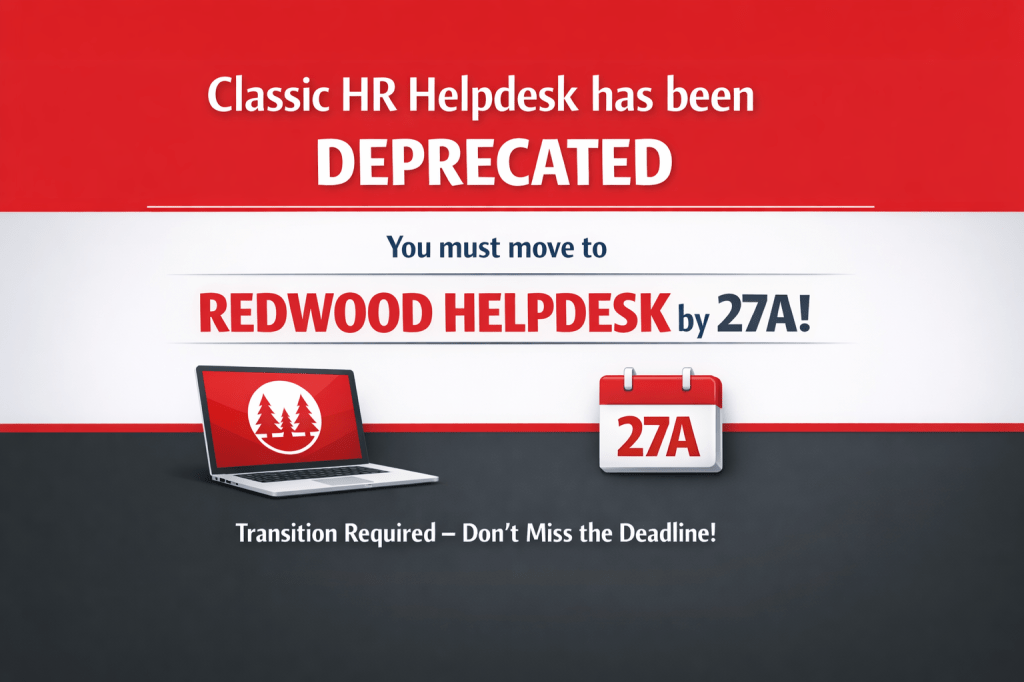
A key message is that Redwood is now the standard. The Classic HR Help Desk experience has been deprecated and will not receive further feature enhancements, with customers expected to complete their move to Redwood ahead of the 27A release. Any new HR Help Desk implementations must use Redwood from the outset. For organisations that have not yet made the transition, this release is a clear signal that now is the right time to plan and prepare.

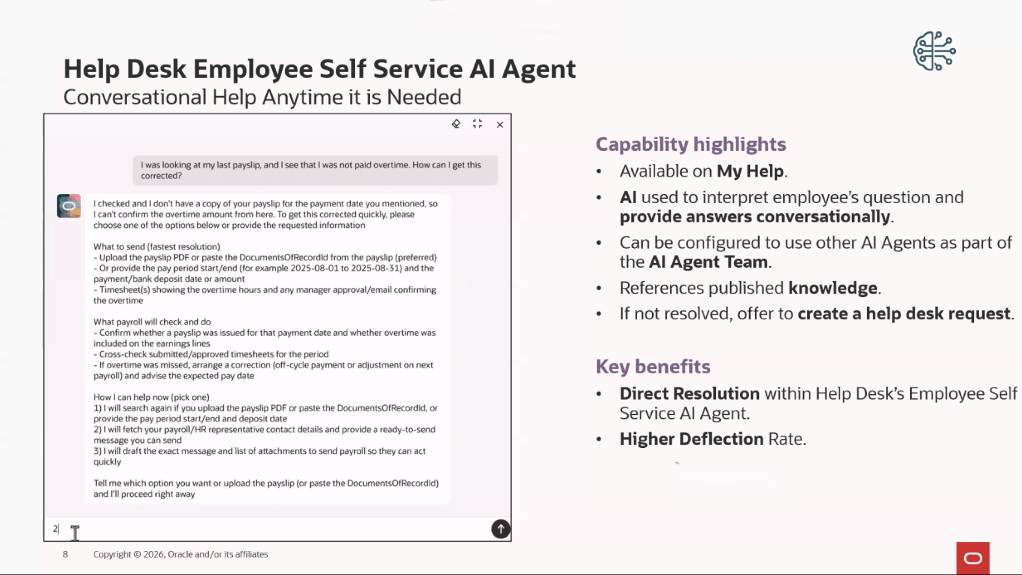
From an employee perspective, 26A introduces a more intuitive and conversational way to get help. A new AI agent within My Help allows employees to ask questions in plain language and receive answers based on published HR knowledge, with the option to raise a request or be guided to the right support when needed. At the same time, Oracle has strengthened how requests are presented to employees by ensuring that primary contacts only see information intended for them, keeping internal notes and agent‑only details out of view by default.

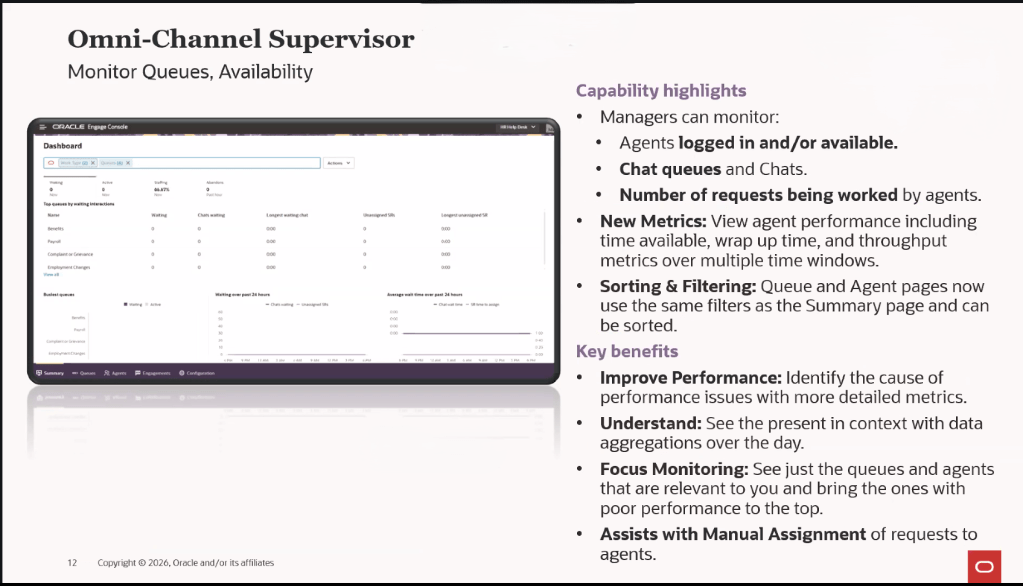
HR agents and supervisors also benefit from more control and visibility. Enhancements to the omnichannel supervisor dashboard make it easier to see agent availability, workload and queue performance, with new metrics supporting better day‑to‑day decision‑making. Case handling has been refined too, with smarter assignment options, improved search, and the ability to upload case documents directly into employee document records. AI‑assisted case analysis is available throughout the case lifecycle, helping agents identify next steps or similar cases, particularly in more complex situations.

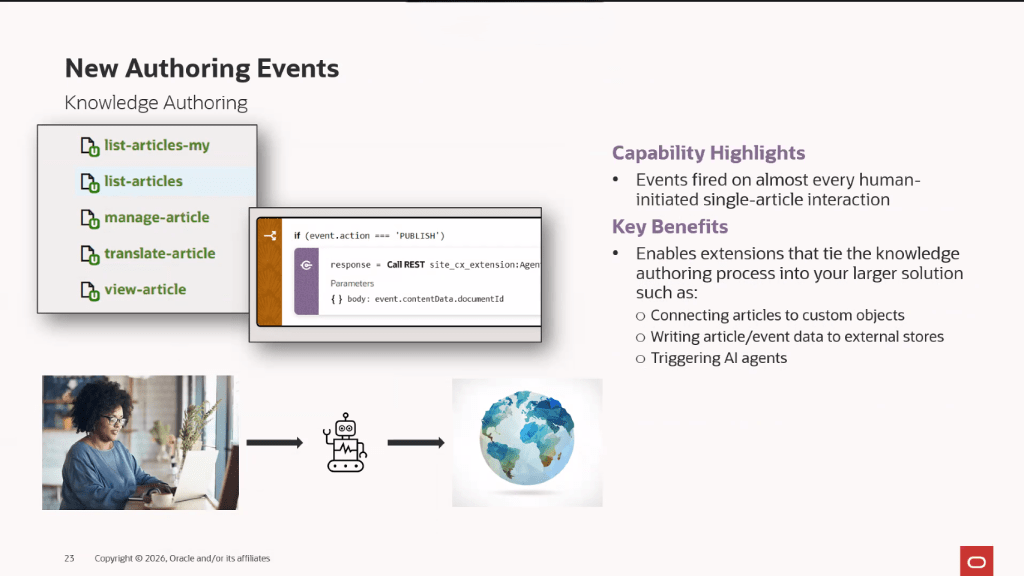
Knowledge management continues to play a central role in HR Help Desk, with 26A introducing new tools to create, structure and reuse content more effectively. Oracle has expanded its AI Agent Studio, added richer attributes for knowledge content, and enabled the use of generative AI to create articles for custom content types. Knowledge events can now be surfaced to support wider integration and automation. Taken together, these changes show Oracle’s continued investment in making HR Help Desk more intelligent, scalable and ready to support modern HR service delivery.

Please note all screenshots are the property of Oracle and are used according to their Copyright Guidelines
Unlocking Real‑World Value with Oracle’s AI Factory

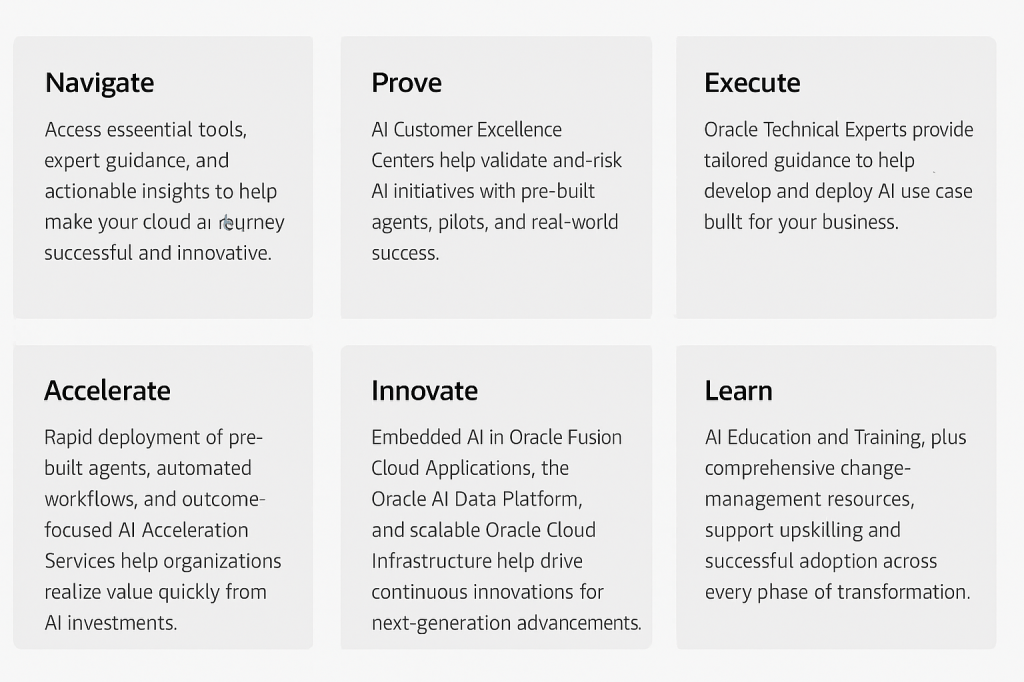
AI is moving at an incredible pace, and it can feel hard to know where to start, or how to get real results quickly. That’s exactly where Oracle’s AI Factory comes in. It gives organisations a clear, practical way forward, with step‑by‑step guidance, useful tools, and expert support to help you adopt, scale, and make the most of AI across Oracle Cloud Infrastructure, Oracle Database, the Fusion Applications Suite, and industry solutions.

Instead of trying to figure everything out on your own, you can tap into prebuilt use cases, clear guidance, and tried‑and‑tested patterns that cut down on both effort and risk. The framework is all about driving real, measurable improvements, whether that means modernising legacy systems, unlocking real‑time insights, or making the most of the embedded AI already available across Oracle’s application suite.

Many organisations don’t realise just how deeply AI is already built into Oracle’s technology stack. Once they see what’s possible, the same questions usually come up: Where do we begin? What does success look like? How do we make sure we see real value? Oracle’s AI Factory is designed to answer exactly those questions and guide customers through every step of the journey. With support from Oracle’s experts and the AI Customer Excellence Centres, you can validate ideas, shape use cases, and run pilots with confidence, all while keeping innovation moving without taking on unnecessary risk.

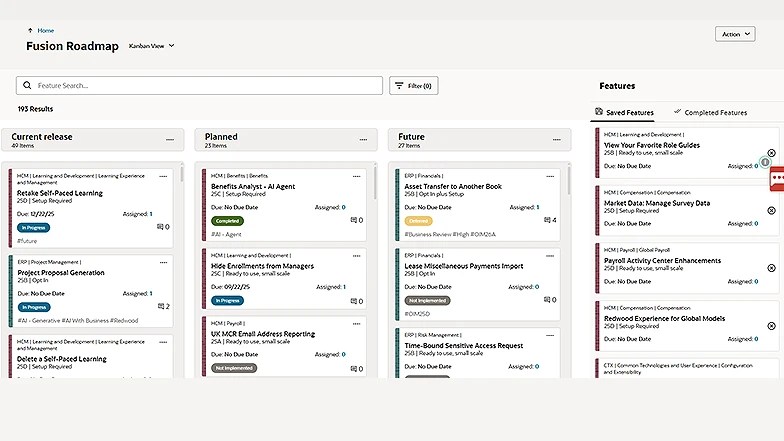
The first tool in the new AI Factory toolkit is one I already use, and genuinely love. Oracle’s Cloud Success Navigator is an AI‑powered platform that supports customers through every stage of their Oracle Cloud journey, from best‑practice guidance to migration support, feature updates, and resources that help speed up adoption. It brings everything together in one place: useful tools, expert insights, and clear, structured guidance to help organisations get implementations right, stay up to date with new capabilities, and get more value from their investments. By cutting through the complexity that often comes with cloud decisions, it helps teams move faster, reduce risk, and take full advantage of Oracle’s latest innovations across infrastructure and applications.

Oracle’s AI Customer Excellence Center gives organisations a practical, low‑risk way to explore and validate advanced AI and multicloud architectures by working directly with Oracle experts. It’s essentially a global hub where customers can try out proof‑of‑concepts, refine complex designs, and make sure their AI solutions perform reliably at scale. With this expert support on hand, teams can move faster, de‑risk big ideas, and make well‑informed decisions as they modernise and adopt AI across cloud, hybrid, or multicloud environments. It’s all about giving customers the confidence to innovate, without the unnecessary guesswork.

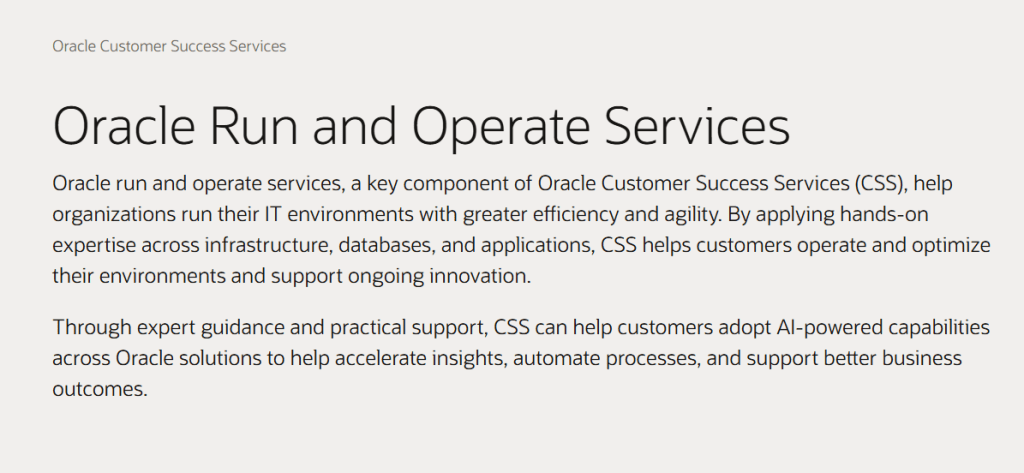
Oracle’s Operate services help organisations run their Oracle technology more efficiently by giving them hands‑on expertise across infrastructure, databases, and applications, while also opening the door to AI‑powered capabilities that streamline day‑to‑day work and support better decision‑making. The idea is simple: free up your internal teams to focus on innovation and higher‑value work, while Oracle takes care of the smooth running, optimisation, and ongoing evolution of your cloud environment. It’s a practical way to stay agile, reduce operational risk, and get more from your Oracle investment.

Oracle’s Innovate services are all about helping organisations adopt new Oracle capabilities quickly and confidently. They combine expert guidance, proven best practices, and time‑saving automation to speed up transformation and make the whole process feel far more manageable. Because these services are closely connected with Oracle Product Development, and delivered in collaboration with partners, customers get the support they need to embrace AI‑powered features, modern cloud technologies, and continuous improvement across their Oracle estate. The goal is simple: reduce risk, shorten implementation timelines, and ensure organisations can unlock long‑term value and innovation from their Oracle investments, all while keeping pace with fast‑changing business demands.

I love that Oracle has pulled together a complete toolkit across Applications, Data, and Infrastructure to support organisations on their AI journey. I keep a close eye on what others in the market are doing, and time and again it feels like Oracle is ahead, not just in delivering the technology, but in giving customers the tools and guidance they need to get real value from it. I’m genuinely excited to hear more about AI Factory and see what comes next. If you’re interested in exploring how it could help your organisation, now’s the perfect time to start the conversation.

Please note all screenshots are the property of Oracle and are used according to their Copyright Guidelines