
If you’ve been working in Oracle Cloud for any length of time, you’ll know that data governance quality determines the quality of everything downstream. Reports, forecasts, consolidations, AI outputs: they’re all only as good as the master data behind them. Following the EDM London Spotlight I attended, here’s where the product stands and where it’s heading.
What EDM is (and isn’t)
The naming matters. EDM is “Enterprise Data” Management, not Enterprise “Data Management.” It’s not a database tool or storage layer. It’s a governed system of reference for managing the data that describes your enterprise: hierarchies, dimensions, master data, reference data, data maps, taxonomies, reporting structures.
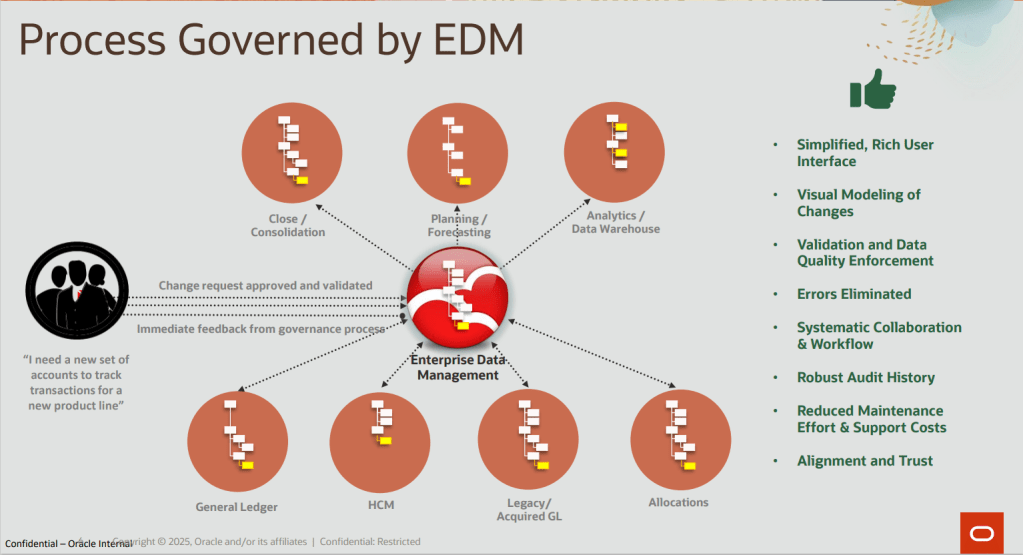
The problem it solves is one most Oracle customers will recognise. Without EDM, a chart of accounts change request starts with an email to IT, fans out to half a dozen application admins, and ends somewhere between a hierarchy mismatch in Planning and a data kickout in Financial Consolidation and Close (FCC). No audit trail, no systematic workflow, no single point of control. EDM replaces that with a governed, collaborative process where changes are requested, validated, approved, and propagated in a controlled sequence.
EDM versus Oracle DRM
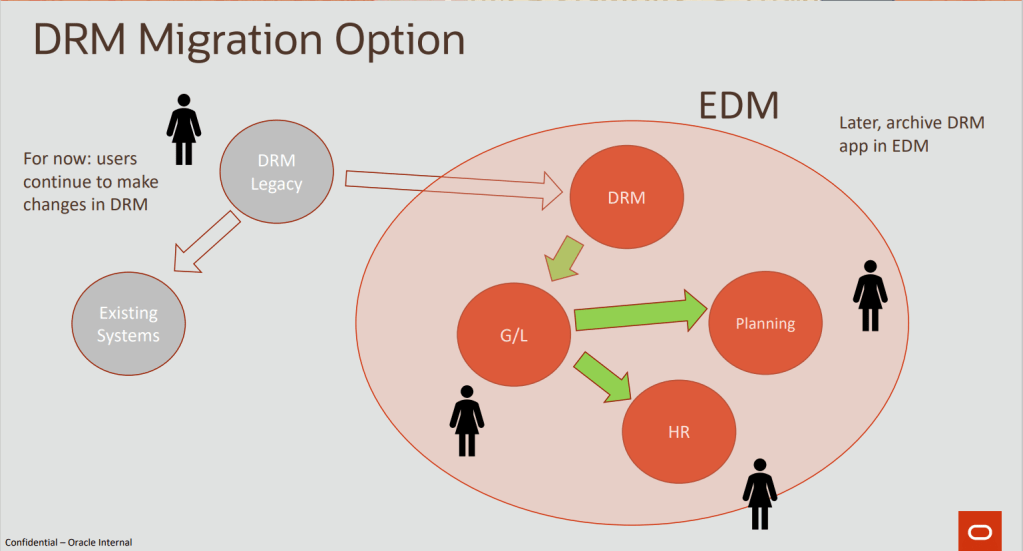
DRM was built for waterfall implementation: gather requirements, build the model, deliver, train, repeat. EDM is designed for an agile, incremental approach. Turn it on, start using it, add rules and policies as they become evident. The traditional MDM big-bang approach has a well-documented failure rate, and EDM’s application-centric model sidesteps it. You start with one application, demonstrate value, and grow from there. New applications are onboarded incrementally without disrupting what’s already in place. For organisations still on DRM, the migration path is practical: users continue in DRM while it’s registered inside EDM as an application, and the legacy system is archived once the transition is complete.
Implementation design patterns
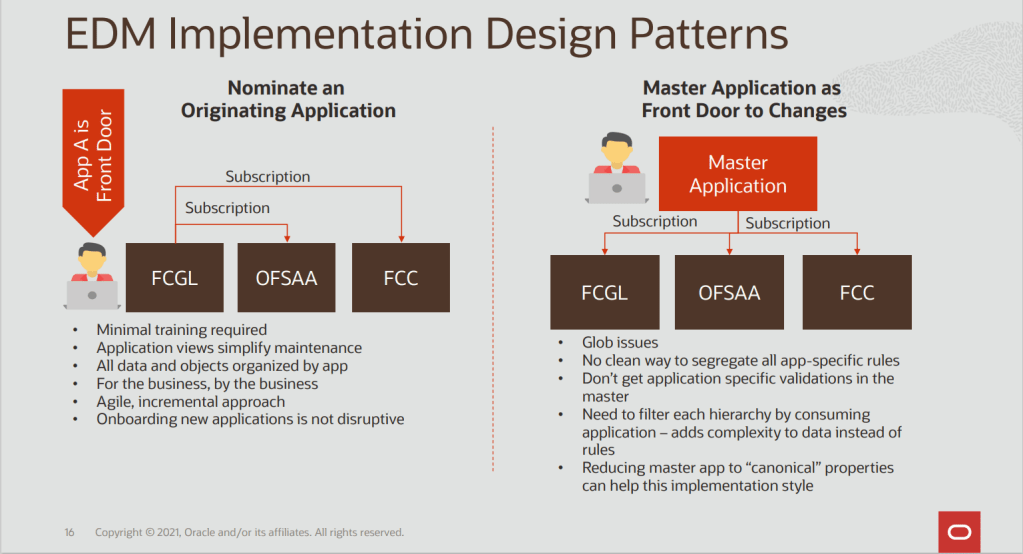
The London session was clear on which pattern works best. Nominate an originating application rather than using a master application as the front door to all changes. The originating application pattern keeps data, objects, and validations scoped to the application that owns them. Downstream applications subscribe to changes. This avoids the problem where a single undifferentiated data model makes it impossible to isolate which rules belong to which application. The master application pattern can work if you reduce it to canonical properties only, but it adds complexity and makes onboarding new applications more disruptive.
EDM and AI
Oracle’s AI approach in EDM operates at two levels.
Internal assistants work within EDM’s existing request and approval model. The Registration Assistant (25.12) generates application metadata and configuration artefacts from a sample data file, accelerating new application setup considerably. The Conversational Request Assistant lets users query master data in natural language, ask questions about existing requests, and generate bulk update actions, all within normal governance controls. Future internal assistants on the roadmap include a Data Profiling Assistant and a Data Matching Assistant using hybrid string, fuzzy, and semantic match rules.
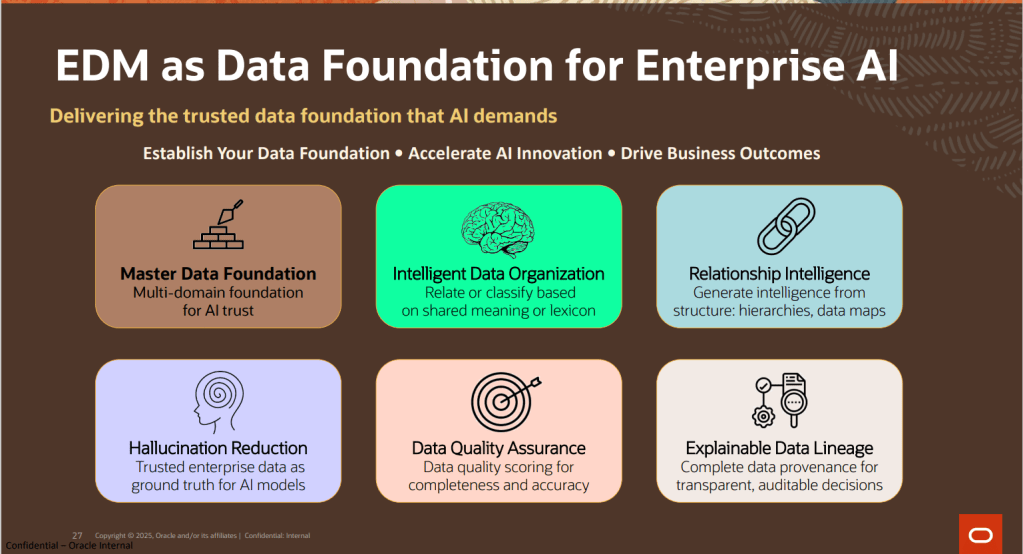
Foundational data governance for AI is arguably the most consequential angle. When enterprise data objects lack clear intent in their descriptions, AI models infer incorrectly. Conflicting hierarchies across ERP, EPM, SCM, and HCM produce inconsistent answers. EDM’s governed descriptions, properties, hierarchies, and cross-application mappings become the ground truth that AI models rely on, reducing hallucination risk and making outputs auditable. If your organisation is investing in enterprise AI, getting master data governance right isn’t optional preparation: it’s what determines whether your AI outputs are trustworthy.
Multi-domain MDM and the roadmap
EDM was built domain-agnostic from day one, which is a genuine competitive differentiator. Competitors largely started in a single domain and expanded. EDM covers Party, Product, Location, Finance, and other domains natively. For Fusion ERP customers, CDM (Customer Data Management) remains the right starting point for mastering customer party records. EDM enriches those with alternate hierarchies, data maps, and cross-application alignment before distributing to EPM and Analytics. For heterogeneous environments with multiple Salesforce instances across regions, EDM can act as the central master customer data hub.
If your Oracle Cloud implementation hasn’t included an EDM conversation yet, it probably should. And if you’re planning an AI initiative on top of Oracle Fusion, EDM is where the trusted data foundation that makes AI outputs reliable actually gets built.
Please note all screenshots are the property of Oracle and are used according to their Copyright Guidelines

 K8 Mead