
It’s my favourite time of the quarter, Oracle has just shared what’s coming in release 26B. I don’t usually write about the Common Features releases, but this is where the really exciting developments for AI Agent Studio tend to appear, and this update is no exception. As ever, more features may follow later in the month, but for now let’s take a look at what’s been announced so far.
AI Agent Studio now supports the creation of agentic apps, bringing together multiple specialised AI agents to deliver a single, seamless user experience. Rather than relying on one general‑purpose agent, organisations can combine task‑focused agents such as Sales, Inventory or Finance, each with its own context and reasoning, to provide deeper insights and more relevant actions. This modular approach makes it easy to scale and evolve apps over time, while enabling them to analyse information, prioritise activities and recommend actions that help drive the business forward.
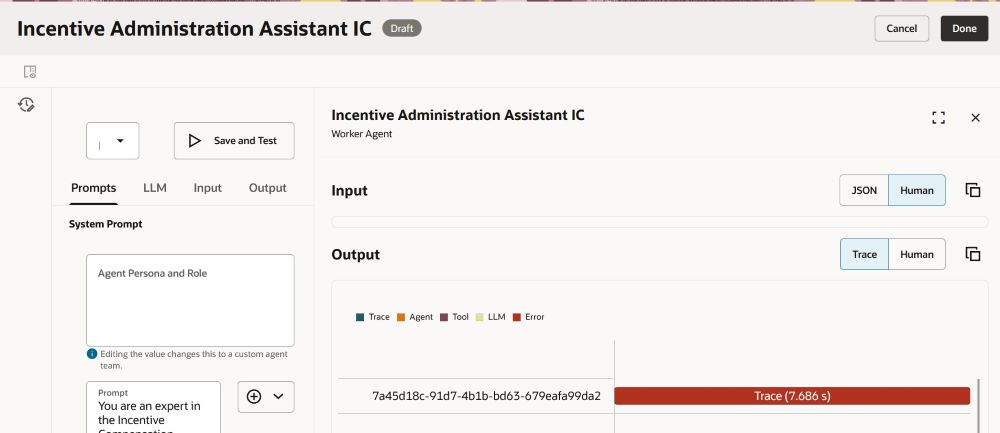
The new Playground capability in AI Agent Studio makes it much quicker, and safer, to refine and validate custom AI Agents by letting you edit and test individual parts of an agent team directly in the studio, rather than running the entire end‑to‑end flow each time. You can isolate specific nodes (including supervisor, agent and LLM nodes), tune prompts and parameters, and see results immediately using Save and Run, with dynamic prompt insertion to add expressions on the fly and Run History to track changes. In practice, this shortens the build–test cycle, improves quality control, and gives teams far more confidence when creating and evolving custom AI Agents because they can verify behaviour in real time before publishing. I’m really looking forward to this one!
AI Agent Studio now includes a set of Oracle‑managed, predefined topics that can be applied across agents and agent teams to help deliver more consistent and professional interactions. These topics support areas such as professional voice and tone, age‑neutral language and gender‑neutral responses, automatically shaping outputs to be appropriate, inclusive and business‑ready. By applying these topics directly within agents and nodes, organisations can accelerate agent design while increasing confidence that responses align with expected standards and organisational values.
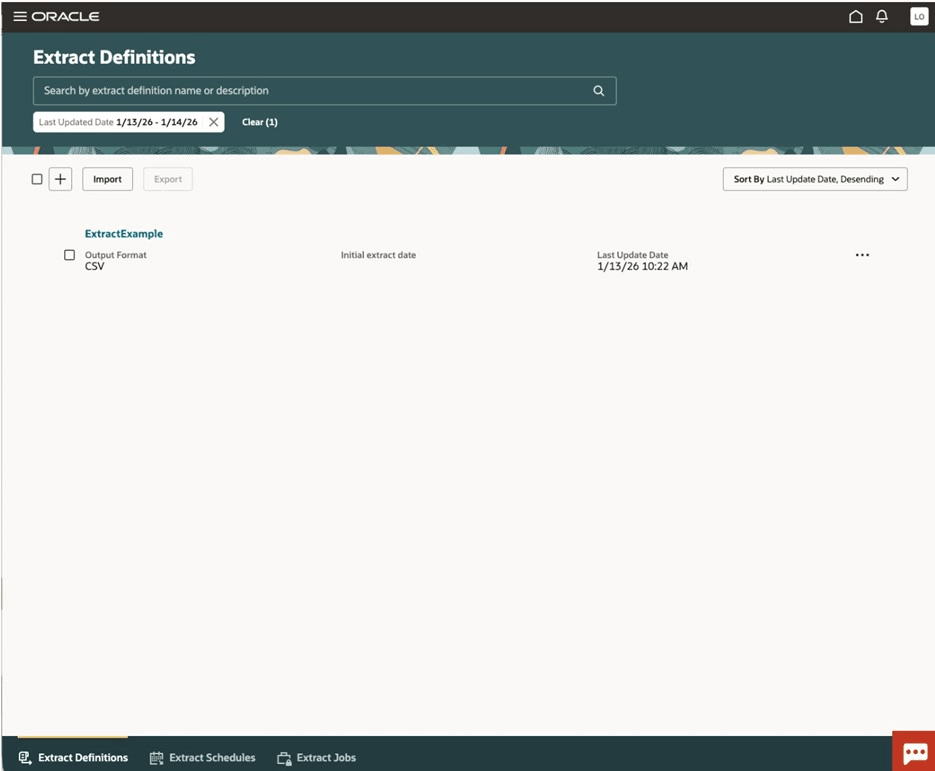
The final feature isn’t an AI one, but a integration change. This Redwood enhancement enables faster and more reliable data extraction by shifting reporting and integration workloads away from the transactional system and onto a read‑optimised replica, synchronised in near real time. By extracting data from a replicated Autonomous Data Warehouse, organisations can reduce load on live Fusion applications while benefiting from a modern architecture that abstracts business objects from the underlying data model. To support this, specific security changes are required, including enabling the external application integration profile option, assigning new extract and scheduling privileges, and granting roles to allow users to manage extracts and securely view or download files, ensuring controlled access to this high‑performance data extraction capability.
As noted earlier, Oracle may introduce further Common Features later this month. If any of these updates stand out, I’ll share a follow‑up blog covering the highlights. In the meantime, you might like to read my latest post exploring the new Core HR features in Release 26B, which you can find here.
Please note all screenshots are the property of Oracle and are used according to their Copyright Guidelines

 K8 Mead