
I’m writing this from Oracle AI World in London today, where Oracle has just unveiled its new Agentic Applications for Oracle Fusion Cloud. It’s genuinely one of the biggest announcements we’ve seen in quite some time. These aren’t early ideas or future promises, they’re real applications, with names, availability details, defined process areas and clear outcomes for customers. Here’s a quick look at what matters and why it’s worth paying attention to.
Oracle’s message today is pretty clear: traditional enterprise systems may hold vast amounts of information, but they don’t genuinely understand it. They capture data, store it, and generate reports, but it’s always been down to people to interpret what’s happening and drive the next step. Agentic Applications change that. They bring reasoning, context awareness and prioritisation into the flow of work, acting within your existing governance and security boundaries without needing constant, step‑by‑step direction.
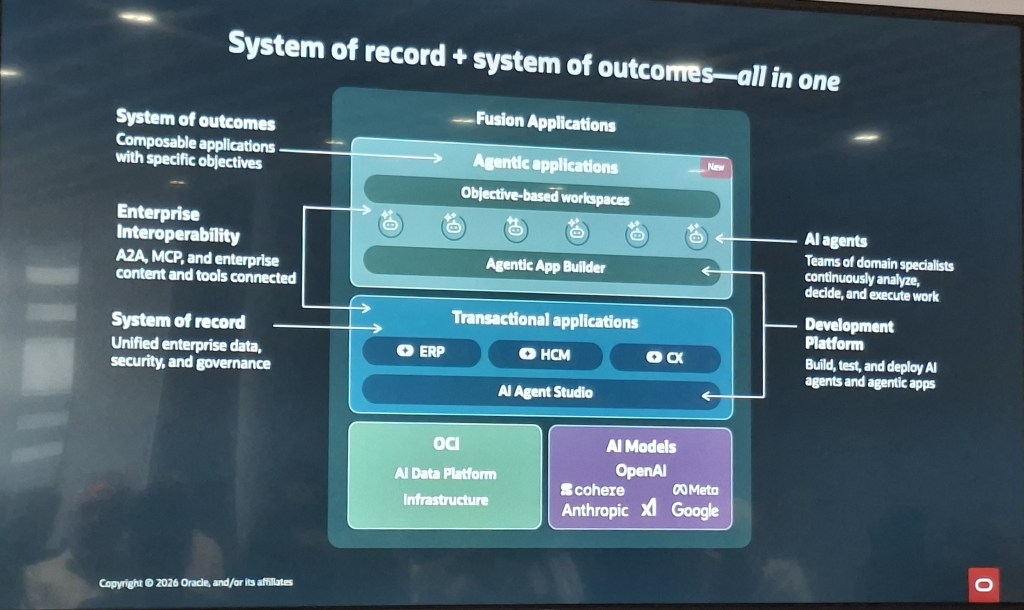
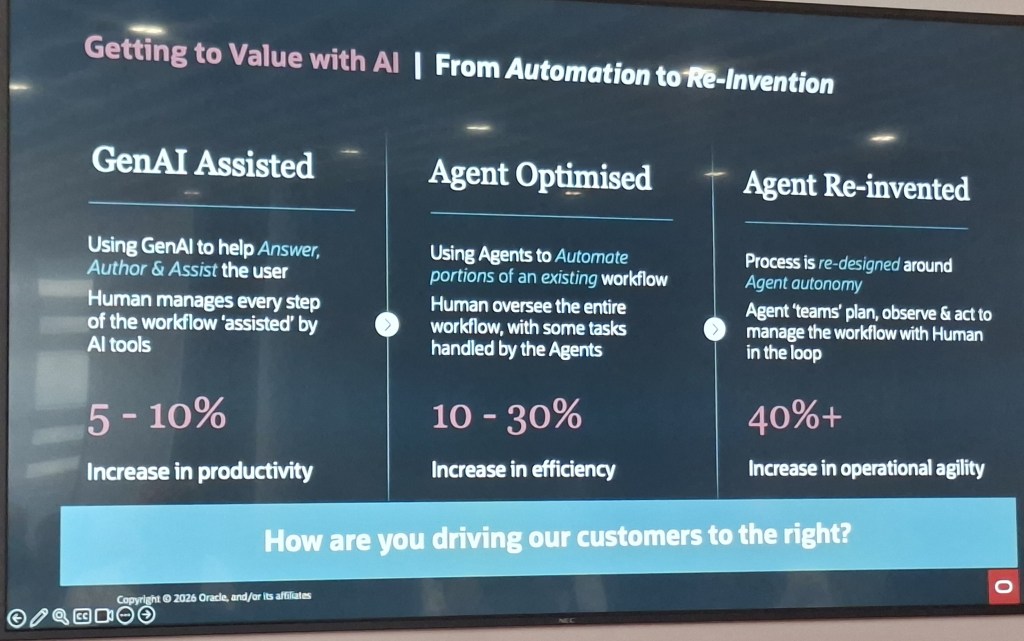
In this updated architecture, Oracle positions Agentic Applications in a new, composable layer above the existing Fusion transactional systems, ERP, HCM and CX. Beneath that, they can tap into a broad set of LLMs from OpenAI, Cohere, Meta, Anthropic, xAI and Google. At the centre is Oracle AI Agent Studio, which provides the development and configuration layer that connects everything together. Oracle also introduced a helpful maturity model: GenAI Assisted, delivering around a 5–10% productivity uplift; Agent Optimised, offering 10–30% efficiency gains; and Agent Re‑invented, where processes are re‑designed around autonomous agents and Oracle is seeing improvements of 40% or more in operational agility.
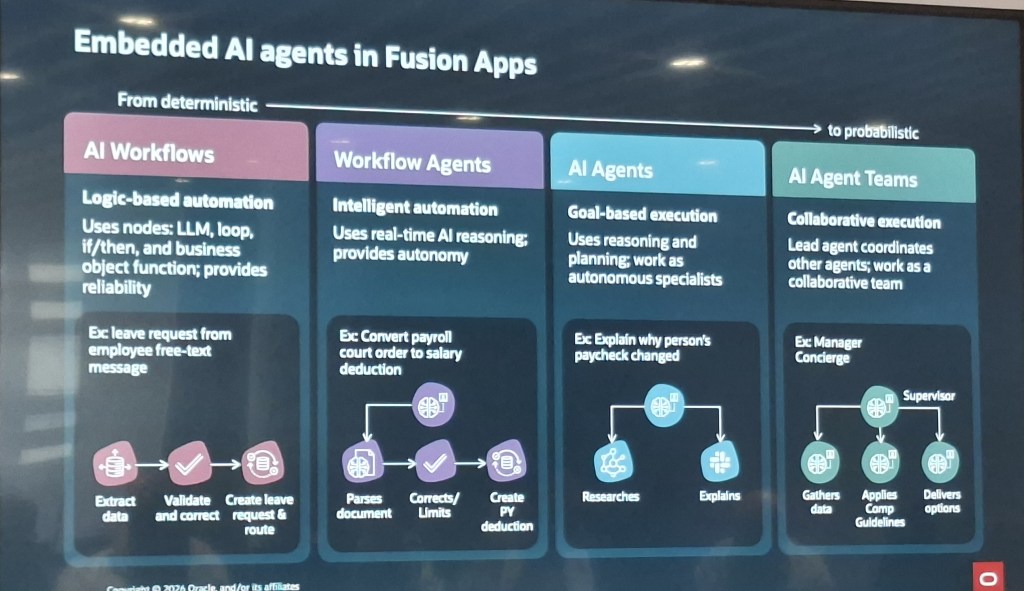
Oracle was also keen to emphasise that not all AI in Fusion is created equal. There’s a spectrum that runs from AI Workflows, logic‑driven automation using LLM nodes, loops and if/then conditions, through to Workflow Agents, which introduce real‑time reasoning and greater autonomy. Above that sit AI Agents, which are goal‑based, specialised and able to operate more independently, and AI Agent Teams, where a lead agent coordinates several specialist agents working together. Each step up the ladder trades a little predictability for far greater capability. For anyone who’s spent years configuring Oracle, the workflow layer will feel familiar, but the agentic layers above it represent genuinely new behaviour.
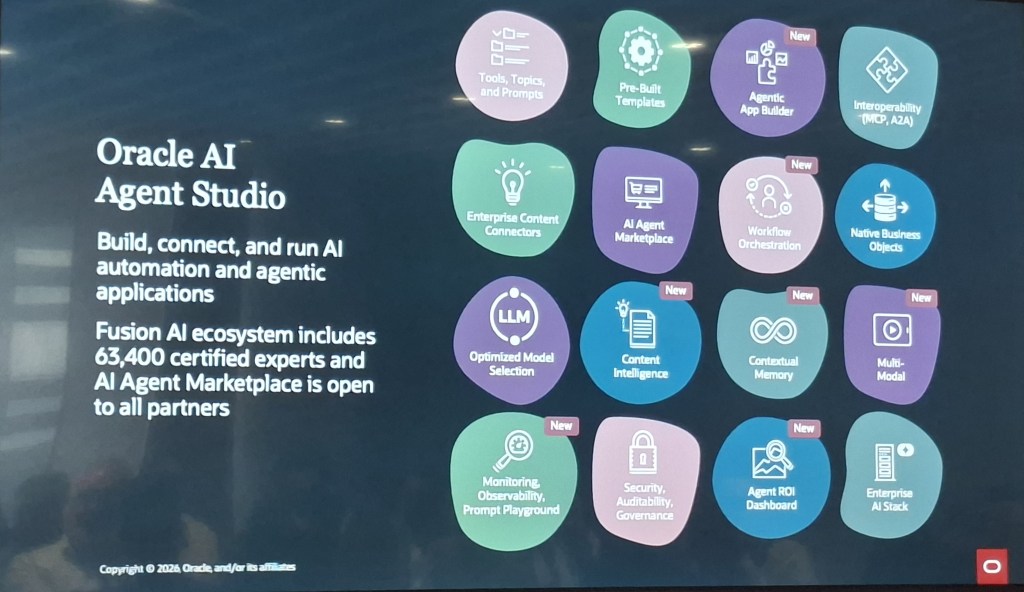
Oracle also announced a set of new capabilities today, including an Agentic App Builder, interoperability through MCP (Model Context Protocol) and A2A (Agent‑to‑Agent) protocols, Contextual Memory, Content Intelligence, multi‑modal support, an Agent ROI Dashboard, and a full suite of security, audit and governance controls. The standout is the Agentic App Builder: you simply describe your objective in natural language and the system assembles reusable agents and workflows into a composable agentic application.
One final announcement that will please a lot of customers: Oracle has simplified its agent pricing. The old split between Seeded Agents (Oracle‑built) and Custom Agents has been removed. If you use Oracle’s standard LLMs, every agent, irrelevant of who has built it, is now free. Premium third‑party LLMs such as OpenAI or Anthropic come with a straightforward consumption‑based charge. Every Fusion customer also receives a monthly allocation of 20,000 AI Units (AUs), with unused units rolling over until the end of the contract term. For organisations that have held back on AI because of cost uncertainty, that barrier has effectively disappeared.
Please note all screenshots are the property of Oracle and are used according to their Copyright Guidelines
 K8 Mead