Oracle Guided Learning Partner Forum Key Learnings

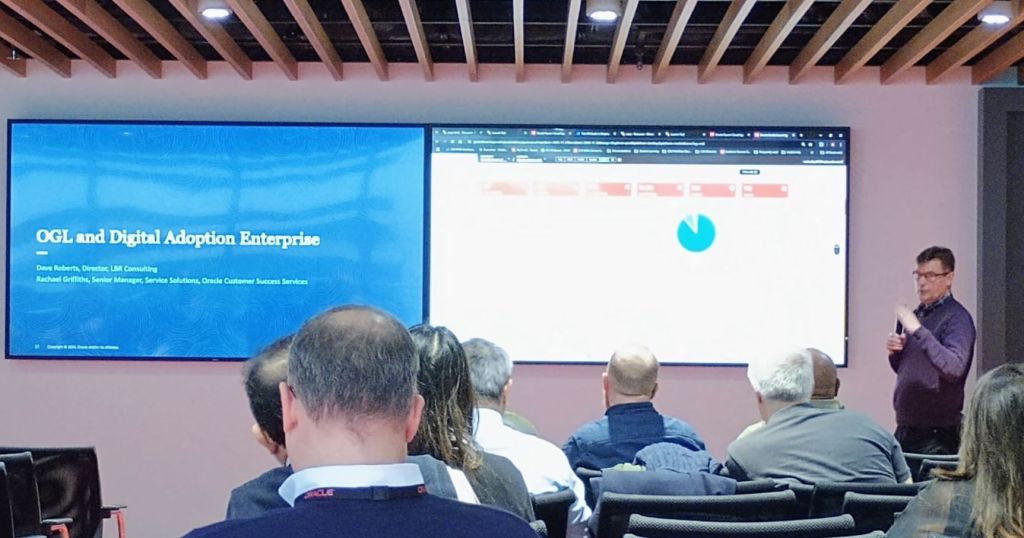
Today I was fortunate enough to attend an Oracle Partner event on Oracle Guided Learning (OGL) in London. Unfortunately due to an issue, the tube was closed and I missed the first hour of the day. Despite this, it was a really interesting day and I’ve learned so much.

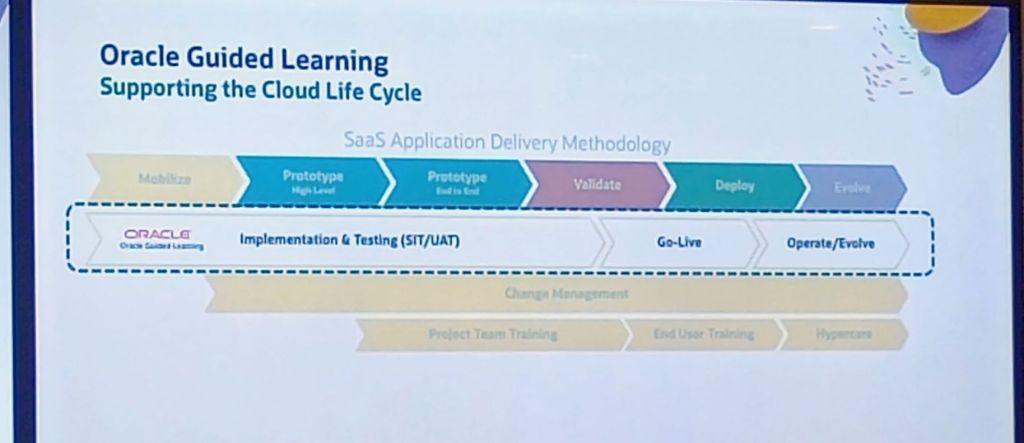
Whilst I already knew what a multifaceted product OGL is, I didn’t realise the full breadth of it’s functionality. The capabilities of the package of OGL, Digital Assistant and Journeys is phenomenal!

OGL can drive users to and through a Journey or use of Digital Assistant. Likewise, Journeys and Digital Assistant can drive users to OGL. For example OGL could be used to support a new user through their onboarding Journey.

Smart Tips can be added throughout pages to explain the purpose for fields. For example a Smart Tip could be added next to sensitive data fields such as Diversity data to explain why the organisation is collecting this data and what it will be used for.

Another useful function of OGL is the ability to add notes on a field. For example if you know there is an issue with the configuration of a particular action such as entering a maternity absence, a message could be added on the absence entry page warning of the issue. This would ensure that everyone who needs to add a maternity absence will be aware of the issue without the need for an organisation wide communication. The message can be updated to reflect it’s current status.

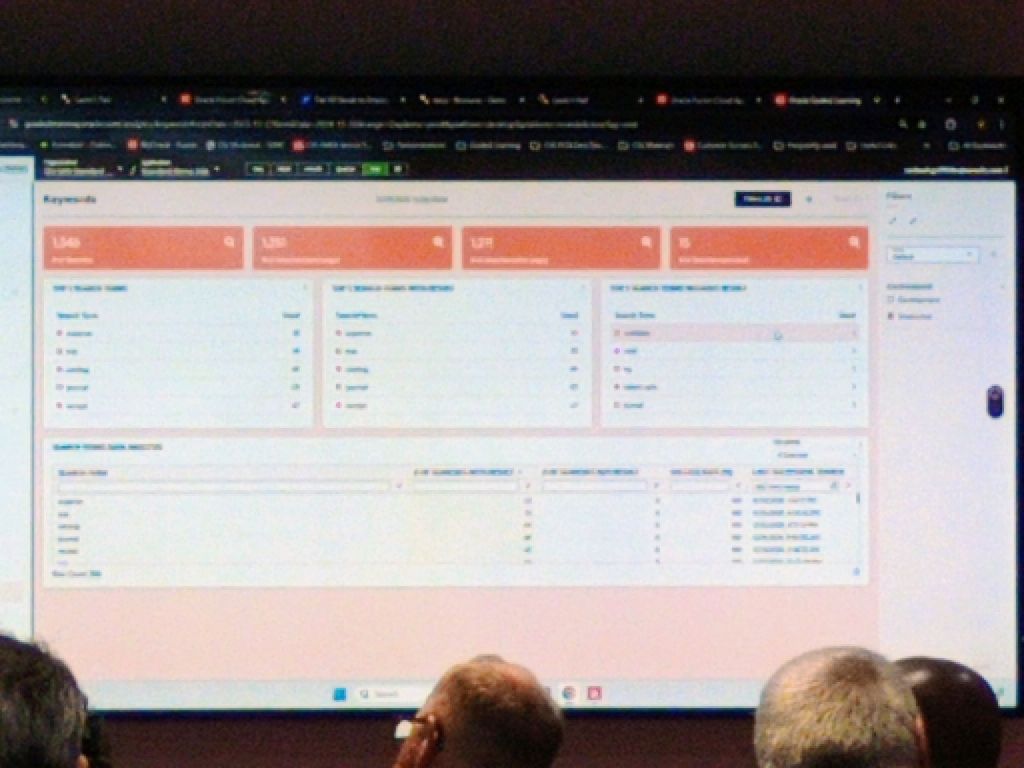
OGL has embedded analytics which allows for reporting on key search terms and how long has been spent on a particular transaction, amongst other items of data. This helps to highlight what users are searching for and might drive to the development of additional guides.

Unlike other Digital Learning platforms, OGL uses JavaScript and works within the browser, without the need for a plugin to be added to the browser. Previously when OGL was used with EPM, it did require a browser plugin but this has been resolved and is no longer the case.

Whilst OGL is an Oracle product, it can be used for third party and non-SaaS products. Each third-party product would need to be reviewed with the OGL team, but many uses have already been developed.

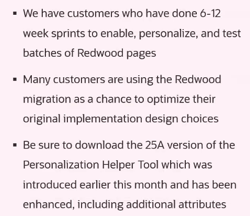
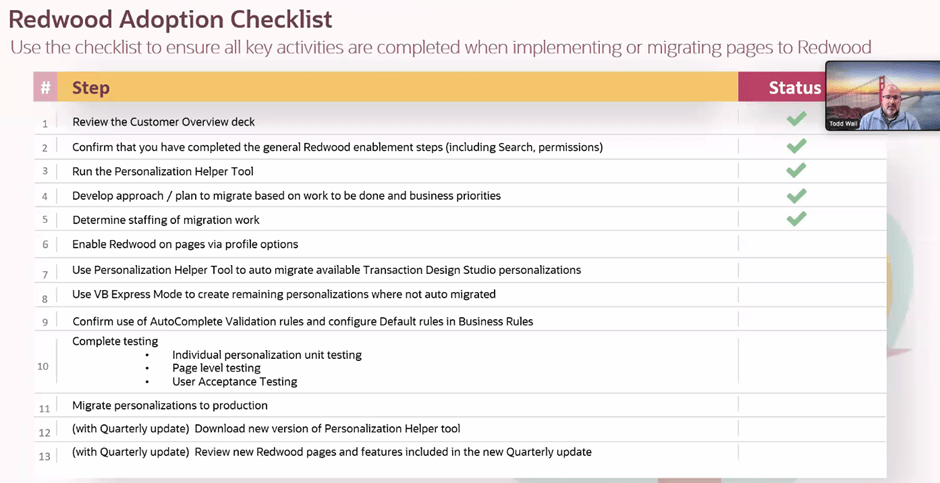
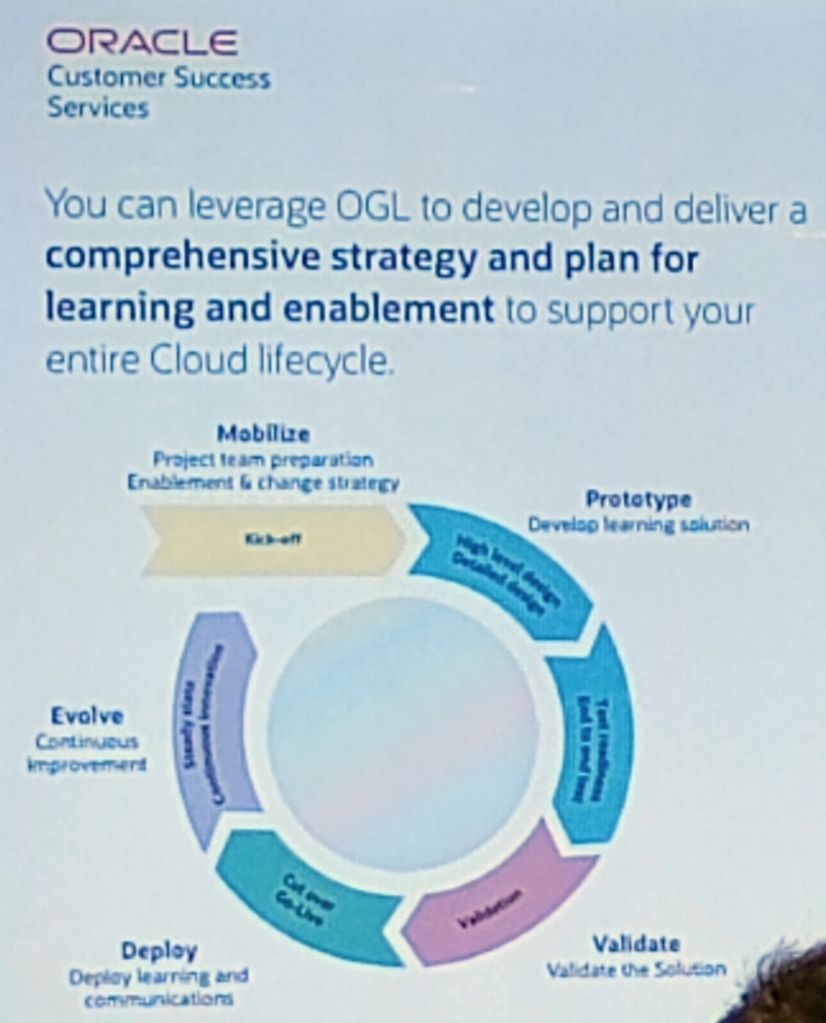
OGL is not just a training tool, it helps users with managing change. If an employee has been promoted and now is a Line Manager, giving them more responsibilities within the system, OGL can help with this! It can be used with (or without) a Journey to walk the user through their new responsibilities and functionality. Another key use can be for communicating changes brought by the introduction of Redwood. Smart Tips can be used to show where fields have moved to or the new process within the Redwood pages.

My absolute favourite part of OGL is the Auto Guide Recorder. The Recorder will do what the name says, record all of the steps followed, clicks made, keys typed to record the process. It is no more complicated that clicking through the steps that would typically be followed. Once this is recorded, the comments, Smart Tips and all other content can be added. This makes the creation of Guides much easier and quicker.

About the Author:

Kate Mead is an Oracle-certified HCM Consultant and Solution Architect at Version 1 with 14 years of experience in Oracle HR and Payroll systems, including 7 years with Oracle HCM Cloud. She has worked across implementation projects and managed services, has a sound knowledge of UK Payroll legislation and — before becoming a consultant — was an HR Manager.

If you have any questions or would like more information on how Version 1 can help you realise the full potential of your Oracle Cloud instances, please contact her at kate.mead@version1.com

Please note all screenshots are the property of Oracle and are used according to their Copyright Guidelines.

Updated Redwood Timelines

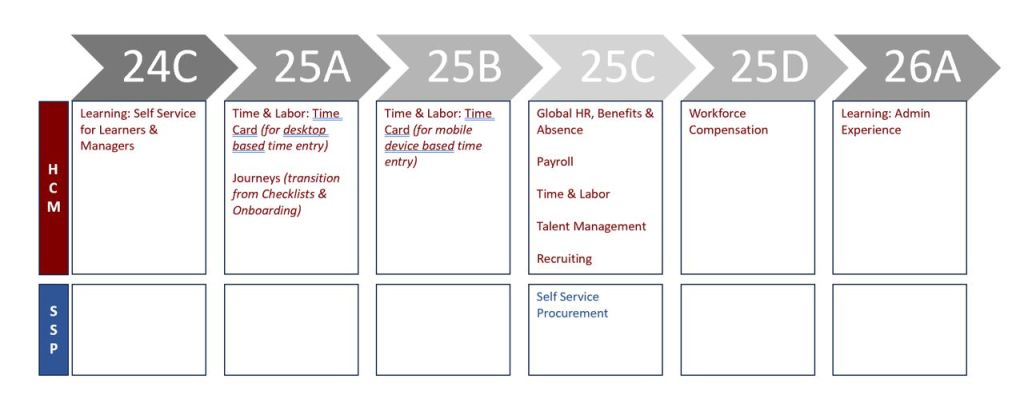
Oracle have made a slight change to the Redwood Timelines that were announced in August. Whilst it is not a significant change, there has been a separation of the deadlines for moving timecards to Redwood.

Those who complete timecards on a desktop / laptop, will still need to migrate to Redwood timecards by release 25A. The change is for those who complete timecards on a mobile device, have a little longer to make the move to Redwood. This has been pushed out to release 25B to give more time to make the necessary changes.

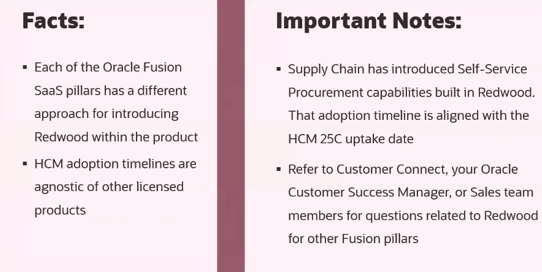
All other dates remain the same. The initial focus is Redwood Journeys and Redwood Timecards for desktop users. These are all mandatory in release 25A. The first deadline in the Procurement area is Self Service Procurement in release 25C.

About the Author:

Kate Mead is an Oracle-certified HCM Consultant and Solution Architect at Version 1 with 14 years of experience in Oracle HR and Payroll systems, including 7 years with Oracle HCM Cloud. She has worked across implementation projects and managed services, has a sound knowledge of UK Payroll legislation and — before becoming a consultant — was an HR Manager.

If you have any questions or would like more information on how Version 1 can help you realise the full potential of your Oracle Cloud instances, please contact her at kate.mead@version1.com

Please note all screenshots are the property of Oracle and are used according to their Copyright Guidelines

Generative AI in Oracle HCM Cloud

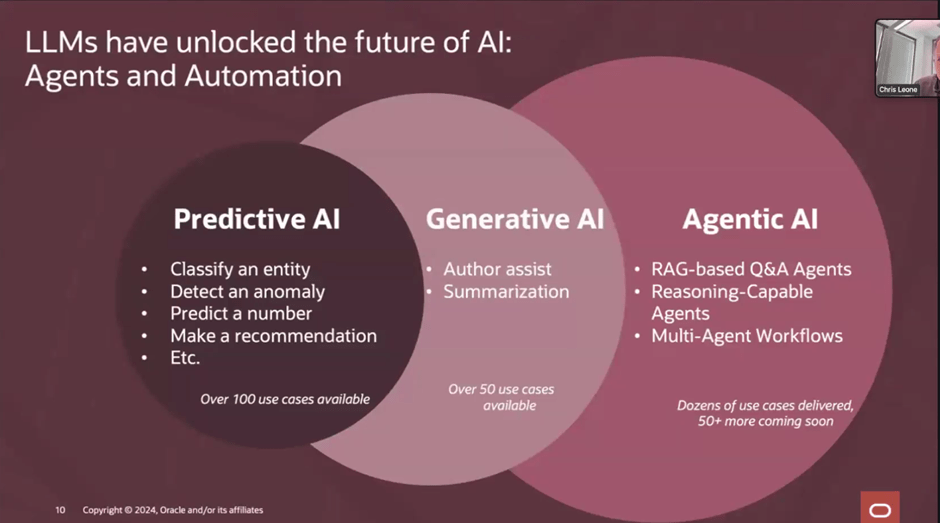
Everyone is talking about AI these days and Oracle is no different! The use of AI within Oracle applications isn’t new – Digital Assistant, Oracle’s chatbot has been in action for a while. Digital Assistant uses ‘skills’ similar to Alexa which are used as a basis for enquiries. Oracle provides seeded skills but custom ones can also be created.

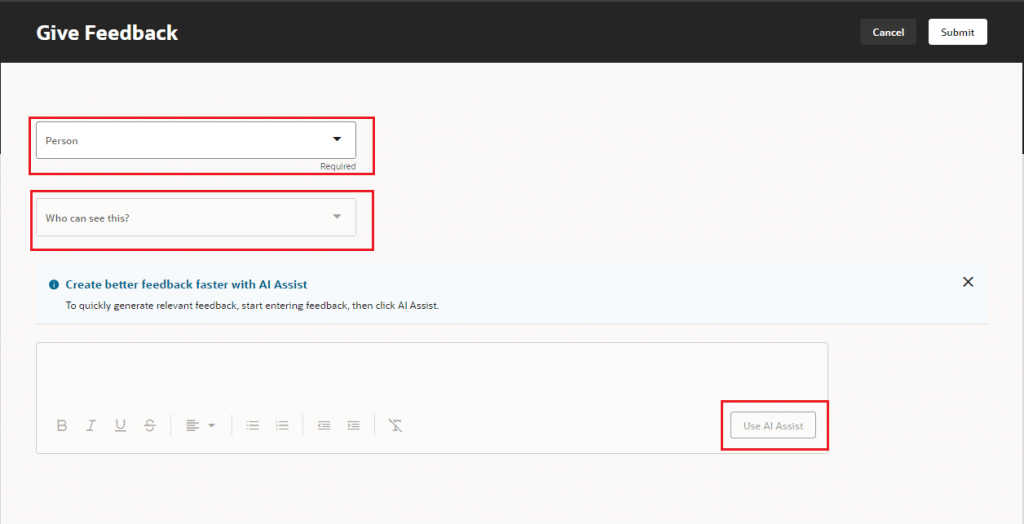
But what about Generative AI or Gen AI? Gen AI uses machine learning to learn patterns from the data and then create content based on it. Oracle have been incorporating Gen AI into HCM Cloud since release 24A. All of the features released require Redwood as they can be activated via VB Studio. Oracle have introduced AI Assist in a lot of applications, although predominantly in the Talent and Performance modules. AI Assist will take the information provided and summarise it. For instance, when a Line Manager reviews all Performance Documents, the AI Assist button will compile and summarise all pertinent performance information for that Employee. This feature saves the manager time by providing an editable summary, designed to enhance efficiency without eliminating the human touch.

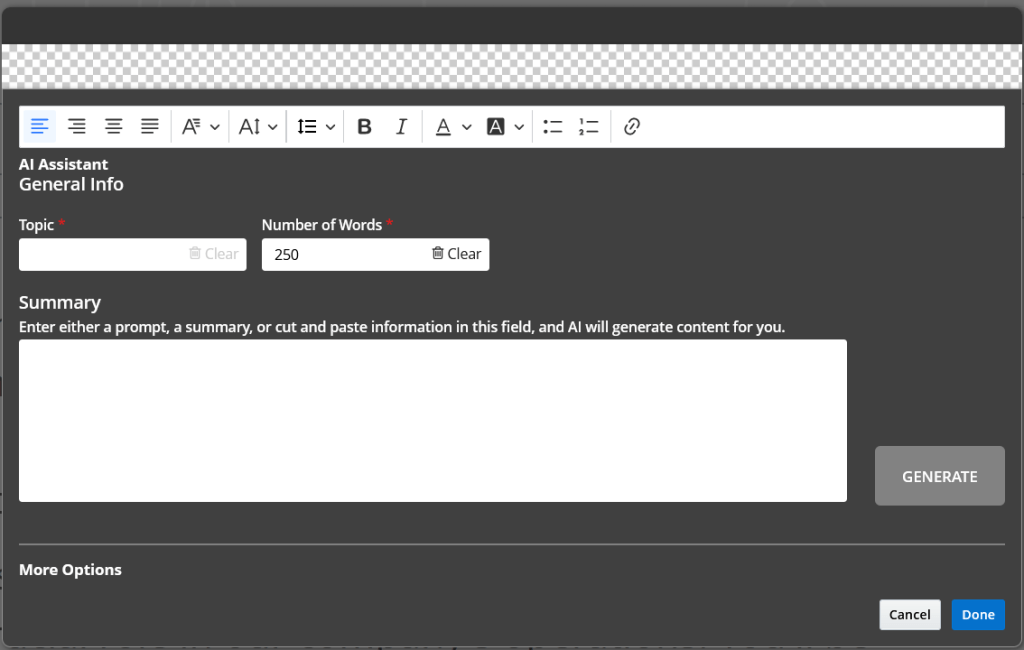
Gen AI is also available in Recruit to help produce content for your Career Site. By populating the topic, how many words you require it to be and a few key terms / words, the AI Assistant will generate the text for you. As with all Gen AI within Oracle, you can tweak the content as much as required, but it will make the process much easier.

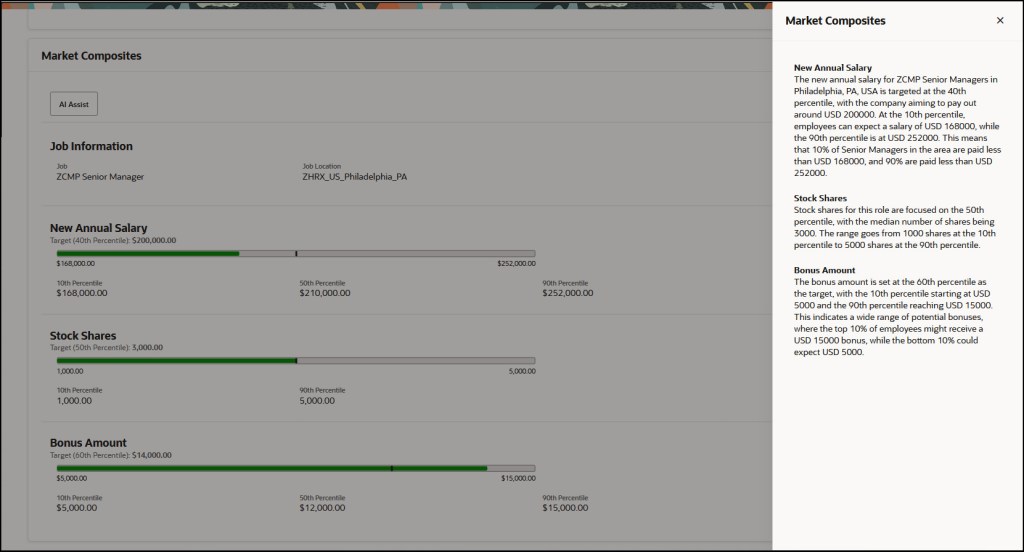
The new AI features continued in 24D, which included the introduction of AI Assistance for Market Composites in Compensation Info. This allows organisations to utilise Gen AI to generate explanations for market composites to Line Managers within the Compensation module. This will help guide the conversations between Line Managers and Employees about the competitiveness of their compensation package.

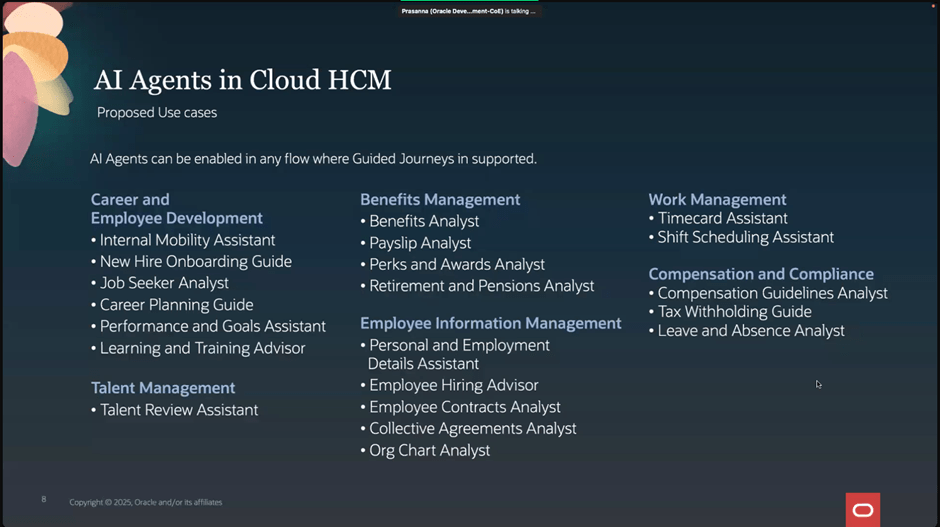
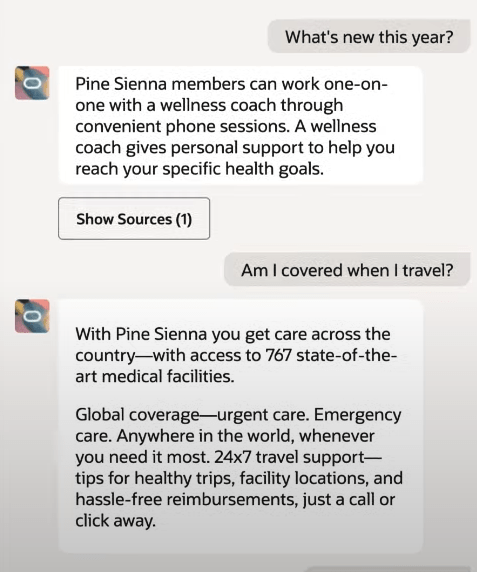
Oracle are constantly working on new use cases for Gen AI. It is anticipated that in 25A, the Benefits Analyst Agent will be available. This will allow Employees and Line Managers to ask the chatbot about available benefits for them, but also question why things have changed etc. It can also link to the sources that it used to determine the response, so the Employee can validate the information, if required.

Oracle is investing heavily in Gen AI and other ways to optimise user’s experience, so there will be more announcements soon. I expect a number of features to be included in 25A, not just the Benefits Analyst Agent. Once they are announced, I will do another post.

About the author:

Kate Mead is an Oracle-certified HCM Consultant and Solution Architect at Version 1 with 14 years of experience in Oracle HR and Payroll systems, including 7 years with Oracle HCM Cloud. She has worked across implementation projects and managed services, has a sound knowledge of UK Payroll legislation and — before becoming a consultant — was an HR Manager.

If you have any questions or would like more information on how Version 1 can help you realise the full potential of your Oracle Cloud instances, please contact her at kate.mead@version1.com

Please note all screenshots are the property of Oracle and are used according to their Copyright Guidelines
Redwood Notifications in Release 24D

Lots of people have asked about the move to Redwood for notifications in release 24D, so I thought I’d better write a blog on it! In several modules, including Compensation, Absence and Recruit, the seeded notifications have moved over to the new Redwood style.

So what does this mean for organisations? If you’re already using Redwood, there is nothing needed to be done. However, what if you’ve not made the move to Redwood yet? Unfortunately it isn’t possible to switch off the Redwood notifications for these modules. There are two options available, firstly to use the notifications as delivered with the Redwood theme applied. Alternatively, create a custom BI notification to replace the seeded Oracle BI notification. It is the specific seeded Oracle BI notifications that have moved to Redwood, rather than all notifications within those modules being in the Redwood toolset.

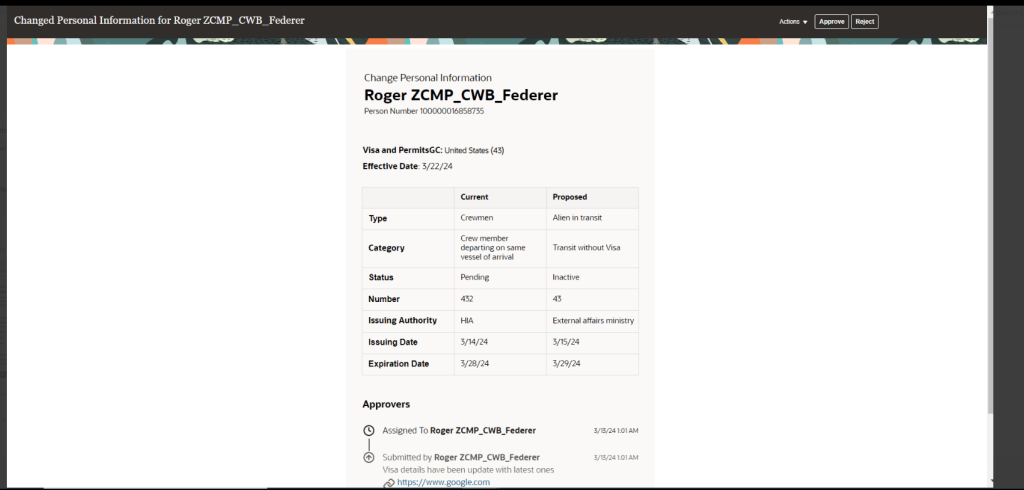
So what do these notifications look like? An example is below, but they are cleaner and easier to read. The actual content hasn’t changed, it is the layout that has.

The only issue is where organisations have a mix of seeded and custom notifications within the modules that have made the move to Redwood notifications. This will mean that some notifications will be in the Redwood look and feel and some won’t. Additionally, where organisations have a mix of modules where some notifications are now in Redwood and some aren’t, they will have the same issue. This will potentially cause confusion with some users, but if I’m honest, the majority are unlikely to notice.

If custom BI notifications have previously been created and they are causing an issue due to the inconsistency of appearance with the mix of Redwood and non-Redwood notifications, it is possible to move the existing custom BI notifications to the Redwood style. If you create a copy of the custom BI notification, the Redwood style will automatically be applied. This can then be set as the active notification.

About the author:

Kate Mead is an Oracle-certified HCM Consultant and Solution Architect at Version 1 with 14 years of experience in Oracle HR and Payroll systems, including 7 years with Oracle HCM Cloud. She has worked across implementation projects and managed services, has a sound knowledge of UK Payroll legislation and — before becoming a consultant — was an HR Manager.

If you have any questions or would like more information on how Version 1 can help you realise the full potential of your Oracle Cloud instances, please contact her at kate.mead@version1.com

Please note all screenshots are the property of Oracle and are used according to their Copyright Guidelines

Welcome to My New Blog!

Hello and welcome to my new blog! To those of you who followed my blog posts on Medium, thank you for joining me here. And to all the new readers, a warm welcome to you as well. I’m thrilled to make this transition and share my insights with everyone, without the need for an account

For those of you who don’t know me, I’m Kate Mead. I am an Oracle certified HCM Consultant with 15 years experience on Oracle HR and Payroll systems, including 8 years with Oracle Cloud HCM. Prior to being a consultant, I was a CIPD Certified HR and Payroll Manager.

I have a deep passion for new technology, especially the latest features within Oracle Fusion/Cloud. I frequently write about Quarterly Releases and new functionalities, including Redwood.

I value your feedback and thoughts on my posts. Please feel free to comment or message me—I’m eager to hear what you think. As always, your comments, likes, and follows are greatly appreciated!

Oracle HCM Cloud Core HR 24D

It’s that time of the quarter again, new features time! If you’re a New Features Nerd like me, I’m sure you’re equally as excited. Despite the date changes with the Redwood timelines, Oracle are still giving us lots of Redwood treats in this Core HR 24D release.

Redwood New Timeline

Originally Journeys and Time Cards were going to be mandatory in 24D, but these have been pushed back to 25A. This gives us a bit more breathing room to move forward in our Redwood journey.

Here are the top 5 new features in Core HR for Release 24D. Please keep in mind that Oracle will continue to roll out additional features throughout the quarter, if there are any subsequent features of note, I will do a follow up blog on these.

Redwood Journey Setup Page

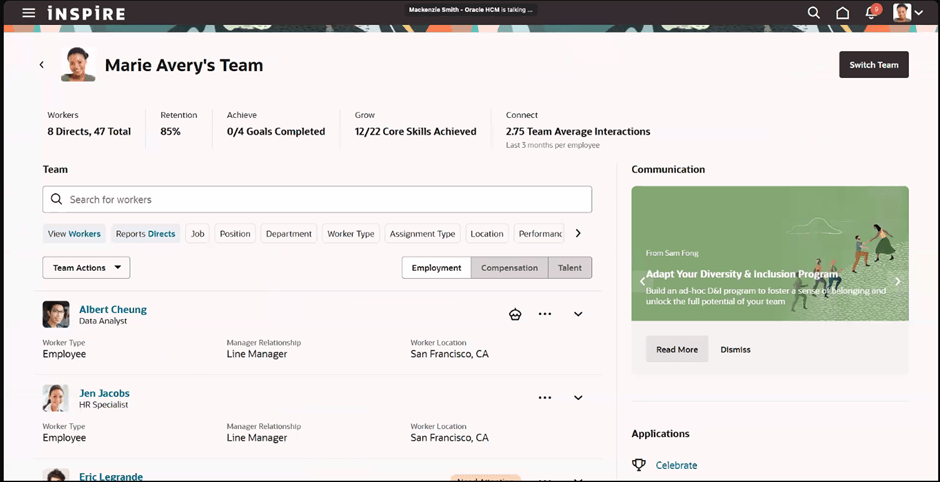
1)Redwood Journey Setup page. It won’t surprise anyone that given the mandatory move to Redwood Journeys in Release 25A, this is a very Journey heavy release. The first key point of note is the new Redwood Journey Setup page. This is the new landing page for anyone wanting to do any configuration relating to Journeys. As part of this, the Journey Templates; Journey Task Groups and Journey Task Libraries have all moved to Redwood.

Redwood Journeys Explore

2) Journeys Available for Non Workers. Keeping on the Journeys theme, I’m delighted that Oracle have now made it possible to assign Journeys to non-workers. Given the push towards the use of Journeys into all areas of Oracle Cloud, particularly SCM and Procurement, this doesn’t come as a large surprise. It does mean that where you have agency workers or Non Exec Directors set up as non-workers, it’s possible to assign Journeys and Journey tasks to them.

Redwood Position Costing

3) Redwood Position Costing. The introduction of position costing to Redwood might be quite a simple change, but it’s something that has been lacking in Redwood positions until now. Many organisations that also use ERP Cloud Financials want to be able to control where the costing of an employee is posted to based on the role they are doing. The introduction of Redwood position costing now allows this. It’s also possible to do split costing by percentage if multiple cost centres need to be charged for the work.

Redwood Pages Delivered Enabled in 24D

4) Redwood Pages Delivered Enabled in Release 24D. As we’re getting closer to the mandatory switch to Redwood pages, Oracle will be delivering certain Redwood pages automatically enabled. In 24D for Core HR there are only 2 pages being delivered switched on, the setup page for Guided Journeys and the Mass Download of Document Records. If you’re not ready for these to be in Redwood yet, they will need to be manually switched off in Manage Administrator Profile Values by setting the profile option to N.

Redwood Default Expense Account in Employment Update Flow

5) Default Expense Account added to Redwood Employment Update Flow. These do need to be configured in the Business Rules area of VBS to be visible, but this is a feature that has been missed by many since Person Management became non-supported. Default Expense Accounts are required before any employee can claim expenses in the ERP Cloud Expenses module. Adding them into the hiring and updating employment flows will minimise the risk of this valuable data not being recorded.

As previously mentioned, Oracle is expected to introduce additional features in Core HR later this month. If these new features prove to be of note, I will create an updated blog post. Stay tuned for blogs covering other modules within HCM Cloud for Release 24D.

Click here to read more about Version 1’s Oracle capabilities.

About the author:

Kate Mead is an Oracle-certified HCM Consultant and Solution Architect at Version 1 with 14 years of experience in Oracle HR and Payroll systems, including 7 years with Oracle HCM Cloud. She has worked across implementation projects and managed services, has a sound knowledge of UK Payroll legislation and — before becoming a consultant — was an HR Manager.

If you have any questions or would like more information on how Version 1 can help you realise the full potential of your Oracle Cloud instances, please contact her at kate.mead@version1.com

Please note all screenshots are the property of Oracle and are used according to their Copyright Guidelines
Oracle HCM Cloud Talent Management 24C

Oracle have announced the new features for Talent Management that are coming in release 24C. As expected, it’s a Redwood heavy one. Given Oracle have recently released the features document, it is likely that more will be added throughout July. Having said that, let’s take a look at the key features announced so far.

Within Goal Management, there have been more functions moved to Redwood. These include the ability to secure goal actions using security privileges. Enabling the configuration of security access on an action by action basis allows organisations to easily manage permissions without complex rules. The key one is the introduction of AI in suggesting Goals for employees based on their previous Performance Review. It uses goal comments; comments in the performance and development goals section or overall summary section of the performance document to generate goal suggestions.

Redwood AI Suggested Goals

Within Performance Management, additional pages have been moved to Redwood. This includes the Performance Documents, Participant Feedback and Performance Eligibility administration pages. The Performance Documents section empowers users to manage existing performance documents and tasks, create new ones, and submit performance-related notifications. Meanwhile, the Participant Feedback page lives up to its name: users can choose a review period and filter by participant, employee, manager, or department to access results. Within these results, specific employees can be searched, and their feedback status for performance documents can be viewed. Lastly, the Performance Eligibility page provides insights into processed eligible performance documents and check-ins for individual employees. Users can also assess an employee’s eligibility for a performance document or check-in that remains unprocessed.

Performance Documents

In Oracle’s 24C release within Profile Management, there hasn’t been a significant number of new features introduced. However, there’s a crucial enhancement that will help during the transition from Responsive to Redwood Profile Management pages. Specifically, field label customisations for the Skills and Qualifications page don’t migrate across. To address this, Oracle have made an update to the Redwood Profile Management page, now you have the ability to tailor the labels on the Profile Types. Although this involves a modest amount of effort, it eliminates the necessity of creating new profile types and transferring data across systems.

Redwood Profile Management — Edit Labels

Within Succession Management, there is only one new feature this release. A new Worker Succession Info quick action has been added for Line Managers and HR Specialists. With this addition, they gain the ability to view essential details related to workers’ succession and talent pools. This encompasses insights such as talent ratings, succession plans for employees, and a comprehensive view of candidates accessible to them. Moreover, they can delve into the talent pools in which an individual is a member, thus facilitating a streamlined succession planning process for both Line Managers and HR professionals.

Worker Succession Info

The latest feature I’d like to highlight is within Talent Review. We now have a new Redwood Talent Review Template configuration page. It incorporates a guided process to easily create and manage Talent Review templates. The page has been reformatted, with each section now residing on a separate tab: General Info, Rating Options, Box Chart Views, Data Options, and Display Options. This layout allows you to focus on the specific area you’re interested in, making it much less cluttered. The General Info tab contains all the necessary information for a talent review template, including the option to include matrix managers as reviewers for meetings created using the template. Additionally, users can indicate whether they want to include succession plans and talent pools in the Talent Review meetings. The Rating Options tab empowers implementers to add ratings that reviewers can use to assess the review population. In the Box Chart Views section, implementers can create multiple XY and single rating views, although box assignments can only be submitted for one XY and one single rating view. The Data Options tab allows for colour-coded options to highlight specific sections and provides a default potential assessment questionnaire for reviewers to rate their reports. Lastly, the Display Options tab enables configuration of colours and shapes for selected risk of loss, impact of loss, or mobility ratings.

Redwood Talent Review Template

As previously mentioned, Oracle is expected to introduce further improvements in the forthcoming 24C Release. Should these features have a significant impact, I will provide an updated blog to share the latest developments and insights. Please check out my blog on the my top 5 new features in Release 24C within Core HR below:

Oracle HCM Cloud Core HR 24C – K8 Mead

Click here to read more about Version 1’s Oracle capabilities.

About the author:

Kate Mead is an Oracle-certified HCM Consultant and Solution Architect at Version 1 with 14 years of experience in Oracle HR and Payroll systems, including 7 years with Oracle HCM Cloud. She has worked across implementation projects and managed services, has a sound knowledge of UK Payroll legislation and — before becoming a consultant — was an HR Manager.

If you have any questions or would like more information on how Version 1 can help you realise the full potential of your Oracle Cloud instances, please contact her at kate.mead@version1.com

Please note all screenshots are the property of Oracle and are used according to their Copyright Guidelines

Oracle HCM Cloud Recruiting 24C

Oracle have announced the new features that will be coming in Release 24C. Given Oracle’s move towards Redwood, it’s not surprising that there are a number of Redwood features for Oracle Recruiting Cloud (ORC) in this release. Whilst there hasn’t been a definitive date announced for when ORC will be mandatory in Redwood, it is likely to be soon and these features are another step on the journey.

The first area that has moved to Redwood is for candidates. Both the Candidate List page and Candidate Details page have moved to the Redwood toolset. The Candidate List page is where you search for candidates. In addition to the functionality that is available in the Responsive pages, there are some new features in the Redwood version. These include a new summary view for the list of Prospect and Event Audience Lists and the addition of new filters for Pool Members, Prospects and Event Audience.

Redwood Candidate List

The Candidate Details page has also moved to Redwood. The layout has changed with the introduction of several tabs. The ‘Details’ tab contains all the candidate’s key information including personal details, CV, previous employment etc. The ‘Screening’ tab lists the completed assessments for the candidate across their job applications. The ‘Messages’ tab shows emails and text messages sent to the candidate. The ‘Activity’ tab shows any system activities related to the candidate, this includes all the requisitions, candidate pools, and events the candidate is associated with. The ‘Similar’ Candidates tab lists candidates who are similar to the candidate you’re viewing.

Redwood Candidate Details

Oracle’s Redwood candidate page now also features AI Assist, a cutting-edge tool designed to streamline communication with candidates. By harnessing artificial intelligence, AI Assist empowers users to quickly compose personalised emails and text messages. Its advanced generative capabilities produce content that is not only ready-to-use but also tailored to the specific topic at hand. To utilise AI Assist, users simply start the process by telling the tool about the subject of their correspondence, and AI Assist takes care of crafting both the subject line and the body of the message with pertinent information.

AI Assist for Redwood Candidate Communication

Recruiting Activity Centre was introduced in Release 23C. One year later and Oracle are continuing to improve it. It is now possible to assign activities to all members of the Recruiting Team, including Collaborators, not just the the Recruiters and Hiring Managers as was the option previously. This change means that you can keep all members of the hiring team up to date on activities and Collaborators can access the Recruiting Activity Centre to view them.

Recruiting Activity Centre — Configuring Assignees for a Recruiting Activity Item

The final feature I want to highlight is a change to the configuration of the Career Site. With the introduction of a dedicated section in the Category Tiles Element, users now have the autonomy to style each category tile on the Career Site individually. This new feature not only allows for a more detailed personalisation but also significantly elevates the site’s aesthetics and enriches the candidate’s journey through the site.

Career Site — Edit an Individual Tile Category

As indicated earlier, Oracle is likely to unveil additional enhancements in the upcoming Release 24C. In the event that these new features prove to be substantial, I will provide an updated blog to share the latest developments and insights. Please check out my blog on the my top 5 new features in Release 24C within Core HR below:

Oracle HCM Cloud Core HR 24C – K8 Mead

Click here to read more about Version 1’s Oracle capabilities.

About the author:

Kate Mead is an Oracle-certified HCM Consultant and Solution Architect at Version 1 with 14 years of experience in Oracle HR and Payroll systems, including 7 years with Oracle HCM Cloud. She has worked across implementation projects and managed services, has a sound knowledge of UK Payroll legislation and — before becoming a consultant — was an HR Manager.

If you have any questions or would like more information on how Version 1 can help you realise the full potential of your Oracle Cloud instances, please contact her at kate.mead@version1.com

Please note all screenshots are the property of Oracle and are used according to their Copyright Guidelines
Oracle HCM Cloud Payroll 24C

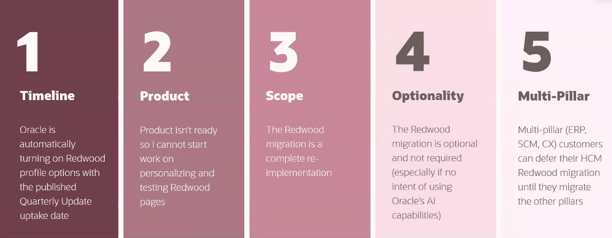
I love new feature announcement time, it’s my favourite time of the quarter! For Release 24C, this is quite a small release for Global Payroll, but that doesn’t make it any less important. With the move to Redwood for all Employee and Management Self Service processes in Release 25B, every new Redwood page released makes the journey to Redwood much easier.

Oracle may announce additional features prior to the release being deployed to Wave 1 customers in August, but I have picked my key new features that have been announced at present. If additional features are announced that will add significant value, I will provide an updated post.

Redwood Payment Results

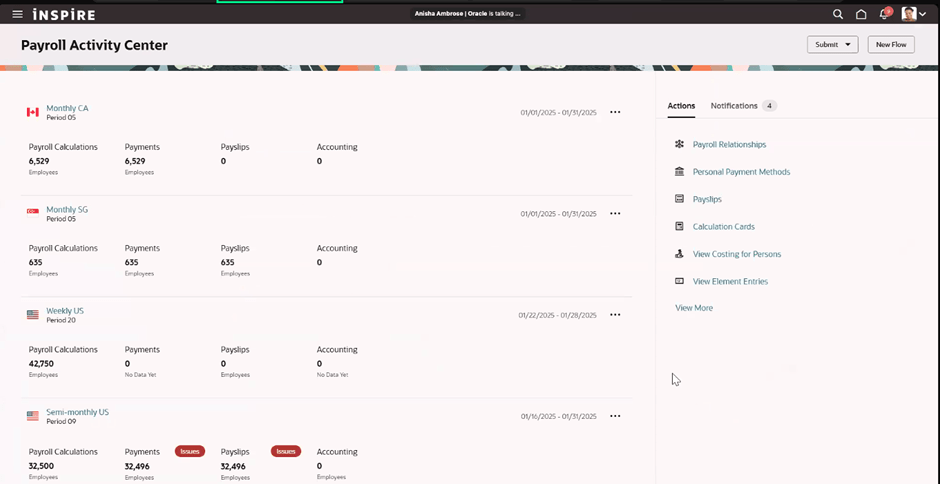
The first page to move to the Redwood toolset in this release is the Payment Results page. This doesn’t just have the Redwood ‘look’, it’s been rewritten in the Redwood toolset from scratch, so has all of the benefits this provides in terms of performance and useability. The page has all the functionality you would expect. Firstly you can view employee payment details: Dive into the specifics of each payroll run, examining payment details for individual employees. Secondly, status tracking: Quickly identify the status of any payment — whether it’s pending, completed, or encountering issues. Thirdly, corrective actions: Based on payment status, take necessary corrective measures effortlessly. Finally, external payments: Execute actions like initiating external payments directly from the page.

Redwood Payroll Flow

The Submit a Flow page has also been moved to the Redwood toolset. As well as submitting payroll flows, you can schedule the submission for a future time and date and view recently submitted flows. It is now possible to use the ‘Linked Flow’ tab to link flows together in an easy, user friendly way. Additionally there is now the functionality to allow the uploading of files using drag and drop, as per the screenshot above. This can be used for single or multiple files. This option only displays on the page if you have defined the flow to allow the upload of files.

Audit Element Security Profiles

For those organisations using Auditing, it is now possible to audit and track the change history of the Element Security Profile. Once the auditing is switched on, any changes made to element security profiles will trigger the audit process and then they will be reported upon. This will ensure that any changes made to the element specific security profiles can be monitored and reported on more easily, which will provide more reassurance to auditors and senior management.

Redwood Person Messages

Another page which has moved to the Redwood toolset is the Person Messages page, which can be accessed via the Person Results application. This page is critical for understanding issues with payroll processes, so the move to Redwood for this is a big step forward. All messages can be searched for, additional details of the message can be viewed and can be exported to Excel.

Redwood Payslip

The final feature I wish to highlight is an update to the existing Redwood Payslip. The Redwood page has now added in the ability to export the payslip. You can select the folder you wish to download it to and it will automatically zip them to minimise storage usage.

As previously stated, Oracle may announce further new features in Release 24C later this month. Should these features demonstrate significance, I shall produce an updated blog. Please check out my blog on the my top 5 new features in Release 24C within Core HR below:

Oracle HCM Cloud Core HR 24C – K8 Mead

Click here to read more about Version 1’s Oracle capabilities.

About the author:

Kate Mead is an Oracle-certified HCM Consultant and Solution Architect at Version 1 with 14 years of experience in Oracle HR and Payroll systems, including 7 years with Oracle HCM Cloud. She has worked across implementation projects and managed services, has a sound knowledge of UK Payroll legislation and — before becoming a consultant — was an HR Manager.

If you have any questions or would like more information on how Version 1 can help you realise the full potential of your Oracle Cloud instances, please contact her at kate.mead@version1.com

Please note all screenshots are the property of Oracle and are used according to their Copyright Guidelines
Oracle HCM Cloud Time & Labor 24C

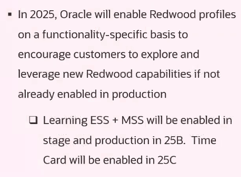
It’s my favourite time of the quarter — new features time! As Redwood Timecards within Time and Labor is mandatory from Release 24D, 24C is a critical one for your journey to Redwood. Check out my recent post on planning your move to Redwood Time and Labor for more details: https://k8mead.com/?p=114


Redwood Timecard

There are a number of updates to the Redwood Timecard, including being able to add row level comments; the ability to sort any of the grid columns on the timecard; the ability to show scheduled hours on the timecard in addition to the recorded time; and finally the ability to resize the timecard in such a way that it will remember it next time you open it on the same device. All of these features are small but are impactful as they will improve the user experience significantly within minimal effort.

Timecard Template

Oracle have now added the functionality to allow you to now save a Redwood timecard as a named template. This template can then be used to create Redwood timecards with the same assignment ID and layout set ID as the template. At present you can save up to 6 templates, but the use of the word ‘currently’ by Oracle implies that this limitation will be amended in the near future. This will make it easier for implementors to create updated timecard templates.

Default On-Call on Redwood Timecard

In a previous release, Oracle introduced the defaulting of Workforce Scheduling on-call shifts. In 24C this has been improved by the introduction of linking the defaulted on-call shifts with assigned workday definitions. Using workday rules, it is now possible to assign the on-call shift to the days specified in the rules. Additionally, if the rules specify on-call shifts but those shifts aren’t worked in the current timecard period, it will automatically assign them to the next timecard period once it’s created. This will reduce the need for manual assigning of on-call shifts but has the added flexibility of using automation to only assigning the payments if that shift is included in the timecard period.

Timecard Approval Notification

Whilst this is a relatively small change, it will make the review of the approval of timecards easier. You can now view approval comments for each completed Redwood timecard approval task from the Bell icon or the email notification. It should be noted that the notification now shows the status, but won’t show the comments, for confidentially reasons. Approvers can see instantly the status of the timecard without having to drill down into the application.

Additional Status on Team Time Cards

The final feature I want to highlight is the introduction of additional statuses on the Redwood Team Timecard. These allow the users to review the processing and transfer statuses for timecards, by their specific role, for example payroll, project costing etc. There is a ‘drawer’ that can be opened to see more details, as shown in the screenshot above. This ensures that the functionality that is currently available in the Responsive Timecards is available in Redwood Timecards, so there is no loss of functionality.

As previously stated, Oracle is anticipated to unveil further enhancements in Release 24C later this month. Should these features demonstrate significance, I shall produce an updated blog. Please check out my blog on the my top 5 new features in Release 24C within Core HR below:

https://k8mead.com/?p=117

Click here to read more about Version 1’s Oracle capabilities.

About the author:

Kate Mead is an Oracle-certified HCM Consultant and Solution Architect at Version 1 with 14 years of experience in Oracle HR and Payroll systems, including 7 years with Oracle HCM Cloud. She has worked across implementation projects and managed services, has a sound knowledge of UK Payroll legislation and — before becoming a consultant — was an HR Manager.

If you have any questions or would like more information on how Version 1 can help you realise the full potential of your Oracle Cloud instances, please contact her at kate.mead@version1.com

Please note all screenshots are the property of Oracle and are used according to their Copyright Guidelines