Beyond the Agent: What Really Powers AI Agent Studio

One of the challenges with talking about AI Agent Studio is that the name can be slightly misleading. People hear the word agent and immediately picture a chatbot, a large language model, or an automated assistant. Whilst those are certainly part of the story, they’re only a small part of it. After spending time exploring Oracle’s latest AI Agent Studio capabilities, I’ve become increasingly convinced that the most important thing Oracle is building isn’t actually the agents themselves. It’s everything around them.

Enterprise AI isn’t difficult because AI models are difficult. Enterprise AI is difficult because organisations need systems that are secure, governed, reliable, testable and capable of operating at scale. Oracle’s latest vision for Agentic Applications reflects this, positioning agents as just one layer within a much broader framework that includes orchestration, security, governance, testing, approvals, connectors and enterprise context. That’s a very different proposition from simply deploying a chatbot.
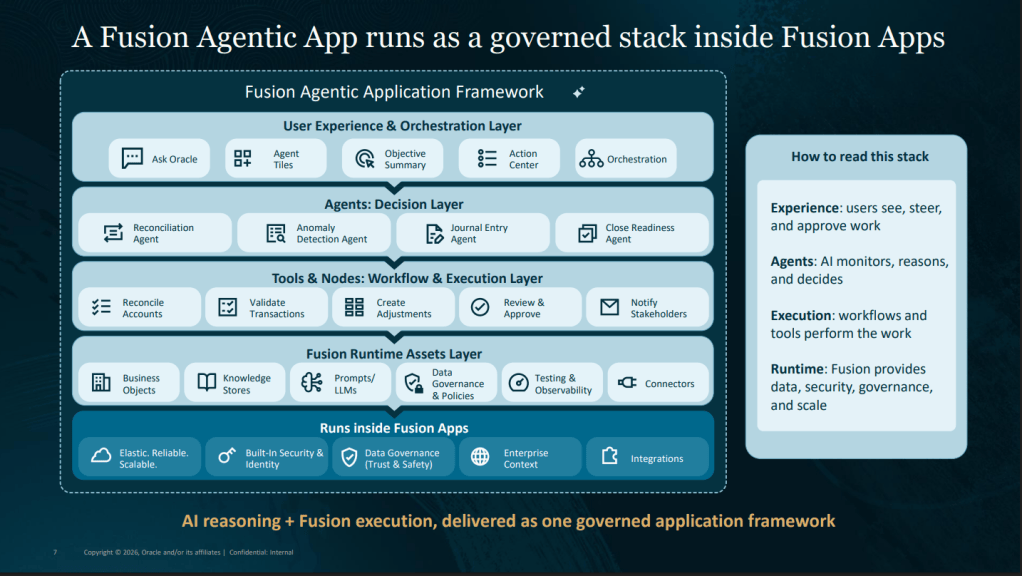
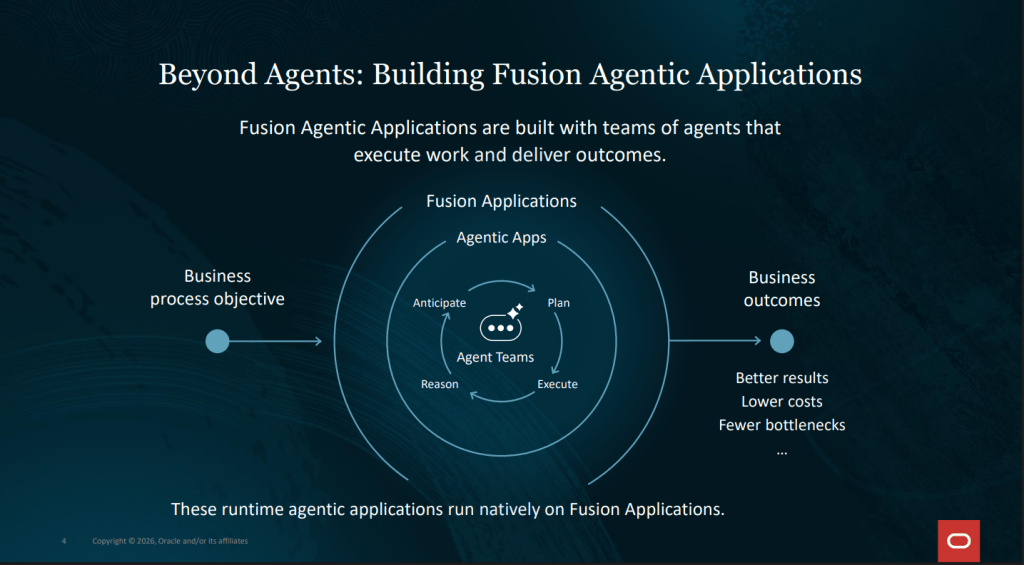
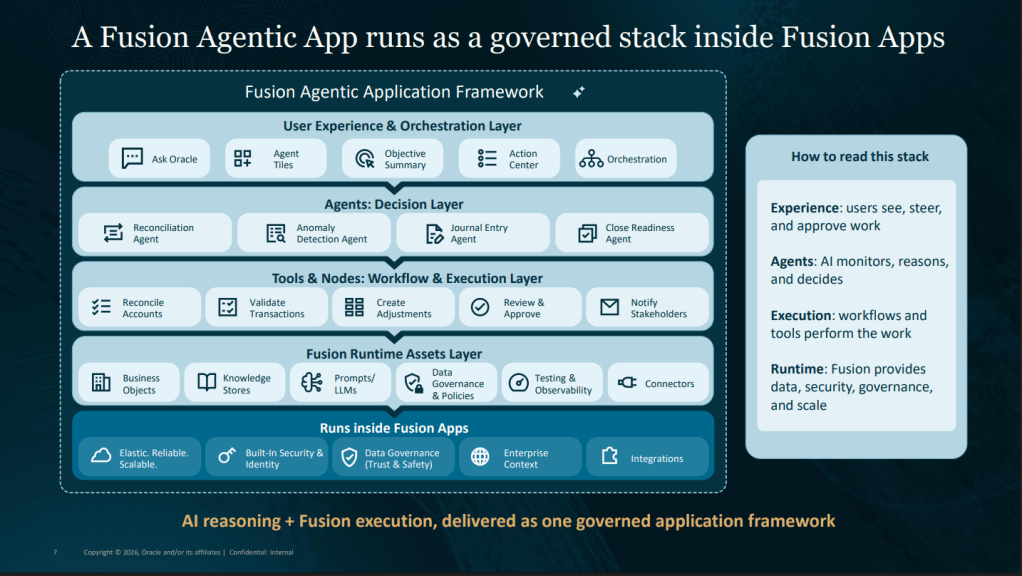
One of the concepts Oracle talks about repeatedly is the idea of Agentic Applications rather than individual agents. An individual agent can reason, recommend and generate content. An Agentic Application brings together agents, workflows, data, approvals, security controls and user experiences to deliver a specific business outcome. Oracle describes these applications as teams of specialised agents working together to achieve business objectives and deliver measurable outcomes. I think that’s an important distinction.

Most business challenges aren’t solved by a single person working alone. A recruitment process doesn’t rely entirely on HR. A supplier issue isn’t owned solely by Procurement. A financial review often involves multiple stakeholders bringing different expertise and perspectives. The same principle applies here.

Rather than building one all-knowing agent that attempts to handle everything, organisations can create specialist agents focused on particular domains, responsibilities or business processes. Oracle’s architecture explicitly supports specialised agents working as coordinated teams, allowing organisations to break complex business challenges into smaller, more manageable areas of expertise. That may sound like a technical design choice, but it’s actually a business one. The clearer an agent’s purpose, the easier it becomes to build trust, establish accountability and continuously improve performance.
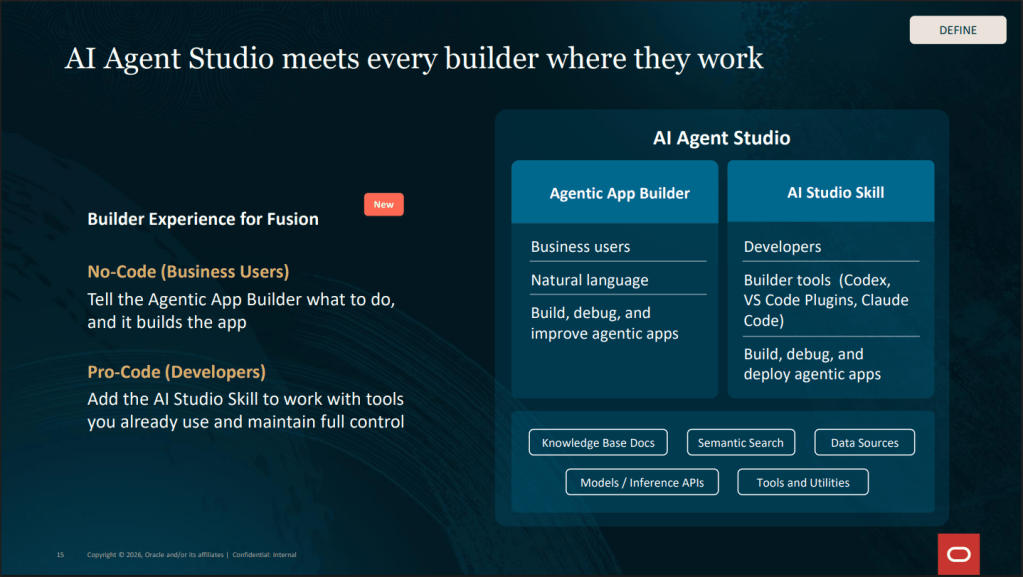
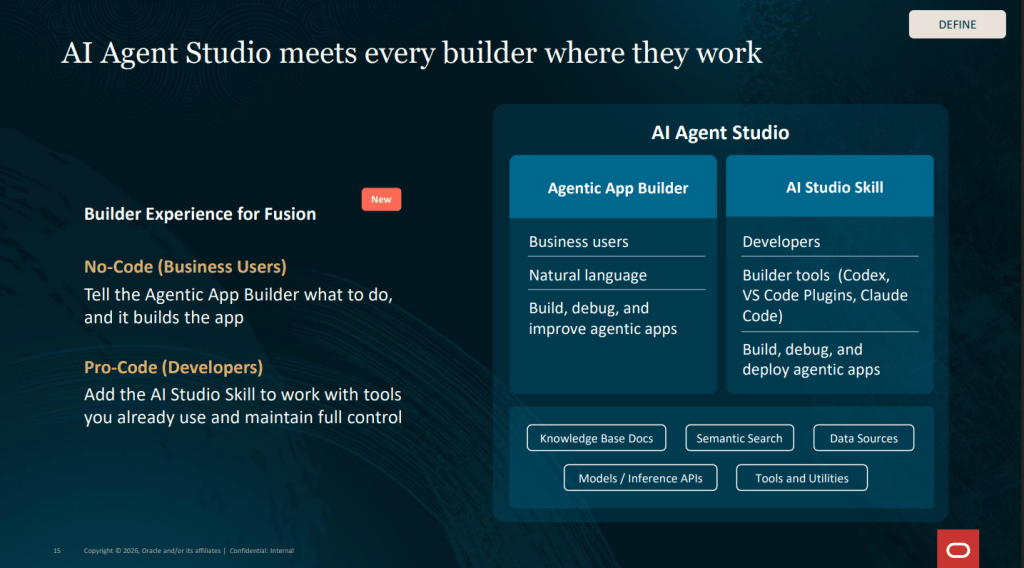
Whenever I speak to customers about AI, I often encounter the assumption that there are only two types of people involved: business users and developers. The reality is far more nuanced. Oracle’s latest AI Agent Studio experience recognises this by providing a spectrum of builder experiences, ranging from no-code and conversational design through to full pro-code development using tools such as VS Code, command-line interfaces and source-controlled development workflows.

Business users can describe outcomes in natural language, whilst developers retain full control when required. I think this approach reflects how successful transformation projects actually work. The people closest to a business challenge are often best positioned to understand the outcome they’re trying to achieve. The people responsible for architecture, security, integrations and governance are best positioned to ensure solutions can operate safely and reliably at enterprise scale. Neither group can solve the problem effectively in isolation. By supporting different types of builders, Oracle appears to be acknowledging that enterprise AI is as much about collaboration as it is about technology.

One of the biggest differences between consumer AI and enterprise AI is context. Public AI tools are incredibly capable, but they generally know very little about your organisation. They don’t understand your policies, your data, your approval processes or your business rules. Enterprise AI becomes valuable when it can work within the context of the organisation it serves.
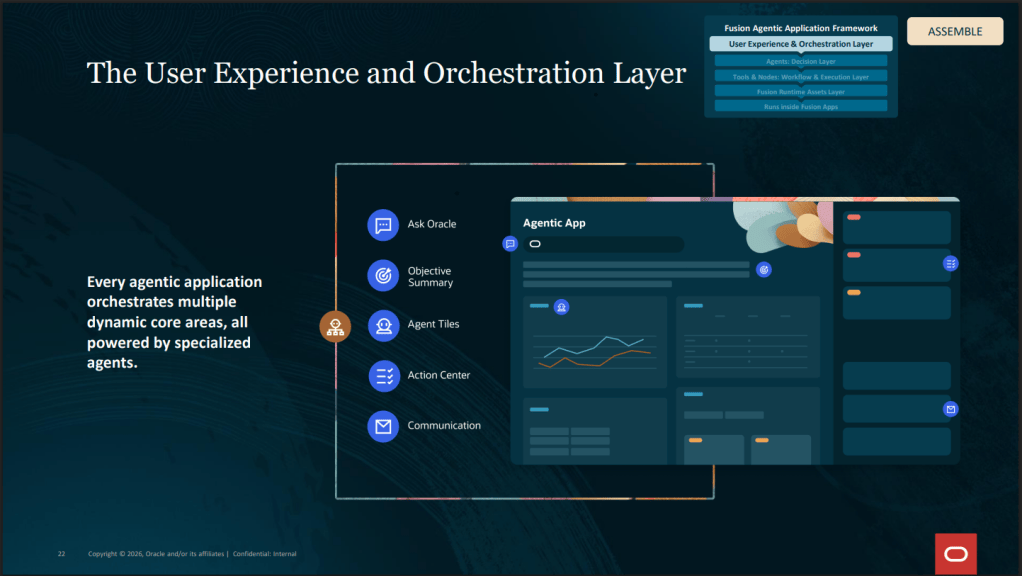
Oracle’s architecture places significant emphasis on enterprise knowledge, business objects, connectors, policies and organisational context. Agents can be grounded in enterprise content, connected to external systems, and informed by the processes and data that already exist within Fusion Applications.

Why does that matter? Because business decisions rarely rely on a single source of truth. An HR recommendation might depend on employee records, compensation history, learning activity and organisational policy. A procurement recommendation could depend on supplier performance, contract information, delivery schedules and financial exposure. A project management decision may require information from staffing, budget, risk and operational systems. The more context an agent can access responsibly, the more useful it becomes. Without context, intelligence quickly loses value.
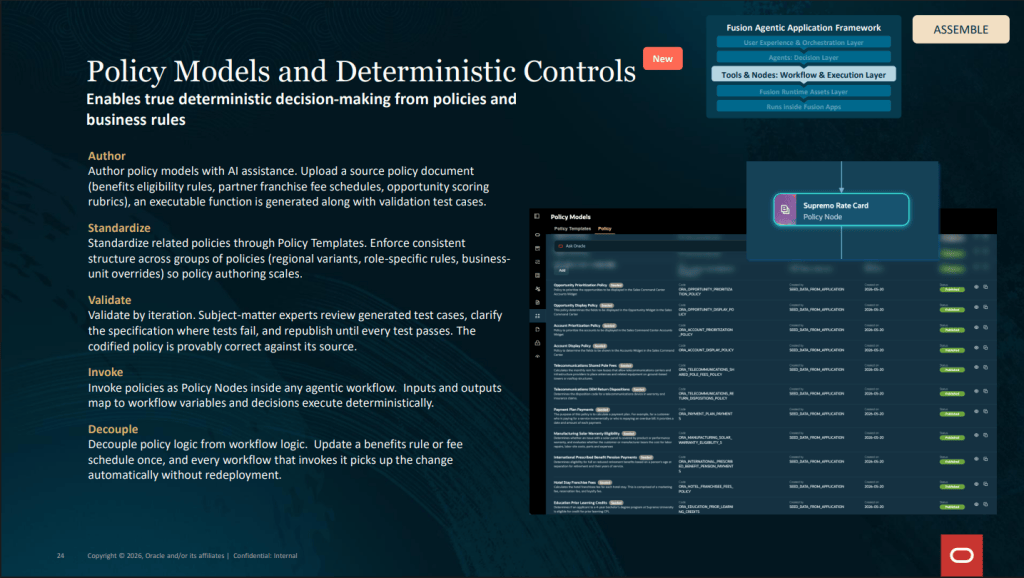
One of the most interesting additions to AI Agent Studio is the introduction of Policy Models. This capability addresses a challenge that many organisations have been struggling with since generative AI entered the mainstream. What happens when a decision must be correct every single time? There are many situations where approximation simply isn’t acceptable. Benefits eligibility. Financial calculations. Regulatory compliance. Contractual obligations. Compensation rules.

Oracle’s answer is Policy Models. These allow organisations to upload source policy documents, generate executable policy functions, validate them using test cases and then invoke them within workflows as deterministic decision-making components. Policy logic becomes reusable, consistent and centrally managed rather than being recreated repeatedly across multiple workflows.

Personally, I think this is one of the most significant capabilities Oracle has introduced. Not because it’s particularly exciting. But because it addresses one of the most common concerns organisations have about AI. Trust. Many business leaders are comfortable allowing AI to summarise information or suggest recommendations. They’re less comfortable allowing AI to interpret regulatory rules or apply financial calculations inconsistently.

Policy Models create a clear separation between reasoning and rules. The AI can help understand the situation. The policy ensures the decision follows the organisation’s defined rules. I suspect that distinction will become increasingly important as organisations move from experimentation to production use cases.

One message came through strongly when reviewing Oracle’s latest direction for AI Agent Studio. Enterprise AI is moving beyond experimentation. Oracle talks about AI Agents becoming operational centres within deployable business applications, supported by trust, governance, integration, reliability and business context.

The focus is shifting from individual AI capabilities towards complete systems that can safely execute work and deliver outcomes. I think that’s exactly where the industry needs to go. Most organisations aren’t looking for another AI demonstration. They’re looking for solutions to real business problems. They want to improve employee experiences. Reduce risk. Accelerate decision-making. Increase efficiency. Improve service delivery. That’s not achieved through agents alone.

It’s achieved through combining intelligence, governance, data, approvals, security and business processes into a cohesive solution. And that’s what makes Oracle’s current direction particularly interesting. The conversation is no longer about whether AI can generate a response. It’s about whether AI can operate responsibly within the realities of an enterprise environment. For me, that’s where the real story begins.

In the next article, I’ll explore another critical aspect of enterprise AI: trust. Specifically, how testing, approvals, governance, security and auditability are helping organisations move from AI experimentation to AI they can confidently rely on every day.

Please note that all screenshots are the property of Oracle and are used in accordance with Oracle’s Copyright Guidelines.
Oracle Payables Agent: The Licensing and Security Questions Everyone Is Asking

When Oracle talks about the future of touchless Accounts Payable, most of the attention naturally goes to AI-powered invoice processing, anomaly detection and automation. What I’m finding in customer conversations, though, is that the first questions are rarely about functionality. They’re usually much more practical.

Is Payables Agent included in my existing licence? Do I need additional subscriptions for Document IO? Will this consume AI Units? How do I secure it? And how will all of this fit alongside the Agentic Apps Oracle keeps talking about?

The answers aren’t always obvious, particularly now that Oracle has introduced Document IO, Compliance and Control, new Redwood experiences and an expanding portfolio of AI services. In this article, I’ll walk through the areas that seem to generate the most confusion and explain what customers should understand before they start implementing Payables Agent.

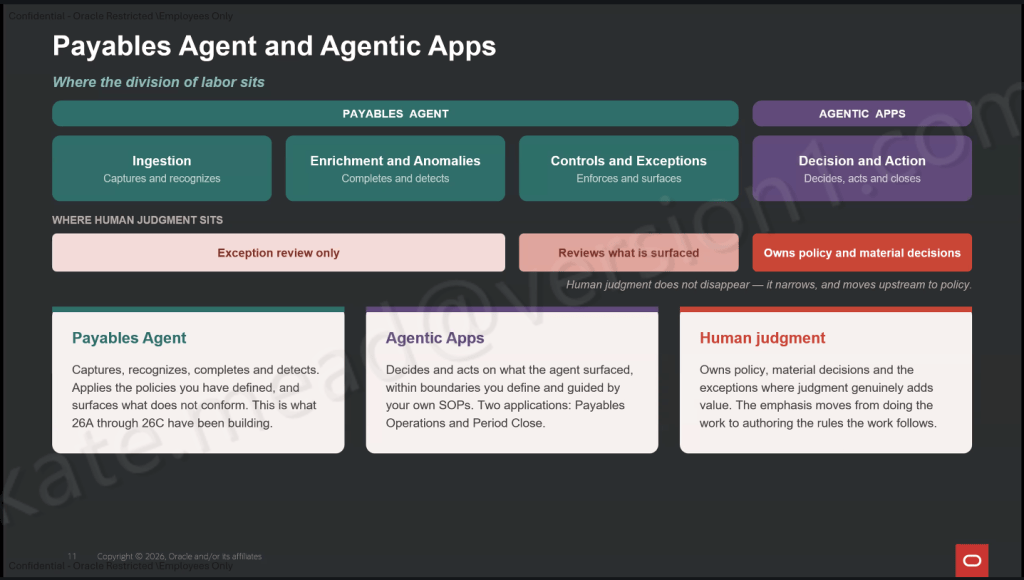
One of the biggest misconceptions is that Payables Agent is somehow the same thing as Oracle’s broader Agentic AI strategy. It isn’t. Payables Agent is focused on invoice processing. Its purpose is to extract information from invoices, identify exceptions, apply controls and help AP teams move towards exception-based processing. The Agentic Apps Oracle has been demonstrating are designed to tackle a different problem, helping users make decisions and drive business outcomes rather than simply automating transaction processing.

That distinction matters because customers are often concerned that adopting Payables Agent today could mean investing in something that will soon be replaced. Oracle’s messaging has been fairly consistent here. Payables Agent remains part of the Fusion roadmap and sits alongside, rather than underneath, the broader Agentic Apps strategy.

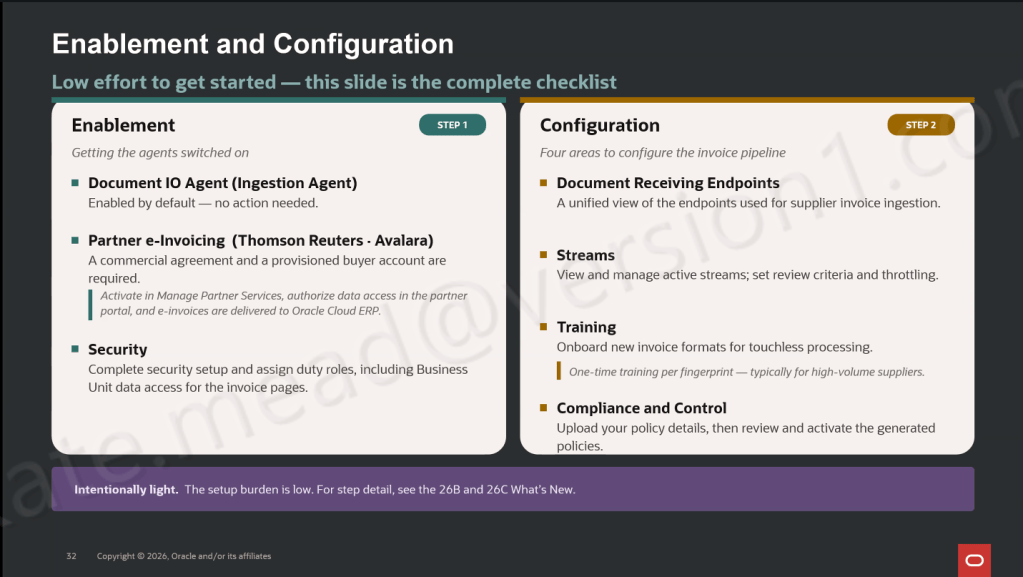
The second area that causes confusion is Document IO. For organisations using invoice imaging, Document IO is now the default invoice recognition engine. The functionality itself is straightforward enough, but the licensing position is something worth validating before implementation begins.

I’ve already seen customers assume that because Payables Agent is part of their Fusion estate, everything associated with invoice recognition must be included too. That isn’t necessarily the case. Depending on your commercial arrangement and the services you’re using, additional subscriptions may be required for document recognition and imaging workloads.

My advice is simple: don’t leave this conversation until go-live. Confirm your position early, particularly if PDF invoice processing forms a significant part of your AP operation. It’s much easier to address licensing questions during design than during deployment.

Whenever Oracle introduces a new AI capability, the next question is almost always about consumption and cost. The good news is that Payables Agent isn’t currently positioned as a major AI Unit consumer. Document IO and invoice processing use Oracle’s basic AI capabilities rather than the enhanced models that drive some of Oracle’s more advanced AI services.

That’s reassuring for customers who are trying to understand and manage AI Unit consumption across multiple Fusion modules. However, Oracle’s licensing documentation continues to evolve, so it remains important to validate assumptions against the current service descriptions rather than relying on historic guidance.

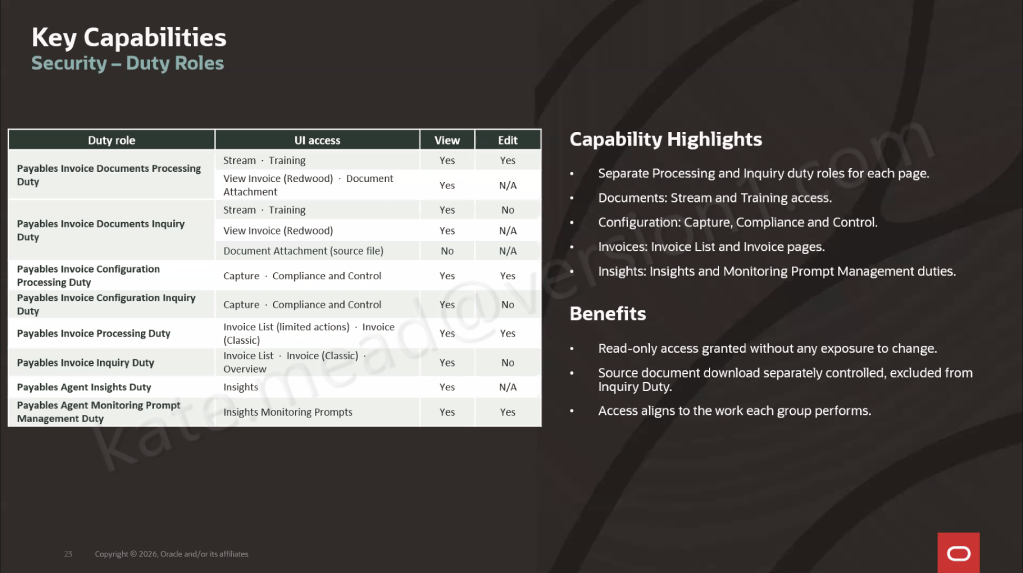
The most successful implementations I’ve seen tend to treat security as a design activity rather than a technical task completed at the end of a project. Payables Agent introduces new capabilities around document training, compliance configuration, exception management and operational monitoring. Not every user should have access to all of those functions.

For example, the people responsible for training document extraction models may not be the same people who maintain compliance policies. Similarly, those investigating invoice exceptions may not need access to the controls that govern how anomalies are detected in the first place. Oracle’s newer Redwood experience and consolidated duty roles make this easier than it has been in previous releases, but organisations still need to think carefully about who should own each responsibility.

What I find particularly interesting is that AI governance often becomes more important than technical configuration. Giving someone access to train extraction models sounds relatively harmless until you realise they’re influencing how future invoices will be interpreted. Allowing users to modify compliance policies sounds straightforward until those policies begin driving accounting decisions, tax determinations or project coding.

As organisations adopt more AI-enabled functionality within Fusion, governance becomes increasingly important. Who approves changes? Who reviews model performance? Who monitors recognition accuracy? And who is accountable when exceptions occur? Those questions are often more difficult than the technical implementation itself.

Another reason to get security right now is that Payables Agent is unlikely to be the final stop on Oracle’s AI journey. As Agentic Apps become available across Fusion, many organisations will find themselves managing multiple AI-enabled services with different responsibilities, different user communities and potentially different control requirements. Building a strong governance model today gives organisations a foundation they can reuse as those additional capabilities arrive.

The technology behind Payables Agent is impressive, but most implementation challenges won’t come from invoice recognition or anomaly detection. They’ll come from licensing assumptions, security design and governance decisions. Customers that take the time to understand those areas early tend to have a smoother implementation experience and a clearer path towards the touchless AP model Oracle is aiming for.

If you’re planning a Payables Agent implementation, I would spend as much time understanding the licensing and security model as you do exploring the functionality itself. Both are essential if you want to move from a successful proof of concept to a production-ready solution.

Please note that all screenshots are the property of Oracle and are used in accordance with Oracle’s Copyright Guidelines.
Oracle Payables Agent: Is Touchless AP Finally Becoming Reality?

Most finance teams have heard the promise for years: invoices arrive, the system processes them automatically, and AP teams focus on exceptions rather than data entry. The reality has often been different. Supplier formats vary, invoice data is inconsistent, and teams still spend significant time correcting, validating and chasing issues before invoices can be paid.

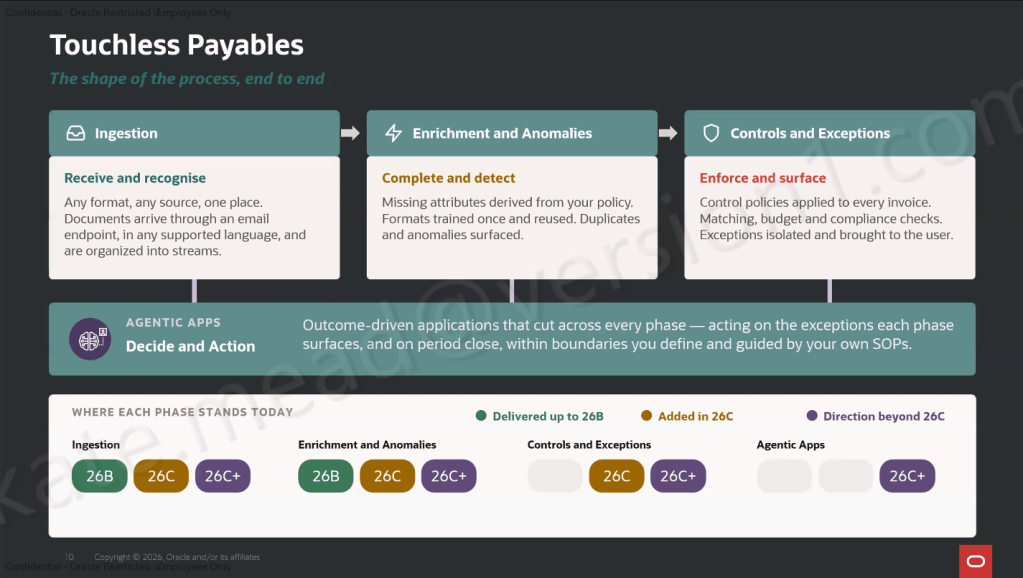
Oracle’s latest Payables Agent capabilities feel like a more realistic attempt to solve that problem. What makes this release interesting isn’t a single AI feature. It’s how Oracle has combined document recognition, compliance controls and operational monitoring into a single process.

One of the biggest changes is Oracle’s move from Intelligent Document Recognition (IDR) to Document IO. For customers, the important point isn’t the technology change. It’s the outcome. Oracle can now recognise a broader range of invoice formats, including handwritten invoices, while continuing to benefit from existing IDR learning.

When new supplier formats arrive, users can map fields once and allow future invoices to be processed automatically. Functional teams can manage this themselves without relying on technical development. That has the potential to reduce one of the most common bottlenecks in invoice processing: onboarding new suppliers.

What interested me most wasn’t document recognition. It’s Oracle’s shift towards exception-based processing. Rather than asking AP teams to review every invoice, Oracle is attempting to surface only the transactions that genuinely need attention. That includes duplicate detection, policy validation, account coding checks and anomaly identification before invoices reach the payment stage. For organisations with high invoice volumes, that’s where the real efficiency gains are likely to be found.

One capability that may be overlooked is Compliance and Control. This sits alongside existing Oracle defaulting rules rather than replacing them. It helps fill gaps by completing missing information and continuously assessing invoices against defined policies. The result is fewer manual reviews and more consistent application of controls.

For finance leaders focused on auditability and compliance, this could prove just as valuable as the AI-powered document recognition itself. The success of Payables Agent won’t be determined by how impressive the technology sounds. It will depend on three things:

  • The quality of the document training.
  • How well compliance policies are configured.
  • Whether teams embrace exception-based working practices.

Get those right and AP teams can spend less time entering data and more time resolving issues that genuinely need human judgement.

What Oracle is building here feels less like another AI announcement and more like a practical evolution of Accounts Payable automation. The combination of Document IO, Compliance and Control, and the Payables Operations Workspace gives organisations a clearer path towards touchless invoice processing than we’ve seen before. It’s not completely hands-off, and it still requires thoughtful configuration. But for organisations looking to reduce manual effort while improving control and visibility, there’s plenty here worth exploring.

Please note that all screenshots are the property of Oracle and are used in accordance with Oracle’s Copyright Guidelines.
Understanding the Building Blocks of an Agentic App

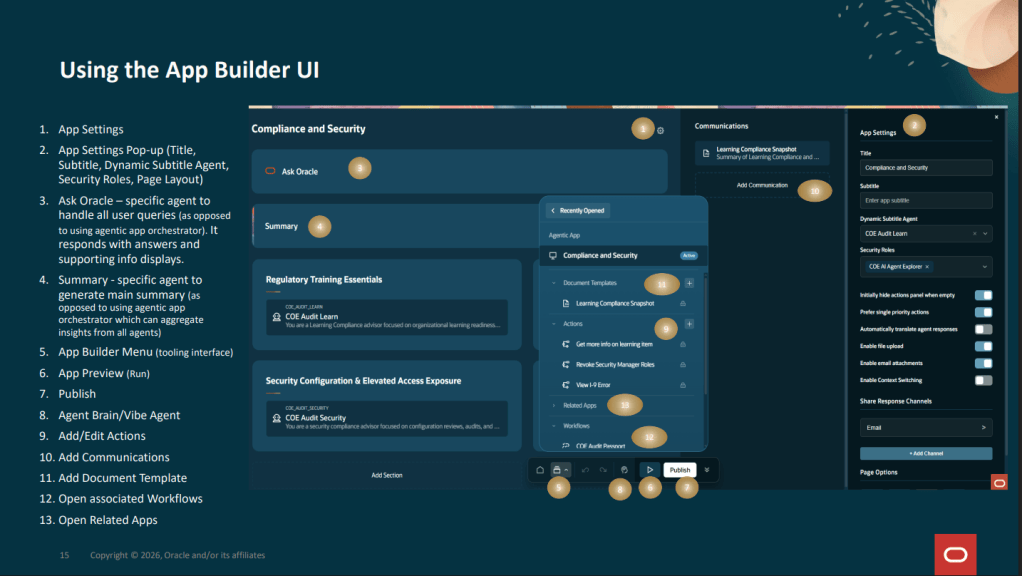
In the first article in this series, I talked about how Oracle Fusion AI Agent Studio appears to be shifting the conversation away from technology and towards business outcomes. In the second article, I explored Oracle’s Builder Assistant and how it helps close the gap between an idea and a working solution. But at some point, it’s worth understanding what actually sits behind an Agentic App. Not because you need to become a developer or learn every technical detail. Quite the opposite. Understanding the building blocks helps explain why Agentic Apps have the potential to deliver value in a way that traditional dashboards, reports and workflows often struggle to achieve.

One of the biggest misconceptions I encounter is that an Agentic App is simply a chatbot with a different interface. After spending time working with Oracle AI Agent Studio, I don’t think that’s an accurate description at all. A well-designed Agentic App is more like a digital team. Different components contribute different capabilities, each performing a specific role whilst working together towards a common outcome. When you look at it through that lens, the architecture starts to make much more sense.

At the heart of every Agentic App are one or more agents. Oracle refers to these as workflow agents, but I think it’s easier to think of them as specialists. In any organisation, complex decisions rarely rely on a single person. Different experts contribute different perspectives. A manager dealing with an employee issue might seek input from HR, Payroll and Learning teams. A finance director reviewing project performance might need information from project managers, procurement specialists and budget owners. Agentic Apps work in a similar way.

Instead of trying to create one agent that knows everything, Oracle encourages organisations to build focused agents with clearly defined responsibilities. One agent might specialise in workforce compliance, another in employee retention, another in supplier risk and another in project performance. That may sound like a technical decision, but it’s actually a business one. The clearer an agent’s purpose, the easier it becomes to trust its recommendations, govern its behaviour and improve its effectiveness over time.

Most people don’t open business applications because they enjoy looking at data. They open them because they need answers. This is why insights are such an important part of the Agentic App experience. Rather than requiring users to navigate through reports, dashboards and transactions, agents can analyse information from multiple sources and surface the things that genuinely matter.

Think about an HR manager responsible for hundreds of employees. What they typically need isn’t more data. They need help identifying which individuals require attention today. Perhaps a valued employee is showing signs of disengagement. Perhaps a professional certification is about to expire. Perhaps a new starter hasn’t completed mandatory onboarding activities. An insight helps bring those situations to the surface before they become bigger problems.

The same principle applies across Finance, Procurement, Supply Chain and Customer Operations. The objective isn’t simply to provide information. It’s to help people focus their limited time and attention where it will have the greatest impact. That’s where the real value starts to emerge.

One of the challenges with traditional reporting is that the report often becomes the end of the process. A manager discovers there’s a problem. They make a note. They send an email. They open another application. They create a task. Eventually, something happens. Agentic Apps are designed to shorten that journey.

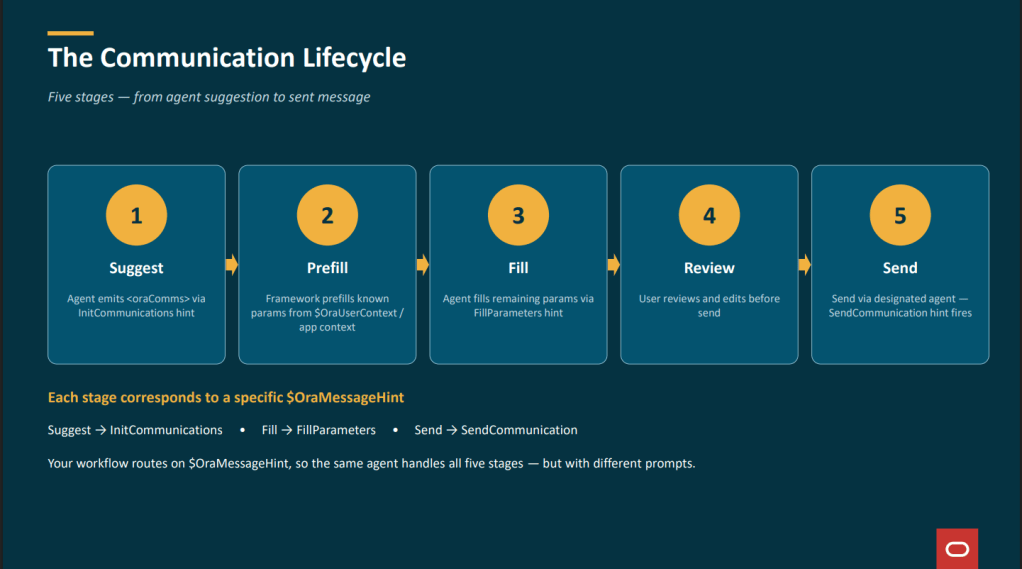
In Oracle’s architecture, agents can surface actions alongside the insights they generate. Rather than simply highlighting an issue, they can help the user decide what to do next and initiate the appropriate process. Imagine receiving an alert that an employee’s work permit is due to expire. The application could simply notify you. Or it could help initiate the follow-up activity, prepare communications, gather supporting information and guide you through the next steps.

Similarly, if a procurement agent identifies a supplier at risk of missing a key delivery commitment, the application could help trigger supplier engagement activities before the issue starts affecting customers. The outcome is the same. The difference is the amount of effort required to get there. I think that’s one of the most important distinctions between traditional productivity tools and agentic applications. They don’t just help people understand what needs attention. They help people move towards resolution.

Whenever I talk to customers about AI, one concern inevitably comes up. What happens when the system starts communicating on behalf of people? It’s a valid question. Most organisations want AI assistance, not AI acting independently without oversight.

What I particularly like about Oracle’s approach is that communications are designed to support people rather than replace them. AI can help draft content, prepare messages and bring together relevant information, but the human remains responsible for reviewing, approving and ultimately deciding whether communication should be sent.

Think about an HR team responsible for monitoring expiring visas or certifications. Creating individual communications can be time-consuming, especially when managing large populations. An agent can help prepare that content using the information already available, allowing HR professionals to focus on quality and decision-making rather than administration. The same principle could apply to supplier communications, project updates, audit notifications or customer engagement activities. The technology handles the repetitive work. People retain ownership of the decision. That feels like the right balance.

Data Still Matters. None of this works without data. However sophisticated the AI might be, the quality of the outcome will always depend on the quality of the information available. This is where Oracle’s business objects, integrations and data access capabilities play such an important role. Agents need access to information before they can generate meaningful insights, recommendations or actions.

The good news for Oracle Fusion customers is that much of that information already exists within the applications they use every day. Employee data. Talent information. Financial transactions. Supplier records. Projects. Learning activities. Procurement spend. The opportunity isn’t necessarily creating new information. It’s bringing existing information together in a way that helps people make better decisions.

Individually, agents, insights, actions, communications and data capabilities are all useful. Collectively, they become something more powerful. An insight identifies an issue. An action helps drive resolution. A communication engages the right people. An agent orchestrates the process. Underlying data provides the necessary context. Together, they create an experience focused on outcomes rather than transactions. And I think that’s really the key message behind Agentic Apps.

They’re not trying to replace Oracle Fusion. They’re not trying to replace employees. They’re not even trying to replace existing processes. Instead, they’re helping organisations navigate increasing levels of complexity by bringing together information, recommendations and actions in a more intelligent way. That’s a challenge every organisation faces, regardless of industry.

As organisations begin experimenting with Agentic Apps, it can be tempting to focus on the technology itself. Which model should be used? Which integrations are required? Which features should be enabled? Those questions are important, but they’re not the first questions I would ask. I’d start with the business outcome. What decision are we trying to improve? What problem are we trying to solve? What experience are we trying to create? Once those answers are clear, the building blocks start to fall naturally into place.

By now, we have explored the core building blocks that make Agentic Apps possible. However, if you’ve ever wondered what separates an interesting AI demonstration from something that can genuinely be trusted in a production business environment, that’s where the story becomes even more interesting. In the next article, I’ll look beyond the agents themselves and explore the capabilities that make enterprise AI possible at scale, from policy models and human approvals to enterprise integrations, governance and control.

Please note that all screenshots are the property of Oracle and are used in accordance with Oracle’s Copyright Guidelines.
From Idea to Agent: How Oracle is Redefining Application Design

In my previous article, I talked about how Oracle Fusion AI Agent Studio feels different from many of the AI platforms that have emerged over the last few years. The shift isn’t really about a new feature or a new model. It’s about moving away from technology-first thinking and focusing instead on business outcomes.

One capability in particular stands out as an example of that shift: the Builder Assistant. On the surface, the Builder Assistant looks like another AI-powered assistant. You describe what you want, it helps generate the building blocks, and you continue refining the solution through conversation. But I think the significance runs deeper than that.

For years, we’ve accepted that creating applications requires a detailed understanding of how technology works. We capture requirements, design workflows, build integrations and configure business logic, often translating the same business need several times before reaching a finished solution.

The Builder Assistant starts to challenge that assumption. Rather than asking users to begin with the technical design, it encourages them to start with what they are trying to achieve. That might seem obvious, but it’s a meaningful change in how applications are conceived and created.

When organisations begin any transformation programme, they rarely describe their challenges in technical terms. An HR Director doesn’t typically ask for a workflow containing multiple nodes, integrations and business objects. They might say: “We need to identify employees who may be at risk of leaving.” A Procurement Manager might say: “We need earlier warning when suppliers are likely to miss critical deadlines.” A Finance Director might say: “We want to focus our team’s attention on unusual spending patterns before they become a problem.” These are business challenges, not technical requirements.

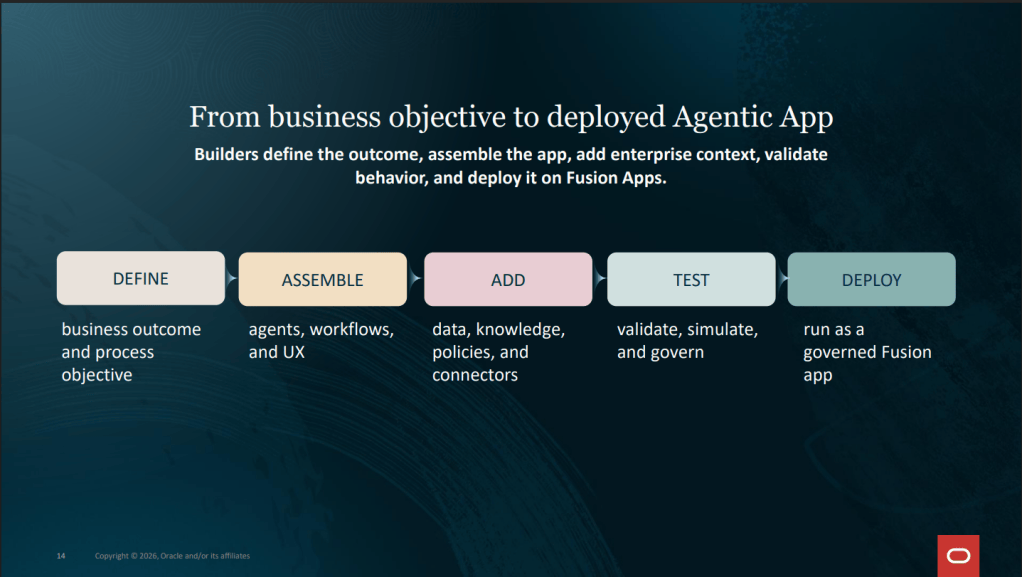
Traditionally, there has been a considerable gap between those conversations and the resulting application design. Someone has to translate the business need into technical specifications before any development can begin. What Oracle appears to be doing with the Builder Assistant is helping to narrow that gap. Instead of immediately thinking about workflows, integrations and data structures, users can start by describing the outcome they want to achieve. The platform then helps build the underlying components needed to support that outcome. The complexity hasn’t disappeared, but it has become less of a barrier to getting started.

A common misconception about AI is that its primary purpose is automation. Whilst automation is certainly part of the story, I think one of the biggest opportunities lies elsewhere. AI can help organisations capture expertise more effectively. Every organisation has people who understand its processes, challenges and priorities exceptionally well. They know which risks matter, which decisions take too long and where valuable time is lost. What they often lack is the ability to translate those ideas into working applications. Historically, that has required specialist technical skills.

As tools like the Builder Assistant evolve, we’re starting to see a world where business experts can contribute much more directly to the solution design process. Imagine an HR specialist describing the characteristics of employees who may require additional support and seeing a prototype solution emerge. Imagine a compliance team defining the type of risks they need to monitor without having to understand every technical object behind the scenes. That doesn’t remove the need for governance, technical review or implementation expertise. But it does allow the people closest to the problem to become much more involved in shaping the solution. For many organisations, that could prove transformational.

One of the things that interests me most about Agentic Apps is that they encourage organisations to think differently about applications altogether. Traditionally, software has been designed around transactions and processes. Users navigate through screens. They search for information. They run reports. They review dashboards. Then they decide what action to take. Agentic applications take a different approach. They start with the question: “What does the user actually need to accomplish?”

A manager may not care about navigating between multiple screens to gather workforce information. They care about whether someone on their team requires support or intervention. A procurement leader may not care about reviewing dozens of supplier records. They care about understanding where the next potential supply chain issue is likely to emerge. A finance manager may not want another dashboard. They want confidence that significant risks or unusual patterns will be highlighted before they become larger problems. This shift from information-centred design to outcome-centred design is one of the most interesting aspects of the agentic journey. The Builder Assistant feels like an important step in enabling that change.

One challenge I hear repeatedly from customers is that they have far more ideas than they have capacity to deliver. Every organisation can identify opportunities to improve employee experiences, streamline processes or make better use of data. The difficulty is often turning those ideas into reality. Development backlogs grow. Priorities compete for attention. Useful ideas can remain stuck in planning documents for months or even years.

By reducing some of the complexity involved in creating solutions, tools like the Builder Assistant have the potential to accelerate innovation. That doesn’t mean every idea should become an application. Nor does it mean every solution should be built without proper governance or oversight. What it does mean is that organisations can spend more time evaluating whether an idea delivers value and less time struggling with the mechanics of getting started. That feels like a much healthier place to focus effort.

Whenever AI enters the conversation, there is often concern about replacing human expertise. Personally, I see the opposite happening here. The value of the Builder Assistant isn’t that it removes people from the process. It’s that it allows people to contribute in different ways. Business specialists can focus on outcomes. Functional consultants can focus on user experience, process design and governance. Technical teams can concentrate on architecture, security and enterprise integration. Each group can spend more time applying their expertise where it adds the greatest value. The technology becomes an enabler rather than the centre of attention. And that’s exactly how it should be.

We’re still at the beginning of this journey. The Builder Assistant is not going to eliminate the need for solution design, implementation expertise or governance. Complex enterprise applications will always require careful planning and oversight. But the direction of travel is becoming increasingly clear. The gap between having an idea and creating a working solution is reducing. The ability to express business intent is becoming just as important as technical skill. And organisations are starting to gain tools that help them focus on outcomes rather than implementation details. For me, that’s a far more interesting conversation than discussing individual AI features.

In the next article in this series, I’ll look at the building blocks that sit behind Agentic Apps and explore how agents, actions, communications and insights work together to deliver meaningful business outcomes.

Please note that all screenshots are the property of Oracle and are used in accordance with Oracle’s Copyright Guidelines.
Oracle Fusion AI Agent Studio Has Changed. Here’s Why That Matters

I’ve spent quite a lot of time exploring Oracle Fusion AI Agent Studio over the past few months. Like many new Oracle capabilities, it’s evolved quickly. Features have appeared, interfaces have changed, and new possibilities seem to arrive with every release.

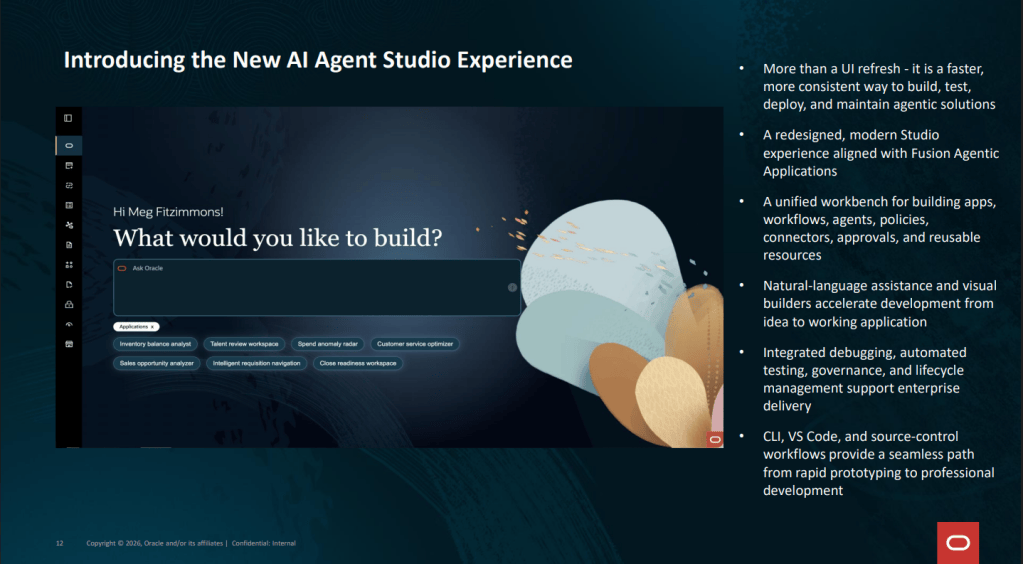
What struck me recently wasn’t a new large language model, agent type or connector. It was the user experience itself. The latest version of AI Agent Studio feels fundamentally different from where it started. That matters because one of the biggest challenges with enterprise AI has never really been the technology. It’s been accessibility.

For years, we’ve talked about empowering business users, citizen developers and functional consultants, yet many AI platforms still require specialist knowledge before you can create anything useful. Understanding prompts is one thing. Understanding workflows, orchestration, APIs and integrations is quite another. Oracle appears to be addressing that challenge head on.

Historically, building applications has required people to translate business requirements into technical specifications. A business leader explains the problem, a consultant documents the requirements, and a developer builds the solution. The process works, but it introduces delays, complexity and the possibility that something gets lost in translation along the way.

What’s interesting about the latest AI Agent Studio experience is that Oracle is increasingly allowing people to describe what they want to achieve rather than focusing on how every component should be configured. Instead of starting with technical objects, workflows and integrations, users are encouraged to start with an outcome.

  • What problem are you trying to solve?
  • What decision are you trying to support?
  • What action should happen next?

That might sound like a subtle change, but I think it’s one of the most significant developments we’ve seen in enterprise software for some time.

For example, an HR team might want to identify employees at risk of leaving and ensure managers take proactive action before valuable talent is lost. A procurement team might want to highlight suppliers that are showing signs of delivery risk before those issues impact customers. A finance team might want to focus attention on unusual transactions that warrant further investigation. The desired business outcome is clear, even if the technology required to achieve it is complex. The technology still matters, of course, but it increasingly sits behind the outcome rather than being the starting point.

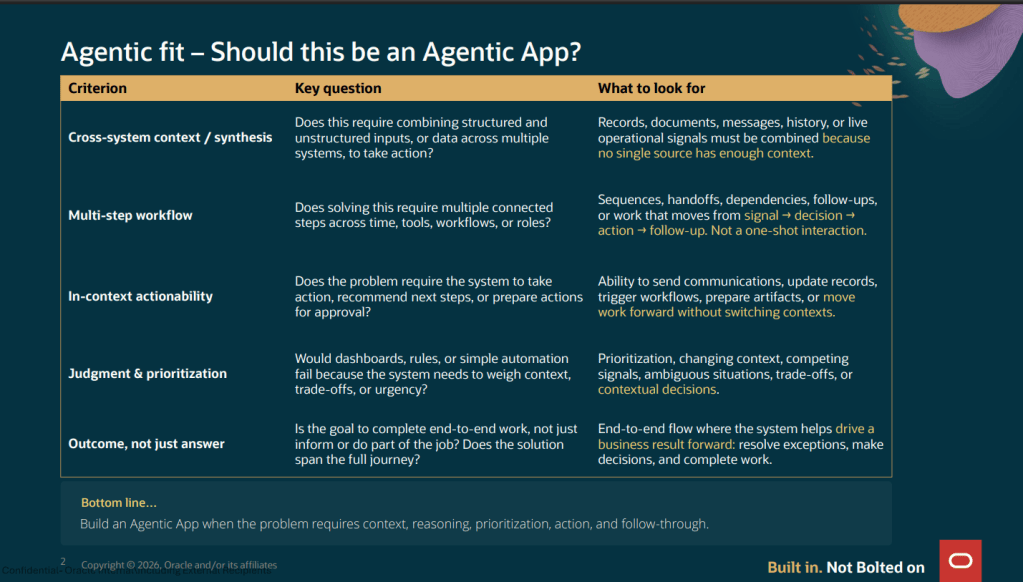
One of the themes I keep hearing from customers is that traditional applications were designed around processes. Employees complete forms, managers review transactions, reports provide information and dashboards highlight exceptions. While these tools are valuable, there is often a gap between understanding what requires attention and actually taking action. This is where agentic applications become interesting. Rather than simply presenting information, they can help identify issues, prioritise actions and guide users towards the next step.

Think about a manager reviewing their team. Traditionally, they might need to examine performance ratings, compensation information, employee engagement scores, absence trends and talent data separately before deciding where intervention is needed. An agentic application takes a different approach. It brings those signals together, highlights where attention may be required and presents recommendations in context.

Imagine opening an application and immediately seeing that a high-performing employee has received below-market compensation, has recently missed development opportunities and is showing signs of declining engagement. Instead of spending time gathering information from multiple sources, the manager can focus on deciding what action to take.

Similarly, a procurement leader could be alerted that a critical supplier has missed key milestones and may be putting future deliveries at risk. A finance manager might receive an early warning that project spending is trending above expectations long before budget thresholds are breached. An HR team could be notified about work permits, professional certifications or compliance training that are approaching expiry, giving them time to act before they become a business risk.

The value isn’t simply that AI has identified something unusual. It’s that the information has been brought together in a way that supports quicker, more informed decisions. The goal isn’t to replace human judgement. The goal is to reduce the effort required to reach an informed decision. That’s a very different proposition from simply adding AI to an existing screen.

Many organisations are already struggling with a familiar challenge. They have more data than ever before, but less time to interpret it. The problem isn’t access to information. The problem is finding the right information at the right moment and understanding what to do with it. This is particularly true across HR, Finance, Procurement and Supply Chain functions where managers are expected to make decisions quickly whilst balancing increasing levels of complexity. The promise of AI has always been to help address that challenge. The reality, however, is that many AI solutions still require significant effort to implement and maintain.

What I find encouraging about the direction Oracle is taking with AI Agent Studio is that it appears focused on practical business outcomes rather than technology for technology’s sake. The emphasis is increasingly on helping organisations build targeted applications that solve real business problems. Not generic AI. Not experimental pilots. Applications designed around specific outcomes.

That might mean reducing the time it takes to onboard a new employee. It might mean helping managers identify retention risks earlier, ensuring expiring certifications are proactively managed, accelerating supplier issue resolution or helping finance teams focus on the transactions that genuinely require attention. The common thread is that the technology becomes a means to an end rather than the end itself.

One of the misconceptions I still hear is that AI Agent Studio is aimed primarily at developers. Having spent time working with the latest experience, I don’t think that’s the case. Technical skills are still valuable. Understanding integrations, security, governance and architecture remains important. But the barriers to entry are reducing significantly. Functional consultants can contribute more directly. Business specialists can participate more actively in the design process. Subject matter experts can help shape solutions using the language of the business rather than the language of software development. I think that’s where the real opportunity lies. The people who understand organisational challenges are often best placed to identify opportunities for AI. Giving those people better tools to express their ideas is just as important as improving the underlying technology itself.

We’re still in the early stages of the agentic journey. Most organisations are exploring use cases, experimenting with ideas and trying to understand where AI can deliver genuine value. There will undoubtedly be lessons learned along the way. There will be successful projects and others that don’t deliver the expected outcomes. But when I look at the direction Oracle is taking with AI Agent Studio, what stands out is the shift from building technology to enabling outcomes. The conversation is gradually moving away from prompts, models and technical configuration. Instead, we’re starting to talk about decisions, actions and business value. For me, that’s the most important change of all.

In the next article in this series, I’ll take a closer look at Oracle’s Builder Assistant and explore what it tells us about the future of application design in Oracle Fusion. After all, if AI can help us describe what we want to achieve rather than how to build it, perhaps we’re closer than ever to closing the gap between business ideas and working solutions.

Please note that all screenshots are the property of Oracle and are used in accordance with Oracle’s Copyright Guidelines.
Oracle’s New HCM Professional Activity Centre: The Beginning of the End for Person Management?

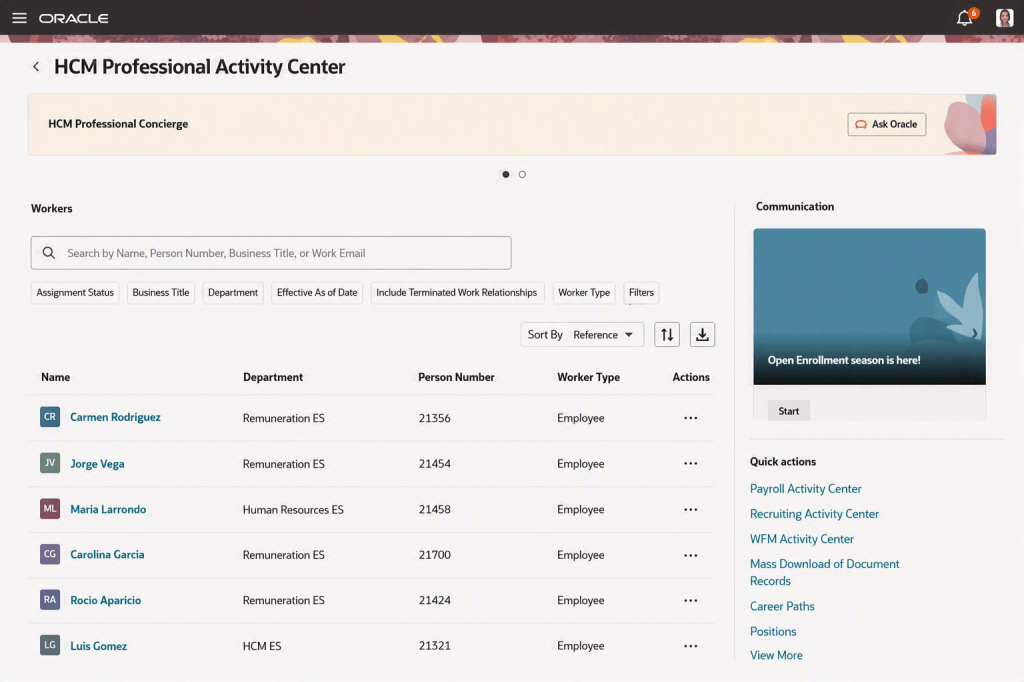
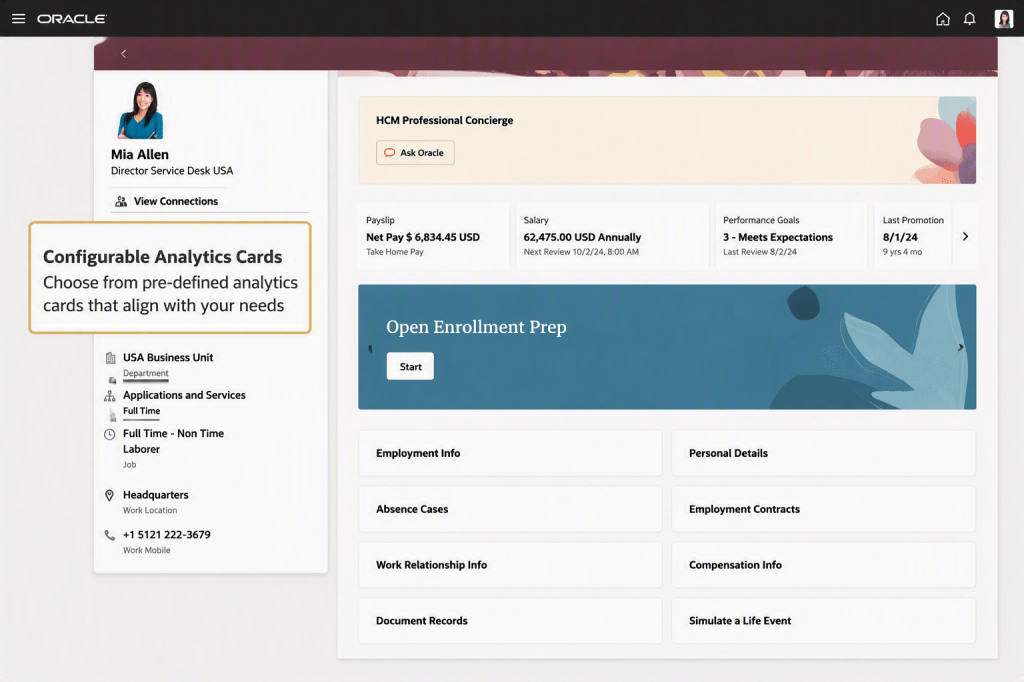
Oracle continues to reshape the HCM user experience, and one of the most significant innovations arriving in Release 26C might not be getting the attention it deserves. The new HCM Professional Activity Centre brings together worker search, employee information, HR transactions and AI-powered assistance into a single workspace designed specifically for HR professionals.

At first glance, it looks like another Redwood-enhanced page. In reality, it represents something much bigger. For years, Person Management has been the starting point for most HR administration activities within Oracle Fusion HCM. Whether updating assignments, reviewing employment information or managing employee records, HR teams have become accustomed to navigating in and out of multiple pages to get their work done.

The HCM Professional Activity Centre changes that approach completely. More importantly, Oracle has confirmed that Person Management will eventually be decommissioned, with the new Activity Centre becoming the strategic destination moving forward. While the retirement date is not yet immediate, organisations that rely heavily on Person Management should see 26C as an opportunity to start preparing for the future.

One of the biggest frustrations for HR teams is context switching. A typical HR task might involve searching for an employee, reviewing employment details, checking absence history, viewing compensation information and then processing a transaction. Individually these tasks are simple, but moving between multiple pages and menus can quickly become inefficient.

The HCM Professional Activity Centre brings these activities together into a single experience. Users can search for workers, review key information and launch transactions without continually navigating around the application. The result is a more streamlined way of working that keeps HR professionals focused on the employee rather than the system.

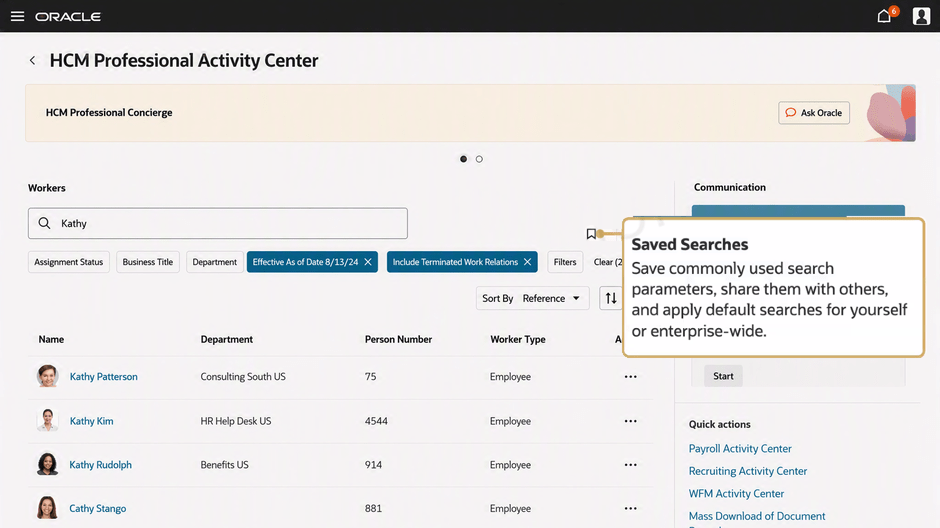
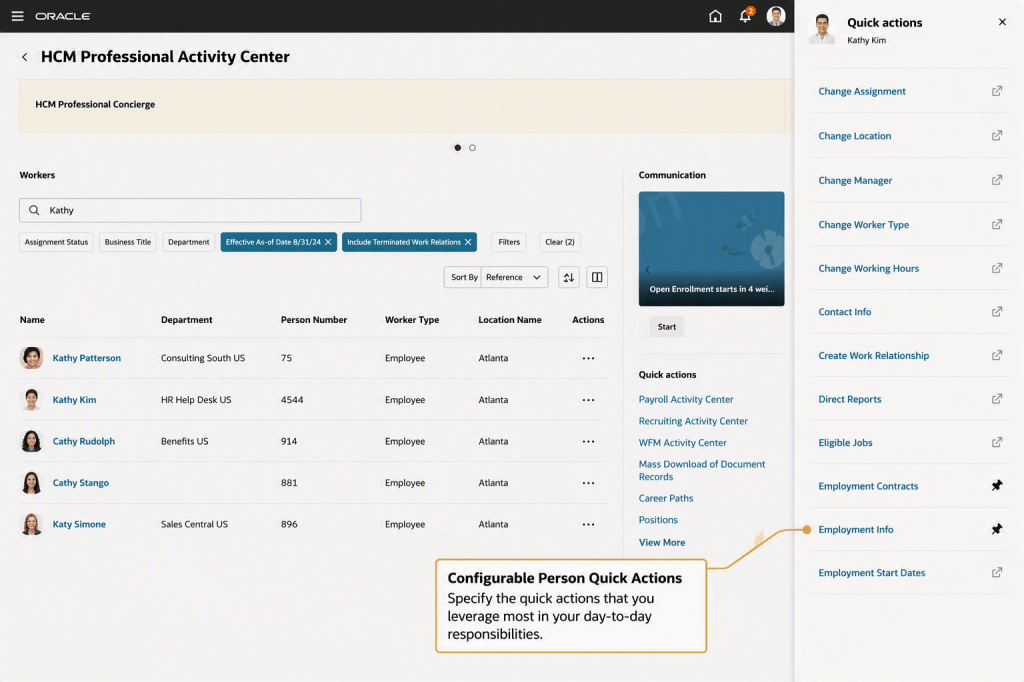
The first thing many users will notice is the search experience. Oracle has introduced a flexible worker search capability that supports names, person numbers, business titles and email addresses. It also includes fuzzy search functionality, making it far more forgiving when users do not enter exact values. For organisations with large workforces, this can remove a surprising amount of frustration from everyday HR administration.

Filters can be saved, shared and reused, allowing teams to create views tailored to particular business units, countries or employee populations. Search results are also configurable, ensuring users only see the information most relevant to their role. If required, results can be exported directly to Excel for further analysis or sharing. While these may appear to be small enhancements, they can significantly reduce the time spent performing routine HR activities.

Once a worker has been selected, the real strength of the Activity Centre becomes apparent. Rather than opening separate pages for different areas of employee information, HR professionals are presented with a unified worker profile that consolidates key data in a single location. Employment details, absence information, compensation data, benefits and document records are all readily accessible, alongside a timeline view that helps users understand an employee’s history and changes over time.

Oracle has also introduced configurable insight cards, enabling organisations to surface the information most relevant to their HR processes. This could include salary information, performance ratings, recent promotions or other workforce metrics. The focus is clearly on helping HR teams access information faster and make decisions with greater confidence.

A key theme throughout the Activity Centre is reducing unnecessary navigation. HR users can initiate transactions directly from the worker profile or search results, allowing them to move seamlessly from reviewing information to taking action. Common tasks such as assignment changes, location updates and salary changes can be accessed through configurable quick actions, helping teams complete work more efficiently.

The Activity Centre also provides fast access to related workspaces such as Payroll, Recruiting and Workforce Management, creating a connected experience across Oracle HCM. The ability to open worker records in separate browser tabs may sound like a small enhancement, but anyone managing multiple cases simultaneously will appreciate the flexibility it brings. Taken together, these improvements create a more intuitive and productive way of working for HR teams.

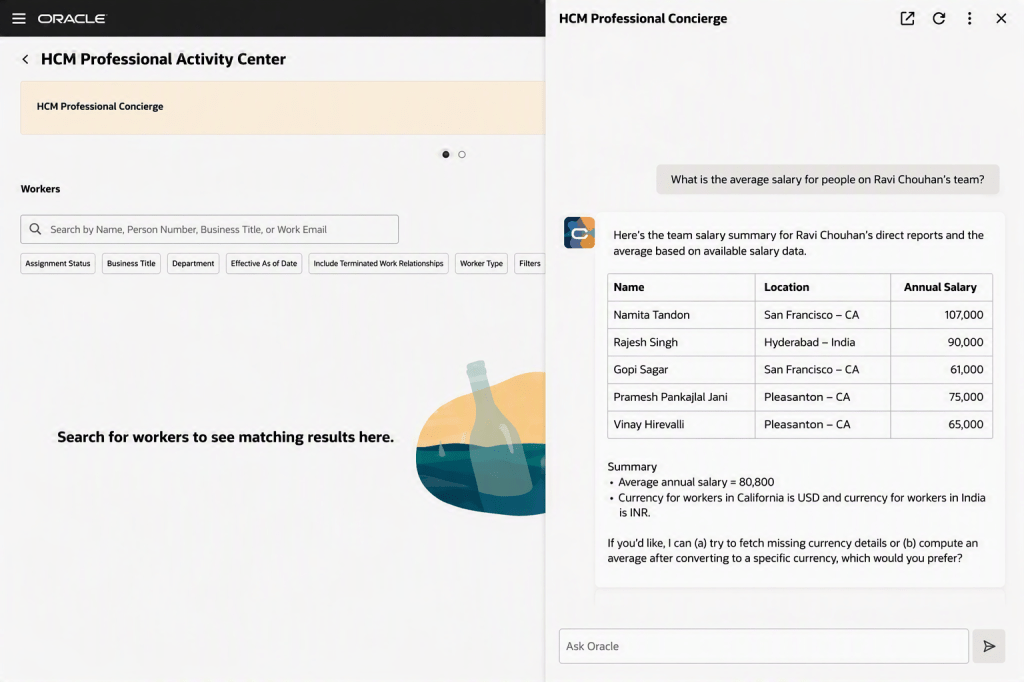
While the redesigned workspace is impressive, the most significant aspect of this announcement is what sits behind it. Oracle has embedded the new HCM Professional Concierge directly into the experience. Rather than searching through reports or navigating to analytics dashboards, HR professionals can ask questions in natural language and receive answers drawn directly from live HCM data.

Need to understand salary distribution within a team? Investigate performance ratings? Review an employee’s employment history? The Concierge can provide answers in seconds while respecting existing security roles and access controls. What makes this particularly interesting is that users can ask follow-up questions and continue the conversation naturally, without needing to start over or navigate elsewhere in the application.

Oracle has also made the Concierge available through Microsoft Teams, allowing HR professionals to access HCM insights from the collaboration tools they already use every day. This feels less like a traditional reporting tool and more like the beginning of a genuinely AI-assisted HR operating model.

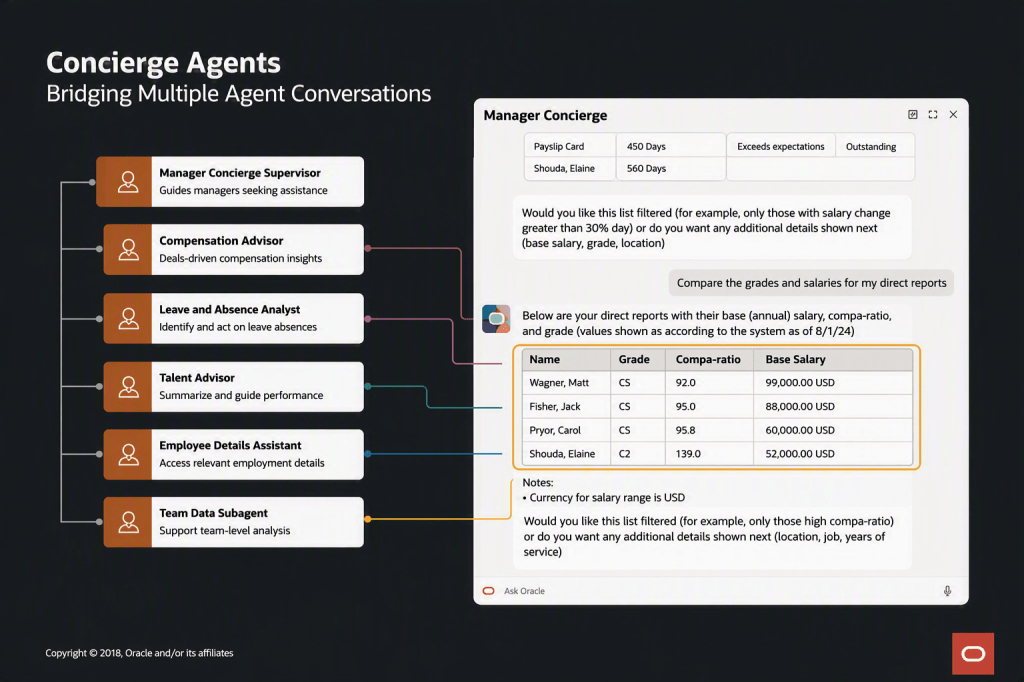
What’s particularly interesting is how Oracle has structured the solution behind the scenes. The Concierge does not rely on a single AI assistant. Instead, it orchestrates a collection of specialist agents covering areas such as compensation, absence management, reporting, employment information and HR policies. Users do not need to know which agent is responding. They simply ask a question and Oracle routes the request to the most appropriate specialist automatically.

This architecture mirrors Oracle’s wider strategy for agentic applications, where specialist AI agents collaborate behind the scenes to solve increasingly complex business problems.

The practical outcome is that HR professionals can ask richer, more contextual questions and receive consolidated answers without manually gathering information from multiple sources. For users, the technology behind the scenes matters less than the outcome: faster answers, less effort and easier access to information when it is needed.

The HCM Professional Activity Centre is not simply a replacement for Person Management. It is the foundation for a broader vision where AI does not just answer questions but actively assists HR professionals by identifying risks, surfacing recommendations and helping prioritise actions.

Future experiences such as the HR Specialist Workspace build on this concept by proactively highlighting compliance concerns, attrition risks and organisational changes that may require attention. Rather than spending time searching for information, HR teams can focus on decision-making, employee engagement and strategic workforce planning. That’s a subtle but significant shift.

It also provides a clear indication of Oracle’s direction of travel. Future innovation is increasingly centred around unified workspaces, AI-driven insights and agentic experiences rather than traditional menu-driven administration.

The HCM Professional Activity Centre is far more than a new page in Oracle Fusion HCM. It represents a significant shift in how Oracle is bringing together employee information, HR transactions, analytics and AI into a single, unified experience.

For HR professionals, the immediate benefits are easy to see. Less navigation, faster access to information, more intuitive search capabilities and the ability to complete common tasks without moving between multiple pages all have the potential to make day-to-day administration more efficient.

However, the bigger story is what this tells us about Oracle’s direction of travel. The introduction of the HCM Professional Concierge, the use of specialist AI agents and the roadmap towards proactive, agent-driven workspaces suggest Oracle is moving beyond simply modernising screens. The focus is increasingly on helping HR professionals find information, make decisions and take action more effectively.

The planned retirement of Person Management reinforces that message. While many organisations will continue to use Person Management for some time, the HCM Professional Activity Centre is clearly where Oracle is concentrating future investment and innovation.

If you’re preparing for Release 26C, this is certainly a feature worth exploring. Even if you’re not planning an immediate move away from Person Management, taking the time to understand how the Activity Centre works and how it fits into Oracle’s wider HCM strategy will help you prepare for what’s coming next.

For me, this is one of the most important HCM enhancements in 26C. Not because of any single feature, but because it provides perhaps the clearest view yet of how Oracle expects HR professionals to interact with Fusion HCM in the years ahead.

Please note that all screenshots are the property of Oracle and are used in accordance with Oracle’s Copyright Guidelines.
Oracle Collector Workspace: Could AI Finally Transform Collections from a Chasing Process into a Strategic Function?

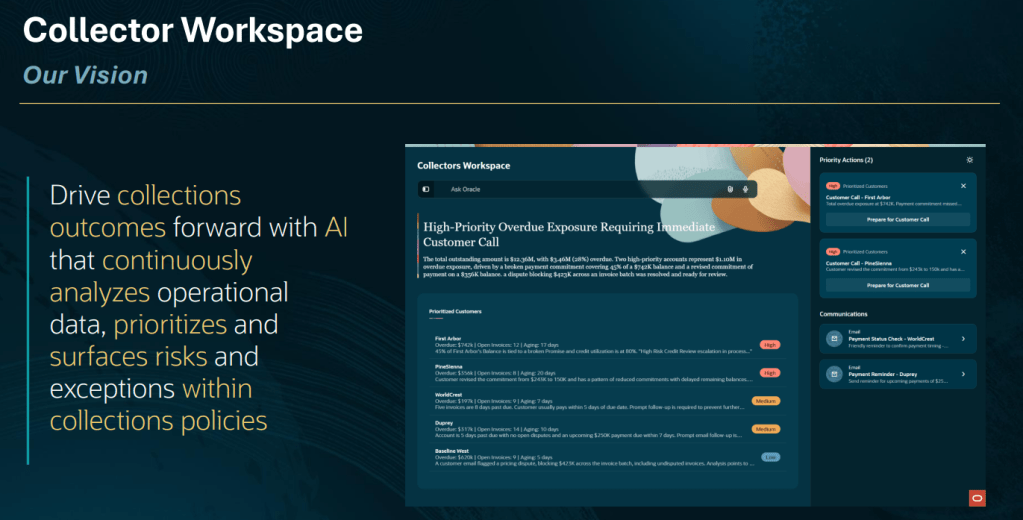
For many finance teams, collections remains one of the most manual activities in the order-to-cash process. Collectors spend their days switching between screens, reviewing ageing reports, checking customer histories, chasing updates from colleagues and deciding who to contact next. The challenge has never really been a lack of data. Most organisations have plenty of it. The problem is knowing which information matters, which customer needs attention now and what action is most likely to improve the outcome. That is exactly the challenge Oracle is aiming to address with the new Collector Workspace Agentic Application in Oracle Fusion Cloud ERP.

One of the themes running through Oracle’s latest Agentic Applications is a shift from helping users complete tasks to helping organisations achieve outcomes. Rather than presenting information and leaving users to work out what to do next, these applications continuously monitor data, identify priorities, recommend actions and help drive work forward.

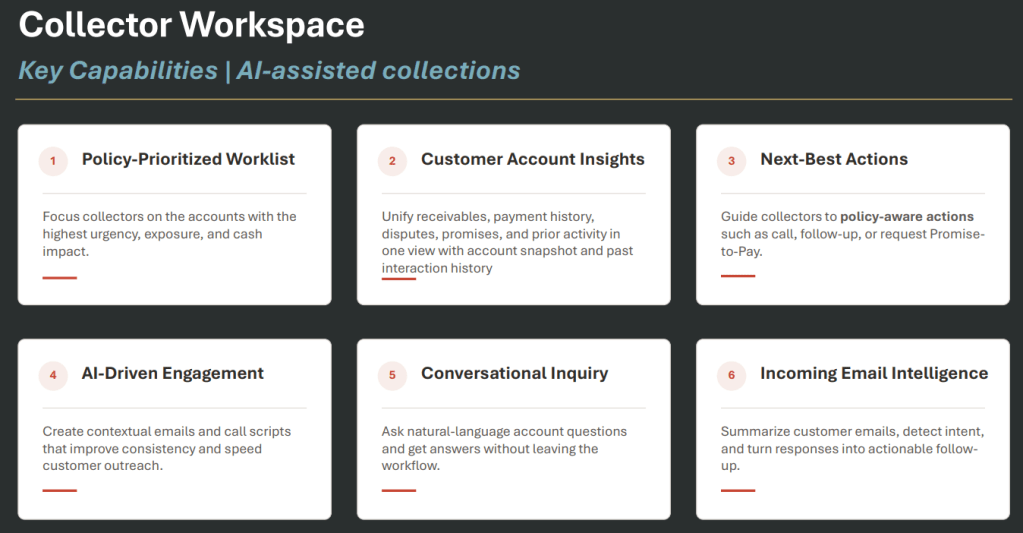
Collector Workspace applies this approach to collections management. The objective is straightforward: improve cash collection performance whilst reducing the effort required from collections teams. Oracle states that the application is designed to support more predictable cash collection, reduced DSO, stronger customer engagement and higher collector productivity. What makes this interesting is that the application doesn’t rely on a one-size-fits-all AI model. Instead, it operates within the framework of an organisation’s own collections policies.

Perhaps the most significant aspect of Collector Workspace is the role of the Collections Policy Document. Rather than allowing AI to make arbitrary decisions, organisations define the rules that drive prioritisation and recommended actions. The policy document can include business metrics, prioritisation criteria, allowed actions and guidance for next best actions in different collection scenarios.

For example, a business could define that customers with a high percentage of overdue balances should receive immediate attention, while lower-risk accounts are handled differently. The application uses these rules to prioritise work and recommend actions. This should feel reassuring to finance leaders who are interested in AI but remain concerned about governance and control. The AI is not replacing established collections processes. It is helping teams execute them more consistently.

One of the reasons collections can be inefficient is the amount of context switching involved. Collectors often need to review payment history, disputes, promises to pay, customer communications and account status before deciding how to proceed.

Collector Workspace brings this information together into a single view, providing account snapshots and historical interaction data in one place. This alone could save significant time. But Oracle has gone further by adding conversational AI capabilities that allow collectors to ask natural language questions about customer accounts and transactions directly within the workflow. Instead of navigating through multiple screens to locate information, collectors can simply ask questions and receive answers within the context of their work.

Another area where Collector Workspace stands out is customer engagement. The application can generate contextual emails and AI-assisted call scripts, helping collectors communicate more consistently and efficiently. It can also create Promise-to-Pay requests and support follow-up activities.

This isn’t about replacing human interaction. Collections often requires judgement, negotiation and relationship management. Instead, the technology aims to remove preparation effort so collectors can focus their attention on the conversation itself.

For organisations with large collections teams, consistency can sometimes be difficult to maintain. AI-generated communications may help ensure that messaging remains aligned to company policy and best practice.

One capability I find particularly compelling is incoming email intelligence. Collector Workspace can summarise customer emails, detect intent and convert responses into actionable follow-up items. It can also identify Promise-to-Pay commitments contained within customer communications.

Anyone who has spent time in finance operations knows just how much effort can be consumed interpreting emails, updating records and determining the next step. Automating these administrative activities could have a meaningful impact on productivity.

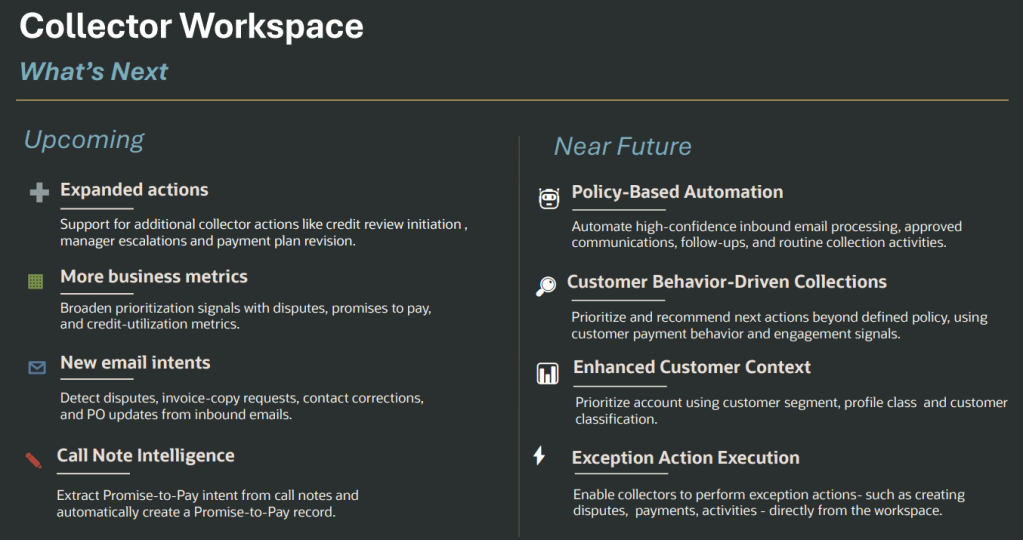
Oracle’s roadmap suggests this capability will continue to grow, with future plans to identify additional intents such as disputes, invoice copy requests, purchase order updates and contact corrections.

What interests me most about Collector Workspace is what it represents. For years, ERP innovation has focused on making transactions faster and processes more efficient. Agentic Applications feel different. They are designed around outcomes rather than transactions.

In the case of collections, success is not measured by how quickly someone can create an activity record or send an email. Success is measured by improving cash flow, reducing overdue balances and helping collectors focus on the accounts that will have the greatest business impact.

Collector Workspace is one of the clearest examples yet of how Oracle is applying agentic AI to solve a real business problem. If it delivers on that promise, collections teams may spend less time deciding what to do next and more time achieving the outcomes the business actually cares about.

And perhaps that is the real story here. The future of enterprise AI may not be about doing the work for us. It may be about helping us focus our expertise where it delivers the greatest value.

Please note that all screenshots are the property of Oracle and are used in accordance with Oracle’s Copyright Guidelines.
Oracle’s Ledger Agent Is Evolving: What You Need to Know About the New Ledger Agentic App

If you’re already using Oracle’s Ledger Agent, there’s an important change arriving with the Oracle Fusion Cloud ERP 26C release. Oracle has introduced the new Ledger Agentic App, which represents the next stage in the evolution of AI-assisted accounting within Fusion. While many of the capabilities will feel familiar, Oracle’s long-term investment is now focused on the Agentic App, and a retirement timeline has been confirmed for the existing Ledger Agent. The good news is that there’s plenty of time to prepare, and getting started is simpler than you might expect.

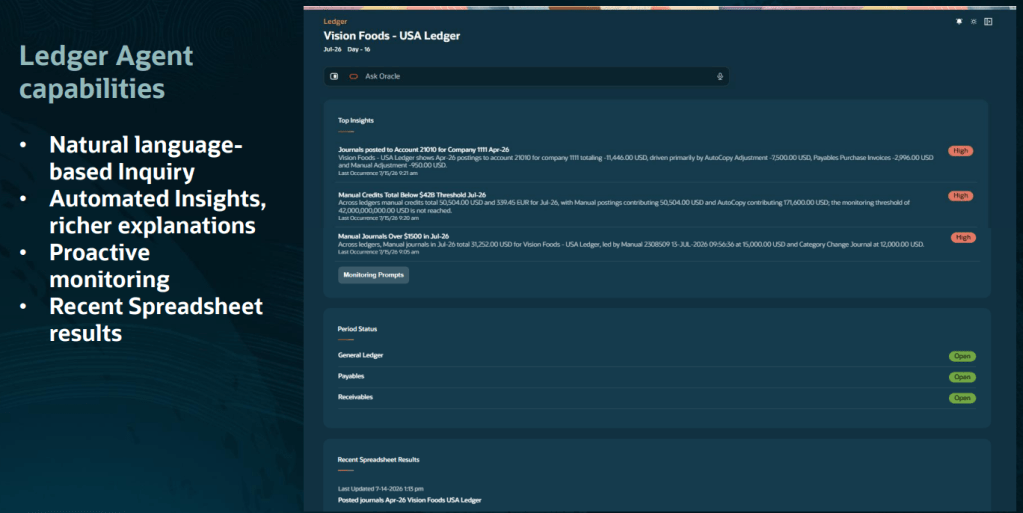
The Ledger Agentic App builds on the foundations of Ledger Agent and brings together accounting insights, proactive monitoring and conversational AI in a dedicated Ledger Workspace. For existing users, the experience will feel familiar. You can still ask questions using natural language and receive financial insights without needing to navigate reports or dashboards. What changes is the overall experience. Rather than offering standalone AI interactions, Oracle is creating a single workspace where accountants can investigate issues, review insights and interact with AI in one place.

In the 26C release, Oracle has enhanced the application’s understanding of accounting terminology and business context, helping it deliver more accurate responses and maintain the flow of conversations more effectively when users ask follow-up questions. This is more than a simple name change. The Ledger Agentic App provides the platform Oracle will use to deliver future accounting-focused AI capabilities.

What happens to the existing Ledger Agent? There’s no immediate pressure to switch. Oracle has confirmed that Ledger Agent will continue to be supported during both the 26C and 26D releases. However, it is scheduled for retirement in 27A, which means organisations currently using Ledger Agent should start planning their transition. 

Oracle recommends evaluating the Ledger Agentic App during 26C and completing the move during 26D, ensuring everything is in place well before Ledger Agent reaches end of life. Importantly, any monitoring prompts and generated insights you’ve already configured within Ledger Agent will remain available through the new Ledger Workspace, making the transition considerably easier. 

One of the most important considerations is licensing. For production environments, the Ledger Agentic App requires Oracle’s Agentic Apps SKU, which is licensed separately from your standard Oracle Fusion subscription. The Agentic Apps licence provides access not only to the Ledger Agentic App, but also to a growing portfolio of agentic applications across Oracle Fusion, including areas such as collections, payables close and billing operations. It also includes access to Oracle’s AI App Builder and agent orchestration capabilities, along with an annual allocation of AI units that can be shared across applications. Licensing models and pricing can vary, so it’s worth discussing your options with your Oracle Account Director to understand what this means for your organisation. 

The good news is that Oracle allows customers to explore the Ledger Agentic App in non-production environments without purchasing the Agentic Apps licence. This provides an opportunity to evaluate the experience, understand the potential benefits and prepare for the transition before making any production licensing decisions. 

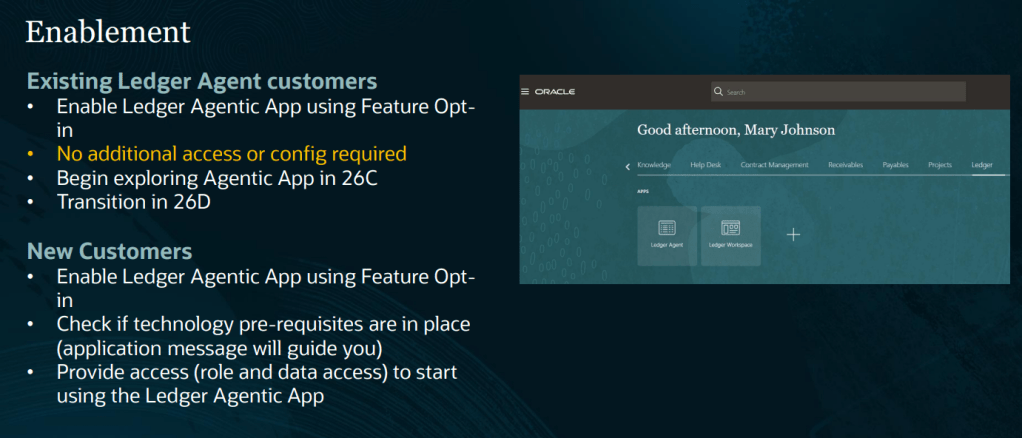
For organisations already using Ledger Agent, enabling the Agentic App is straightforward. There’s no requirement for additional security roles or data access configuration. Administrators simply need to enable the Ledger Agentic Application feature through the General Ledger functional area’s feature opt-in settings. 

Once enabled, users can access both the existing Ledger Agent and the new Ledger Workspace, providing a smooth transition period while teams become familiar with the new experience. If you haven’t yet adopted Ledger Agent, Oracle’s recommendation is even simpler: skip directly to the Ledger Agentic App. 

The introduction of the Ledger Agentic App offers a glimpse into Oracle’s wider vision for the future of finance operations. Oracle is investing heavily in AI capabilities that help finance teams move beyond basic enquiries and into areas such as exception management, root cause analysis and guided decision-making. Future enhancements are expected to help accountants investigate variances, resolve accounting issues and receive recommendations based on organisational policies and financial context. The aim is not to replace finance professionals. It’s to reduce the time spent searching for information and investigating routine issues, allowing teams to focus on higher-value analysis and decision-making. If your organisation is already benefiting from Ledger Agent, the new Ledger Agentic App is a natural next step. 

With support for Ledger Agent continuing through 26D, there is no urgent deadline. However, the transition period provides an ideal opportunity to explore the new experience, understand the licensing implications and begin preparing for Oracle’s future direction. The Ledger Agentic App is clearly where Oracle’s investment is focused, and organisations that start evaluating it now will be well positioned to take advantage of the new capabilities arriving over the next few releases. 

Please note that all screenshots are the property of Oracle and are used in accordance with Oracle’s Copyright Guidelines. 
Oracle’s Cash Processing Agent: Could This Be the End of Manual Cash Matching?

Anyone who has worked in Accounts Receivable or treasury knows that some tasks simply consume more time than they should. Matching receipts to invoices, investigating unidentified payments, tracking cash positions across multiple accounts, and working out how to address funding shortfalls are all activities that can eat into the working day. They are important, but they’re also repetitive, manual, and often frustrating.

That’s why Oracle’s new Cash Processing Agent caught my attention. Rather than simply helping users analyse information faster, it actively performs many of the activities that finance teams traditionally carry out themselves. It creates receipts, matches payments to invoices, identifies exceptions, monitors liquidity, and even recommends actions when it detects potential cash shortfalls. For finance teams, this has the potential to change the way day-to-day cash management is handled.

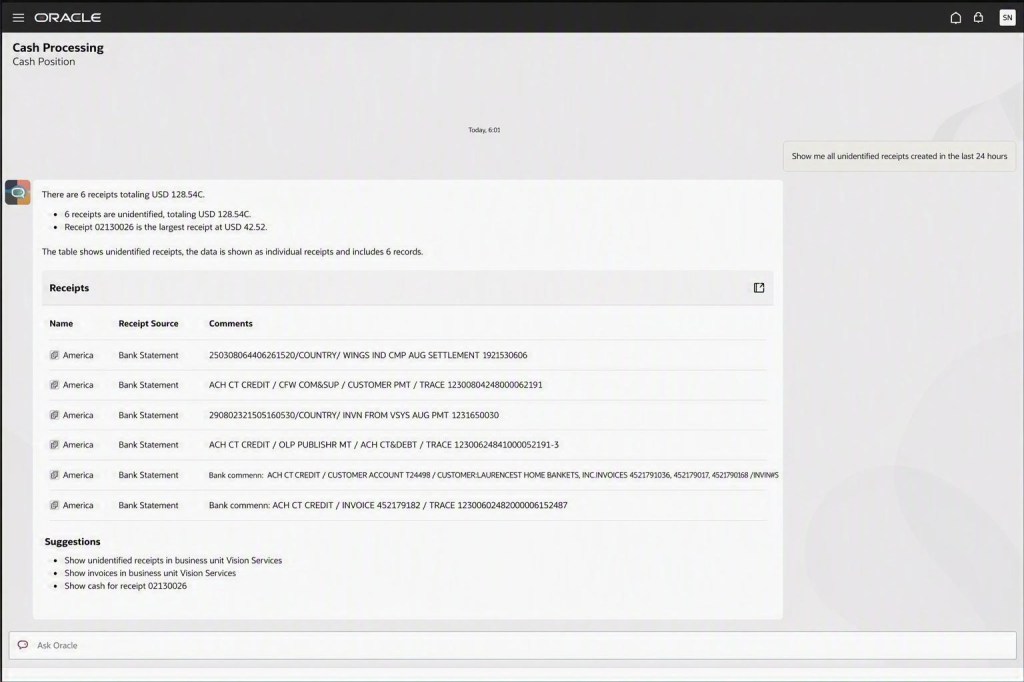
Applying customer receipts can be one of the most labour-intensive processes within Accounts Receivable. Payment information arrives from different sources. Bank statements show money arriving in the account, remittance advice may be sent separately by email, and someone then needs to connect the two before applying the payment to the correct invoices.

The Cash Processing Agent automates much of that process. It can create receipts directly from bank statement transactions, extract information from remittance emails and attachments, identify the related invoices, and apply receipts automatically where sufficient information is available. When something doesn’t match, the agent doesn’t simply leave users with an unexplained exception. Instead, it surfaces the issue along with the information needed to investigate and resolve it.

What I particularly like is the conversational approach. Rather than navigating between multiple screens and work areas, users can investigate receipts, review supporting information and take corrective action from within the same experience.

For finance teams, the practical benefit is straightforward:

  • Less manual receipt processing
  • Faster application of customer payments
  • Reduced exception backlogs
  • More time spent resolving genuine issues rather than routine matching

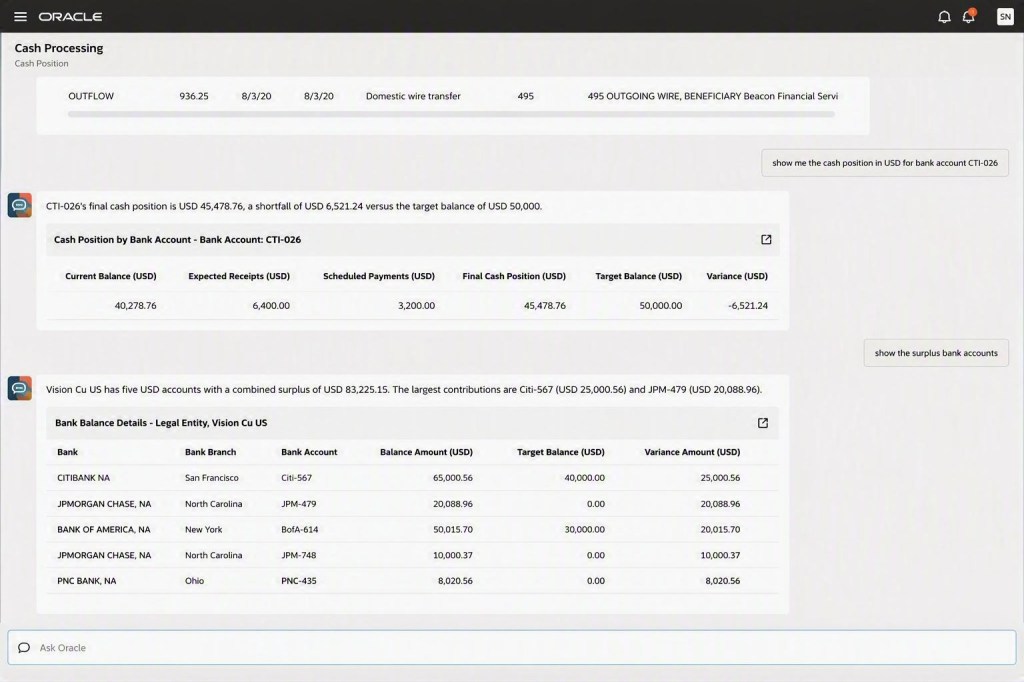
The second area where the Cash Processing Agent adds value is cash position and liquidity management. Many treasury teams still spend a significant amount of time monitoring balances, identifying funding gaps and determining how those shortfalls should be addressed. Traditionally, this has been a reactive process. An analyst identifies a problem and then investigates the underlying cause before deciding what action to take.

The Cash Processing Agent takes a more proactive approach. It continuously monitors cash positions and highlights potential shortfalls as they emerge. Instead of simply raising an alert, it provides context by identifying the transactions contributing to the position and highlighting available surplus funds elsewhere. The agent can then recommend transfers that could be used to address the shortfall.

Users remain in control of the decision, but much of the investigation work has already been completed for them. This means treasury teams can spend less time gathering information and more time making informed decisions.

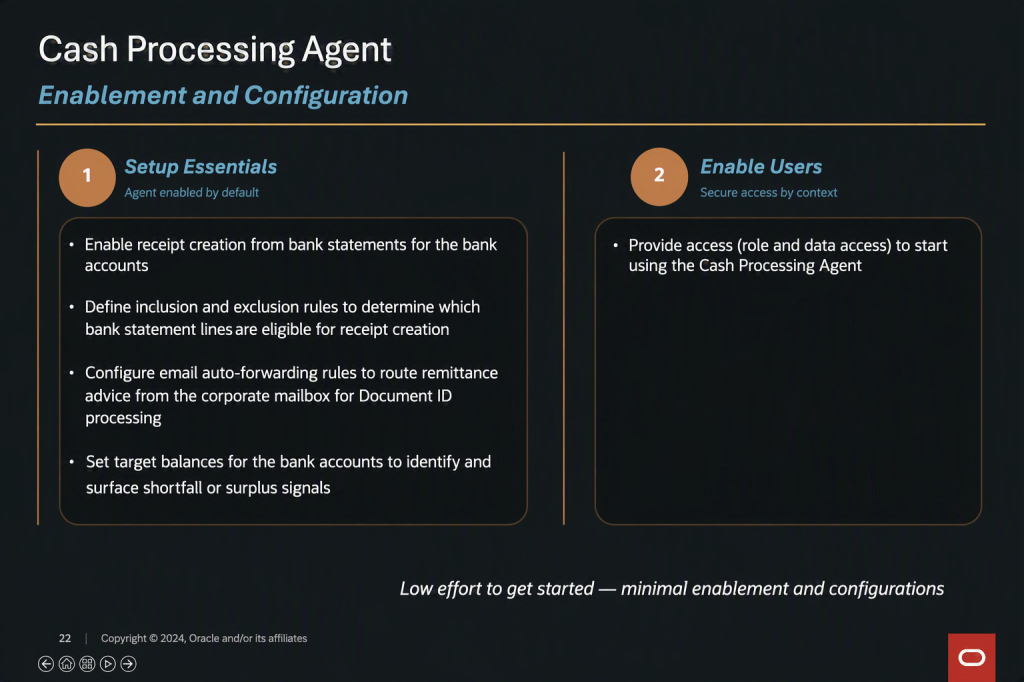
Like most AI capabilities, outcomes will depend heavily on the quality of the information available to the system. If bank statement imports are unreliable, customer payment data is incomplete, or cash management configurations need attention, those issues should be addressed before enabling the agent. The better the underlying data, the more accurately the agent can perform.

Fortunately, Oracle has kept the setup relatively straightforward. Organisations need to configure how bank statement transactions are processed, define which transactions the agent should work with, and establish how remittance information is captured. For liquidity management, threshold balances can be configured to determine when potential shortfalls should be highlighted.

There’s no shortage of AI announcements in the ERP market at the moment, but many still focus on helping users analyse information or generate content. What makes the Cash Processing Agent different is that it performs work that finance teams have traditionally completed themselves.

By automating receipt processing, identifying exceptions, monitoring liquidity and recommending actions, it has the potential to remove a significant amount of repetitive effort from both Accounts Receivable and treasury operations. For users, that means spending less time matching transactions and investigating balances, and more time focusing on the activities that genuinely require human judgement.

Please note that all screenshots are the property of Oracle and are used in accordance with Oracle’s Copyright Guidelines.