
Oracle has rebranded Oracle Cloud Success Navigator as Oracle AI Success Navigator, and while a name change might sound like a cosmetic exercise, what’s happening underneath is far more interesting. Oracle is actively strengthening the partnership between AI Success Navigator and Oracle Guided Learning (OGL), and for those of us who have long championed both products, this new direction is very exciting!
Oracle AI Success Navigator (formerly Oracle Cloud Success Navigator, or CSN) is Oracle’s platform for helping customers plan, implement, and continuously innovate with Oracle Cloud Applications. It’s included as part of your Oracle Cloud subscription, so if you’re not using it, you’re missing a trick to get more from your Fusion instance.
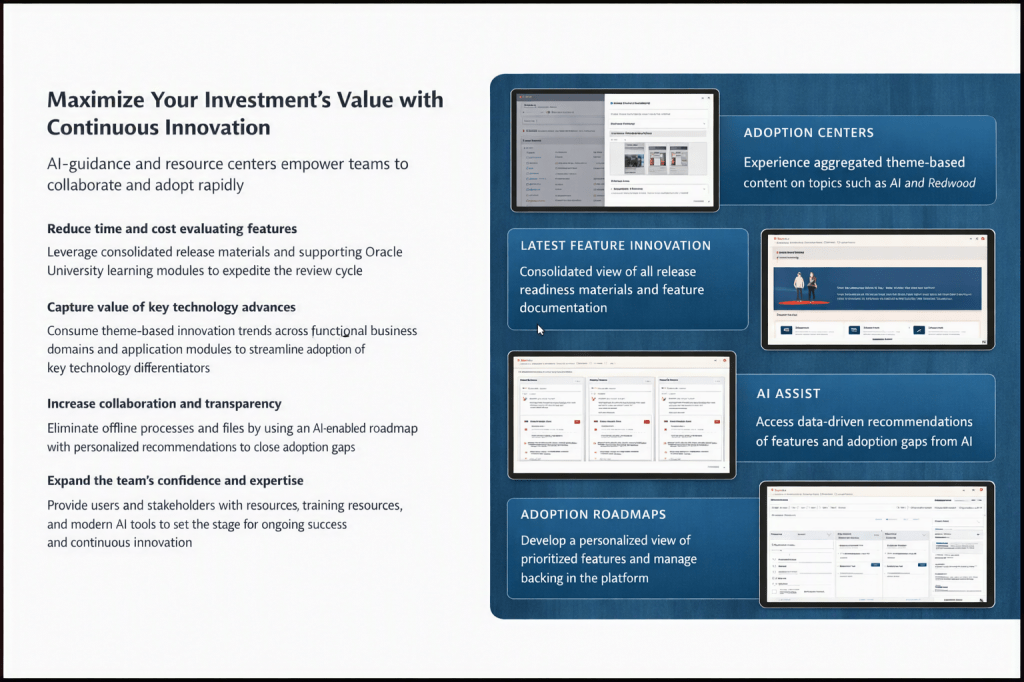
The AI Success Navigator platform gives you four key areas to work with: Latest Feature Innovation, a consolidated view of release readiness materials across your product pillars; Adoption Roadmaps, a personalised and prioritised feature backlog managed directly in the platform; Adoption Centres, theme-based content hubs covering topics like AI and Redwood; and AI Assist, an OCI Generative AI-powered chat interface that I’ll come back to in some detail.
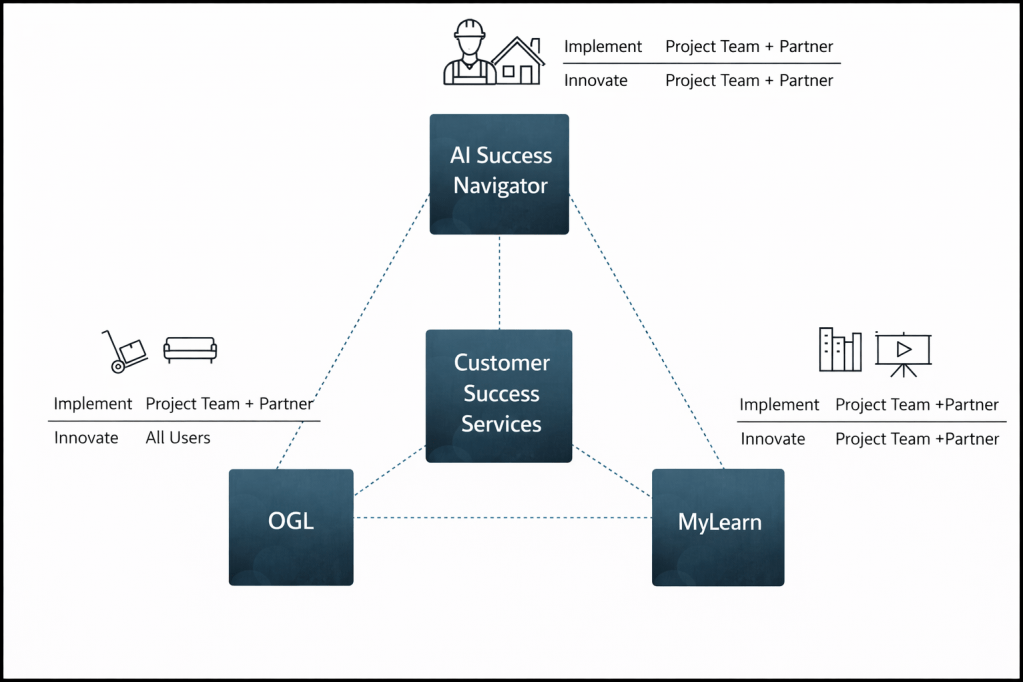
AI Success Navigator, OGL, and MyLearn are all interconnected and Oracle’s Customer Success Services sits in the middle of each. AI Success Navigator is the planning and intelligence layer and OGL is the point-of-need delivery mechanism inside the application. During implementation, OGL is primarily the concern of the project team and partner. Post-go-live, it becomes relevant to all users. MyLearn is the key mechanism for users to learn about Oracle Fusion and therefore is an important consideration.
What’s changing is that these products are no longer operating in isolation. OGL content is now surfaced within AI Success Navigator in the Oracle Modern Best Practice (OMBP) area as job aids, and within Starter Configuration. AI Assist is also being increasingly trained on OGL best practices and project success indicators, meaning the recommendations it produces are grounded in what good OGL adoption actually looks like.
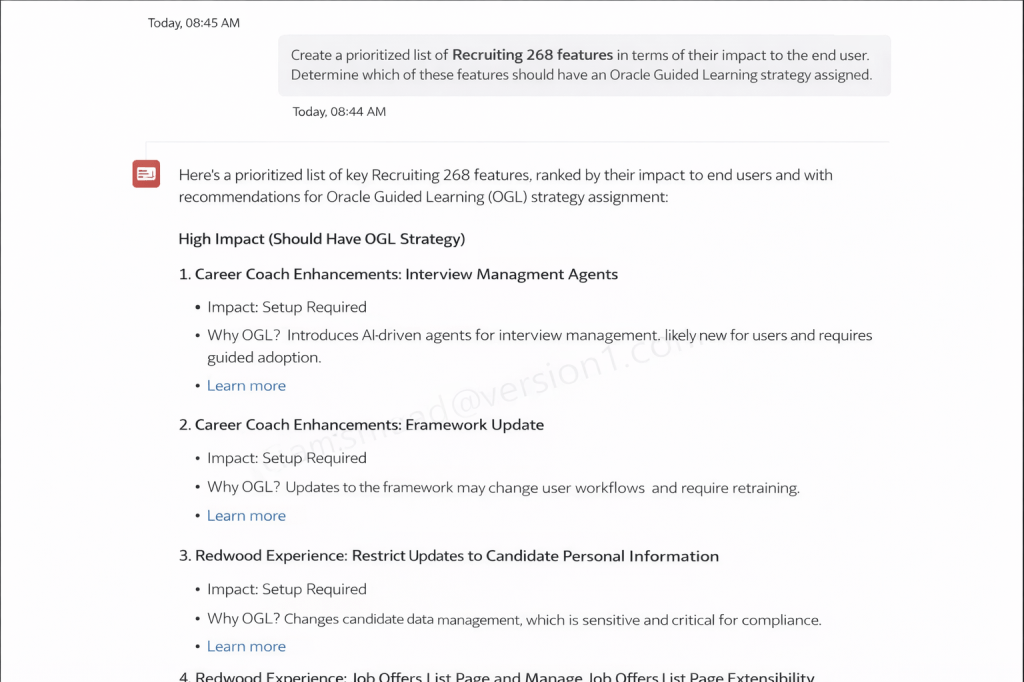
Are you aware of the opportunity to use Success Navigator’s AI Assist to help produce OGL Content? On a recent webinar the presenter asked AI Assist to produce a prioritised list of Recruiting 26B features ranked by end-user impact, with a recommendation on which should have an OGL strategy assigned. The output was a ranked list classifying features as high, medium, or low impact, with a clear rationale for each. Features like Career Coach Enhancements (Interview Management Agents) and the Redwood Experience changes to candidate data management were flagged as high impact, with specific reasoning around setup requirements and workflow changes for end users.
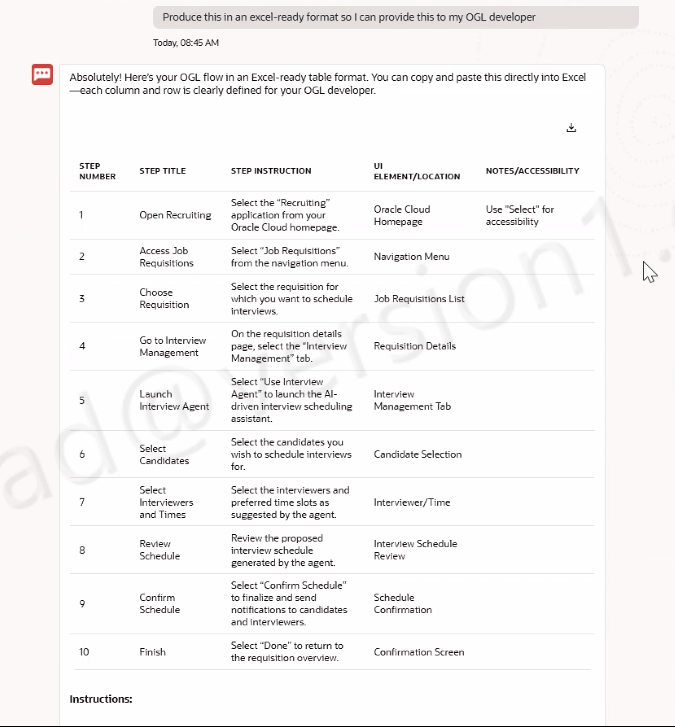
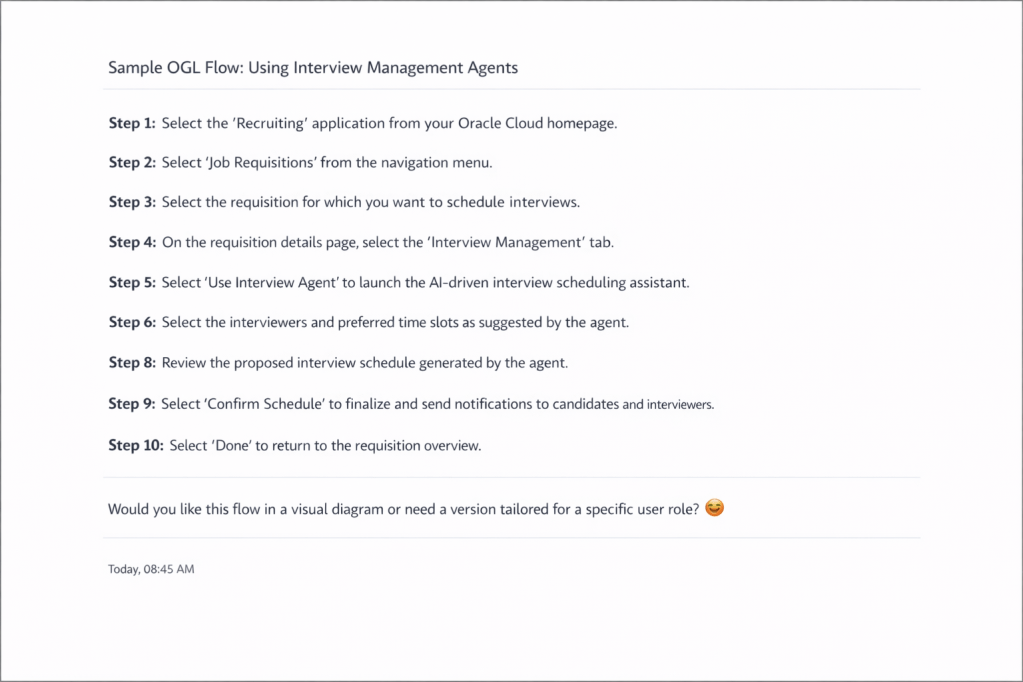
The next step was even more useful. Having identified that the Interview Management Agent feature needed OGL coverage, the presenter asked AI Assist to produce a sample OGL flow. The output was a structured, step-by-step guide covering navigation path, UI element locations, and accessibility notes. When the presenter asked for it in an Excel-ready format, AI Assist reformatted the output into a table with columns for Step Number, Step Title, Step Instruction, UI Element/Location, and Notes/Accessibility, ready for an OGL developer to pick up directly.
So what does this mean in practice? An OGL team no longer has to start from a blank page when a quarterly release drops. AI Success Navigator can triage features, identify which ones need OGL attention, and produce a first-draft flow that a developer can then validate and publish. That’s a material reduction in the time between a feature dropping and users having contextual guidance in the application.
One thing to note: AI-generated flows still need validation against the actual application UI and tailoring to your specific user roles and configuration. The AI is a starting point, not a finished product. But it’s a very good starting point.
The webinar also covered the Testing Agent, which I think gets overlooked. It lets you create test cases from scratch using AI, upload existing test scripts for conversion, and refine them through AI Assist. The connection to OGL is practical: well-structured test cases describe real user workflows, and those workflows are exactly the raw material you need to build accurate OGL guides. If your testing and OGL content creation are happening in silos today, AI Success Navigator gives you a way to bring them closer together.
I’ve always felt that AI Success Navigator and OGL were solving related problems without talking to each other enough. What Oracle is doing now is starting to close that gap, and it’s a direction I’m very happy about.
If you’re not already using Oracle AI Success Navigator and you have an Oracle Cloud subscription, start exploring it. If you’re an OGL practitioner, the AI Assist capability is worth your attention specifically. And if you want to understand how the two products can work together in your programme, now is a good time to start that conversation.
Please note all screenshots are the property of Oracle and are used according to their Copyright Guidelines


