
It’s that time in the quarter again. Oracle has just shared what’s coming in Release 26C, and as you’d expect there is a clear emphasis on AI-driven enhancements, with plenty to take note of. More updates are likely to follow over the coming weeks, but for now it is worth taking a look at what has been announced so far.
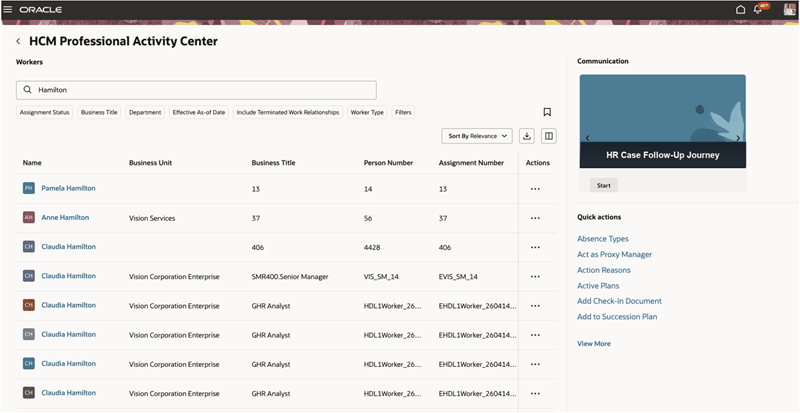
The first feature worth calling out is one many HR teams have been waiting for. Ever since the original Person Management page was effectively retired back in 2020, there has not really been a single, equivalent experience to replace it. What Oracle has delivered here is not a direct like-for-like replacement, and it is clear that is not the intention. Instead, this move aligns with the Redwood design approach and rethinks how users interact with person data. The result is a more modern, task-focused experience that brings together key information and actions in a way that feels far more consistent with the rest of the HCM suite.
In practical terms, it changes how users work day to day. Rather than navigating across multiple pages or relying on memory to find the right option, a HR user can open a worker’s record and see relevant insights alongside the actions they are most likely to take, whether that is updating employment details, reviewing assignments, or initiating changes. This reduces the need for constant clicking and context switching, making everyday tasks quicker and more intuitive. For those who have used the system for a long time, there may still be a sense that the original “one stop shop” is missing. However, this is a clear step forward. It signals a shift away from a single static page towards a more guided and contextual experience that better reflects how people actually work today. It may not replicate everything that Person Management once offered, but it goes a long way towards closing a gap that organisations have felt for some time.
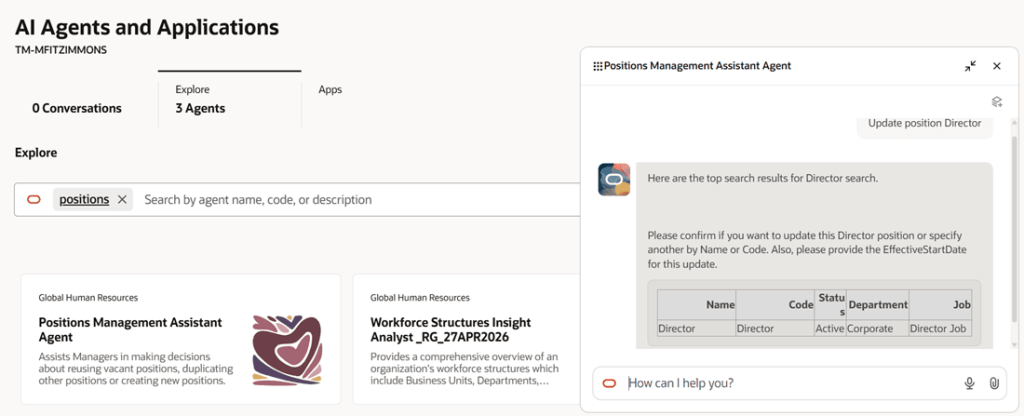
The next feature worth highlighting is AI-led, the Positions Management Assistant. This builds on the Positions Assistant introduced in 25D but takes things a step further by broadening what can be done through a single experience. Rather than focusing only on creating or viewing positions, it now brings editing into the same flow, giving HR teams and line managers a more complete way to manage positions. It uses natural language to understand what the user is trying to do and responds with relevant actions and guidance, which fits with the wider move towards more conversational, AI-driven ways of working.
In practice, this simplifies what can often be a fragmented process. A manager can ask to see vacant positions within their team and the assistant will surface them, suggest next steps and provide a direct route to raise a requisition. If a new position is needed, it can guide the user through creating one, reusing existing information where possible to save time and reduce errors. This makes the experience far more intuitive, particularly for occasional users, while also helping to improve consistency and accuracy. The overall result is a smoother, more guided approach that reduces manual effort, speeds up position management activities and helps organisations move more quickly when filling roles.
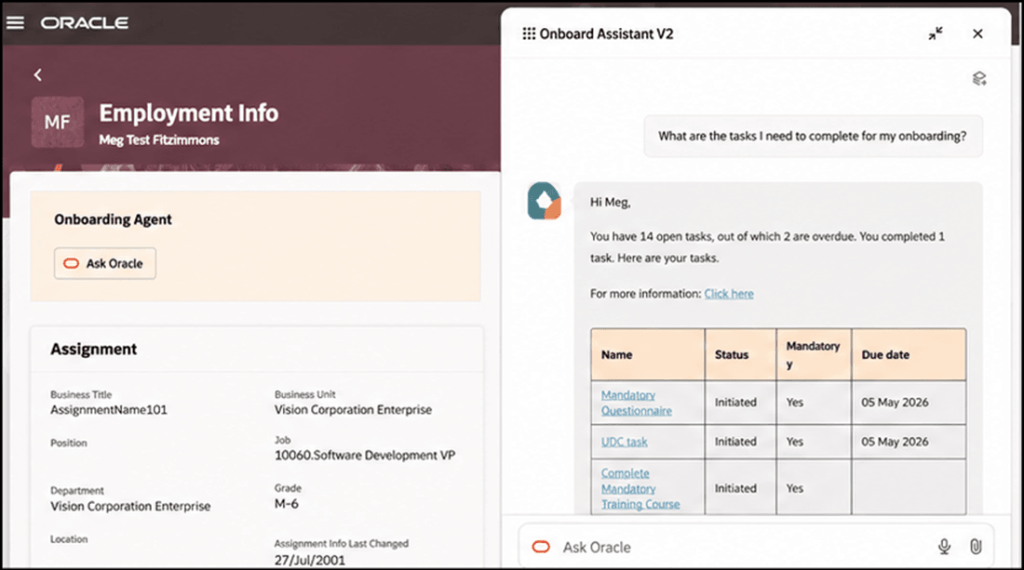
The next feature builds on something we saw introduced in 25D. The Onboarding Agent has now evolved into a workflow agent, marking another step in Oracle’s move towards more intelligent, guided employee experiences. The new Onboard Assistant takes the earlier self-service capability and turns it into a more interactive, conversational experience for new hires. Rather than working through static checklists or searching for information, users can ask questions in plain language and receive clear, relevant answers tailored to their role, location and organisational policies.
In practice, this makes the onboarding journey feel far more straightforward. A new starter can ask what tasks still need to be completed, check for anything overdue and follow a direct link to take action. The assistant can also surface useful resources, provide reminders and guide users through more complex steps when needed. For anyone unfamiliar with the system, this removes much of the uncertainty that can come with getting started. Overall, it creates a more supported and personalised experience that helps new hires get up to speed more quickly, reduces confusion and ensures that key onboarding activities are completed on time.
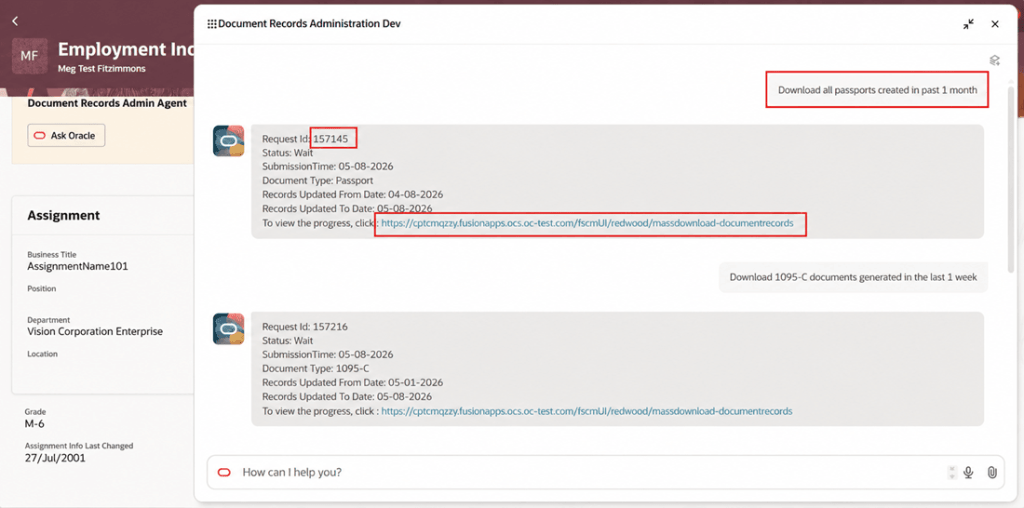
There are a couple of notable updates in Document Records, particularly around the use of AI. The first is the Document Records Administration Assistant, which is a clear example of how Oracle is embedding AI into everyday HR administration. In this case, the focus is on simplifying how users retrieve document records. Rather than working through multiple screens and manually applying filters, users can describe what they need in plain language. The assistant interprets the request and submits the appropriate mass download action, removing much of the effort from what has traditionally been quite a manual process.
In practice, this makes a real difference. A HR user could ask to download all passports created in the past month or retrieve payslips generated in the last week, and the assistant will identify the document type, apply the relevant criteria and trigger the correct request. For infrequent users in particular, this removes the need to understand the underlying navigation. The process becomes far quicker and far more straightforward. Overall, it provides a more intuitive way to retrieve document records, reducing admin time, improving accuracy and helping users get to the right outcome first time.
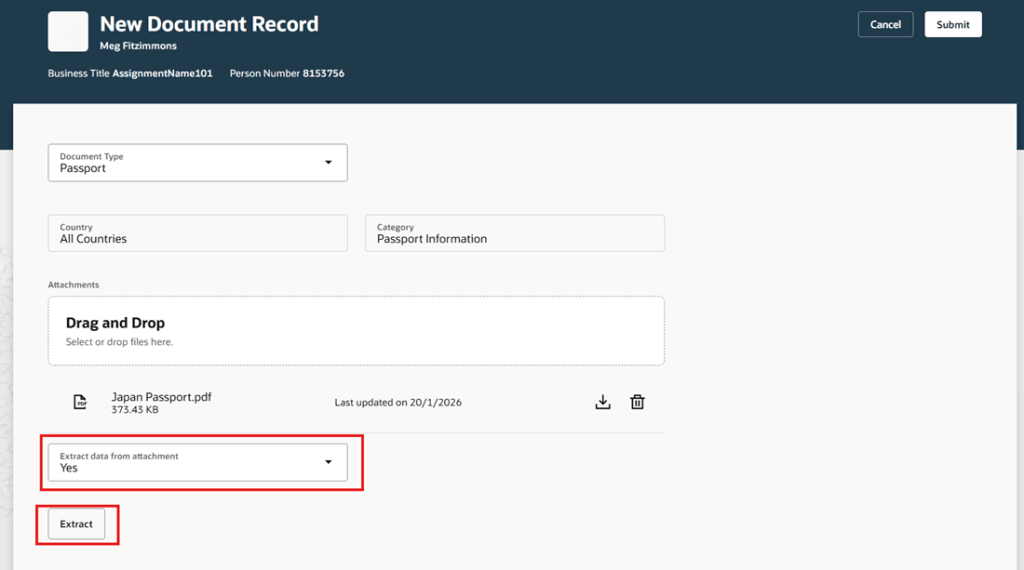
The second update focuses on using AI to extract data from attachments and prefill document record attributes. It is a relatively simple enhancement, but one that addresses a very common pain point in HR administration. When creating document records, users often have to rekey information that already exists in the uploaded file. This feature reduces that effort by using AI to identify and extract key details from the attachment and populate the relevant fields automatically. It aligns closely with the Redwood approach of reducing manual input and making everyday tasks quicker and easier to complete.
In practice, when a user uploads something like a passport or certification, the system can pick up details such as the document number, issuing country and validity dates, and populate these directly into the record. The user can then review and amend the information before saving, rather than starting from scratch. This not only saves time but also reduces the likelihood of manual errors. Over time, capabilities like this can have a noticeable impact on data quality, while also making the process far more efficient for both HR teams and employees managing their own records.
There are a number of upcoming changes around Redwood pages, and the timelines are now starting to feel very close. From 26C, the Redwood person pages will be enabled by default, covering key areas such as Personal Details, Contact Information, Identification Details, Family and Emergency Contacts, Additional Person Information and Person Identifiers for External Applications. For many organisations, this is the point where the move to Redwood becomes unavoidable for core HR data.
This continues in 26D, with areas such as Jobs, Locations, Departments, Enterprise HCM Information, Grade Ladders and all Employment pages, including actions like Add Assignment and Employment Information, also switching to Redwood by default. The same pattern carries into 27A, where processes such as Resign from Employment, Mass Assignment Change and Terminate Employment will be automatically enabled.
If you have not already moved to these Redwood pages, now is the time to start planning. Leaving it until they are switched on by default means losing control over when the change happens and removes the option to step back if needed. Moving earlier gives you the opportunity to test properly, prepare your users and resolve any issues before the transition becomes mandatory.
As mentioned earlier, Oracle is expected to release additional Core HR updates later this month. If anything stands out as particularly impactful, I will share a further update with a more detailed view. In the meantime, keep an eye out for the upcoming posts in this series where we will explore other areas of Fusion as part of Release 26C. If you are reviewing your own roadmap or considering how these changes might affect your organisation, now is a good time to start the conversation.
Please note all screenshots are the property of Oracle and are used according to their Copyright Guidelines


