
When Oracle introduced AI Agent Studio, it gave organisations the ability to build and deploy custom AI agents directly within Oracle Fusion. As customers move from experimentation into production, one question comes up repeatedly: So, which LLM should I use? At first glance, this looks like a technical decision. In reality, it has significant implications for cost, performance and the way your AI agents operate at scale. With Oracle’s new AI Unit pricing model, the LLM you choose can directly affect how quickly you consume your AI allocation, making model selection an important part of both solution design and budget planning.
The Good News is that Oracle Gives You Choice, Oracle AI Agent Studio allows organisations to select the LLM that best fits their requirements. For some use cases, a basic model may provide everything you need. For others, a premium model delivers the additional reasoning and conversational capabilities required for more complex business processes.
The important thing is that Oracle is not forcing customers into a single approach. Instead, organisations can align model selection to the specific needs of each AI agent. This flexibility is particularly valuable because not every business process requires the same level of intelligence.
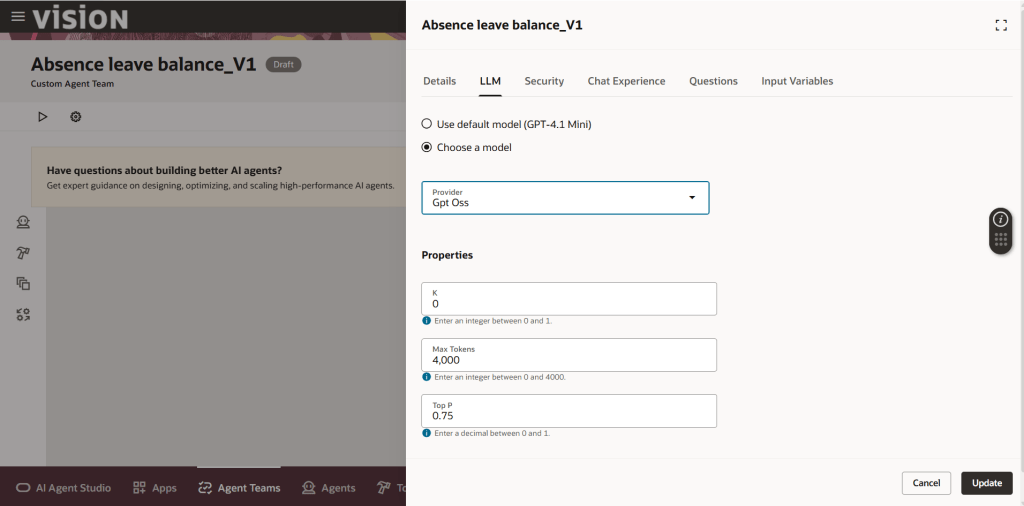
I get asked a lot, how can I check which LLM my agent is using. If you go to AI Agent Studio, find your agent and click on the edit button and then the cog button, the below options will appear. Click on the LLM tab and review what is selected. In this example, the default was GPT-4.1 Mini which is a premium LLM, so I’ve switched it to the free GPT OSS. Just click update and it is all saved.
One of the biggest misconceptions surrounding AI agents is that every use case requires the most powerful model available. In practice, many agents perform relatively focused tasks:
- Classifying documents
- Extracting information from forms
- Routing requests
- Generating standard responses
- Performing workflow actions
For these kinds of activities, a basic LLM may deliver perfectly acceptable results while keeping AI Unit consumption lower. The challenge is that many organisations instinctively select a premium model for every use case without fully understanding the cost implications. As with any cloud service, right-sizing matters.
Another key consideration is the impact on AI Unit consumption. Oracle’s new pricing model is based on AI Units rather than traditional licensing metrics such as users, agents or tokens. Every Fusion customer receives a monthly allocation of AI Units, with additional capacity available if required.
Where this becomes relevant is the relationship between the selected LLM and AI Unit consumption. During Oracle’s recent pricing briefing, examples showed that general actions using a premium model consume AI Units, while actions using a basic LLM can often be performed without additional AI Unit charges. This means the model choice behind an agent can have a direct effect on ongoing operational costs. For organisations planning multiple custom agents, this quickly becomes an architectural consideration rather than simply a design preference.
When deciding whether to use a basic or premium model, I encourage customers to focus on business risk and business value. Ask yourself:
- What is the impact if the answer is wrong?
- Does the process involve customer interactions?
- Is there financial or compliance risk?
- Does the agent need to reason across multiple pieces of information?
- Is a human reviewing the output before action is taken?
For low-risk activities, a basic model may be entirely appropriate. For more complex scenarios, such as HR advisory services, financial decision support or customer-facing interactions, the additional capability of a premium model may justify the additional AI Unit consumption. The goal should not be to minimise AI Unit usage at all costs. The goal should be to use the right model for the right task.
One particularly important point that emerged from Oracle’s pricing session is that AI Units consumed in non-production environments also count towards usage when premium models are being used. This means development, testing and experimentation activities can contribute to overall AI consumption.
Many organisations are accustomed to thinking about production workloads when budgeting cloud services, but AI introduces a different dynamic. Agent testing, prompt refinement and user acceptance testing all have the potential to generate usage. As AI adoption grows, development and testing practices will need to evolve to take this into account.
The reality is that most organisations do not yet have mature governance processes for AI consumption. That will need to change. Oracle has already introduced observability and analytics capabilities to help customers understand performance, accuracy and AI Unit consumption. Future releases will also provide additional controls such as budgets and consumption caps. These capabilities will become increasingly important as organisations deploy larger numbers of AI agents across HR, Finance, Procurement, Supply Chain and Customer Experience. Without visibility, it becomes difficult to understand whether the business value being generated justifies the cost being incurred.
When building agents in Oracle AI Agent Studio, my recommendation would be to always start with the business outcome rather than the technology. Not every use case requires a premium model, and not every process should be optimised purely for cost. The most successful organisations will take a balanced approach, matching model capability to business need. Use premium models where reasoning, accuracy and user experience are critical. Use simpler models for straightforward, repetitive tasks where the additional intelligence offers limited value.
Most importantly, monitor consumption from the beginning. AI Units are becoming the new currency of Oracle AI, and understanding how your model choices affect usage will be essential to scaling AI successfully across the enterprise.
Please note all screenshots are the property of Oracle and are used in accordance with Oracle’s Copyright Guidelines.


