Is RODS the Future of Oracle Fusion Data Extraction?

If you’ve been working with Oracle Fusion for any length of time, you’ll know that getting data out of Fusion is often just as important as getting data into it. Whether it’s feeding a data warehouse, supporting reporting requirements, populating a data lake, or increasingly providing the data needed to power AI initiatives, organisations are extracting more Fusion data than ever before.

Traditionally we’ve had a number of options available to us, including HCM Extracts, BI Publisher and BICC. They all have their place and continue to solve different business challenges. But Oracle has recently introduced something new that could become a significant part of its long-term data extraction strategy: the Read Optimised Data Store (RODS).
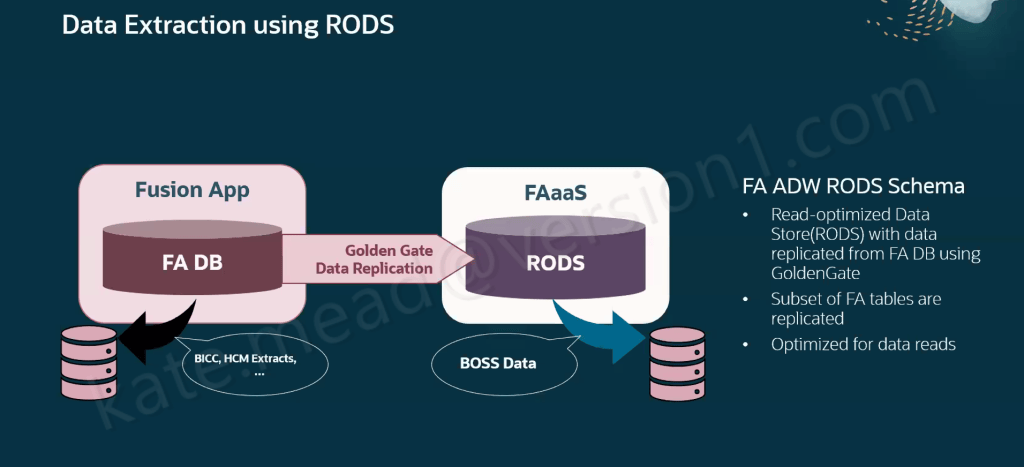
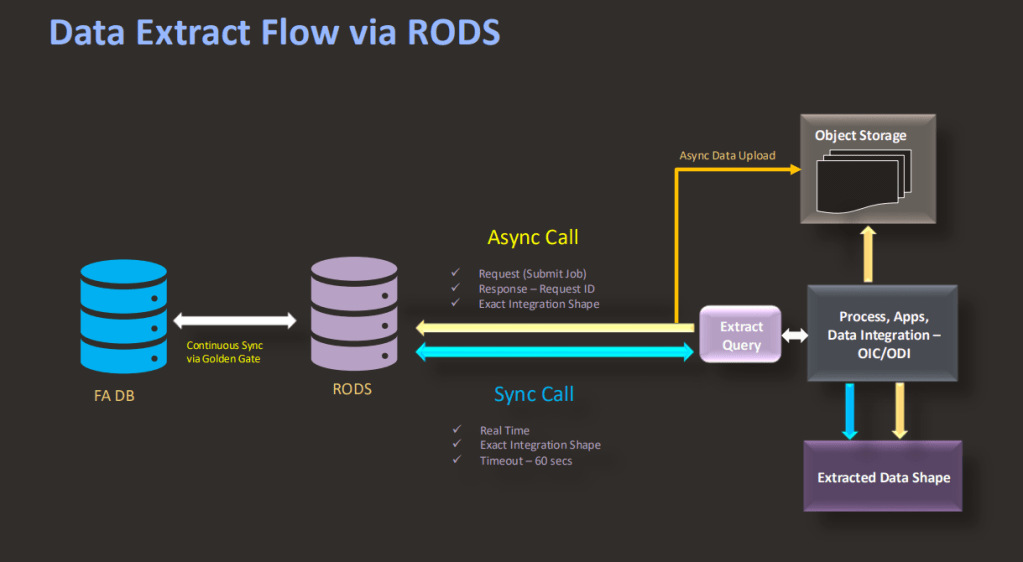
So, what is RODS? At a high level, RODS is exactly what the name suggests: a read-optimised copy of Fusion data designed specifically for extraction and reporting workloads. Instead of running large extraction jobs against the live transactional database, Oracle replicates selected Fusion data into a separate environment using GoldenGate technology. Extraction processes then run against this replicated data store rather than the core application database. The goal is simple. Make high-volume data extraction faster while reducing the impact on day-to-day Fusion operations.

For many organisations, extraction volumes continue to grow. Data is no longer only being extracted overnight for a monthly report. Today’s integrations, analytics platforms, AI services and operational reporting solutions often require much larger volumes of data and much greater frequency.

Historically, there has always been a balance between extracting the data you need and consuming resources that could otherwise be used by the application itself. RODS changes that dynamic. Because extraction workloads are separated from the transactional environment, organisations can run large-scale extracts without placing the same demand on the Fusion application database. That could be particularly valuable for customers with significant reporting requirements or complex integration landscapes.
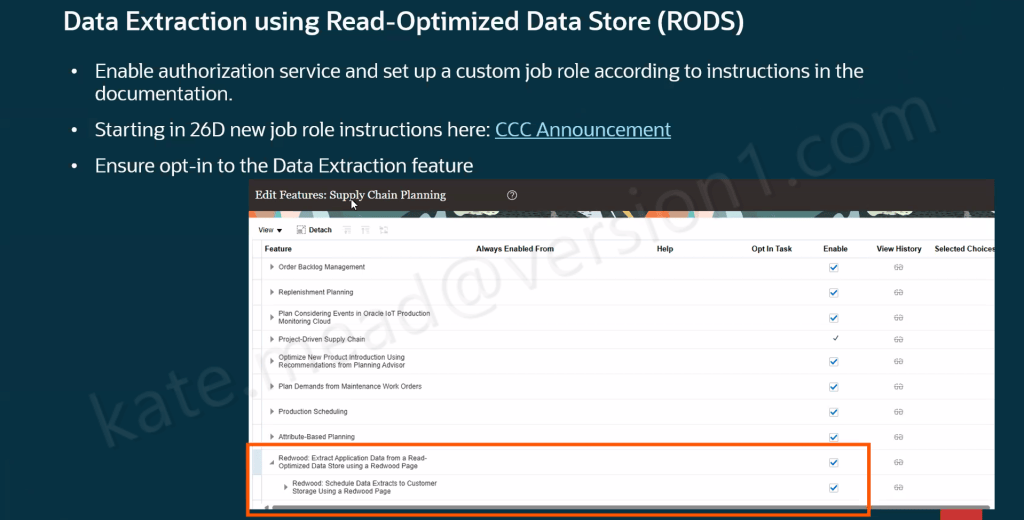
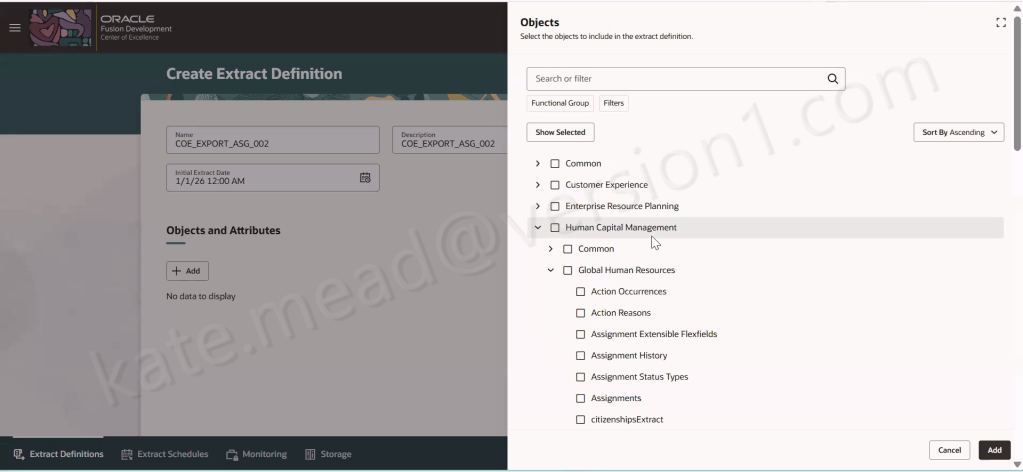
RODS is supported by Oracle’s new Data Extraction Tool (DET), which provides the framework for defining, scheduling and managing extracts. The Data Extraction Tool supports both full and incremental extracts and can output data in either CSV or JSON format. For organisations building modern data platforms, that’s likely to be exactly what they need. Clean, structured data delivered quickly and efficiently.

Does this replace HCM Extracts? No. And I think that’s an important point to understand. Whenever Oracle introduces a new capability, one of the first questions customers ask is whether it replaces what’s already there. The answer, at least today, is no.

HCM Extracts remain incredibly powerful, particularly where organisations require complex formatting, business logic, Fast Formula processing or highly tailored output files. RODS isn’t trying to solve those problems. Instead, it is focused on extracting large volumes of data efficiently and making that data available for downstream consumption. In reality, I suspect most organisations will continue to use a combination of technologies depending on the requirement.

The most interesting aspect for me isn’t necessarily the technology itself. It’s Oracle’s direction of travel. Oracle has openly discussed RODS as the long-term strategic direction for high-volume extraction and replication workloads, with many seeing it as the natural successor to BICC. That doesn’t mean existing extraction methods are going away anytime soon, but it does suggest where Oracle’s investment and innovation are likely to be focused moving forward. For customers making long-term architectural decisions, that’s worth paying attention to.
One area where I think RODS could become increasingly important is AI. As organisations start deploying more AI services, AI agents and autonomous processes, access to timely, high-quality operational data becomes critical. Oracle has confirmed that data replication into RODS occurs in near real-time, creating opportunities for more responsive analytics, automation and AI-driven decision making. Whilst we’re still at the early stages of seeing how customers will use this in practice, the link between modern data architectures and enterprise AI is becoming increasingly obvious.
RODS probably isn’t a feature that will get end users excited. Most employees will never know it exists. But for technical teams, data teams, integration specialists and architects, it could become a very important capability. The ability to extract large volumes of Fusion data quickly, without impacting transactional workloads, addresses a challenge many organisations have wrestled with for years.

I don’t see RODS replacing every extraction method. HCM Extracts, BI Publisher and other tools still have an important role to play. What I do see is Oracle laying the foundations for the next generation of Fusion data extraction, one that is built around scale, performance and increasingly the data demands of analytics and AI. If you’re currently using BICC extensively or are designing your future Fusion integration architecture, RODS is definitely something I’d be taking a closer look at.

Please note all screenshots are the property of Oracle and are used according to their Copyright Guidelines.
Oracle Fusion’s New Data Extraction Tool: Getting Your Data Out, Faster and Easier Than Ever

Oracle has introduced a significant enhancement to data extraction in Fusion Cloud Applications with the Read-Optimised Data Store (RODS) and the new Data Extraction Tool. Together, these capabilities provide a modern approach to accessing Fusion data for reporting, analytics and integration workloads, without placing additional demand on live transactional systems.

For organisations looking to feed data warehouses, support operational reporting or enable near real-time integrations, this represents an important shift in how Fusion data can be accessed and consumed.

Traditionally, organisations have relied on a combination of BICC (Business Intelligence Cloud Connector), REST APIs and BI Publisher (BIP) reports to extract data from Fusion. Each approach has advantages, but also limitations. BICC provides reliable bulk extracts, although these are batch-based by design. REST APIs can deliver more current information but often require significant orchestration and development effort. BI Publisher allows flexible data extraction, but queries execute against the same database that supports day-to-day business transactions.

RODS addresses these challenges by separating data extraction from transactional processing. Rather than querying the live application database, extracts run against a dedicated read-optimised environment that is continuously synchronised with Fusion Cloud. This allows large-scale data extraction activities to take place without competing for resources with business operations.

RODS, or Read-Optimised Data Store, is built on Oracle Autonomous AI Lakehouse technology and is designed specifically for high-volume, read-intensive workloads. Fusion data is continuously replicated into RODS using Oracle GoldenGate technology, providing a near real-time representation of transactional data. The result is a platform that supports reporting, analytics and extraction activities without impacting application performance.

Importantly, Oracle is deploying RODS to customers through its Oracle Application Platform technology upgrade programme. There is no separate infrastructure to purchase or manage, and customers can request early enablement through Oracle Support where available.

The Data Extraction Tool provides a modern, Redwood-based interface for creating and managing data extracts.

Available from release 26A onwards, the tool enables users to define extracts through a straightforward configuration process rather than complex development work. To enable the functionality, organisations must activate the feature in Setup Manager under the Manufacturing and Supply Chain Materials Management offering. Oracle Support must also complete the backend activation, and the appropriate security roles must be assigned before users can access the application.

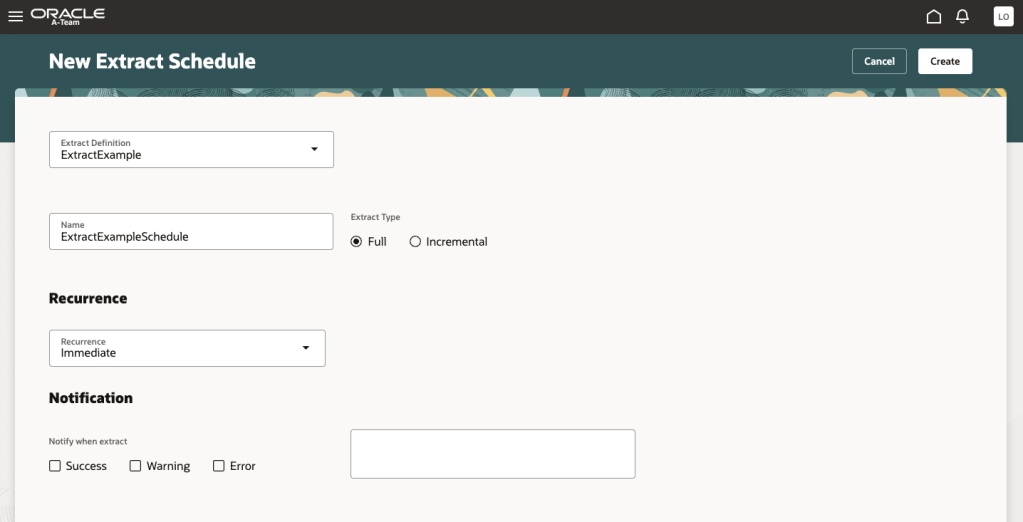
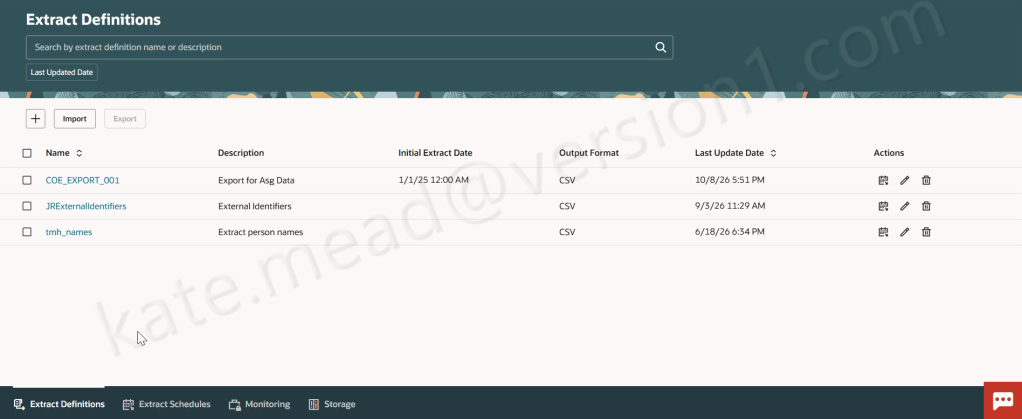
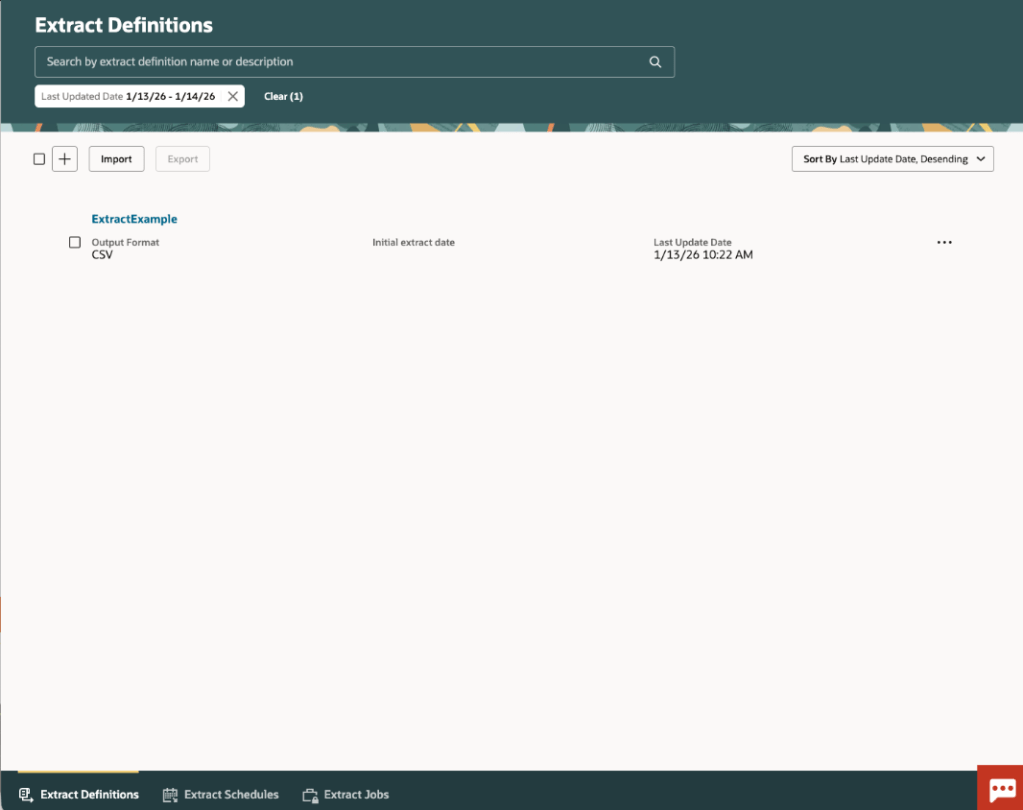
Once enabled, the Data Extraction Tool can be accessed from the Tools menu and is organised around three key areas. Extract Definitions allow users to create and maintain data extraction configurations, selecting the business objects, fields and filters required. Extract Schedules provide a straightforward way to automate the execution of extracts at regular intervals, while Extract Jobs offers visibility of running and completed extractions, making it easy to monitor progress, review results and investigate any issues.

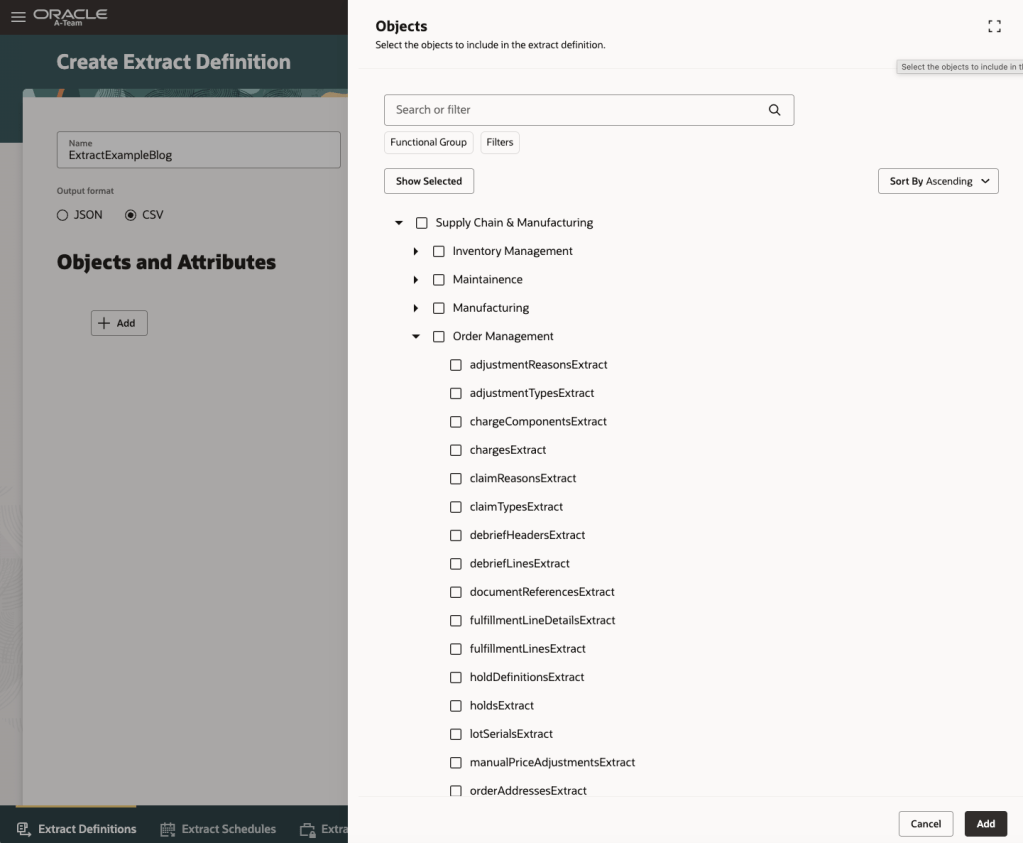
Creating an extract is largely a point-and-click process. Users define an extract name, select an output format (CSV or JSON), choose the required business objects, and specify the fields they wish to include. Filters can be applied to narrow the data set, while column names can be renamed to match downstream integration or reporting requirements.

The tool also supports both Descriptive Flexfields (DFFs) and Extensible Flexfields (EFFs), allowing organisations to include custom attributes alongside standard Fusion data. Extract definitions can be saved for reuse, executed on demand, scheduled for regular execution, or exported between environments.

The Data Extraction Tool supports two execution models:

Synchronous processing is intended for smaller data requests that can be completed immediately. Results are returned within the same transaction, making this suitable for focused data retrieval scenarios. Oracle currently applies a 60-second execution limit.

Asynchronous processing is designed for larger extraction workloads. Users submit a job and receive a job reference that can be used to monitor progress. Once complete, output files are delivered to Oracle Cloud Object Storage or UCM.

Each extract includes metadata detailing the extraction period, row counts and any processing errors, helping administrators validate results and troubleshoot issues.

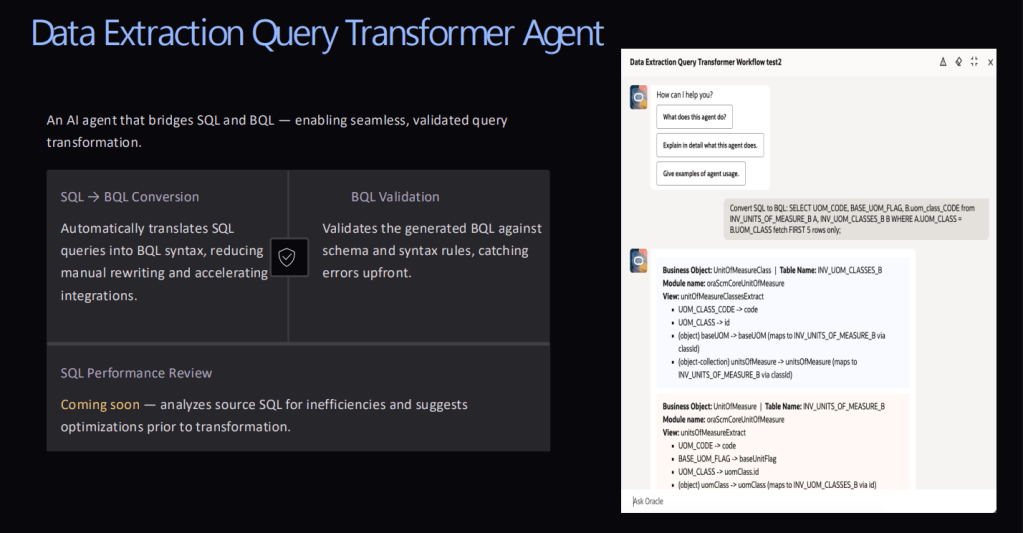
One of the more interesting additions is Oracle’s Data Extraction Query Transformer Agent. Many organisations have invested heavily in BI Publisher reports and custom SQL queries over the years. The Query Transformer Agent helps modernise these assets by converting SQL into Business Object Query Language (BQL), the format used by the Data Extraction Tool. The agent also validates converted queries against the target schema, helping users identify issues before execution. Oracle has also indicated that future releases will introduce SQL performance assessment capabilities to help organisations identify optimisation opportunities before migration.

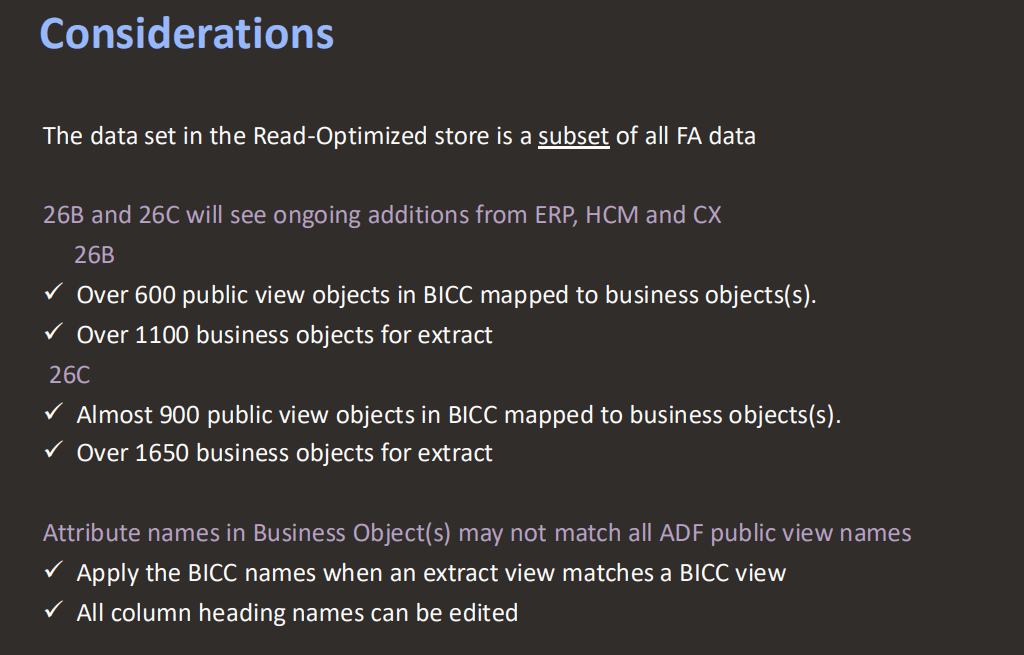
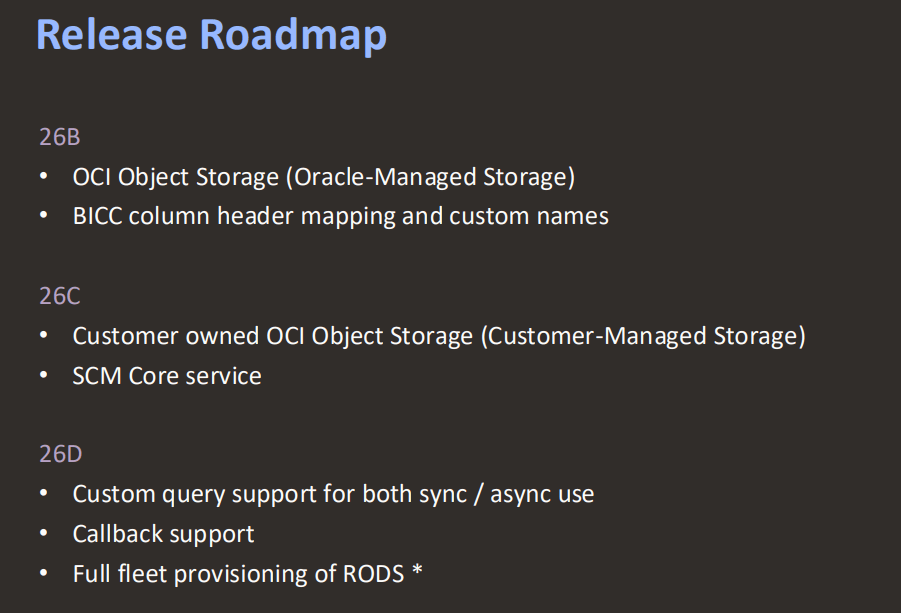
RODS coverage continues to grow with each quarterly release. In release 26B, Oracle supports more than 1,100 business objects and has mapped over 600 BICC public view objects. Release 26C is expected to increase coverage to more than 1,650 business objects and nearly 900 mapped BICC view objects, extending support across ERP, HCM, SCM and CX.

Organisations should be aware that business object attribute names may not always match existing ADF View Object or BICC naming conventions. However, output column names can be customised, providing flexibility for downstream integrations and reporting solutions.

Release 26D is set to introduce several important enhancements, including support for custom queries across both synchronous and asynchronous extractions, as well as callback capabilities that enable event-driven processing and notifications.

Oracle is also investing in additional self-service capabilities, including richer extract management, reusable query registration, pre-execution testing and AI-assisted query analysis. As these capabilities mature, the Data Extraction Tool is increasingly positioned as Oracle’s strategic approach to data extraction from Fusion Cloud Applications.

For organisations that currently rely on BI Publisher for integration-focused data extraction, or those finding limitations in existing BICC-based approaches, RODS is worth evaluating. By separating extraction workloads from transactional processing, Oracle has created a more scalable and modern foundation for reporting, analytics and integrations. While coverage is still expanding, the direction is clear: RODS and the Data Extraction Tool are becoming central to Oracle’s long-term strategy for accessing Fusion Cloud data.

Please note all screenshots are the property of Oracle and are used according to their Copyright Guidelines