
One of the questions I hear most when talking about AI in Oracle Fusion is: “What are the use cases?” It’s a perfectly reasonable question. But I’m increasingly convinced it’s also slightly the wrong one. We have spent the last couple of years looking for places where we can add AI to a business process. Where can we summarise something? Where can we generate something? Where can we make an interaction more conversational?
With Fusion Claw, I think we need to turn that thinking around. Don’t start by looking for an AI use case. Start by looking for work. Specifically, look for the work that people are still stitching together manually across Oracle Fusion. The things that involve checking multiple sources, applying judgement, producing an output, chasing exceptions and deciding what needs to happen next. That distinction matters because Fusion Claw isn’t designed simply to answer another question or perform another transaction.
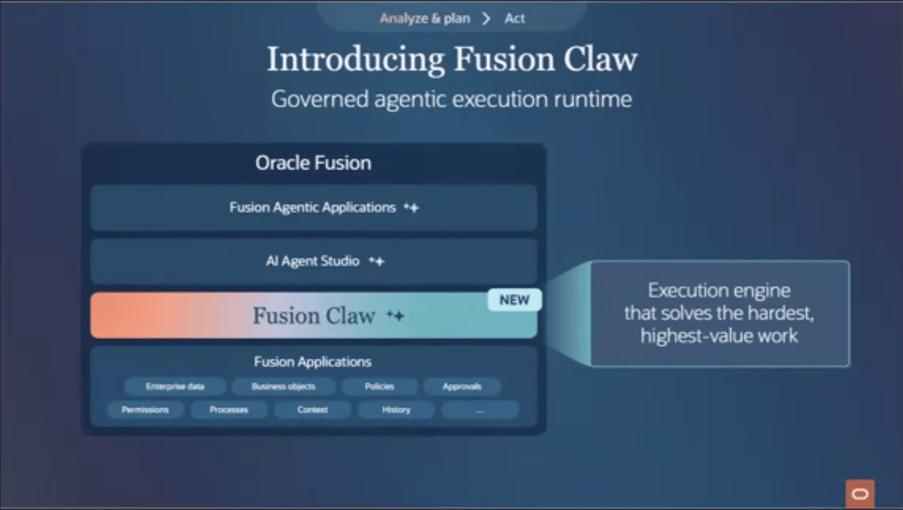
Oracle describes a Fusion Claw use case as“a business result that someone owns and wants handed over.” I think that is probably one of the most useful ways of thinking about agentic AI that I’ve seen.
Imagine someone in Finance asks: “What is the balance for account 3210?” That isn’t really a Fusion Claw use case. There is a question. Oracle already knows the answer. We just need the quickest and most appropriate way of retrieving it. Now compare that with: “Get us ready for month-end close and show me anything that could prevent us closing.” That is very different.
To achieve that outcome, somebody might need to check the ledger and subledgers, compare information against close policy, identify variances, investigate exceptions, work out which ones actually matter, escalate anything unresolved and produce evidence explaining what they found. There isn’t one answer. There is work to be done. And that, to me, is where Fusion Claw starts to get interesting.
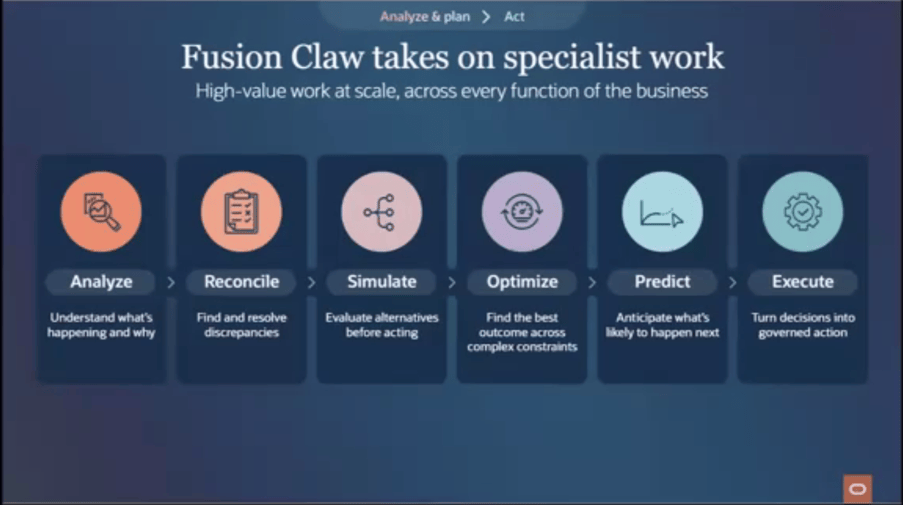
Oracle’s guidance suggests a useful rule of thumb: if a knowledgeable person would normally spend 30 minutes to several hours researching, comparing information, producing something or chasing follow-ups across systems, it may be worth considering Fusion Claw. That immediately gives us a much more practical way of finding opportunities.
Forget brainstorming futuristic AI scenarios for a moment. Go and talk to the people actually using Fusion and listen for sentences like: “Every Friday I pull together…”; “I download this into Excel and then…”; “It takes me half a day to…” etc. Oracle highlights very similar phrases in its guidance because they often reveal processes involving research, judgement, multiple steps and exceptions. Those are potential Claw conversations. And they are much more interesting than asking a room full of people,“What could we do with AI?”
So what might those use cases actually look like? Once you start looking at Fusion through that lens, there are opportunities everywhere.
Finance: “Tell me if we’re actually ready to close.” Don’t just show the close tasks. Review the position across the ledger and relevant subledgers, check it against policy, identify unusual balances or incomplete activity, investigate exceptions and give the Finance team an evidence-backed view of what’s stopping them being close-ready. The outcome isn’t another dashboard. It is confidence about whether you can close.
Procurement: “Find the things we should be worried about.” Imagine regularly reviewing purchase orders, suppliers, invoices and relevant policies to identify unusual activity. Which transactions deserve attention? Which exceptions can be explained by the available information? Which need a human to investigate? And importantly, can you provide the evidence alongside the recommendation? That is considerably more useful than simply producing a list of transactions which meet a predefined query.
HR: “What needs my attention today?” A manager doesn’t necessarily want to navigate five different parts of HCM to understand what is happening across their team. They want to know: What do I actually need to deal with? That could mean looking across outstanding approvals, absence, recruitment activity, upcoming talent actions and other relevant signals, then identifying what matters and why. The deliverable isn’t the individual pieces of data. It’s the prioritised brief.
Projects: “Tell me where this project is going off track.” Imagine analysing project costs, commitments, milestones and relevant operational information, then investigating significant exceptions rather than simply flagging every variance. The value isn’t telling a project manager something is red. It’s doing some of the work required to understand why it is red.
Oracle identifies seven characteristics that indicate a job may suit Fusion Claw:
- Multi-step: the work needs to be planned and carried out in stages.
- Long-running: it can take minutes or hours rather than requiring an instant response.
- Research-heavy: somebody needs to examine multiple records, documents or policies.
- Cross-functional: the outcome spans several objects, agents or business areas.
- Exception-heavy: investigating what went wrong is part of the job.
- Produces something: the outcome might be a report, spreadsheet, plan or evidence pack.
- Governed action: the process may ultimately make changes, but only through controlled and approved capabilities.
Not every use case needs all seven. But if you’re ticking several of them, it’s probably worth investigating. I would add an eighth question of my own: Would somebody be genuinely pleased not to have to do this anymore? Because that’s often where the real value is hiding.
Not everything needs Claw. This may actually be the most important part. One of the risks whenever a new technology arrives is that we immediately try to apply it to everything. That would be a mistake.
If somebody simply needs to ask “How many open requisitions do I have?”, a conversational experience such as Ask Oracle may be more appropriate. If the requirement is “Route every new requisition through the same approval steps”, that’s a workflow. If someone has already made a decision and simply needs to execute a transaction, the existing Fusion action may already be the right answer.
Oracle explicitly makes this distinction: lookups, quick status questions, fixed workflows and straightforward transactions don’t suddenly become better because we put a more autonomous agent in front of them. Use the simplest technology that solves the problem. Agentic doesn’t automatically mean better.
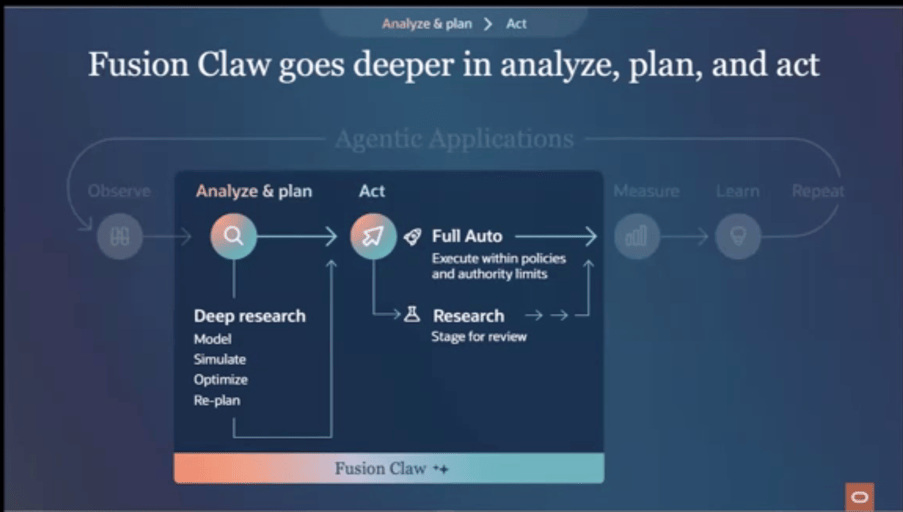
There’s another idea in Oracle’s guidance that I particularly like. Good Fusion Claw opportunities may actually be two use cases rather than one. The first researches. The second acts. For example: Research: Review the available information, investigate the exceptions, apply the appropriate policy and recommend what should happen. Then Action: Once that recommendation has been reviewed, carry out the approved next step.
Oracle describes this as starting in Research mode, reviewing the evidence and recommendations, and gradually handing over actions as confidence develops. For enterprise AI, that feels like a much more sensible adoption model than jumping straight to full autonomy.
Trust is earned. Let the agent demonstrate that it can research the problem properly. Let people inspect the evidence. Let them challenge the recommendation. Then decide what you’re comfortable allowing it to do.
My advice: don’t start with your biggest process. I’d be tempted to start somewhere much more boring. Find something that happens every week. Something with a clear owner. Something that currently takes an experienced person an hour or two. Something involving enough research and judgement to be annoying, but not something so business-critical that everyone becomes terrified of changing it.
Run it in Research. Compare what Fusion Claw produces with what the person would have produced. Understand where it gets stuck. Understand where your data, policies or processes aren’t quite as clear as you thought they were. Then improve it.
A weekly process may teach you far more about agentic working than attempting to automate an enormous quarterly process on day one. Oracle makes a similar recommendation: start with a recurring use case that can be proven in Research mode.
For a long time, enterprise AI conversations have started with: “Where can we use AI?” With Fusion Claw, I’d change the question. Ask your Finance team: “What takes you half a day every week?” Ask HR: “What information do you have to pull together before you can make a decision?” Ask Procurement: “What exceptions do your experienced people spend their time investigating?” Ask managers: “What do you repeatedly have to check before you’re comfortable taking an action?” And perhaps most importantly: “What work are our people doing today where the value is in the outcome, not in them personally clicking through every step required to get there?”
That’s where I’d start looking for Fusion Claw. Because the interesting thing about agentic AI isn’t another clever way of interacting with Oracle Fusion. It’s the possibility that, increasingly, we can give Fusion an objective and let it help get the work done. And that feels like a much bigger change.
Please note all screenshots are the property of Oracle and are used according to their Copyright Guidelines.


