Oracle ERP AI Agents in 26D: Less Processing, More Decision Making

If Release 26D tells us anything, it’s that Oracle’s vision for finance is no longer about giving users better screens. It’s about giving them less work to do in the first place. That might sound like marketing speak, but this quarter’s ERP updates genuinely feel different. Across Payables, Payments, Expenses, Billing, Fixed Assets and Budgetary Control, Oracle continues to move beyond AI assistance and deeper into agent-led execution. In many cases, the software isn’t just helping users do the work. It’s identifying issues, recommending actions and increasingly resolving routine tasks on their behalf. The common theme throughout 26D is simple: finance professionals spend less time chasing transactions and more time focusing on decisions that genuinely need human judgement.

If you’ve read any of my previous AI blogs, you’ll know I keep coming back to Payables. That’s because it’s one of the clearest examples of where agentic AI can deliver measurable business value. Invoice processing is still surprisingly manual in many organisations. Someone uploads an invoice, someone investigates an exception, someone releases a hold, and someone else spends time trying to understand why the same issue keeps appearing month after month. Oracle is steadily removing those touchpoints.

The Payables Agent now supports more of the invoice lifecycle than ever before. Invoice ingestion has been enhanced with broader document support and improved integration options, making it easier to bring invoices into Oracle regardless of the format or source system. For organisations dealing with different supplier standards, languages and document types, that’s a practical improvement that should reduce manual effort from day one.
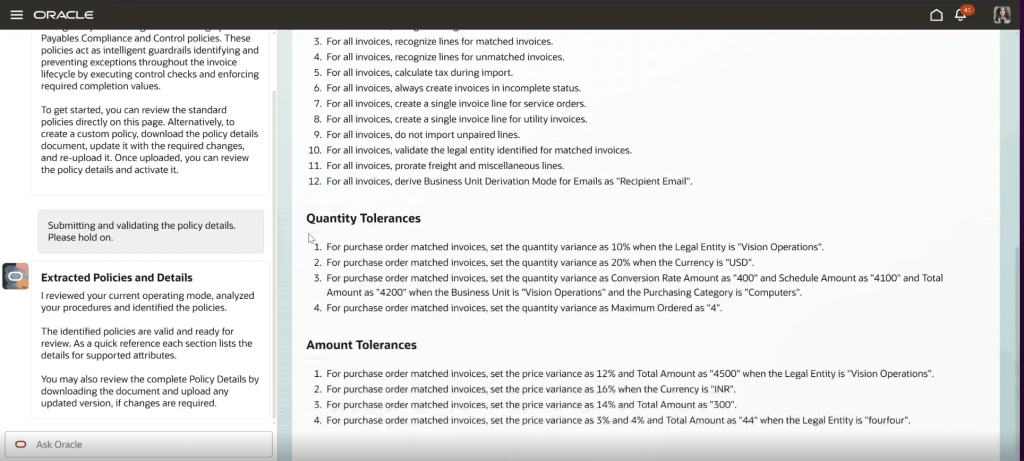
The feature that stood out most to me, however, is Actionable Insights. Rather than finance teams having to trawl through reports looking for recurring issues, Oracle now highlights patterns automatically. If users are repeatedly overriding exceptions or releasing holds without addressing the root cause, the system identifies the behaviour and recommends corrective action. This is where AI starts becoming genuinely useful. Rather than simply helping users process invoices faster, it helps organisations understand why problems occur in the first place.

Oracle has also expanded automated exception resolution, allowing more invoice import errors to be addressed through predefined resolution paths rather than manual intervention. Combined with enhanced matching controls and business-specific tolerance rules, organisations have more flexibility to reduce unnecessary holds while still maintaining appropriate financial controls.
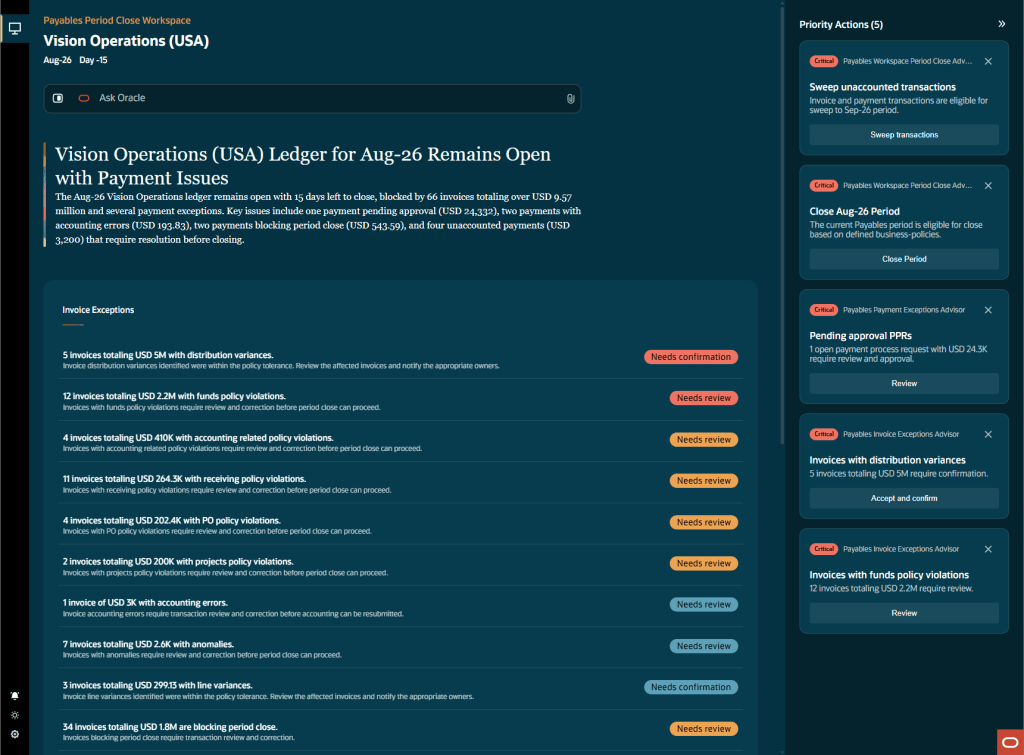
Another welcome addition is the new Payables Period Close Workspace. Month-end close is often less about processing transactions and more about coordinating people. Teams spend significant time identifying what still needs attention, chasing outstanding items and managing exceptions across multiple reports and spreadsheets. Oracle now brings those activities together into a single workspace that highlights priority actions, identifies high-value exceptions and guides users through the close process. For customers still relying on spreadsheets, email chains and manual status updates during close, this could make a significant difference.
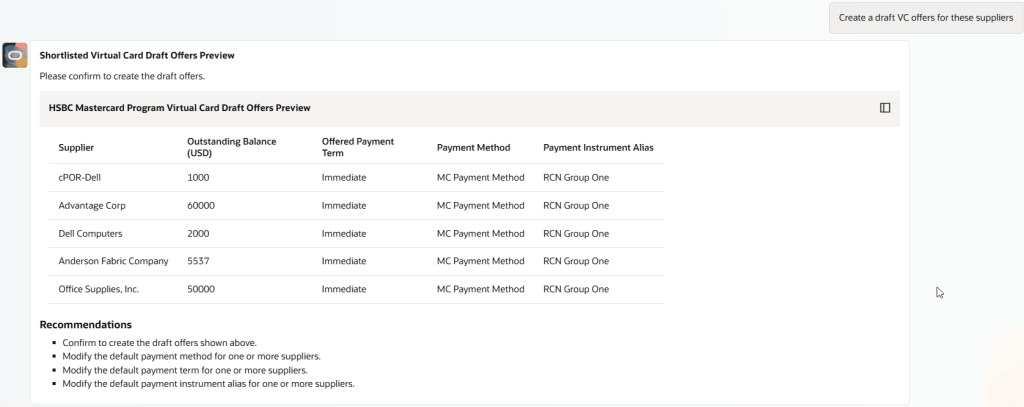
One of the criticisms I’ve had of some early AI assistants is that they often stop at telling users what they should do next. That’s useful, but it’s only half the journey. In 26D, Oracle is starting to close that gap. The Payments Agent can now support activities such as virtual card offers, dynamic discounting and supply chain financing, allowing payment specialists to move from opportunity identification into execution within the same experience.

What I find particularly interesting is Oracle’s focus on working capital optimisation. Rather than treating financing options as separate initiatives, the platform can compare multiple strategies and help users determine which approach is most appropriate for a particular supplier or payment population.

There’s also a practical enhancement that many finance teams will probably value more than the headline AI announcements. When payment processes fail, the agent can now explain the issue in business language and recommend a course of action. Anyone who has spent time trying to decipher technical process logs during a payment run will understand the value of that immediately.
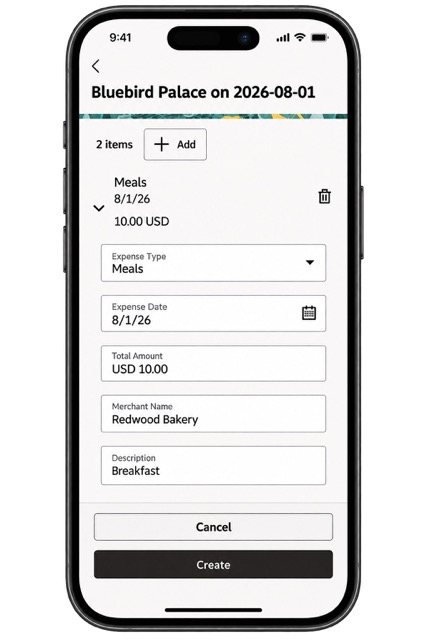
Let’s be honest. Expense management isn’t usually anyone’s favourite process. It’s one of those areas where frustration tends to come from lots of small inefficiencies rather than one major issue. Missing receipts, incomplete itemisation, attendee information, rejected claims and lengthy approval cycles all add up. Oracle is tackling several of those issues in 26D.

The Expenses Agent can now collect missing itemisation and attendee details through email interactions, allowing employees to provide information using natural language rather than navigating back into the application. That may sound like a small change, but anyone involved in expense administration knows that itemised expenses and entertainment claims often generate disproportionate amounts of back-and-forth communication. Capturing that information before the approval process begins should reduce delays and improve approval cycle times.
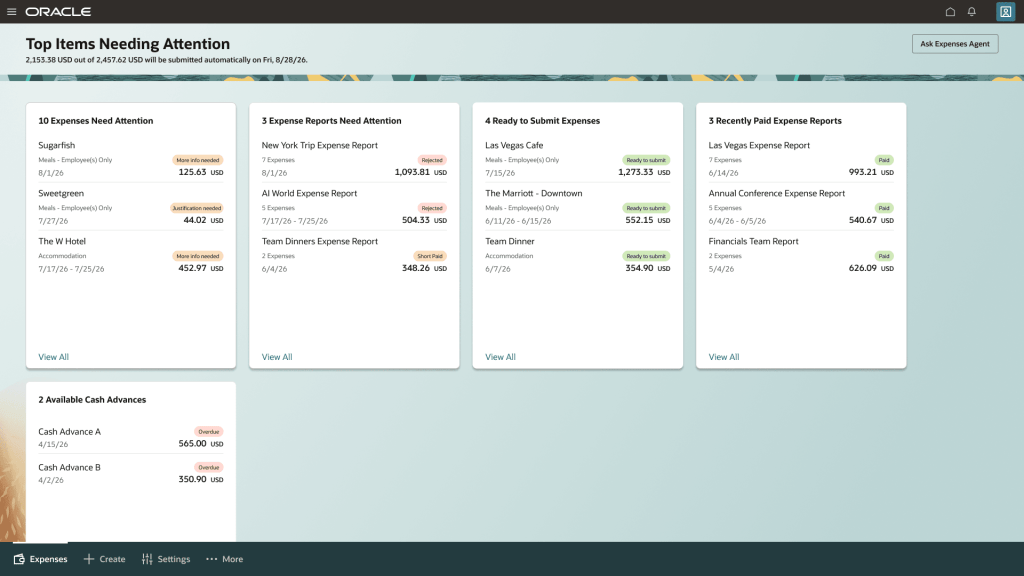
The new Expenses landing page is another welcome addition. Employees and delegates now have a single view showing reports requiring attention, reports ready for submission, recent payments and other key activities. For delegates managing expenses on behalf of multiple employees, this is particularly useful. Instead of jumping between multiple users and screens, they can manage activity from a single location and quickly identify where action is required. Oracle has already confirmed this will become the default experience in 27B, so now is probably a good time for organisations to start evaluating it.
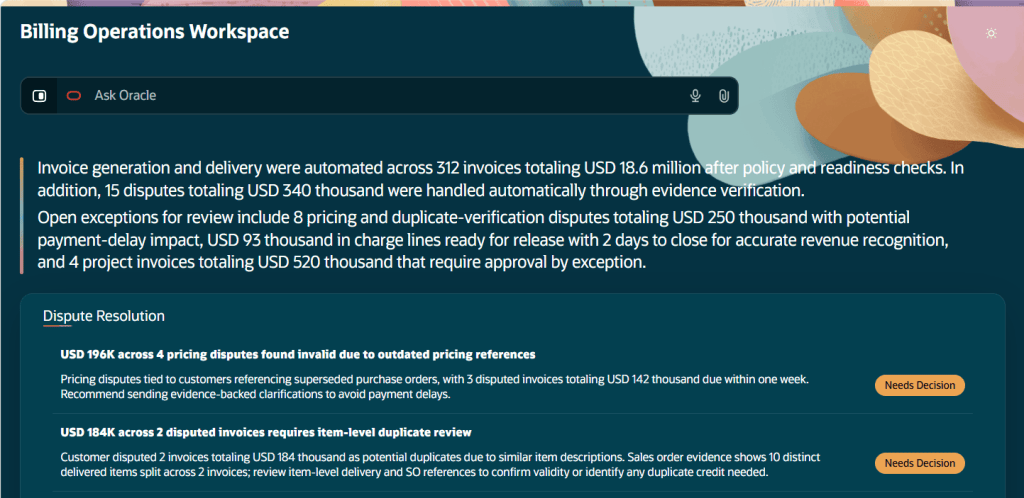
If there is one release area that genuinely feels different, it’s Billing. The new Billing Operations Workspace isn’t simply another dashboard. It’s built around the idea that agents should continuously perform routine work, while people focus on exceptions and decisions. The workspace covers project billing readiness, invoice generation and dispute resolution.

On the project billing side, the agent monitors overdue approvals, sends reminders and escalations according to defined procedures and identifies billing issues before they become month-end surprises. It can even update existing draft invoices when held transactions are released, eliminating manual rework that many project accounting teams know all too well.

For invoice generation and delivery, the agent handles qualifying activities automatically and surfaces only those situations requiring human review. Dispute management follows a similar pattern. Customer billing queries received by email can be converted into disputes, assessed by the agent and, where appropriate, resolved automatically or routed for review with supporting evidence. This is probably one of the strongest examples in 26D of Oracle’s broader vision for agent-led business processes.
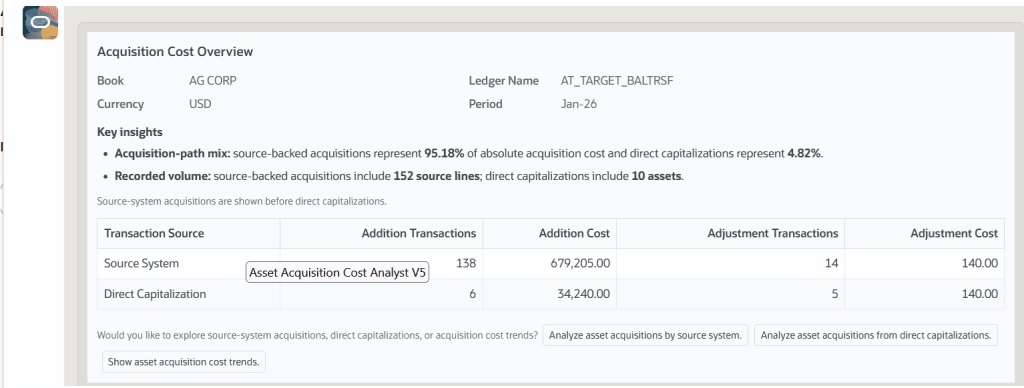
Fixed Assets rarely gets the same attention as Payables, Procurement or Financials, but Oracle has introduced several genuinely useful assistants in this area. New capabilities support asset additions, depreciation forecasting, acquisition cost analysis and capital expenditure planning. What’s interesting is that Oracle hasn’t focused on flashy demonstrations here. Instead, the emphasis is on reducing spreadsheet dependency.

The Asset Additions Assistant helps users create assets through a guided conversational experience. The Depreciation Projection Assistant provides on-demand forecasting from live data. Additional tools analyse acquisition costs and support capital expenditure planning activities. None of these capabilities are likely to dominate conversations, but they address real activities that finance teams perform every month. In my experience, that’s often where the biggest productivity gains come from.

The Budget Adjustment Assistant first appeared in 26C, but Oracle has continued to build on it in 26D. The most significant enhancement is policy validation. Budget transfers can now be validated against organisational policies before they enter the approval process, helping prevent invalid adjustments from progressing and creating unnecessary rework.

When validation issues are identified, the assistant explains the issue in plain language and provides guidance on how to resolve it. The approval process and audit trail are managed as part of the overall workflow. It’s worth noting that this enhanced capability is currently available through a controlled release, so customers interested in evaluating it will need to engage Oracle Support.

When Oracle first started talking about AI agents, I think many customers wondered whether they would be genuinely useful or simply another layer on top of existing processes. Release 26D provides some of the clearest evidence yet that Oracle is serious about changing how finance work gets done.

What stands out isn’t any single feature. It’s the number of areas where Oracle is systematically removing repetitive effort. Whether that’s invoice exceptions, payment investigations, expense administration, billing disputes, fixed asset analysis or budget adjustments, the goal is increasingly the same: let the system handle routine work and focus human attention where it adds the most value.

We’re still some distance away from a fully autonomous finance function, and frankly I don’t think most organisations would want that anyway. But we are moving closer to a world where finance professionals spend less time moving transactions between stages and more time applying judgement, managing risk and supporting the business. For me, that’s where the real value of AI sits. Not replacing finance teams, but helping them spend more time doing the work only they can do.

Oracle regularly introduces additional functionality throughout the quarter, so it’s worth keeping an eye on the What’s New documentation as Release 26D progresses. If any significant new ERP capabilities appear, I’ll be sure to cover them in a future update.

Please note all screenshots are the property of Oracle and are used in accordance with Oracle’s Copyright Guidelines.
Oracle Recruiting 26D: From Reactive Hiring to Proactive Recruiting

It’s that time again, quarterly release time, and Oracle Recruiting 26D is shaping up to be one of the more interesting releases we’ve seen for a while. At first glance, it’s easy to assume this is simply another AI-heavy update. After all, almost every major enhancement includes some form of advisor, agent or generative capability. But looking a little deeper, I think there’s a more interesting story here.

For years, recruiting technology has largely focused on helping recruiters process candidates more efficiently once a vacancy exists. A requisition opens, recruiters search for candidates, screening begins, interviews are arranged and eventually an offer is made. Release 26D starts to challenge that model.

Many of the new capabilities are focused on helping organisations anticipate hiring demand, build pipelines earlier, make more informed decisions and reduce administrative effort throughout the recruitment lifecycle. In other words, moving from reactive hiring towards proactive recruiting.

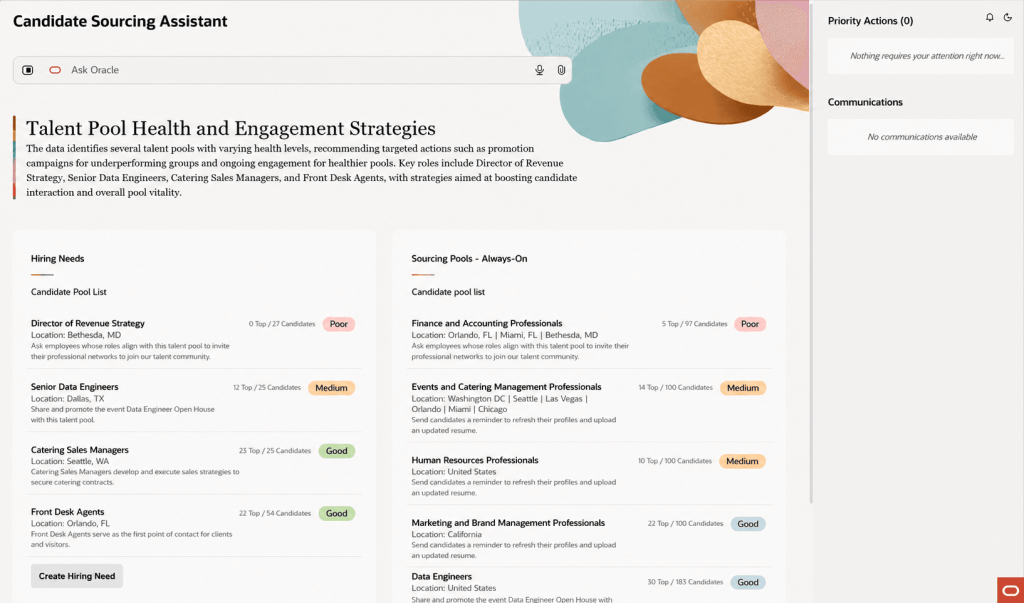
The feature that caught my attention most is Candidate Sourcing Workspace. Most recruitment teams know the pressure that comes with a new vacancy. As soon as a requisition is approved, the clock starts ticking. Recruiters begin searching, hiring managers want candidate shortlists immediately, and the race is on to identify suitable people. Oracle is trying to change that.

The new Candidate Sourcing Workspace allows recruiters to build and maintain talent pipelines before a requisition even exists. Using previous hiring patterns and anticipated demand, Oracle can help recruiters identify and nurture potential candidates in advance, creating a pool of talent ready to engage when opportunities arise.

Rather than starting every search from scratch, recruiters can draw from existing talent pools, review AI-generated candidate summaries and quickly identify the strongest matches for anticipated hiring needs. For organisations that regularly recruit into similar roles, this could have a significant impact on time-to-hire. More importantly, it allows recruiters to spend less time hunting for candidates and more time building relationships with them. That’s a much more strategic use of everyone’s time.

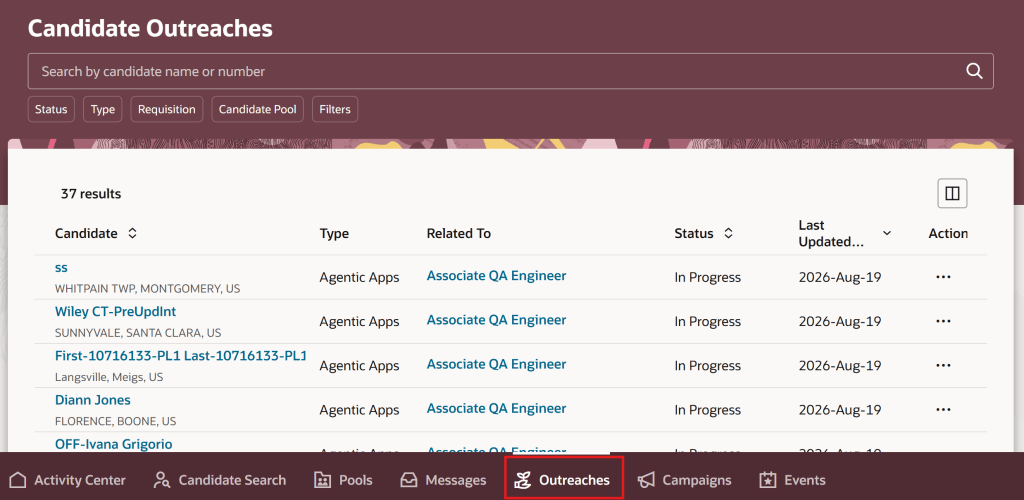
Supporting the new sourcing workspace is an enhanced outreach experience that brings together all candidate engagement activity into a single view. That might not sound particularly exciting on paper, but anyone who has ever managed a large recruitment campaign knows how easy it is for conversations to lose momentum. Candidates don’t respond immediately, follow-ups are forgotten, and promising prospects gradually disappear from the process. Oracle is addressing that problem with automated reminders, consolidated outreach tracking and AI-generated summaries of candidate responses. The result is a much clearer picture of who has been contacted, where conversations stand and what action should happen next.

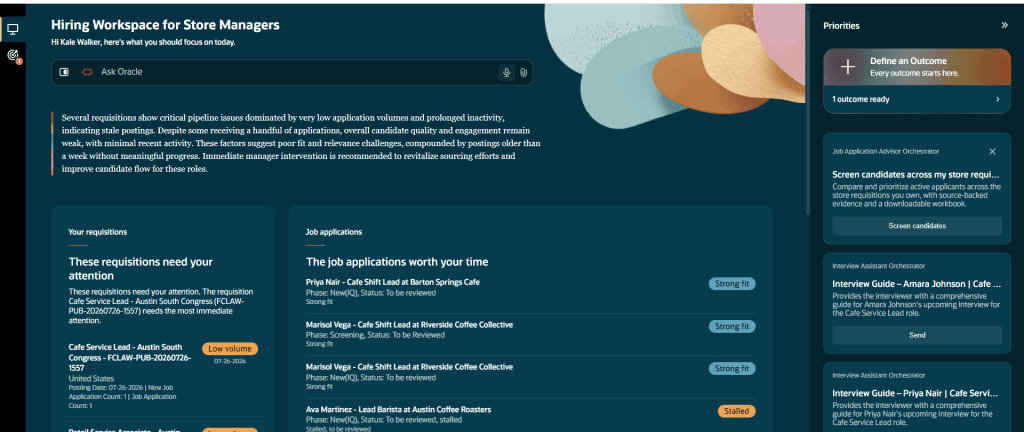
Another interesting addition is the new Hiring Workspace for Store Manager. Although initially aimed at retail organisations, the broader theme here is relevant to any organisation managing high-volume recruitment. The workspace allows managers to ask natural-language questions such as: “What requires my attention today?” or “Where is hiring off track?” and receive a structured response that highlights issues, priorities and recommended actions.

What I like about this feature is that Oracle isn’t simply presenting data differently. The platform is actively helping managers understand what requires attention and what they should do next. That may sound like a subtle distinction, but it’s an important one. Most recruitment systems already provide dashboards and reports. The challenge isn’t usually accessing information. It’s understanding what action should be taken based on that information. This workspace starts to bridge that gap.

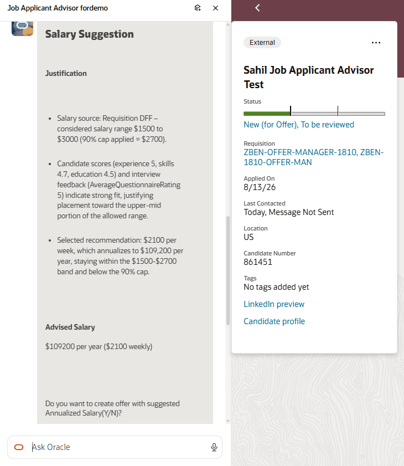
Probably the most practical AI enhancement in the release is the new Compensation Recommendation and Job Offer Creation Advisor. Creating a competitive offer has traditionally involved a mixture of salary benchmarking, internal comparisons and professional judgement. It can also be surprisingly time-consuming. Oracle’s new advisor pulls together relevant information from the requisition, candidate assessments and internal salary data to provide a recommended salary range before helping create the draft offer itself.

What particularly stood out to me is Oracle’s emphasis on explainability and guardrails. The recommendations are based on defined business criteria and Oracle explicitly states that protected characteristics such as age, gender, race and disability are not used when generating recommendations. In a world where organisations are rightly paying more attention to AI governance and pay equity, that’s an important message. Will recruiters still want human oversight? Absolutely. But reducing the administrative effort involved in preparing offers while supporting consistency of decision-making feels like a genuinely useful application of AI.

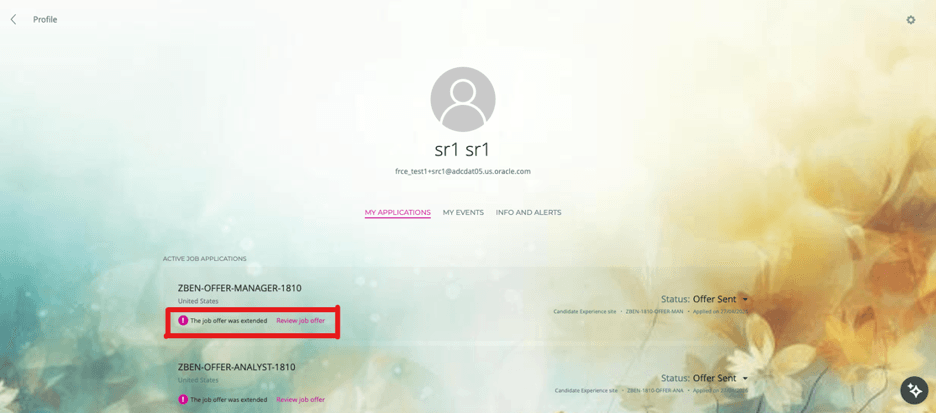
Not every valuable enhancement in 26D relies on AI. Oracle has also simplified how candidates access and respond to job offers by making offers available directly through candidate-facing experiences. External candidates can access offers through career sites, while internal candidates can access them through Opportunity Marketplace. They can review offer documentation, accept or decline offers and access completed documentation after acceptance.

It’s a relatively simple change, but one that removes a common point of friction. Offer emails can be missed, filtered or buried in busy inboxes. Giving candidates a consistent place to access offer information feels like a sensible improvement that should help remove avoidable delays from the process.

While most of the release focuses on new innovation, there is one update that deserves immediate attention. Oracle has confirmed that Digital Assistant (ODA) Fusion Apps templates for Recruiting will no longer be supported from November 2026. If your career site currently relies on Oracle Digital Assistant, now is the time to begin planning your transition. Oracle’s recommended path forward is Career Coach, which becomes the strategic candidate assistance experience going forward. This isn’t something I’d leave until the last minute. November 2026 will arrive much faster than many organisations expect, and early planning will help avoid unnecessary disruption.

What stands out to me about Recruiting in 26D is that Oracle appears to be focusing on the right problems. The most valuable features aren’t necessarily the ones generating content faster. They’re the ones helping organisations build stronger talent pipelines, make more consistent hiring decisions and remove friction from the recruitment process.

That’s why Candidate Sourcing Workspace was the feature that caught my eye. If organisations can move from scrambling to find candidates every time a requisition opens to maintaining an always-on pipeline of talent, that has the potential to transform recruitment performance far more than any chatbot ever could. There are still plenty of AI announcements in this release, but for once they feel connected to genuine business outcomes rather than being technology in search of a problem. And if you’re still relying on Oracle Digital Assistant on your career site, don’t overlook the deprecation announcement. November 2026 will arrive faster than you think.

Please note all screenshots are the property of Oracle and are used in accordance with Oracle’s Copyright Guidelines.
Oracle Help Desk 26D: AI Gets More Practical and the Redwood Clock Keeps Ticking

It’s quarterly release season again and Oracle has already revealed a healthy batch of new features for Help Desk in 26D. What struck me most this quarter wasn’t necessarily the number of new features, but how much Oracle continues to invest in making support part of the wider employee experience. The latest updates are less about helping agents work faster and more about helping employees find answers, complete actions and stay on top of requests without having to navigate multiple areas of HCM.

There’s also an important reminder for anyone still running Classic HR Help Desk. Oracle has reconfirmed that the Redwood migration deadline is fast approaching and, if you haven’t started planning yet, now is the time. As always, Oracle may add further features as the release progresses, but let’s take a look at the highlights from the first wave of 26D announcements.

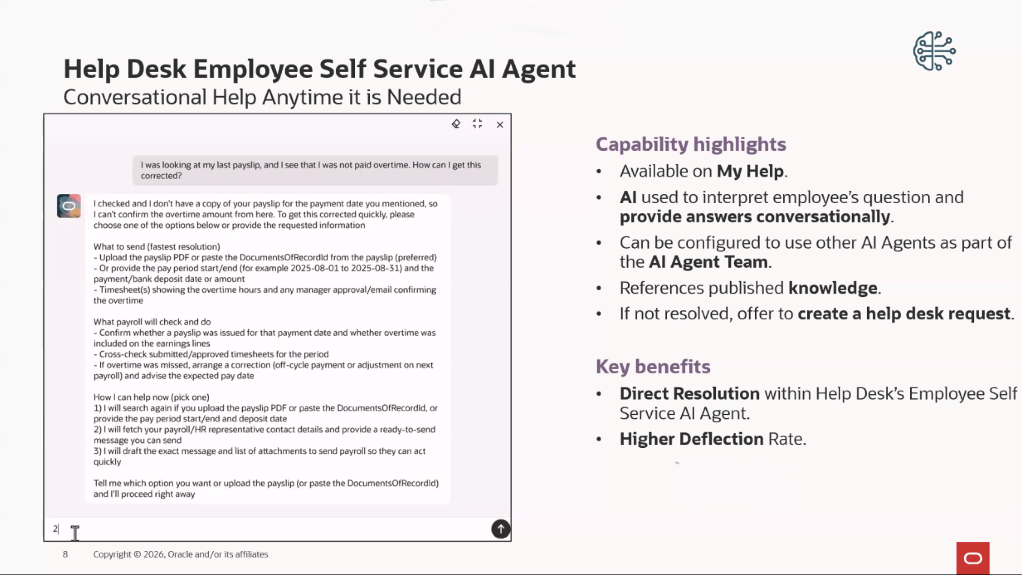
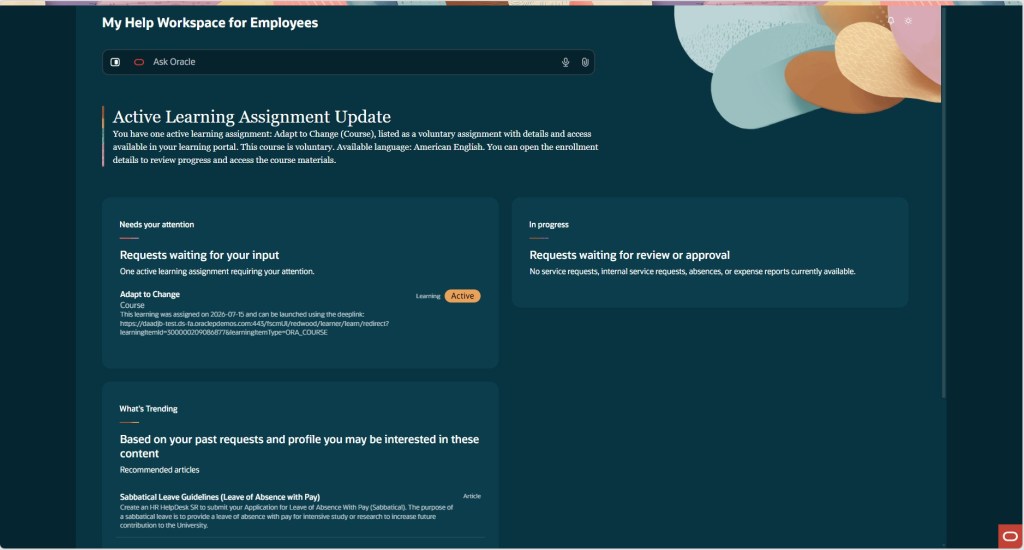
The standout feature in 26D for me is the new My Help Workspace for Employees. If you’ve ever watched employees navigate Oracle HCM, you’ll know one of the biggest frustrations isn’t necessarily finding information. It’s remembering where everything lives. Help requests sit in one place, learning assignments in another, expenses somewhere else, and absence requests somewhere else again. Oracle is clearly trying to tackle that problem.

The new workspace gives employees a single place to see the activities and requests that need their attention. Whether that’s a Help Desk request waiting for a response, an outstanding task, or useful knowledge content, employees can quickly see what requires action without having to navigate around multiple parts of Oracle HCM.

What I particularly like is that it isn’t just a reporting page. Employees can take action directly from the workspace. If a Help Desk analyst is waiting for additional information, the employee can respond immediately. If a request seems to have gone quiet, they can follow up without having to navigate elsewhere.

Oracle has also made it easier to get support when employees need it. The Ask Oracle search capability is available directly within the workspace, with access to a full AI-powered chat experience without taking users away from what they’re doing. This feels very much like the direction Oracle is heading with many of its AI investments. Rather than forcing users to jump between modules, Oracle is bringing information and actions together in a single experience and letting AI help guide employees to the next thing they should do.

For organisations exploring Oracle’s Agentic AI strategy, this is probably one of the clearest real-world examples we’ve seen so far. It’s practical, employee-facing and solves a genuine problem rather than introducing technology for technology’s sake.

The Employee Help Desk Self Service Assistant continues to mature with every release, and 26D includes a collection of smaller enhancements that together make a significant difference. The most interesting addition is the use of the Classification Agent when requests are created through the assistant. Instead of employees having to work out categories, priorities and classifications themselves, the AI can now determine much of that information automatically. That might not sound particularly exciting on the surface, but anyone who has spent time reviewing Help Desk data will immediately recognise the value. Better categorisation means better reporting, more consistent routing and less manual effort for support teams.

Oracle has also improved how knowledge content is surfaced by filtering results based on Business Unit. In practice, that means employees are more likely to see information that is relevant to their part of the organisation rather than scrolling through articles that may not apply to them.

One enhancement that I think many customers will appreciate is the ability to identify requests created through the AI assistant using a dedicated source code. Until now, measuring AI adoption has often been surprisingly difficult. Organisations can now report on how many requests originated through the assistant, making it far easier to understand whether employees are actually using the capability and whether it is delivering value. For me, that’s an important step. AI shouldn’t just be implemented. It should be measurable.

Oracle has also continued its push to make AI Agent Studio the centre of AI configuration by allowing the assistant to be run and customised directly from the platform. That gives organisations more flexibility to tailor the experience as their AI strategy evolves.

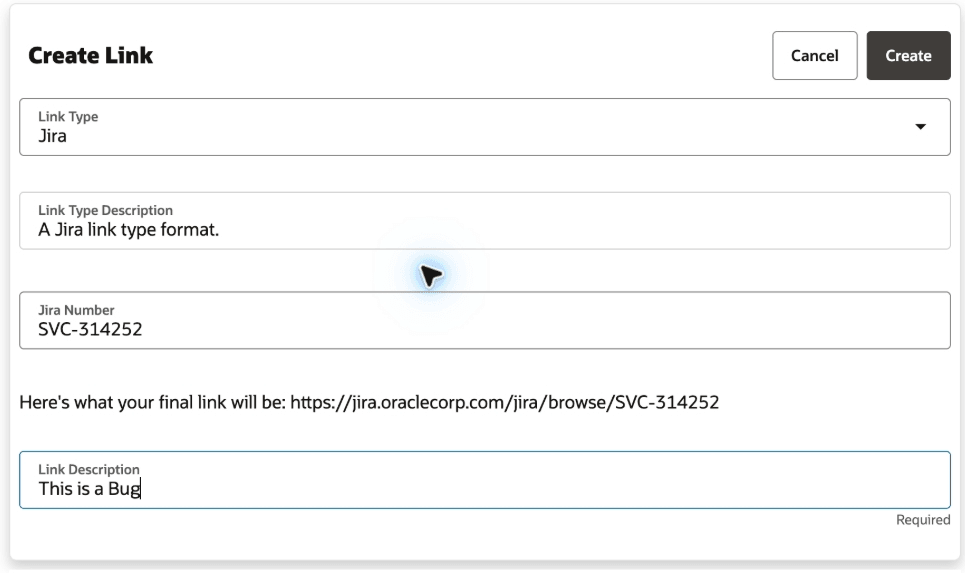
One of the more practical additions in 26D is the ability to associate external links directly with Help Desk requests. Whether your teams work with Jira, SharePoint, Confluence, Google Workspace or other business systems, agents can now link relevant records directly from within a service request.

This isn’t a headline-grabbing feature, but it’s exactly the sort of improvement that saves people time every day. Instead of searching through emails, chat messages or separate applications to find supporting information, agents can access everything they need from the Help Desk request itself. For organisations where support processes span multiple systems and teams, small improvements like this can have a surprisingly positive impact on efficiency and collaboration.

Another area receiving attention in 26D is administration. A number of Help Desk configuration pages have now been brought into the Redwood experience, including Categories, Severities, Channels and Visibilities, Message Types and SmartText. On the surface, this might not feel like a particularly exciting enhancement. However, administrators who regularly manage Help Desk configurations will probably appreciate it more than most.

One of the frustrations during Oracle’s Redwood journey has been moving backwards and forwards between Redwood pages and older administration screens. Every additional configuration page that moves to Redwood helps create a more consistent experience. It’s not transformational, but it is another sign that Oracle’s commitment to Redwood remains firmly on track.

Normally I finish these blogs by talking about what’s coming next. This quarter, I want to finish with a warning. Oracle has reconfirmed that Classic HR Help Desk will no longer be available from 27B. If you’re already running Help Desk in Redwood, that’s not a problem. If you’re still using Classic HR Help Desk, however, this deadline should be firmly on your radar. The reason isn’t simply that Oracle is retiring the old experience. Increasingly, the innovation is happening exclusively in Redwood.

Many of the capabilities organisations are looking at today, including AI-powered self-service, modern employee experiences, enhanced case management capabilities and the new My Help Workspace for Employees, are only available in the Redwood experience. As each quarterly update arrives, that gap is becoming more noticeable. That’s becoming a recurring theme across Oracle HCM as a whole. The question is no longer whether organisations should move to Redwood. The question is whether they’re leaving themselves enough time to get there.

Migration isn’t something I’d recommend leaving until the final few months before an update. There are prerequisites to review, validation activities to complete, testing cycles to run and potentially business processes that need to be reviewed along the way. Starting early gives you time to resolve issues before they become critical path activities. Oracle has provided migration guidance, workbooks and checklists to support the transition, but the key message remains the same: if you’re still on Classic HR Help Desk, this should be a priority for the remainder of 2026.

Overall, this isn’t a release packed with dozens of transformational features, but it does show a very clear direction of travel. Oracle continues to invest heavily in AI-assisted support, employee self-service and Redwood-first experiences, while gradually bringing together information and actions that have traditionally been scattered across multiple areas of HCM.

For most organisations, the new My Help Workspace for Employees and the continued evolution of the Self Service Assistant will be the features worth paying closest attention to. They demonstrate how Oracle is moving beyond simply answering questions and towards helping employees complete tasks, resolve issues and manage their work through AI-assisted experiences. And if you’re still running Classic HR Help Desk, the Redwood migration deadline should probably be the feature getting the most attention of all.

Please note that all screenshots are the property of Oracle and are used in accordance with Oracle’s Copyright Guidelines.
Oracle Fusion Cloud Payroll 26D: Small Changes, Real Benefits

It’s quarterly release time again, and while Payroll 26D doesn’t contain the sort of headline-grabbing feature that will completely transform how payroll teams work, it does include a collection of enhancements that solve real-world problems. There’s continued progress on Oracle’s Redwood journey, some useful legislative updates for UK and Irish payroll, stronger visibility into tax calculations for US payroll teams, and a handful of practical improvements that should reduce administration effort and simplify troubleshooting.

What stood out to me this quarter is that many of the enhancements focus on making payroll easier to manage rather than simply adding new functionality. Several address common frustrations that payroll teams have been dealing with for years, while others provide much-needed transparency into processes that have traditionally felt like a black box. As always, Oracle may introduce additional features over the coming weeks, but here’s what has caught my attention so far.

One theme that won’t surprise anyone by now is Redwood. Oracle continues to replace classic payroll pages with their modern Redwood equivalents, and 26D brings another significant batch of payroll administration pages across. At this stage, most payroll customers understand that the question is no longer whether Redwood is coming, but when they’re going to adopt it. Releases like 26D continue to chip away at the remaining classic pages and make that transition increasingly inevitable. While not every Redwood page introduces brand new functionality, many do improve usability and create a more consistent experience across HCM Cloud.

The Legal Entity Calculation Card and Legal Reporting Unit Calculation Card have now moved to Redwood. These cards hold payroll statutory unit and tax reporting unit defaults, making them some of the more important configuration pages within Payroll. For customers already using Redwood profile options, the new experience is enabled automatically. Functionally, very little changes, but it continues Oracle’s journey towards a consistent user experience across the application.

The Fast Formula migration is probably the Redwood enhancement that will attract the most attention from payroll specialists. The new page introduces a genuinely modern code editor experience, including syntax highlighting and quicker access to database items and functions. Anyone who spends their day building or troubleshooting formulas will likely find it easier to navigate than the classic version. That said, there is one notable omission. Expression Builder isn’t available in the Redwood experience yet, which may influence how quickly some organisations choose to move over. It’s not a blocker for everyone, but it’s definitely something worth testing before making the switch.

Oracle has also moved a further six payroll setup pages into Redwood: Balance Exceptions, Balance Exceptions and Reports, Element Security Profiles, Features by Country or Territory, Organisation Payment Methods and Run Types. It should be noted that these pages are enabled by default. One point worth highlighting relates to Organisation Payment Methods. If you’ve previously granted access through custom job roles, you’ll need to review those roles and ensure they include both the Organisation Payment Method Management Duty role and the Manage Organisation Payment Method function privilege.

One Redwood enhancement I’m particularly pleased to see is the update to Balance Adjustments. Historically, making multiple balance corrections could be a fairly manual process, particularly when trying to understand the wider impact of those changes. The new experience allows administrators to work with multiple adjustments in a single transaction while immediately seeing the before and after effect across affected balances.

The ability to apply separate costing to individual adjustments and navigate directly from Balance Results into Balance Adjustment creates a much smoother experience than before. It’s the sort of enhancement that won’t generate much excitement in release announcements, but for payroll teams dealing with corrections and reconciliations it could save a significant amount of time.

The Retropay enhancement is another feature that feels small on paper but addresses an issue that has caught a number of organisations out in practice. Where employees are processed through multiple payroll runs within the same period, for example a bonus run followed by the regular payroll run, previous behaviour could sometimes create duplicate retro entries or unnecessary offset adjustments. Those situations could take time to understand and even longer to explain.

The new logic helps Oracle determine whether the entry has already been processed within a later payroll run before generating retrospective adjustments, creating a cleaner and more predictable outcome. This feature is disabled by default and requires the Set Late Recurring Retro Entry Earliest Date process to be run, so customers will want to carefully consider when to enable it.

There are a number of UK-specific enhancements in 26D and, I’ve called out three that address genuine operational scenarios rather than simply introducing administrative changes. The first on is Process Results Enhancements. Anyone who regularly analyses payroll results will appreciate this one. The Run Pension Automatic Enrolment Letters process now displays the employee name and payroll relationship number. Send HMRC XML results show the flow name instead of the payroll action ID, and Pension Assessor Updates include employee details alongside a direct link to the pension component within Earnings and Deductions. These aren’t transformational changes, but they’re exactly the sort of usability improvements that reduce investigation time when payroll teams are trying to locate information quickly.

This Enhanced Statutory Parental Bereavement Leave and Pay for Northern Ireland Employees enhancement delivers support for legislative changes effective from 6 April 2026. Oracle now supports the expanded eligibility requirements for Northern Ireland employees, including miscarriage-related absences and day-one eligibility. The system also records and reports qualifying payments separately from existing statutory parental bereavement pay arrangements. The enhancement is automatically enabled and requires no customer action.

The next one is the Use Published Schedules to Determine UK Statutory Sick Pay Qualifying Days. Customers using Workforce Management alongside UK Statutory Sick Pay should pay close attention to this enhancement. Where a published schedule exists before the absence begins, Oracle can now use that published schedule to determine SSP qualifying days rather than relying solely on the employee’s work pattern. For organisations with complex scheduling arrangements, this should help ensure SSP calculations more accurately reflect planned working patterns. Customers planning to use this functionality should review the Schedule Hierarchy Starting Point configuration within relevant sickness absence types.

The US payroll enhancements arguably provide the strongest collection of updates this quarter, combining compliance improvements, increased transparency, and continued investment in AI-assisted payroll analysis. Managing SECURE 603 eligibility has often required manual effort, particularly for organisations with large employee populations. Oracle now automates the determination of catch-up eligibility outcomes through the Start-of-Year process, evaluating high-earner status based on payroll statutory units, tax reporting units, or tax groups depending on configuration. The inclusion of a draft mode is particularly welcome, allowing payroll teams to review outcomes before committing them in final mode. Some complex organisational structures will still require manual intervention, but for many employers this should significantly reduce annual administration effort.

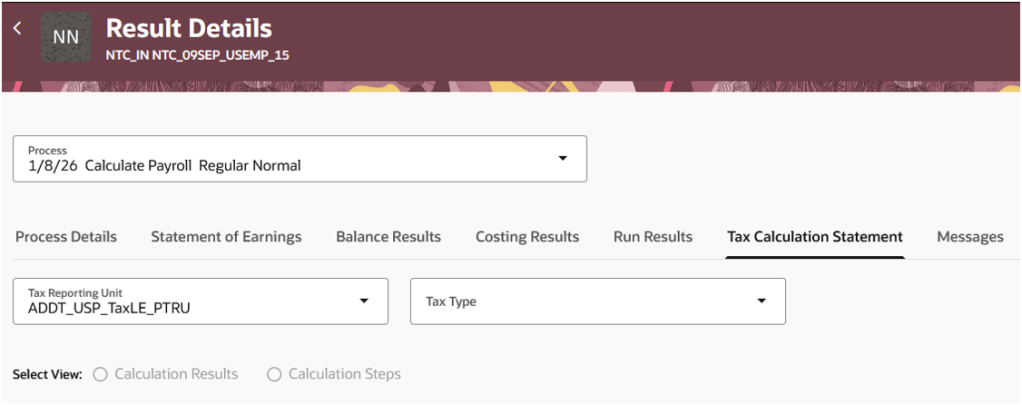
The next feature is the Tax Calculation Statement Page: Federal Income Tax. This is probably my favourite enhancement in the US payroll release. Payroll teams are regularly asked why a particular tax deduction was calculated in a certain way, yet historically obtaining that answer often meant navigating several screens or performing manual calculations. Oracle has introduced a new Tax Calculation Statement view that provides complete visibility into Federal Income Tax calculations. Administrators can either review the calculation components directly or work through a step-by-step breakdown showing intermediate values and calculation logic. For troubleshooting and employee query resolution alone, this has the potential to save a huge amount of time.

Oracle continues to expand the capabilities of its Payroll Run Analyst AI Agent. The agent can now answer natural language questions relating to Federal Income Tax calculations, allowing administrators to ask questions such as why a calculation was performed a particular way or which attributes contributed to the result. This is one of the more practical examples of AI within payroll. Rather than trying to automate the payroll process itself, Oracle is using AI to make it easier for payroll professionals to understand and investigate payroll outcomes.

Oracle has added a new Tax Enforcement Level field within the Federal component of the employee Tax Withholding card. This allows administrators to determine whether annual limit tax tracking should occur at the PSU, TRU, or tax group level. Because the setting exists at employee level, it can also override organisation-level defaults when required. For organisations with more complex employment structures, the additional flexibility will be welcome.

Oracle has also improved how USOPTE statutory tax rule overrides are managed. Payroll administrators can now create, update, delete, and end-date override records directly from the Statutory Rules interface, while also reviewing override history over previous years. It brings what has sometimes been tracked externally back into Oracle in a much more controlled and auditable way.

Oracle continues to invest heavily in Irish payroll, and that’s entirely understandable. Irish Payroll is still relatively new within Oracle Fusion compared to some of the more mature localisations, and Oracle have been steadily expanding both functionality and legislative coverage release after release. The pace of delivery remains impressive, with large number of enhancements arriving in 26D alone. While some of these changes are legislative in nature, others help bring Irish Payroll into line with capabilities that customers in longer-established payroll localisations have already been benefiting from.

The Payroll Activity Centre is now available for Irish payroll customers. This provides administrators with a consolidated view of payroll activity, balances, and exceptions, including Irish-specific values such as PAYE, PRSI, USC, and My Future Fund deductions. The real value isn’t the visibility itself, but the ability to identify and resolve issues earlier in the payroll cycle before they become employee-facing problems.

Oracle has updated eligibility calculations for SSP and Illness Benefit so that they now use recorded sickness absence dates rather than medical certificate dates. It’s a relatively straightforward change, but one that better reflects how absences are typically managed in practice.

The Periodic Foreign Tax Credit enhancement allows payroll teams to apply periodic or annual foreign tax credits through the employee’s PAYE Additional Information card. Rather than waiting for relief to be claimed after year end, payroll can now reduce tax liability during payroll processing itself. For employees with cross-border tax obligations, that has the potential to improve cash flow and reduce the impact of dual taxation while relief is being processed.

Oracle now automatically applies the Department of Social Protection’s 15% net-pay deduction cap for applicable Notice of Attachment deductions. Whenever statutory limits apply, the payroll calculation automatically uses the lower of the requested deduction amount or the permitted cap.

The final enhancement supports deletion requests for previously submitted My Future Fund contribution records. The Send File Submission process can now determine whether an earlier submission exists and automatically generate either an initial submission or a deletion request as appropriate. Additional audit reporting has also been introduced to maintain visibility of deleted contribution records.

Overall, I wouldn’t describe 26D as a blockbuster Payroll release, but that’s not necessarily a criticism. Some of the most valuable payroll enhancements aren’t the flashy ones. They’re the improvements that make investigations quicker, reduce administration effort, improve compliance, or remove manual work that payroll teams have quietly accepted as part of daily life.

For me, the stand-out areas this quarter are the continued maturity of the Redwood payroll experience, the Retropay processing enhancement, and the new transparency around US Federal Income Tax calculations. Together they show Oracle continuing to focus on usability and operational efficiency rather than simply adding more functionality.

If you’re planning your 26D review, I’d recommend paying particular attention to the Redwood changes and checking whether there are opportunities to simplify payroll administration processes as part of your wider upgrade planning. And as always, keep an eye on the What’s New documentation throughout the release cycle. Oracle occasionally slips in additional gems after the initial announcement, and payroll is no exception.

Please note that all screenshots are the property of Oracle and are used in accordance with Oracle’s Copyright Guidelines.
Oracle Learning 26D: Smarter Learning Through Practical AI

It’s quarterly release season again and Oracle Learning has delivered a surprisingly strong set of updates in 26D. What stood out to me wasn’t any individual feature. It was the direction of travel. Over the last couple of years, we’ve seen Oracle talk extensively about AI, skills intelligence, digital assistants and, more recently, Agentic Apps. For many customers, the question has been whether these capabilities would genuinely change the way people work or simply provide another layer of technology to navigate. With 26D, Oracle Learning starts to answer that question.

Several of the headline updates focus on something far more practical than flashy AI demonstrations. They help managers understand whether learning is driving development, reduce administrative effort for learning teams, and make it easier for employees to manage their own learning journeys.

What’s particularly noticeable is that Oracle is investing across the entire learning ecosystem. Managers gain better visibility into skill development, learning specialists receive more powerful AI-assisted administration tools, and learners benefit from a significantly upgraded self-service experience. As always, Oracle may add additional functionality as the quarter progresses, but let’s take a look at the highlights announced so far.

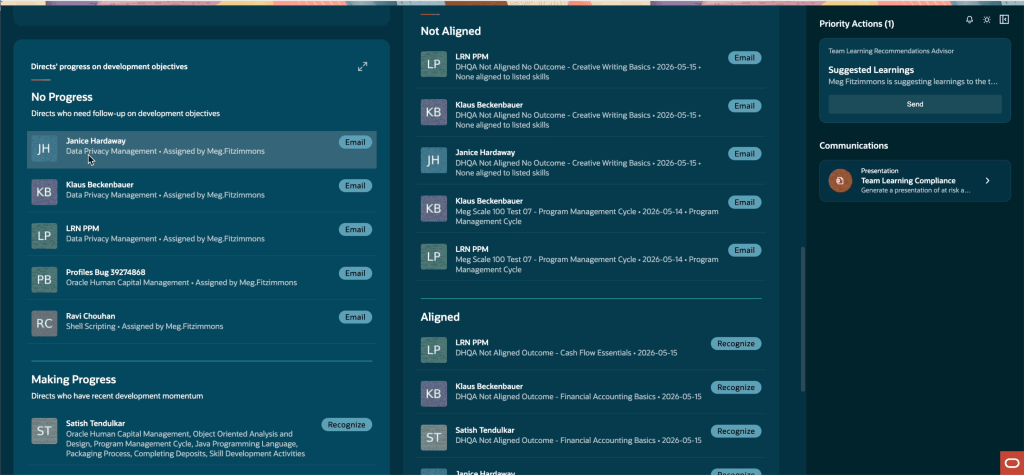
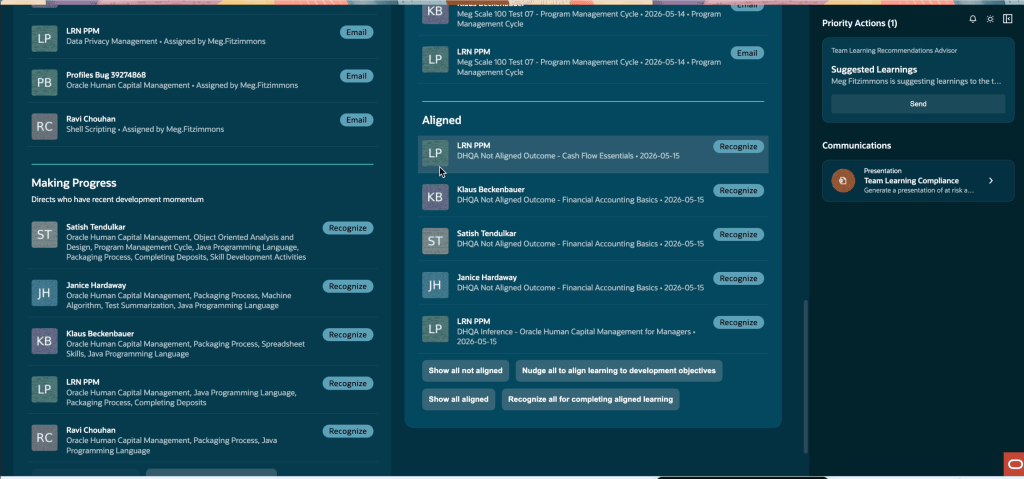
If you’ve been following Oracle’s Agentic Apps journey, the Team Learning and Development Workspace for Managers is perhaps the most interesting Learning enhancement in 26D. One of the challenges managers often face is connecting learning activity with actual employee development. Completion rates and learning hours tell part of the story, but they rarely answer the question that really matters: is this learning helping people develop the skills they need? Oracle is clearly trying to bridge that gap.

The previous Skills Development by Skill and Skills Development by Direct panels have been replaced with two new views: Directs’ Progress on Development Objectives and Directs’ Learning Alignment with Development Objectives. Rather than simply showing learning activity, managers can now see whether development goals are progressing and whether completed learning is contributing towards those goals.

The Directs’ Progress on Development Objectives panel highlights which team members are making progress against assigned development skills during a 90-day evaluation period. Managers can take action directly from the workspace through delivered email actions, either nudging employees who haven’t started progressing or recognising those who have. The Directs’ Learning Alignment with Development Objectives panel provides a different perspective. It helps managers understand whether completed non-compliance learning aligns with an employee’s development objectives, using completion outcomes and learning context to make those connections visible.

One of the concerns I often hear when discussing AI in HR is whether we’re removing too much human judgement from people processes. Oracle has struck a sensible balance here. The agent analyses learning activity, identifies who may need support and drafts appropriate communications, but managers remain firmly in control. Nothing is sent automatically. The manager decides whether intervention is needed and whether the suggested communication is appropriate. To me, that’s where enterprise AI delivers the most value. Not by replacing managers, but by helping them spend less time finding issues and more time acting on them.

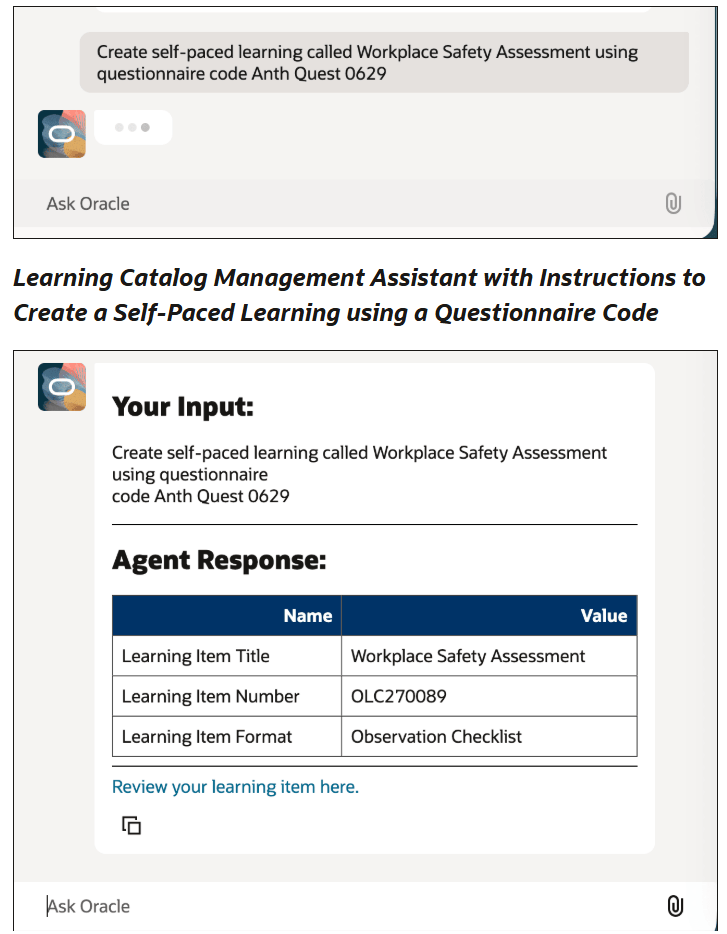
You may remember the Learning Creation Assistant, first introduced in 25D and enhanced further in 26B. In 26D, it has been renamed the Learning Catalog Management Assistant, and Oracle continues to expand what it can do. The main enhancement is support for questionnaire-based self-paced learning.

Learning specialists can now provide a questionnaire title or code and instruct the assistant to create the associated learning item. The assistant validates the questionnaire, determines whether it should be implemented as an assessment or observation checklist, and creates the learning in draft status ready for review and activation.

At first glance this might feel like a relatively small enhancement. In reality, it’s another step towards natural language administration. Learning specialists can focus on what they’re trying to achieve rather than remembering every configuration step required to get there. By allowing administrators to describe the learning experience they want to create and letting the assistant build the underlying structure, Oracle continues to remove friction from content administration. It’s exactly the type of repetitive setup activity that AI should be helping with. The assistant can also capture additional details such as mastery scores, attempt limits and visibility settings as part of the prompt, reducing the amount of manual configuration required.

Customers who already implemented the earlier Learning Creation Assistant should note that the property on the agent must be updated to reference the new delivered runnable agent. Any customisations made against copied templates will also need to be reapplied.

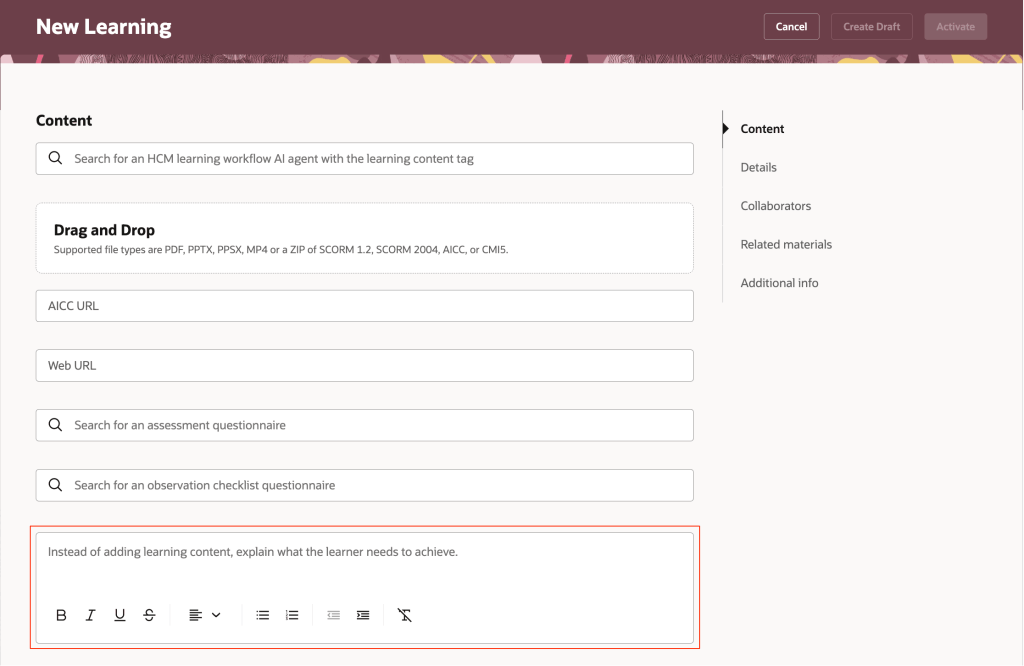
One of my favourite enhancements in 26D is also one of the simplest. Learning specialists can now create task-based self-paced learning directly from rich text instructions, removing the need for a supporting content asset. That may not sound revolutionary, but anyone who has implemented Learning Cloud will recognise the problem it solves.

Many organisations need to track activities that happen outside the platform. Reading a policy, completing an offline activity, attending an external event or carrying out a workplace task are all valid learning experiences, yet administrators have often needed to create workaround content simply to make those activities available in Learning Cloud. 26D removes that complexity entirely.

Learning specialists can simply enter instructions directly within the Redwood learning experience. Learners see those instructions as part of the enrolment details page and complete the activity according to the configured completion rules. Where learner confirmation is enabled, employees can mark the activity as completed themselves. Where administrator verification is required, that option is hidden and completion remains under administrative control.

It’s not necessarily the most exciting feature in the release, but I suspect it will become one of the most useful. The feature is enabled automatically and requires no additional configuration.

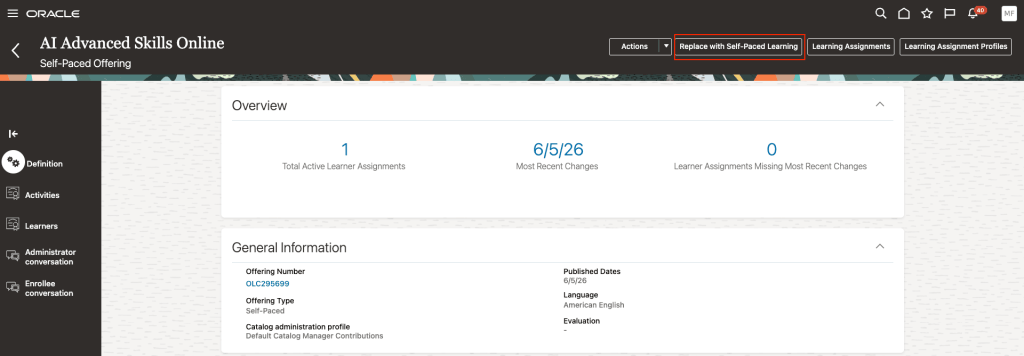
This enhancement originated in Oracle Ideas Lab, which is always encouraging to see. Learning specialists can now add self-paced learning directly into a course structure, allowing learners to access online content through courses in the same way they access instructor-led or virtual offerings. From the course details page, administrators can either attach an existing self-paced learning item or create a new one directly within the workflow.

The standout capability, however, is the new Replace with Self-Paced Learning action. I particularly like the inclusion of the replacement capability. Replacing learning content in large catalogues can be surprisingly challenging. Organisations need to modernise content without losing visibility of historical completions, compliance records and in-progress learning.

Oracle has clearly thought beyond simply enabling a new feature and considered the operational reality of managing learning catalogues over time. When a legacy offering is replaced, completed and in-progress learning records are preserved for reporting and audit purposes. Learners already progressing through an offering can still complete it, while future assignments are redirected towards the new self-paced learning. Deprecated offerings become read-only and are no longer available for enrolment, assignment or discovery within the catalogue.

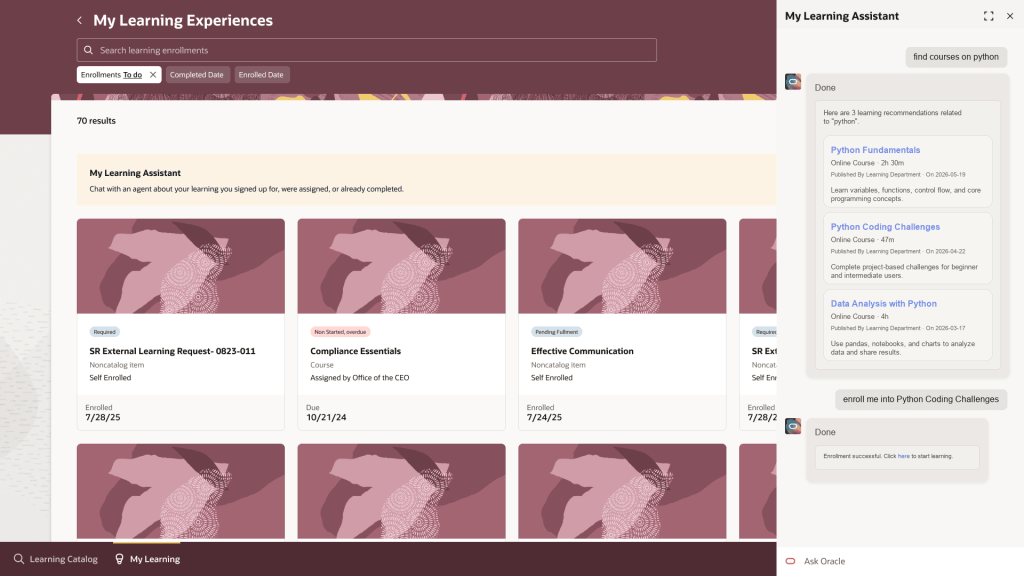
The final enhancement that caught my attention is the continued evolution of My Learning Assistant. We’ve moved well beyond the stage where conversational assistants simply answer questions. Oracle is increasingly positioning learning assistants as task-oriented experiences, helping users complete actions rather than just retrieve information. In 26D, learners can review assignments, explore recommendations, enrol onto learning and access key learning processes from a single conversation. That moves the assistant much closer to becoming a genuine learning companion rather than simply a search tool.

The assistant can now answer questions about active, overdue, mandatory, upcoming, self-enrolled and completed learning. It can recommend content from the catalogue, support enrolment directly where eligibility allows, and launch processes such as Record External Learning and Request Noncatalog Learning. Recommendation cards are also richer, displaying details including learning type, effort, pricing information, AI-generated reasoning and links to catalogue information.

Just as importantly, Oracle continues to ground responses in actual Learning data and workflows. If information doesn’t exist, the assistant won’t invent it. That may sound obvious, but trust is one of the most important factors in successful enterprise AI adoption. Users need confidence that recommendations and answers are based on real information, particularly when they’re making decisions about compliance or professional development.

Customers who deployed My Learning Assistant using the original 25D template should take note. Oracle recommends replacing the existing template with the updated delivered version to avoid inconsistent behaviour. Depending on your deployment approach, guided journeys used to surface the assistant through the Ask Oracle banner may also require updates.

If I had to summarise Oracle Learning 26D in a single phrase, it would be practical AI. There are no headline-grabbing announcements or futuristic concepts here. Instead, Oracle continues to focus on helping managers, learning specialists and learners spend less time navigating systems and more time focusing on development.

What I find particularly interesting is that Learning is becoming one of the strongest showcases for Oracle’s broader AI strategy. Across multiple features, Oracle isn’t attempting to remove people from the process. The technology is being used to surface insights, reduce administration and support decision-making while keeping humans firmly in control. That’s where I believe enterprise AI creates the greatest value. Not by replacing expertise, but by helping people apply it more effectively. And if Oracle continues along this path, Learning could become one of the strongest examples of AI delivering measurable business value within Oracle Fusion Applications.

Please note all screenshots are the property of Oracle and are used in accordance with Oracle’s Copyright Guidelines.
What’s New in Core HR: Oracle Fusion HCM Cloud Release 26D

It’s that time again, quarterly release time, and 26D brings a solid set of updates for Core HR teams. There’s a meaningful enhancement to the Assignment Change Assistant, a quiet but important fix for position synchronisation via HCM Data Loader (HDL), continued evolution of the Activity Centre experience, and a deprecation notice that anyone who built agents in the last couple of releases needs to act on. As usual, Oracle may add further features throughout the month, so let’s take a look at what’s been introduced so far.

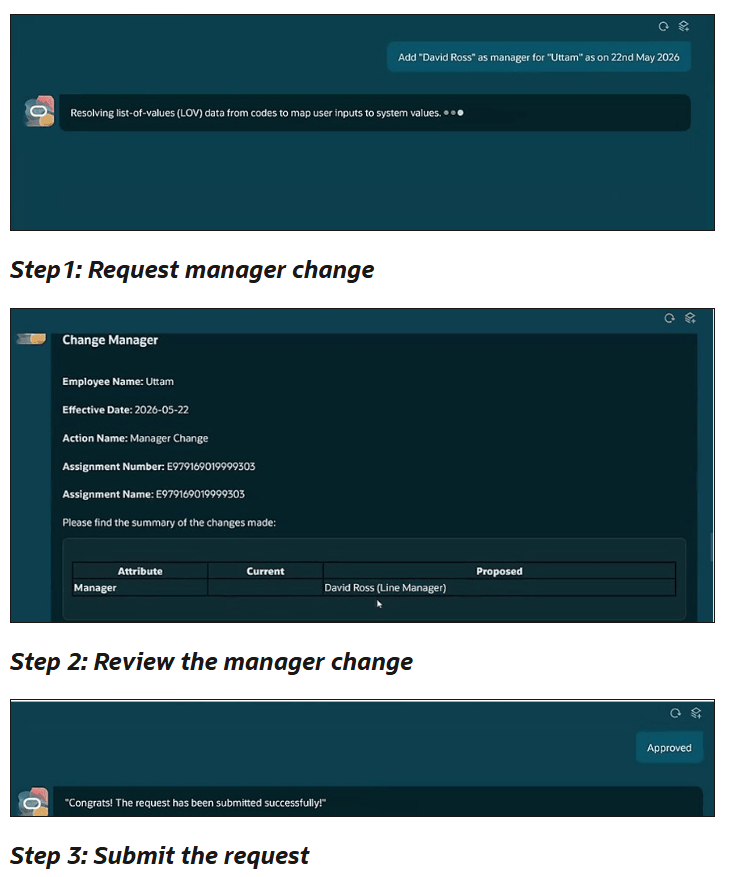
First introduced in 26C, the Assignment Change Assistant, now referred to as the Employment Updates Agent, has been extended considerably in 26D. The original release allowed managers and HR specialists to initiate assignment changes conversationally through the AI agent framework. In 26D, Oracle has addressed one of the natural limitations of that first version: users can now ask the agent for information before deciding what to change.

So rather than jumping straight into a transaction, a manager can open a conversation and ask something like “Who is David’s current manager?” or “What job is this person assigned to?” and get a direct answer from the agent before initiating any update. That’s a genuinely useful shift in how the assistant works. It moves from being a transaction tool to being a decision-support tool as well.

Beyond information retrieval, the supported transaction scope has grown. Change Working Hours and Change Manager are now supported processes alongside the original capabilities. Salary updates are also now handled directly through the agent: managers or HR specialists can specify either a new salary amount or a percentage increase , which covers the majority of straightforward salary adjustment scenarios without needing to exit to a quick action. For anything more complex, Oracle’s guidance is to use the standard quick actions, which is sensible.

Two other additions worth noting: Business Title can now be derived automatically from the selected Job or Position and presented in the review summary before submission, and on the review page, users can now click Request Change to modify any supported assignment attribute before submitting, not just the manager notes as was the case in 26C.

One thing to note: salary update access through the agent requires the user to already hold the privilege and data access needed to create a salary change through the standard application. The agent doesn’t grant any additional access beyond what the user already has.

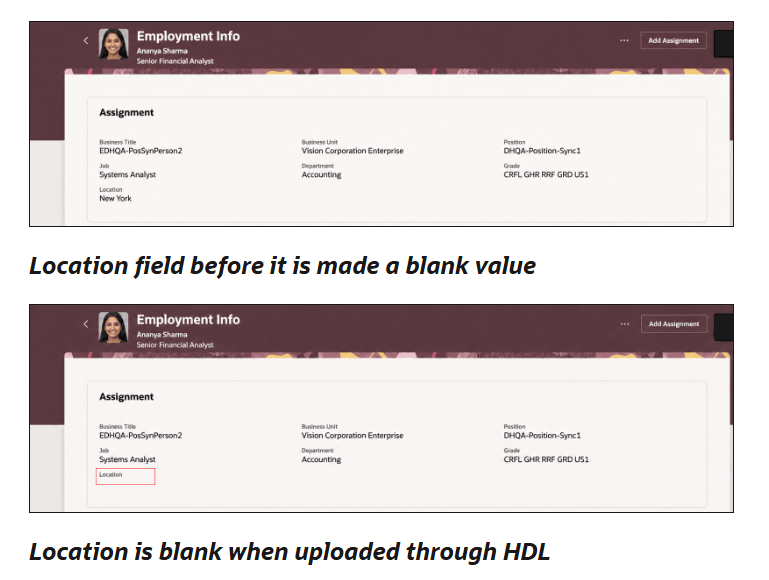
The next feature I want to highlight is Blank Position Values Now Synchronise Correctly via HDL. This one might look small on paper, but if you’ve ever had to unpick mismatched position and assignment data after a bulk load, you’ll appreciate exactly why it matters.

Prior to 26D, when a position attribute configured for synchronisation was cleared, running an HCM Data Loader (HDL) load would not propagate that blank value down to the assignment. The result was that the assignment retained a old value even though the corresponding position attribute had been removed. For organisations that rely on position synchronisation to keep assignment data consistent, this created a category of data discrepancy that was difficult to detect and time-consuming to resolve.

From 26D, blank values are synchronised to the assignment provided the attribute is configured for position synchronisation. The logic is straightforward: if Grade Ladder is a synchronised attribute and it’s removed from a position, the next HDL load can now clear that value on the corresponding assignments. In addition, Position Name can now be configured to synchronise with Assignment Name through HDL, so the Assignment Name is derived from the Position Name as part of the synchronisation process.

If your organisation built agents in 26A or 26B using either the Personal Information Assistant or the Person Legislative Information supervisor agent templates, this is the announcement you need to pay attention to. Both templates are deprecated in 26D. Agents already created from these templates will continue to function for now, but Oracle has confirmed these templates will no longer be enhanced. The replacement is the Person Data Assistant, introduced in 26C as a workflow agent that extends person data management with workflow-based child agents for selected data areas.

The practical implication is clear: any new development should be on Person Data Assistant, and existing agents built on the deprecated templates should be migrated. If your organisation has already deployed either of the old agents in production, now is the right time to start your migration planning. The agents won’t break overnight, but you’ll be building on a foundation that Oracle is no longer investing in, and the gap between the deprecated templates and Person Data Assistant will only widen with each subsequent release.

Start by reviewing what data areas your existing agents cover, map those to the Person Data Assistant’s workflow-based child agent structure, and assess the configuration effort involved. There’s no need to rush into a weekend migration, but equally don’t leave this until the deprecated templates stop functioning without warning.

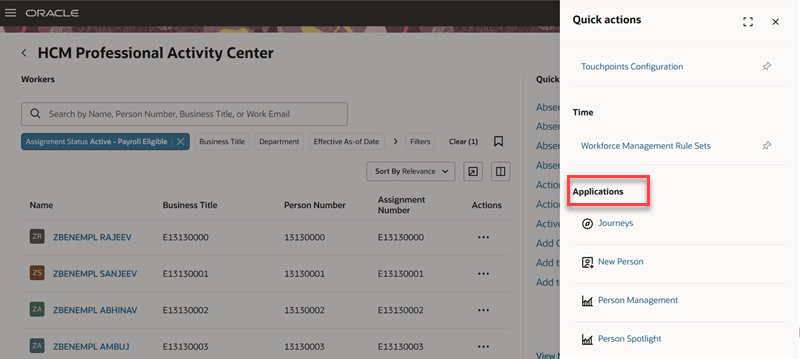
The HCM Professional Activity Centre was introduced in 26C and is already a firm favourite. 26D brings a couple of enhancements that make it meaningfully easier to use for both HR professionals and the administrators who configure it. Applications and quick actions are now consolidated into a single list under the Quick Actions section. Previously these were presented separately, which added navigation steps for users looking to get to a specific action or application. Now, selecting View More in the Quick Actions section shows pinned quick actions first, followed by other quick actions, and then the list of applications in one continuous view.

The second enhancement is organisation-level default pinning. Administrators can now define a default set of pinned quick actions for all users via the Structure tool. If a user hasn’t set their own pins, they’ll see the organisation defaults. If they have already personalised their pins, those personal choices remain and aren’t overridden. This gives administrators a sensible way to surface the most commonly needed actions for their user population without forcing any individual into a rigid layout.

One thing to note: navigation to a future hire’s person activity centre from search results has been disabled in this release.

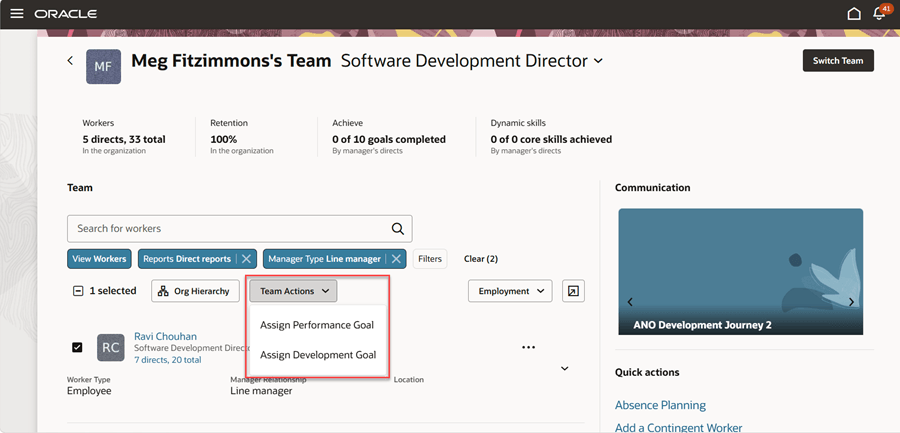
The Team Activity Centre enhancements in 26D follow a similar pattern to the Professional Activity Centre improvements above, with the addition of a genuinely useful capability for managers around goal assignment. Managers can now assign a performance or development goal to multiple direct and indirect reports selected through Team Activity Centre filters, all in a single action. Previously, assigning the same goal to a group of employees meant repeating the process person by person. For managers cascading goals across a team or department, that was a real time cost. This feature removes it.

The same quick actions and applications consolidation available in the Professional Activity Centre applies here too. Quick actions and applications are now in a single list under View More, with pinned actions appearing first. Organisation-level default pins work the same way.

Overall, 26D is another incremental but worthwhile update for Core HR. The headline change is the deprecation of the older personal information templates, so if you’ve built agents using those templates it’s worth starting your migration planning sooner rather than later. Beyond that, Oracle continues to refine both the AI and user experience story, with improvements that should make everyday HR processes a little smoother. As always, keep an eye on the readiness materials throughout the quarter, as Oracle sometimes introduces additional enhancements after the initial announcement.

Please note all screenshots are the property of Oracle and are used according to their Copyright Guidelines