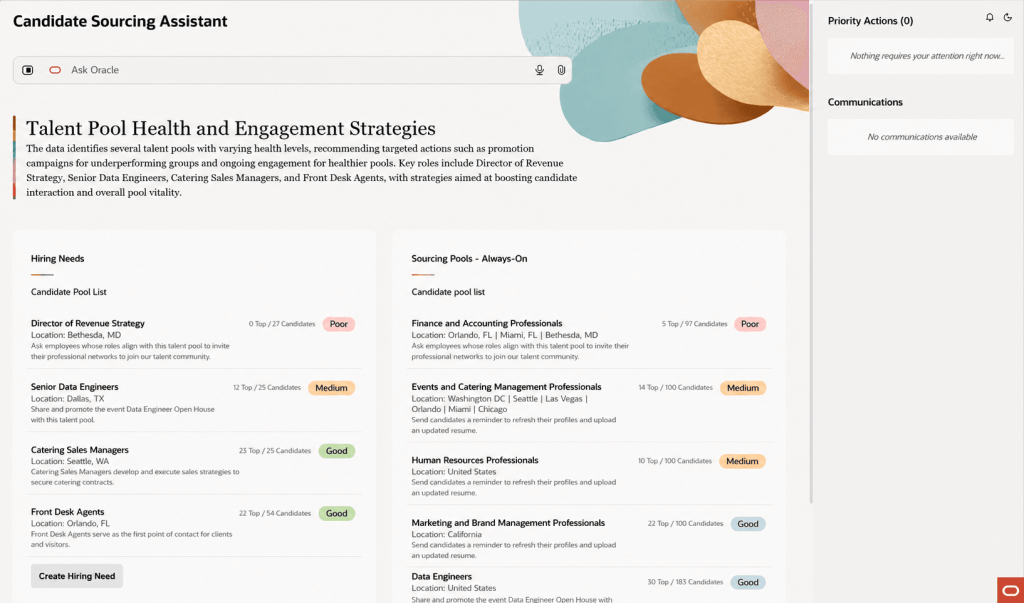
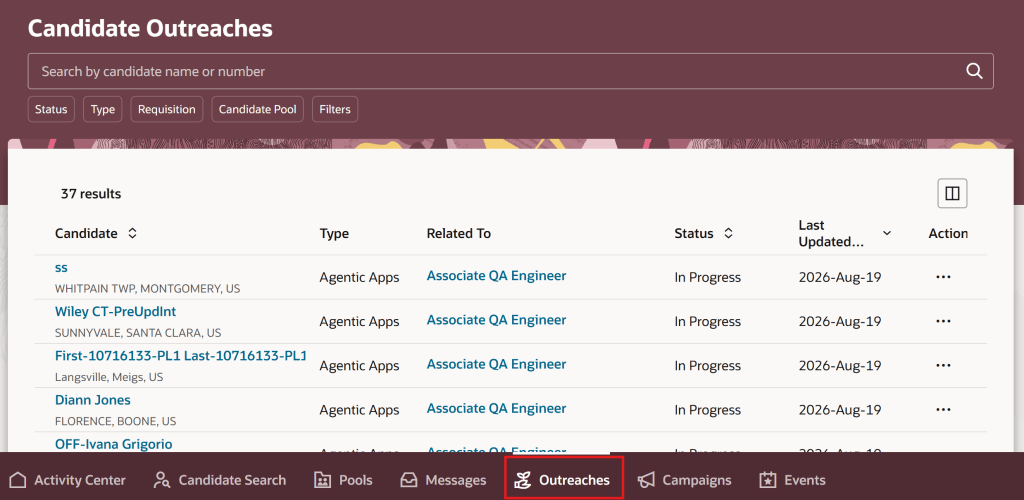
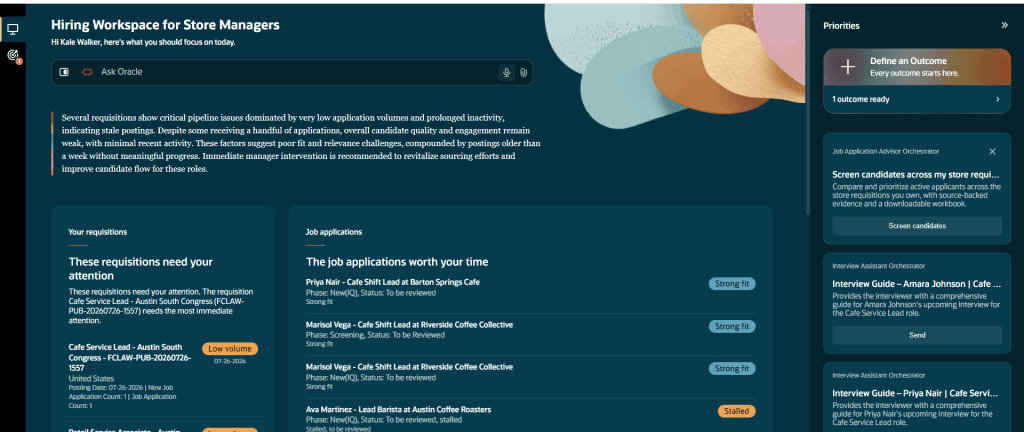
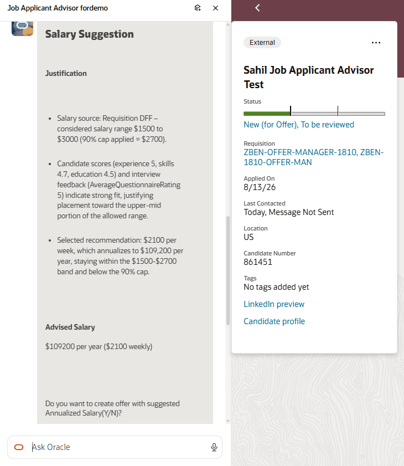
Over the past couple of years, we’ve seen Oracle steadily evolve its AI story. It began with AI capabilities embedded within Fusion Applications. Then came AI Agents, followed by AI Agent Studio, giving customers the ability to build, extend and govern their own AI-powered processes. Oracle has unveiled the next piece of the puzzle: Fusion Claw.
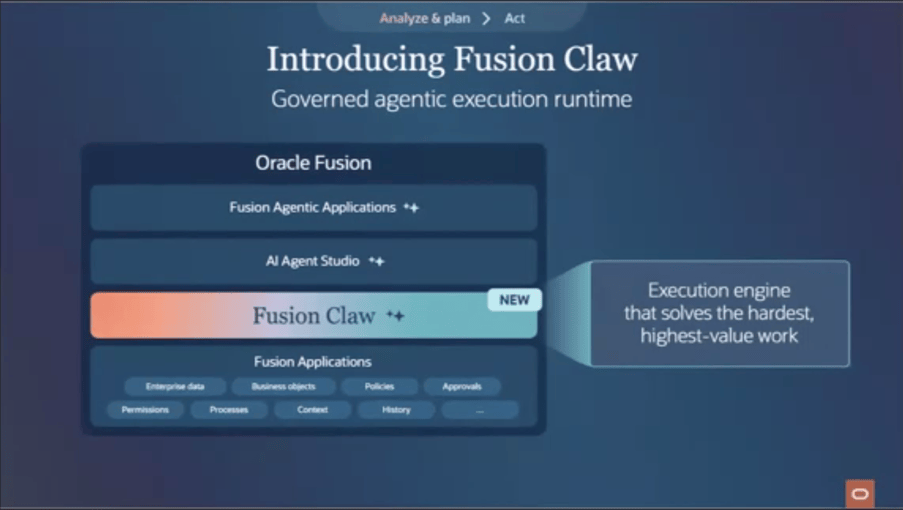
I’ll admit that when I first heard the name, I wasn’t entirely sure what to make of it. Another AI agent? A new orchestration framework? Perhaps just another acronym to add to the ever-growing AI dictionary? Having sat through the recent webinar, I came away thinking this may actually be one of the most significant Oracle AI announcements we’ve seen so far.
Not because it introduces more AI. But because Oracle appears to be addressing one of the biggest challenges organisations face today: how do you move from AI recommendations to AI-driven outcomes whilst maintaining governance, accountability and human oversight?
Most enterprise AI today is still fundamentally assistive. Whether it’s generating content, summarising information, analysing data or helping users complete transactions, AI is primarily helping people do their jobs more efficiently. Even many AI agents stop at recommendations. They identify an issue, gather information, analyse options and suggest a course of action. A human then reviews the output and decides what happens next. Fusion Claw appears to be Oracle’s answer to that gap.
Oracle positions Fusion Claw as a governed execution runtime that sits between AI planning and enterprise execution. People define objectives, policies and desired outcomes. Agentic Applications orchestrate business processes. Fusion Claw plans and executes activities. Fusion Applications remain the system of record. That distinction is important.
Oracle is not proposing a future where AI operates outside enterprise controls or invents its own ways of working. Instead, Fusion Claw operates against the same business objects, security model and governance framework that organisations already trust. In simple terms, Oracle is creating a mechanism for translating business outcomes into governed action.
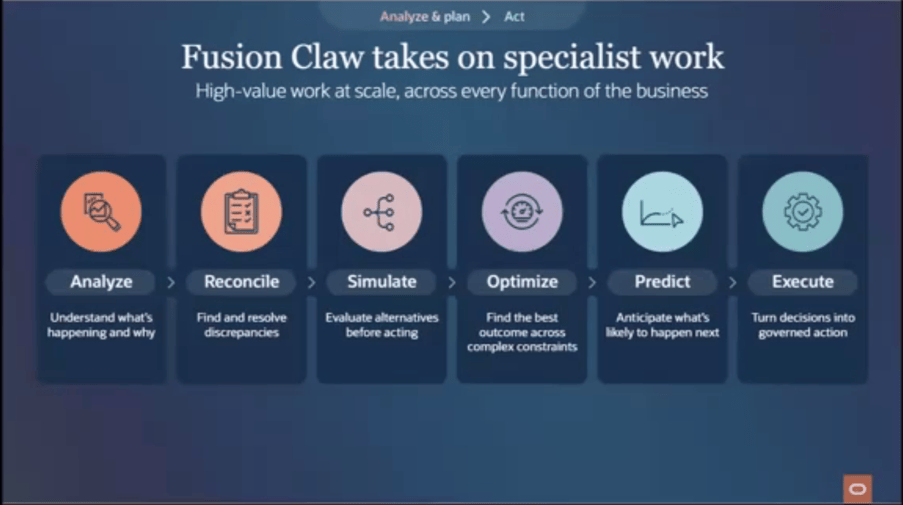
Fusion Claw is designed for complex, high-value work rather than simple transactional activities. Its core capabilities are Analyse; Reconcile; Simulate; Optimise; Predict; and Execute. Those first five capabilities are becoming increasingly common across enterprise AI platforms. The sixth is what makes Fusion Claw different. Execution has traditionally been the point where AI recommendations hand off to humans. Oracle is now seeking to close that gap.
Imagine an organisation identifying a workforce issue, supply chain disruption, financial variance or operational risk. A traditional AI capability might identify the problem. An AI agent might recommend a solution. Fusion Claw is designed to take things further by evaluating multiple options, simulating outcomes, optimising the approach and, where authorised, executing approved actions. That feels like a notable evolution in Oracle’s AI strategy.
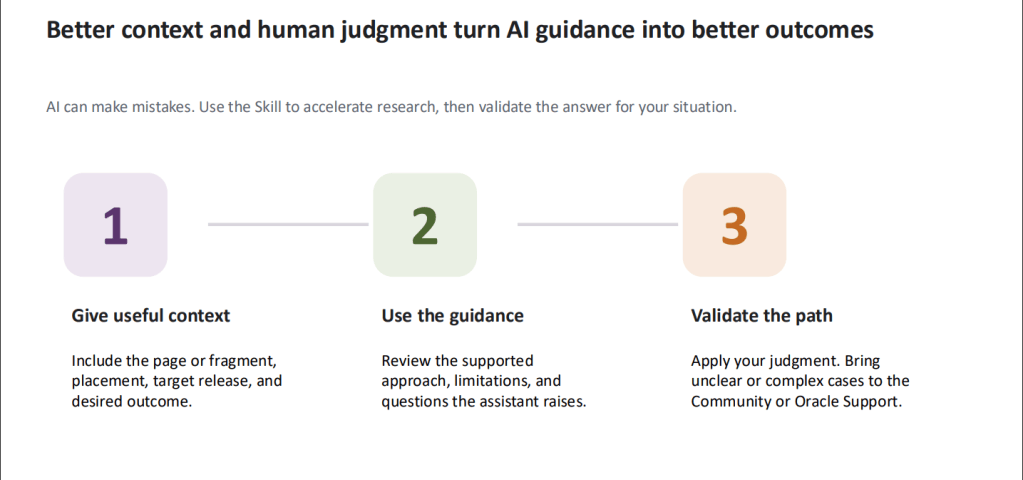
The focus is no longer: “How can AI help me complete this task?” Instead, the question becomes: “How can AI help achieve this business outcome?”
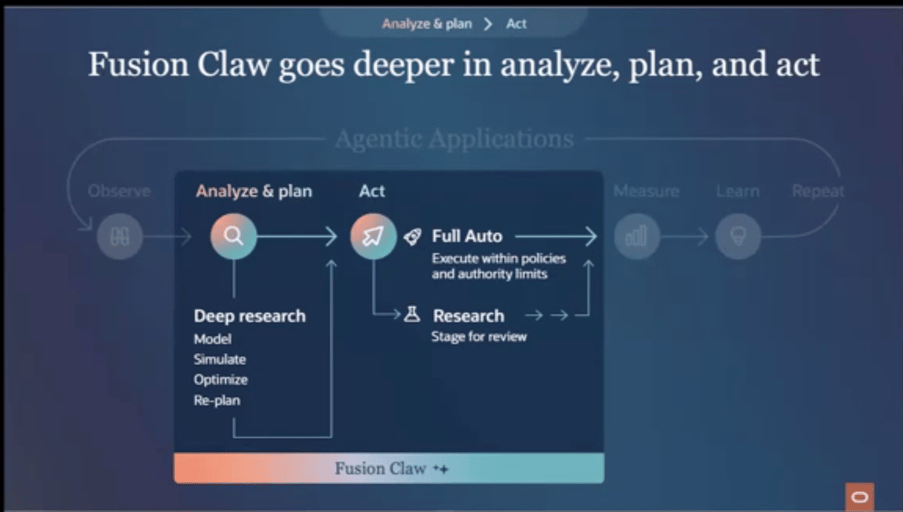
One of the most interesting concepts introduced during the session was the distinction between two the operational models Deep Research vs Full Auto. In Deep Research mode, Fusion Claw investigates, analyses and simulates. It evaluates scenarios, compares potential outcomes, surfaces recommendations and presents options for human review.
Importantly, the human remains responsible for making the decision. For many organisations, particularly those operating in highly regulated environments, this will likely be the most comfortable starting point. The value comes from faster analysis and better decision support, whilst maintaining a clear human approval process.
Full Auto mode is where things become significantly more transformative. In this model, Fusion Claw can plan and execute authorised activities automatically in pursuit of a defined business outcome. That naturally raises questions. Who controls it? Who is accountable? What prevents unintended actions?
Anyone who has read my blogs over the past year will know that governance is often the first question that I and customers ask. The technology itself is rarely the challenge. Trust is. The encouraging aspect of Fusion Claw is that governance appears to have been designed into the platform from the outset rather than added afterwards.
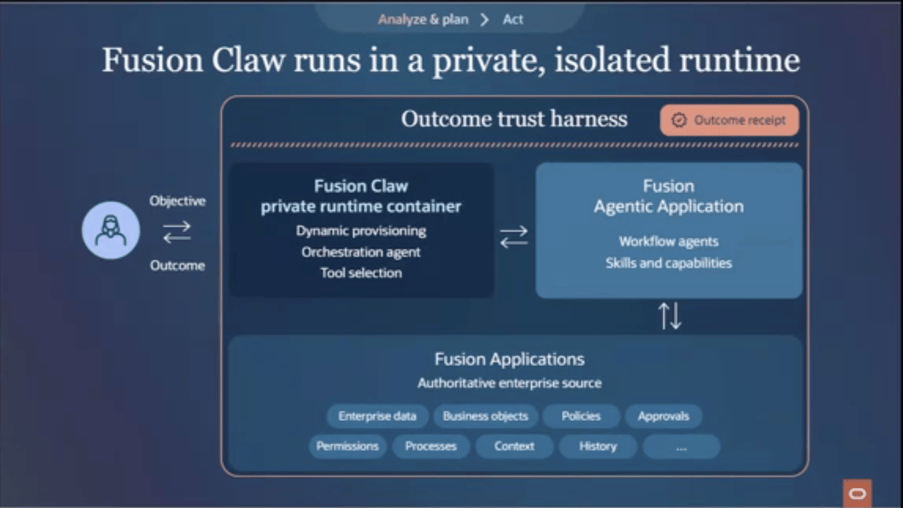
Fusion Claw operates inside a private runtime container within the customer’s Fusion environment and works directly with authoritative Fusion business data. Perhaps most importantly, Fusion Claw does not grant itself authority. Organisations decide what actions can be taken, under which circumstances and with what level of oversight. Human accountability remains in place. For customers concerned about explainability, risk and compliance, that message will be every bit as important as the AI capabilities themselves.
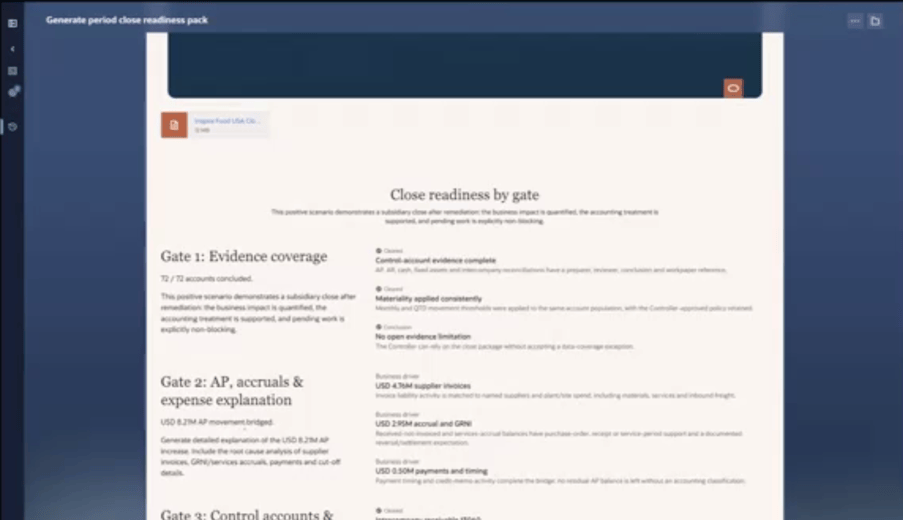
One feature that particularly caught my attention was the concept of an Outcome Receipt. Every execution performed by Fusion Claw generates a detailed record that explains: What happened? Why it happened? What information was used? Which controls were applied? Which actions were executed?
At first glance, this sounds like an audit feature. In reality, it could become one of the most important capabilities in the platform. As AI becomes responsible for increasingly valuable business activities, organisations will need evidence. They’ll need to demonstrate how decisions were reached, what data was considered and who authorised the action. For public sector organisations, financial institutions and heavily regulated industries, this level of transparency could prove essential. Many organisations are no longer asking whether AI can make decisions. They’re asking whether they can prove how those decisions were made.
Most enterprise systems operate on a transaction basis. Users initiate activity, the system responds and the process ends. Fusion Claw appears designed to work differently. It is runtime that continuously monitors conditions, reassesses plans and adjusts activities in pursuit of an outcome. Execution can be triggered by user requests; scheduled activities or configured triggers. Rather than waiting for users to notice and react, Fusion Claw is designed to continuously work towards a defined objective. That’s a subtle but potentially significant shift in how we think about enterprise applications.
One other key point of note is Fusion Claw’s ability to work across business functions. Rather than being constrained to a single process or module, it is intended to support end-to-end activities spanning multiple Fusion pillars. This cross-functional capability is important because real business outcomes rarely exist within the boundaries of a single application module.
Most organisational challenges span departments, processes and data sources. Fusion Claw appears designed with that reality in mind. It should also be noted that whilst Fusion Claw is firmly rooted within Fusion Applications, it can interact with external services and other agents where appropriate access has been configured.
A practical concern for many customers will be whether existing investments become obsolete. Fortunately, Oracle’s answer appears to be no. They have confirmed that existing agents can be reused and enhanced rather than rebuilt from scratch. Given that many organisations are only just beginning their AI Agent Studio journey, that will be welcome news.
For those already thinking ahead to roadmap planning, there are a few key details you should know. Fusion Claw is currently targeted for the 26D timeframe. If you have already purchased the licence for the Agentic Applications, you will automatically be able to use Fusion Claw.
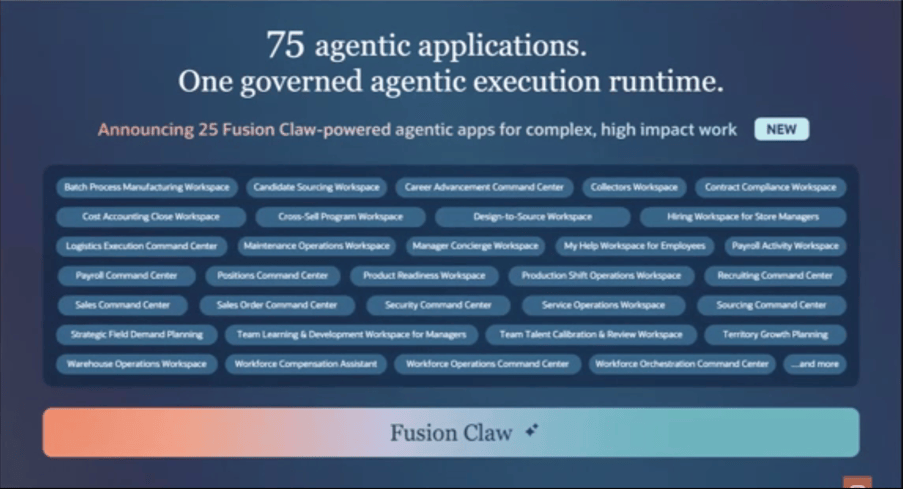
By the time you receive 26D, Oracle will have provided 75 Agentic Applications out of the box, of which 25 will be Fusion Claw-powered applications focused on more complex enterprise activities. You won’t be limited to just these 25 Fusion Claw applications, as with all AI Agents and Agentic Applications, you can build your own. This can be via the No Code methods in AI Agent Studio or the Low Code options using CLI.
So, Is This Oracle’s Most Important AI Announcement Yet? Maybe. It’s certainly one of the most ambitious. AI Assist features help users work faster. AI Agents help users make better decisions. Fusion Claw appears to be aiming for something larger: helping organisations achieve business outcomes through governed AI execution. Whether customers are ready to embrace that level of autonomy remains to be seen.
Some organisations will begin with Deep Research, keeping humans firmly in the decision-making loop. Others will be attracted by the possibility of allowing approved activities to execute automatically within carefully defined guardrails. Either way, the conversation is changing. We’re moving beyond asking how AI can assist users and starting to explore how AI can help organisations achieve measurable outcomes. For me, that’s the real significance of Fusion Claw.
The technology itself is impressive, but the bigger story is what it represents: Oracle’s vision for moving from AI that advises, to AI that acts, whilst still maintaining the governance, security and accountability that enterprises demand. And that may ultimately make Fusion Claw one of the most important steps yet in Oracle’s AI journey.
Please note all screenshots are the property of Oracle and are used according to their Copyright Guidelines.