
For many Oracle Fusion SCM customers, Tuesday’s announcement will have come as welcome news. The mandatory Redwood adoption deadline has moved from before 27A to before 27B, giving organisations approximately another three months to complete their transition. Oracle’s latest guidance now places mandatory adoption before 27B for most SCM products, rather than before 27A.
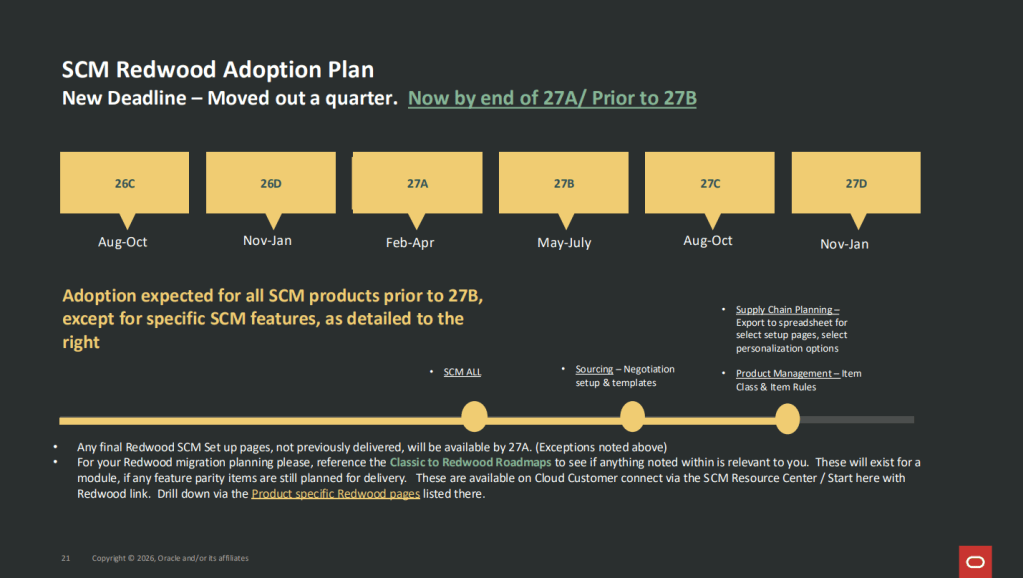
If you’ve been worried about fitting testing, change management, personalisation reviews and training into an already busy roadmap, that extra quarter will undoubtedly help. But if you’re interpreting this as an opportunity to pause your Redwood programme, I think that would be a mistake. The deadline has moved. The amount of work required has not.
The reality is that many customers have been asking for more time. Across Procurement, Inventory, Manufacturing, Order Management and other SCM modules, Redwood adoption isn’t simply a technical upgrade. It requires organisations to review processes, retrain users, validate extensions, revisit personalisations and test end-to-end business flows.
The additional quarter gives customers breathing space to do those activities properly rather than rushing to meet an arbitrary date. That’s a positive outcome. It also allows Oracle to continue delivering the final Redwood experiences and setup pages that are still being completed across parts of the SCM portfolio. Oracle’s recent communications highlight continued delivery of Redwood functionality alongside a growing catalogue of Redwood-only features and AI capabilities.
What the extension does not change is Oracle’s strategic direction. Classic remains on the retirement path. Redwood remains the future. A year ago, many conversations about Redwood in Supply Chain focused on colours, layouts and navigation. Today that feels increasingly outdated.
Almost every release introduces new capabilities that are built specifically for Redwood pages. Across Procurement and SCM, Oracle is investing heavily in AI Agents, Agentic Apps, enhanced analytics, intelligent search experiences and workflow automation that simply do not exist in classic pages.
Examples include:
- Autonomous supplier research
- Purchase order advisory agents
- Sourcing Command Centre Agentic Apps
- AI-assisted contract capabilities
- Redwood-only procurement administration pages
- Enhanced receiving approvals and workflows
These aren’t cosmetic improvements. They fundamentally change how users interact with Oracle Fusion SCM. The risk of delaying Redwood adoption is no longer just missing a compliance deadline. It’s falling behind on innovation.
Whenever I talk to customers about Redwood, I often hear concerns about profile options, configuration settings or deployment approaches. Those things matter. But they are rarely the hardest part. The bigger challenge is behavioural change.
Many organisations successfully enable Redwood but continue allowing users to navigate through familiar legacy pathways. Users naturally revert to what they know, training materials remain based on old screenshots, and business processes continue reflecting classic ways of working. The result is that Redwood becomes technically deployed but operationally underused. That’s important because many new capabilities assume users are operating within Redwood experiences. If users never fully transition, organisations struggle to realise the value Oracle is delivering.
One of the reasons Redwood projects are frequently underestimated is because the technical enablement is usually only a small part of the overall effort. The work that catches organisations out tends to include:
- Reviewing existing Page Composer personalisations
- Assessing extensions and integrations
- Updating training materials
- Revising support documentation
- Testing business-critical scenarios
- Running end-to-end process validation across multiple modules
- Preparing suppliers and external users for interface changes
- Supporting adoption after go-live
These activities take time. More importantly, they require availability from business users who are typically balancing day jobs alongside project responsibilities. An additional quarter definitely helps. It should not be wasted.
Interestingly, the organisations that benefit most from this timeline change probably won’t be the ones that slow down. They will be the ones that use the additional time strategically. Instead of rushing towards a deadline, they can:
- Perform more comprehensive testing
- Complete personalisation assessments properly
- Validate role-based access thoroughly
- Deliver stronger training and communications
- Run pilots with business users
- Resolve adoption challenges before they impact operations
Those activities reduce risk significantly more than simply delaying action for another three months.
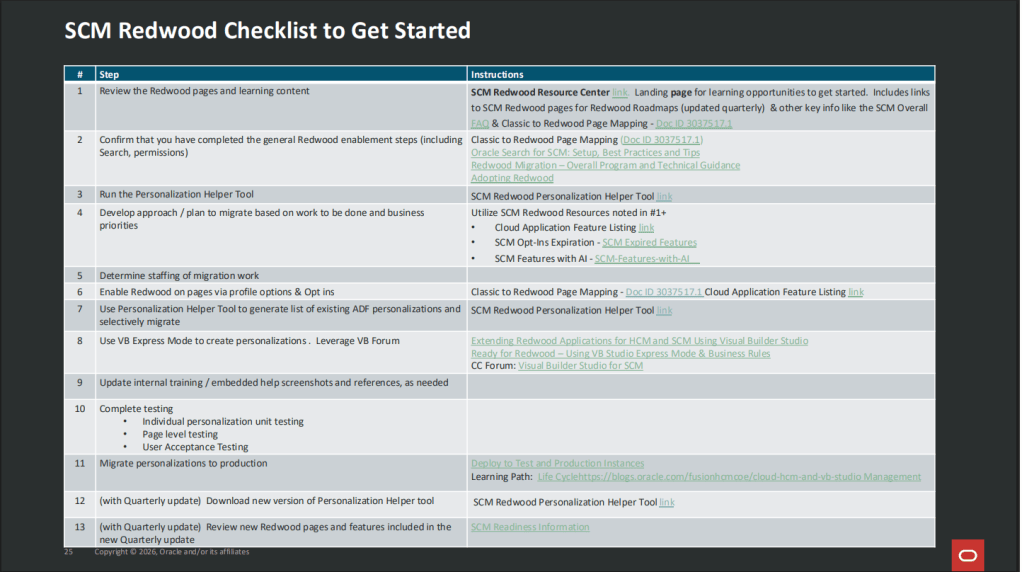
Although Oracle has moved the mandatory deadline to before 27B, my recommendation remains largely unchanged. Plan for 27A. Deliver by 27A if possible. Use the additional quarter as contingency rather than scheduling your entire programme around it. Projects rarely run exactly to plan. Key resources become unavailable. Testing uncovers unexpected issues. New quarterly updates introduce further considerations. Competing priorities emerge. Organisations that reach readiness by 27A will have flexibility. Organisations that wait until the final possible moment may find themselves under pressure once again.
Perhaps the most important thing to remember is that Redwood was never supposed to be a simple compliance activity. Oracle’s long-term investment in user experience, automation, AI Agents and Agentic Apps is increasingly centred around Redwood. Every quarterly update widens the gap between what is available in Redwood and what remains available in classic experiences.
Yes, customers have gained another quarter. That is undoubtedly helpful. But the organisations that see the greatest benefit won’t be those that use the time to delay. They will be the ones that use the time to prepare properly, drive adoption effectively and put themselves in the best position to take advantage of everything Oracle is building next. The clock hasn’t stopped. Oracle has simply given you three more months to get it right.
Please note that all screenshots are the property of Oracle and are used in accordance with Oracle’s Copyright Guidelines.


