
While many organisations are still working out where AI can genuinely improve business processes, Oracle has been steadily embedding generative AI into Oracle Fusion Cloud Procurement. Some of these capabilities are already well established. Both the Procurement Policy Advisor and Supplier Portal Advisor have been available for around a year and are being used by many organisations to improve self-service, increase process efficiency and reduce support overhead. More recently, Oracle has introduced agentic applications such as the new Sourcing Command Centre, released in Oracle Fusion Cloud Procurement 26B, which moves beyond answering questions to actively identifying issues and recommending actions.
The result is not simply faster access to information. These capabilities are designed to reduce administrative effort, improve compliance, support better decision-making and help procurement teams focus on higher-value activities. Three innovations illustrate how Oracle is approaching AI in procurement today: Procurement Policy Advisor, Supplier Portal Advisor and Sourcing Command Centre.
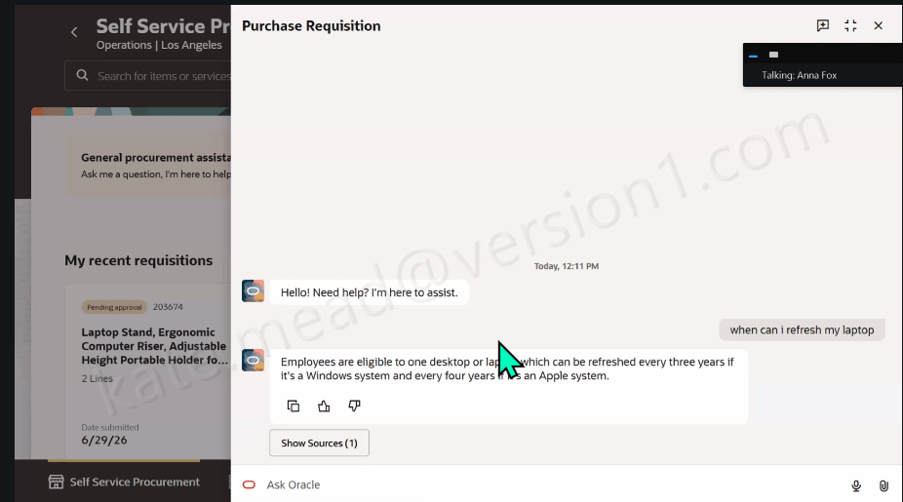
One of the biggest frustrations for employees raising requisitions is finding the information they need. Questions about purchasing policies, approved suppliers, spending limits or equipment refresh cycles often result in searches through intranet pages, policy documents or calls to the procurement team. Oracle’s Procurement Policy Advisor addresses this challenge by providing answers directly within the Self Service Procurement experience. Users can ask questions in plain English and receive immediate responses based on their organisation’s procurement policies and supporting documentation. The capability is designed to provide seamless access to procurement policies while employees are ordering the products and services they need.
Whether an employee wants to know when they are eligible for a replacement laptop or which products can be ordered through approved catalogues, the information is available without leaving the requisition process. Importantly, responses are grounded in approved source documents, allowing users to see exactly where the information has come from. This helps build confidence in the accuracy of the advice while supporting consistent policy compliance across the organisation.
For procurement teams, the benefits are equally significant. By reducing repetitive policy queries and making guidance available at the point of need, organisations can improve the user experience while reducing demand on internal support teams. Oracle specifically highlights streamlined access to policy documents and improved compliance as key outcomes of the solution. As one of Oracle’s earlier procurement AI capabilities, Procurement Policy Advisor is already a proven and mature use case, giving organisations a practical way to deliver the benefits of AI without changing core procurement processes.
Suppliers often need support with routine activities such as invoice submission, payment enquiries or updating organisation details. While these requests may seem straightforward, they can consume significant amounts of time for procurement and accounts payable teams.
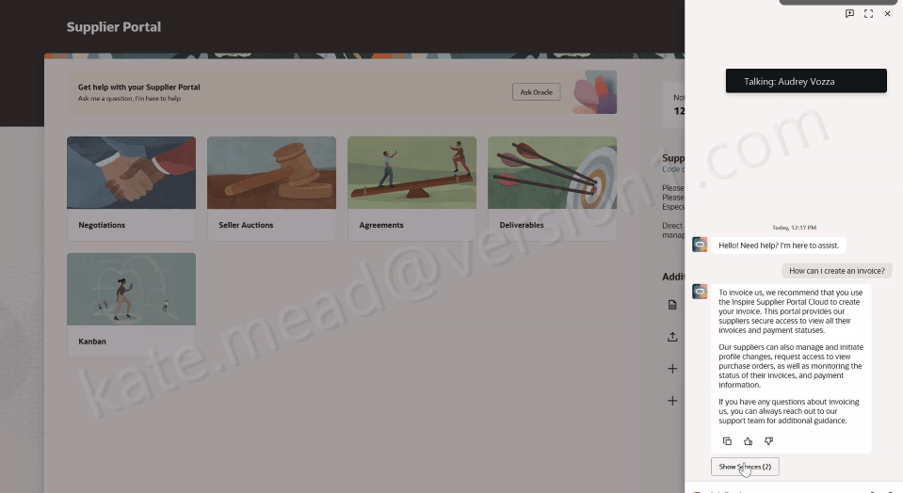
Supplier Portal Advisor extends Oracle’s AI capabilities to the supplier community by providing a self-service assistant within the Supplier Portal. Oracle describes it as a chat-based experience that answers policy, process and how-to questions directly within the application using an organisation’s own supplier support content. Rather than searching through documentation or contacting support teams, suppliers can receive immediate guidance within the portal. Organisations can tailor the advisor using their own supplier-facing documentation, policies, invoicing instructions and onboarding guidance, ensuring answers reflect their specific ways of working. This creates a more consistent experience for suppliers while reducing the number of routine enquiries that procurement and finance teams need to manage.
The value becomes particularly apparent for organisations with large supplier populations, where even a small reduction in support requests can deliver meaningful efficiency gains. Suppliers are able to resolve questions themselves, while procurement teams can focus their time on supplier relationships, sourcing activities and strategic initiatives rather than handling repetitive enquiries.
Like Procurement Policy Advisor, Supplier Portal Advisor is no longer a new concept. It has been available since 2025 and is already helping organisations extend AI-driven self-service beyond employees and into their wider supplier ecosystem.
While answering questions is valuable, Oracle’s Sourcing Command Centre takes AI a significant step further by helping sourcing teams identify risks, prioritise activities and take action more quickly. Unlike the Policy Advisor and Supplier Portal Advisor, which are now established capabilities, Sourcing Command Centre is a new addition introduced as part of Oracle Fusion Cloud Procurement 26B. Oracle positions it as an AI-powered agentic command centre where specialist sourcing agents continuously analyse negotiations, supplier participation and award readiness to identify risks, opportunities and recommended actions.
Organisations interested in adopting Sourcing Command Centre should also be aware that it sits within Oracle’s broader Agentic Applications strategy. Customers will need to license the Agentic Applications Platform before they can take advantage of the capability, making it important to understand both the business case and licensing implications as part of any evaluation.
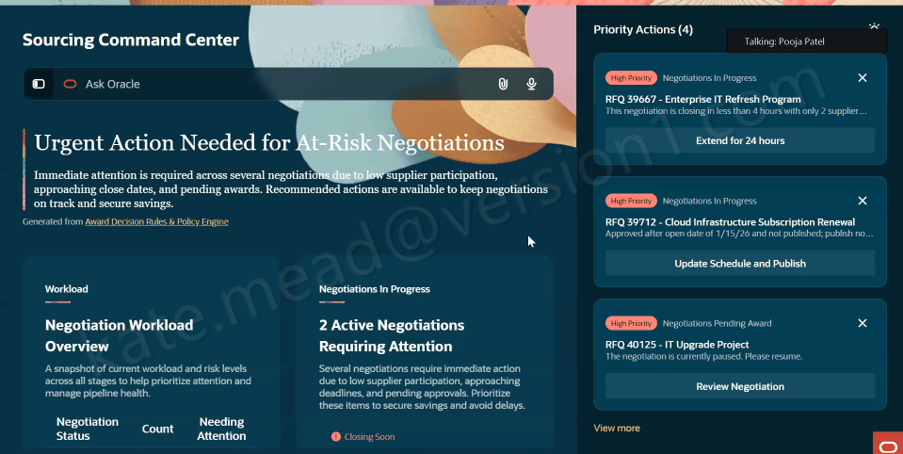
Managing multiple sourcing events often requires buyers to monitor negotiations, track supplier participation, review timelines and assess award options across numerous screens and reports. Important issues can be overlooked simply because of the volume of information involved. Sourcing Command Centre brings these activities together into a single workspace. AI-generated summaries highlight negotiations that require attention and prioritise actions based on sourcing data and business rules. Oracle states that the solution surfaces negotiations needing immediate intervention, including events with low supplier participation, negotiations approaching close dates and sourcing activities awaiting award decisions.
Rather than simply identifying issues, the solution enables users to act directly from the workspace. Recommended actions can include extending negotiations, updating schedules, resuming paused events and communicating with suppliers without navigating elsewhere in the application. The Command Centre can also assist with award decisions by analysing supplier responses and recommending award scenarios. This enables sourcing teams to evaluate options more efficiently while maintaining visibility of how recommendations have been generated. Oracle highlights AI-recommended award actions, negotiation-specific analysis and the ability to apply recommended awards directly from the workspace.
For organisations looking to increase procurement productivity and accelerate sourcing cycles, this represents a significant shift. Rather than AI acting solely as an information assistant, it becomes an active participant in managing procurement processes and helping users drive outcomes.
Although these capabilities address different aspects of the procurement lifecycle, they share a common theme. The Procurement Policy Advisor and Supplier Portal Advisor focus on providing accurate, contextual answers based on an organisation’s own policies and documentation. Both have now matured into established capabilities that are delivering value in real-world implementations. Sourcing Command Centre builds on that foundation by helping procurement professionals identify priorities and take action. It represents Oracle’s next step towards agentic applications that can not only answer questions but also recommend and execute tasks within defined business controls.
Together, these innovations demonstrate Oracle’s practical approach to AI in Fusion Applications. Rather than replacing procurement professionals, they are designed to remove friction, surface relevant information at the right time and support more informed decision-making. For organisations using Oracle Fusion Procurement, AI is no longer an experimental technology. It is becoming an increasingly practical part of day-to-day procurement operations, helping employees, suppliers and sourcing teams work more efficiently while maintaining visibility, governance and control.
Please note all screenshots are the property of Oracle and are used according to their Copyright Guidelines


