
At Oracle AI World, there has been and will be plenty of attention on AI agents, autonomous workflows and the future of enterprise applications. Those announcements will undoubtedly generate the headlines. But one announcement caught my attention for a different reason.
Oracle introduced the Fusion Setup and Configuration Registry (FSCR), and while it may not be as immediately eye-catching as some of the AI announcements, it could prove to be one of the most important foundations Oracle has put in place for the future of Fusion applications. Because before AI can intelligently configure Oracle Fusion, it first needs to understand Oracle Fusion. FSCR appears to be Oracle’s answer to that challenge.
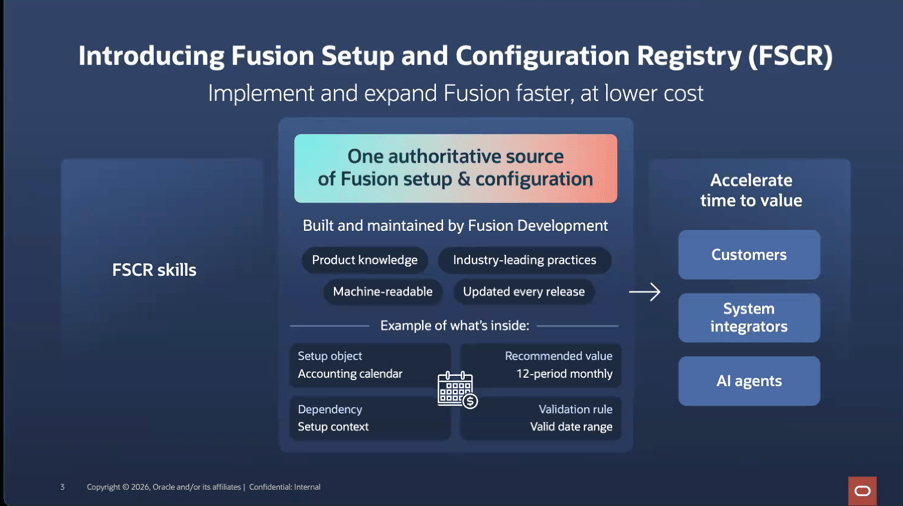
When organisations implement Oracle Fusion, a huge amount of knowledge sits outside the application itself. Configuration decisions are made during workshops. Dependencies are captured in design documents. Best practice is spread across implementation guides, project artefacts, customer experience and consultant expertise. Some of that knowledge is documented. Some lives in spreadsheets. Some exists purely in the heads of the people delivering the project. Over time, this creates an interesting situation.
The technology becomes more intelligent, but the knowledge needed to implement and configure it often remains fragmented. As Oracle continues its journey towards agentic applications and autonomous business processes, that fragmentation becomes increasingly important. After all, how can an AI agent configure a system if it doesn’t have access to the knowledge required to make those decisions?
At its core, FSCR is Oracle’s central repository of Fusion setup and configuration knowledge. It brings together setup tasks, dependencies, validation rules, best practices and implementation knowledge into a structured, machine-readable framework. The phrase “machine-readable” is important here. This isn’t simply another set of implementation documents.
Oracle is creating a knowledge layer that can be consumed not only by people, but also by AI-powered services, agents and automation tools. In effect, Oracle is moving implementation knowledge closer to the product itself. That feels like a significant shift.
Most customers don’t wake up in the morning thinking about configuration registries. They care about delivering projects faster, reducing risk and getting value from their Oracle investment. That’s where FSCR becomes interesting.
By capturing implementation knowledge in a structured way, Oracle creates the potential for a much more consistent approach to configuration and deployment. Instead of repeatedly recreating the same implementation knowledge across multiple projects, that knowledge can become reusable, governed and accessible. The obvious benefit is efficiency. The bigger benefit may be consistency.
Anyone who has worked on multiple Oracle Fusion programmes knows how much time is typically spent checking dependencies, validating setup choices and understanding the impact of changes across different areas of the application. A central knowledge framework has the potential to reduce much of that effort.
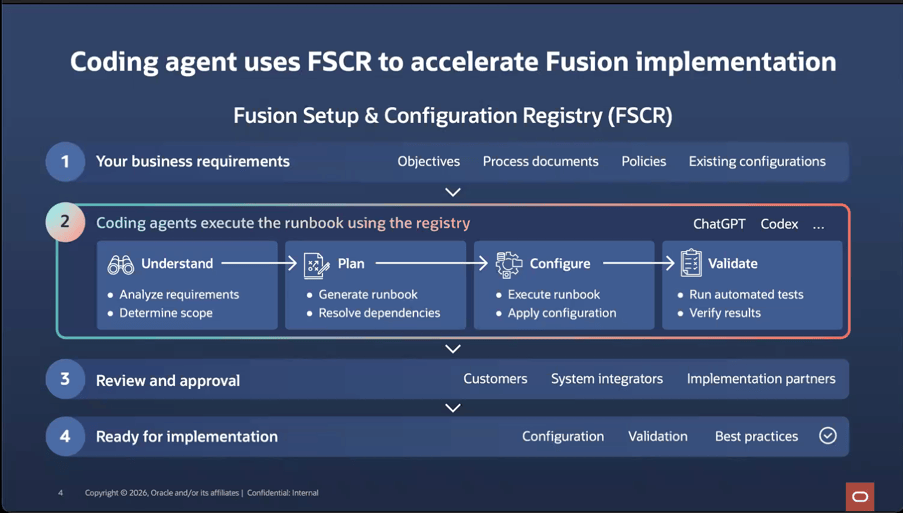
I’ve written quite a lot recently about Agentic Applications and the broader move from automation to autonomy. Most conversations focus on the visible layer. The agent. The user experience. The conversational interface. The outcome. What receives far less attention is the knowledge framework that sits underneath.
Enterprise AI becomes significantly more powerful when it can move beyond making recommendations and start executing trusted actions. But trusted execution only happens when there is confidence in the underlying knowledge. That’s why FSCR feels important.
It provides the structured understanding of Fusion configuration that future AI capabilities will need if they are going to do more than simply answer questions. In many ways, it feels like Oracle is putting the foundations in place before building the next floor of the house.
The interesting thing about FSCR is that its potential value isn’t limited to new implementations. Most organisations spend far longer running Oracle Fusion than they do implementing it. Over time they introduce new functionality, adopt new releases, optimise processes, expand into new business areas and respond to changing organisational priorities.
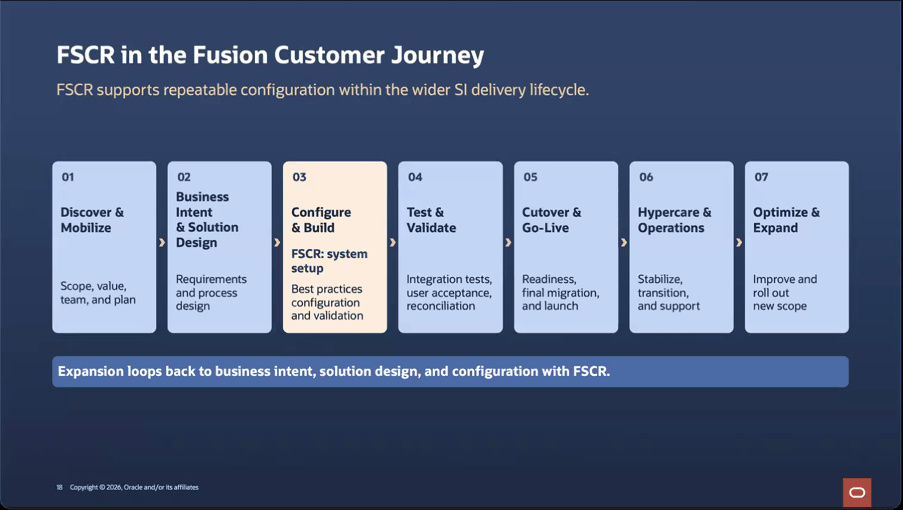
Every one of those activities requires knowledge of how the system has been configured and how different setup decisions interact with each other. If Oracle can maintain that knowledge as a living framework, the opportunities extend well beyond implementation projects. It could support ongoing optimisation, change management, governance and continuous improvement throughout the lifecycle of a Fusion environment. For many organisations, that’s where the real value may emerge. This functionality isn’t there yet though, the initial focus is on new implementations, but Oracle have been plans on expanding it’s functionality.
You might be saying, so what? It’s still early days, and like any significant innovation, the true impact will depend on how Oracle develops the capability over the coming releases. But the direction of travel is clear. Oracle is looking to move implementation knowledge from documents and individuals into a trusted, structured framework that can support both people and AI. For customers, that could ultimately mean:
- Faster implementations
- Greater consistency across projects
- Reduced dependency on individual expertise
- Improved validation and governance
- Better support for future AI-driven configuration and optimisation
None of these benefits happen overnight. Organisations will still need experienced teams, strong governance and informed decision-making. But if Oracle’s vision becomes reality, FSCR could help remove much of the repetitive effort that currently surrounds system configuration and implementation.
I’ve often said that the most important developments in enterprise AI are usually the ones people notice the least. Everyone notices the chatbot. Everyone notices the agent. Everyone notices the flashy demo. Far fewer people pay attention to the infrastructure that makes those capabilities possible.
FSCR feels like one of those foundational innovations. On its own, a setup and configuration registry isn’t particularly exciting. But viewed in the context of Oracle’s wider AI strategy, it starts to look much more significant. Because before Oracle can deliver truly autonomous implementation and optimisation capabilities, it first needs a way for AI to understand how Oracle Fusion works. FSCR might not be the announcement that generates the most headlines from AI World. But in a few months’ time, it may prove to be one of the most important.
Please note all screenshots are the property of Oracle and are used according to their Copyright Guidelines.


