
When Oracle publishes its quarterly updates, most people head straight for HCM, ERP, Payroll or Learning. Common Features is usually the section that gets less attention. That’s understandable. Historically, it’s often been home to the more technical platform updates that only administrators and implementation teams get excited about. But every now and then a release comes along where the Common Features updates deserve a closer look. 26D is one of those releases.
This quarter brings a mixture of Redwood enhancements and AI Agent Studio improvements that focus less on flashy new functionality and more on solving some of the challenges organisations face when running Oracle Fusion at scale. Supportability, governance, testing, deployment, cost control and communication may not sound particularly exciting, but they’re often the difference between a successful implementation and a frustrating one.
Redwood has been Oracle’s strategic user experience for several years now, and most customers are either well into their migration journey or actively planning it. What caught my attention in 26D is that Oracle is continuing to address some of the operational gaps customers have identified along the way.
Organisations spend a lot of time trying to communicate important information to employees and managers. The problem is that emails get ignored, intranet posts go unread, and people rarely look in the places you’d like them to. Oracle’s answer in 26D is the introduction of contextual announcement banners for Redwood pages. Rather than displaying generic messages everywhere, organisations can now surface targeted information directly within specific business processes. Think payroll cut-off reminders, compliance notices, legislative updates, planned maintenance notifications or guidance for a particular transaction.
The real value here isn’t the banner itself. It’s the fact that the message can be contextual. You can display information when and where it’s actually relevant, rather than hoping users remember something they read in an email three weeks ago. For organisations operating across multiple countries or regulatory environments, this could become a simple but effective way to ensure users see the right information at the right time.
This is probably my favourite Redwood update in 26D: Built-In Issue Recording For Redwood Pages. Anyone who has ever raised a Service Request with Oracle knows the conversation often starts with exactly the same question: “Can you provide a recording of the issue?” Until now, that has usually meant reaching for external screen recording software, capturing screenshots, writing detailed reproduction steps and then trying to explain what the problem actually looks like. 26D makes that process much simpler.
Users can now record issues directly from Redwood pages and generate a recording identifier that can be attached to support requests. It isn’t a flashy feature. But it is exactly the sort of practical improvement that customers appreciate because it makes everyday support processes easier. Faster evidence gathering means faster diagnosis. Faster diagnosis means faster resolution. If you’re currently rolling out Redwood or supporting a large user community, this is one of those features you’ll probably start using immediately. It’s also worth noting that access is controlled through specific security privileges, so administrators will need to review role assignments before making the capability available to broader user groups.
I’ve written quite a few blogs about Oracle AI Agent Studio over the last year, and one thing has become increasingly clear. Oracle is moving beyond the “look what AI can do” phase and focusing on what organisations actually need to deploy AI responsibly and at scale. That’s exactly what we see in 26D. Rather than introducing lots of new AI capabilities, Oracle has concentrated on governance, testing, deployment controls and operational management. Frankly, that’s where the focus should be.
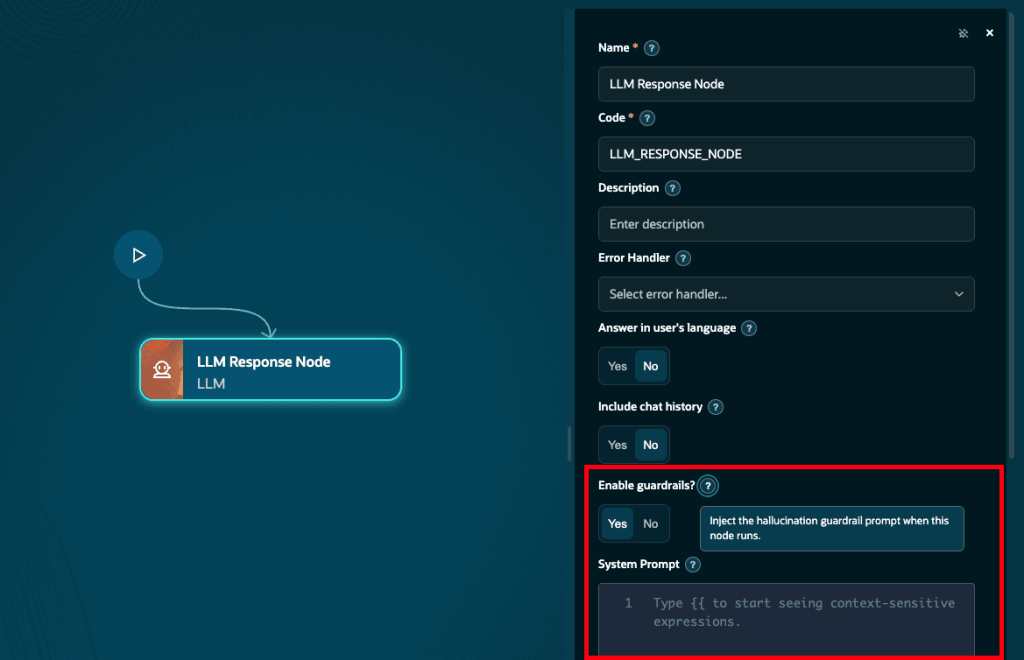
One of the biggest concerns organisations have when introducing AI is maintaining control over responses. Oracle has introduced prebuilt guardrails that can be applied to large language model workflow nodes within AI Agent Studio. The purpose is straightforward. Help keep responses grounded in approved enterprise content and reduce the risk of agents wandering into irrelevant, unsafe or inappropriate territory.
Let’s be clear: guardrails are not a silver bullet. They won’t eliminate every AI risk and they don’t replace broader governance controls. What they do provide is an additional layer of protection inside the workflow itself. For organisations looking at production AI deployments, that’s an important step forward. It is also encouraging to see Oracle making the guardrail instructions visible within debugging tools. Transparency is becoming increasingly important as organisations seek confidence in how AI agents are making decisions and generating responses.
Another welcome enhancement is greater control over model selection. Different models excel at different tasks. Some prioritise speed and efficiency, while others deliver stronger reasoning capabilities but at a higher cost. Until recently, model selection was often treated as a platform decision. Oracle is now giving organisations more flexibility to choose the model that best fits each use case. What I particularly like is the introduction of model lifecycle visibility.
The platform now flags deprecated models, helping organisations identify affected workflows before support is withdrawn. That might sound like a small change, but it removes the risk of discovering a model retirement after it’s already impacted a production process. Anyone responsible for AI governance will appreciate that level of visibility.
One of the challenges many organisations face with AI is that it often sits outside their established development lifecycle. Applications have deployment processes. Integrations have deployment processes. Reports have deployment processes. AI solutions frequently end up managed separately. 26D begins to change that.
Oracle has introduced CI/CD integration for AI Agent Studio workflows and applications, allowing organisations to incorporate AI artefacts into the same controlled release processes they already use elsewhere. For enterprise customers, this matters far more than a shiny new AI feature. It means AI development can follow the same approval processes, audit controls and change management practices as every other critical component within the Oracle landscape. That is exactly what many governance teams have been asking for.
If you’ve spoken to colleagues about AI over the last year, you’ll know that the conversation quickly moves beyond capabilities. Eventually someone asks: “How much is this going to cost?” That’s why I think AI budget management could prove to be one of the most important additions in this release.
Organisations can now allocate AI unit budgets, monitor consumption, set warning thresholds and automatically stop activity when budgets are exhausted. What this really delivers is visibility. Finance teams gain insight into usage patterns. IT teams gain operational control. Business leaders gain confidence that AI spending won’t suddenly spiral beyond expectations. As organisations move from pilot projects into large-scale adoption, this kind of governance capability becomes essential.
If I had to choose the single most important AI Agent Studio enhancement in 26D, it would be ATLAS. Traditional software testing is relatively straightforward. Given the same input, you expect the same output every time. AI doesn’t work like that. Testing AI systems has always been significantly more complex because quality can’t always be measured through traditional pass-or-fail criteria.
ATLAS gives organisations a structured framework for testing, validating and comparing AI workflows before they reach production. Teams can replay scenarios, validate expected workflow routes, measure quality, compare models and identify issues before users ever see them. That may not sound exciting. For organisations deploying AI into business-critical processes, it’s huge.
Good governance isn’t just about controlling access or managing budgets. It’s about ensuring solutions perform consistently and predictably. ATLAS helps bring that discipline to AI Agent Studio. Honestly, this feels like one of the strongest signals yet that Oracle is serious about supporting enterprise-grade AI adoption rather than simply delivering AI features.
Common Features may not be the first section of the release notes you read, but there is a surprising amount of value packed into 26D. The Redwood updates focus on solving real-world operational challenges. Contextual communications help organisations reach users more effectively, while built-in issue recording should make support processes noticeably smoother.
The AI Agent Studio enhancements are arguably even more significant. Oracle is investing heavily in the less glamorous side of AI; governance, testing, cost management, lifecycle control and deployment processes. Those capabilities might not generate headlines, but they’re exactly what organisations need before they can confidently scale AI across the business. None of these updates are likely to be described as revolutionary. But together they make Oracle Fusion easier to govern, easier to support and easier to scale. And in many organisations, that’s exactly the kind of innovation that delivers the greatest value.
Please note all screenshots are the property of Oracle and are used in accordance with Oracle’s copyright guidelines.


