
I wasn’t in Las Vegas for Oracle AI World this year. Like many Oracle customers and partners around the world, I followed the event remotely using Oracle’s free On Air pass, catching up with the keynotes from the UK rather than from the conference floor. While watching remotely means missing some of the atmosphere and conversations that happen between sessions, it does give you the opportunity to focus entirely on the messages being delivered.
Having watched both Mike Sicilia’s opening keynote and Chris Leone’s product keynote, one theme stood out above everything else. Oracle is no longer talking about helping people work faster. Oracle is talking about getting the work done. At first glance, that might sound like a subtle distinction. I don’t think it is. In fact, I think it represents one of the biggest shifts we’ve seen in enterprise applications for years.
For the last couple of years, most AI conversations have been centred around productivity. How can AI draft content faster? How can AI summarise meetings? How can AI help employees find information more quickly? All of those things matter. They deliver value. But fundamentally, the human remains responsible for completing the task.
What struck me during the Day 1 session was how little time Oracle spent talking about AI as an assistant and how much time it spent talking about AI as an executor. Across both keynotes, the discussion repeatedly returned to outcomes. Not generating insights. Not producing recommendations. Delivering results. That feels like an important evolution in enterprise AI.
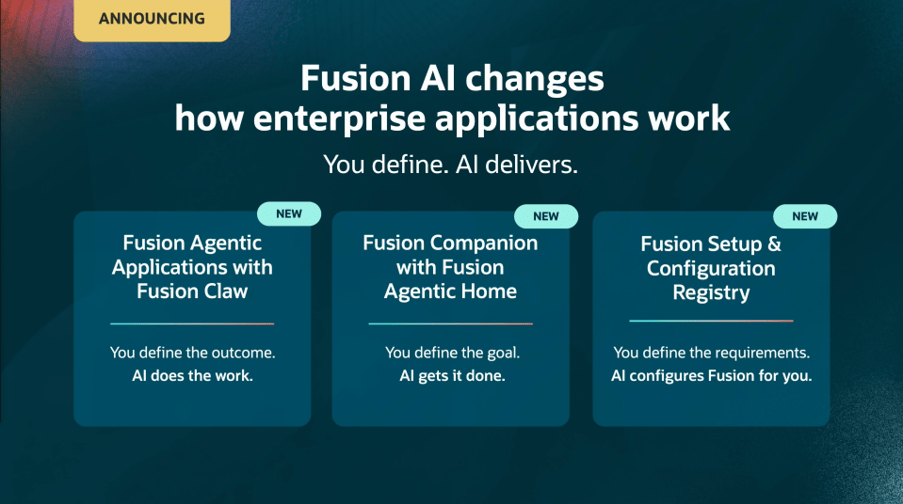
One of the things I liked most about Mike Sicilia’s keynote was that the focus wasn’t really technology. It was people. The message wasn’t that AI should replace people. It was that organisations should be able to remove the repetitive, burdensome activities that consume time and energy, allowing people to focus on higher-value work.
For years we’ve accepted certain activities as simply being part of work. Reconciling data. Chasing approvals. Managing exceptions. Navigating complex processes. Collecting information from multiple systems. What if those activities become the responsibility of software instead? That was the question I kept coming back to throughout the keynote. The vision wasn’t more intelligent software. It was more capable organisations. That’s a subtle but important difference.
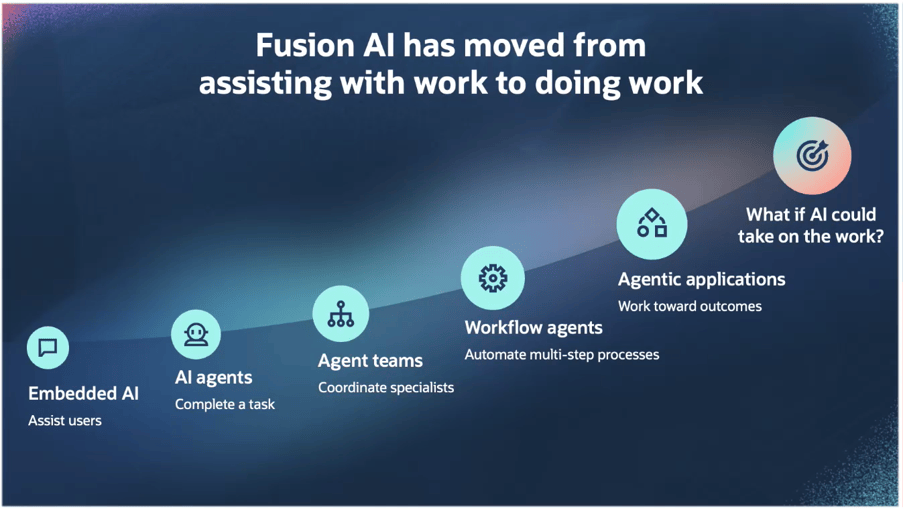
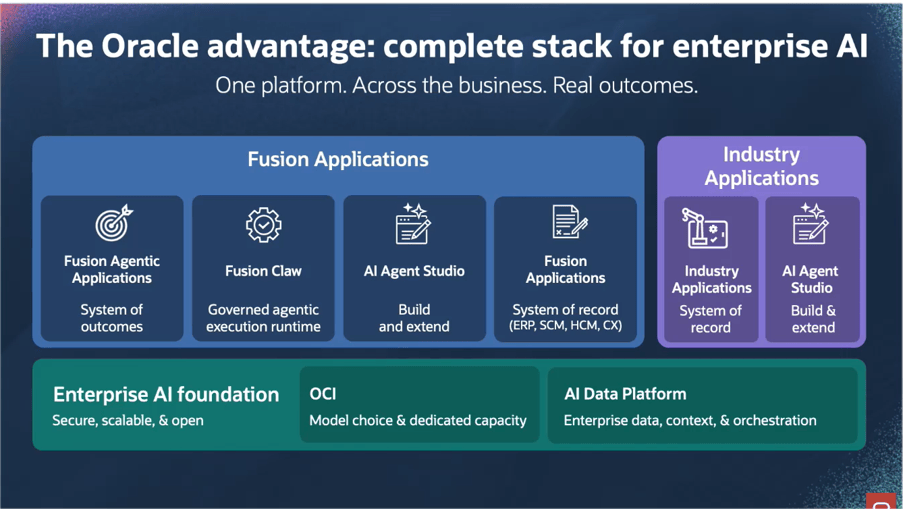
If Mike Sicilia explained the vision, Chris Leone demonstrated how Oracle intends to deliver it. The progression shown during the keynote was fascinating. We have already seen Oracle introduce embedded AI capabilities across Fusion. We have seen AI agents emerge. Now Oracle is talking about agent teams, workflow agents, agentic applications and autonomous execution.
The key message was that AI is evolving from supporting processes to actively participating in them. That shift matters. Historically, enterprise software has recorded work. Increasingly, Oracle appears to be building software that performs work. Not without governance. Not without controls. But certainly with a higher degree of autonomy than most organisations are accustomed to today.
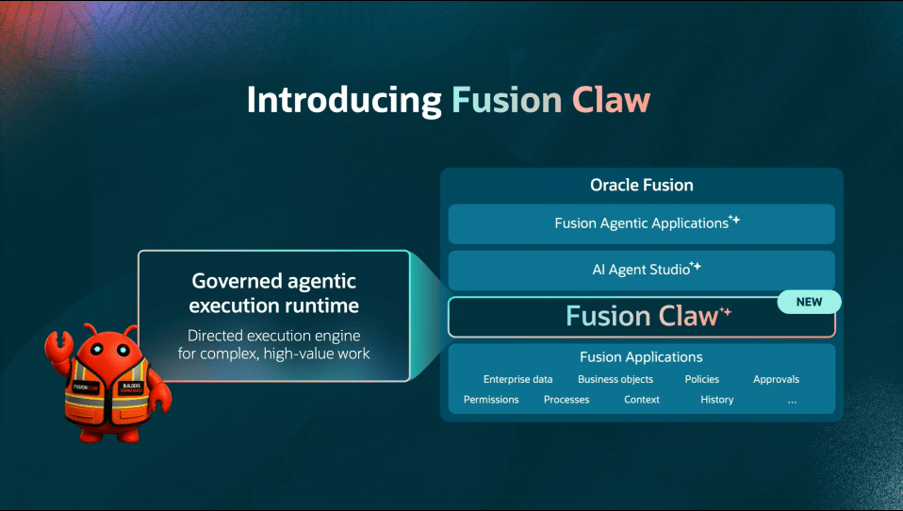
There were plenty of announcements during the keynote, but Fusion Claw was the one that immediately stood out to me. Not because it was the most futuristic. Actually, quite the opposite. What interested me was the emphasis on governance.
Most organisations are no longer questioning whether AI can generate content, identify patterns or make recommendations. The real question is whether AI can be trusted to execute business processes. That is where many current AI discussions begin to stall. The answer is rarely a technology problem. It is a governance problem.
Throughout the demonstrations, Oracle repeatedly emphasised operating boundaries, permissions, policies, approvals and organisational controls. In other words, autonomy with accountability. That feels much more relevant to enterprise customers than unrestricted AI experimentation. The organisations I speak to rarely say, “We need AI to make decisions independently.” What they actually say is, “We need AI to help us achieve outcomes without introducing risk.” Fusion Claw feels like Oracle’s response to that challenge.
Another concept that caught my attention was Oracle’s discussion around systems of outcomes. For decades, enterprise applications have been systems of record. They store information. Track transactions. Enforce processes. Maintain business truth. Those capabilities remain essential.
Oracle’s argument is that organisations increasingly need something more. A layer focused on achieving business outcomes rather than simply recording business activity. The more I think about it, the more significant that feels. After all, organisations don’t exist to process invoices. They don’t exist to approve purchase orders. They don’t exist to complete workflow transactions. Those activities support the real objectives. Better customer experiences. Stronger financial performance. Improved workforce productivity. Increased organisational agility. More resilient supply chains. Those are the outcomes that matter. If AI can continuously coordinate activity towards those outcomes, then we are moving into genuinely new territory.
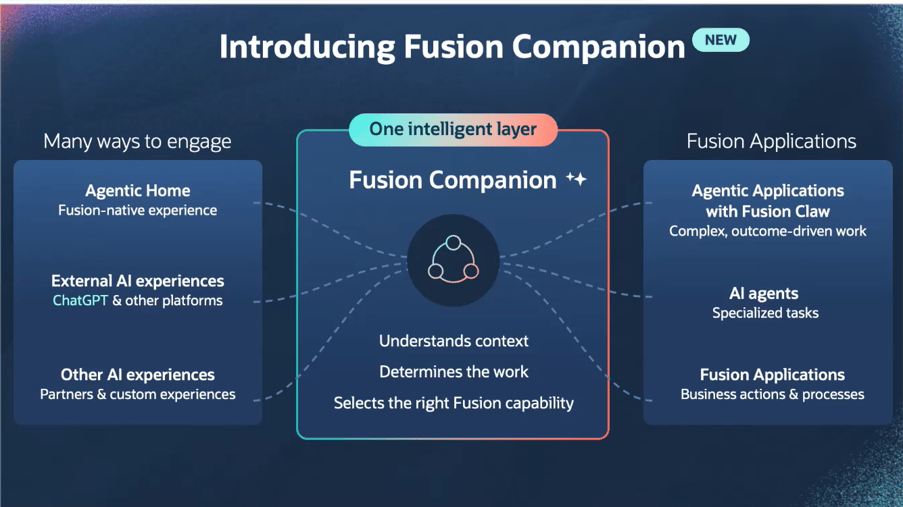
Fusion Claw will probably attract most of the headlines. However, I suspect Fusion Companion could prove just as important over time. As enterprise landscapes become increasingly complex, users don’t think in terms of applications anymore. They think in terms of work. They move between systems, channels, data sources and processes. The value increasingly comes from connecting those experiences together.
The vision Oracle presented for Fusion Companion suggests a future where intelligence follows the user rather than remaining confined within individual applications. If delivered successfully, that could become one of the most practical and impactful developments announced during the keynote.
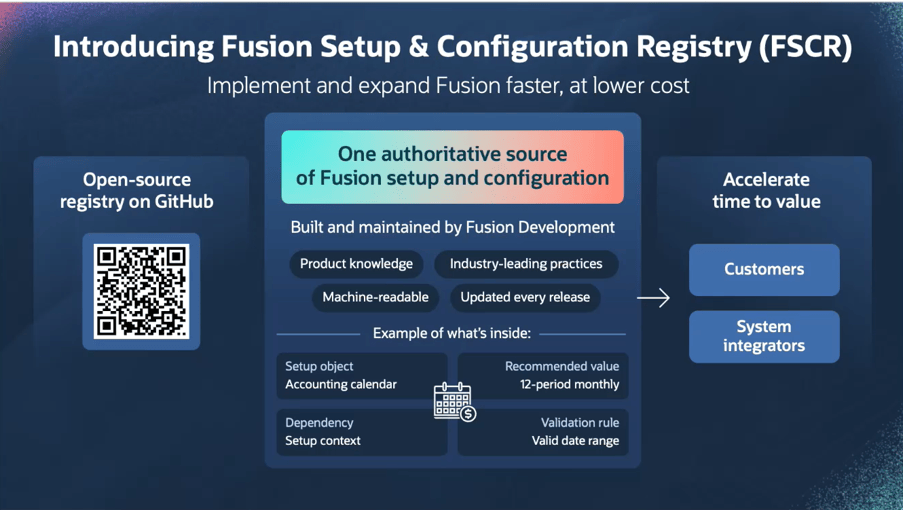
Anyone who has read my recent blogs will know I’ve already posted about Fusion Setup and Configuration Registry (FSCR). Seeing it formally announced during the keynote only reinforced my belief that this could become one of the most important long-term developments for the Oracle ecosystem.
For years, implementation partners have built methodologies, accelerators, templates and frameworks to help customers configure Fusion applications. FSCR has the potential to fundamentally change that model. If Oracle can successfully connect requirements, process design, configuration and AI-driven implementation, then the way organisations deploy Fusion could look very different in the future. It is still early days. But of all the announcements made on Day 1, FSCR may ultimately have one of the biggest impacts on how Oracle projects are delivered.
When I finished watching the keynotes, I kept coming back to one simple thought. For the last two years, the industry has largely been asking: “How can AI help people do their jobs faster?” Oracle now seems to be asking: “How can AI help organisations achieve outcomes with less human effort?” That is a much bigger question. And potentially a much more transformative one.
Whether discussing agentic applications, Fusion Claw, Fusion Companion or FSCR, the underlying message felt remarkably consistent. The goal is no longer simply helping people work. The goal is getting the work done. That doesn’t mean removing people from the process. It means allowing people to spend less time managing the mechanics of work and more time focusing on the decisions, creativity, relationships and innovation that humans are uniquely positioned to provide.
Watching remotely, that was my overwhelming impression of Oracle AI World Day 1. The conversation has moved beyond AI assistance. Oracle is now focusing on AI execution. And that feels like the start of a very different chapter for enterprise applications.
Please note all screenshots are the property of Oracle and are used according to their Copyright Guidelines.

