
Over the past few articles in this series, I’ve talked about how Oracle Fusion AI Agent Studio is shifting the conversation away from technology and towards business outcomes. I’ve explored how the Builder Assistant is helping reduce the gap between an idea and a working solution, and I’ve looked at the key building blocks that sit behind Agentic Apps.
But there’s another question that’s arguably even more important. Just because we can build an Agentic App, does that mean we should? As organisations begin exploring AI Agents, there’s a natural temptation to automate everything. Every process starts to look like a candidate for AI. Every challenge appears to need an Agent. Every requirement seems to demand its own intelligent assistant. In my experience, that’s rarely the right approach.
The most successful Agentic Apps aren’t the ones using the most sophisticated technology. They’re the ones solving a genuine business problem in a way that feels intuitive, useful and trustworthy. The technology matters, of course. But good design matters more.
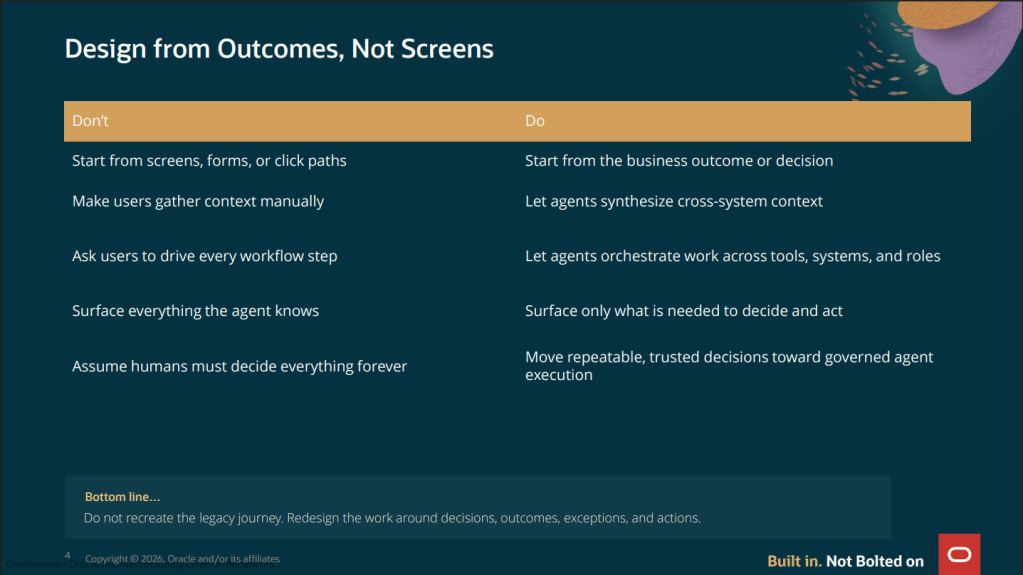
One of the biggest mistakes organisations make when introducing new technology is trying to recreate existing processes in a new tool. We’ve all seen it happen. Paper forms became electronic forms. Manual approvals became digital approvals. Reports became dashboards. The underlying process remained largely unchanged. There’s a risk of doing exactly the same thing with Agentic Apps.
Instead of asking how AI can support an existing process, I think organisations should start by asking a different question. What business outcome are we trying to achieve? For example, an organisation might say they want an AI solution for employee retention. But employee retention isn’t really the outcome. The outcome is helping managers identify people who need support before they choose to leave. Similarly, a procurement team might think they need an AI solution for supplier management. In reality, the outcome is reducing the likelihood of supplier issues disrupting operations. When you focus on outcomes rather than processes, the design conversation changes completely. You stop asking how to automate existing steps and start asking how to help people make better decisions.
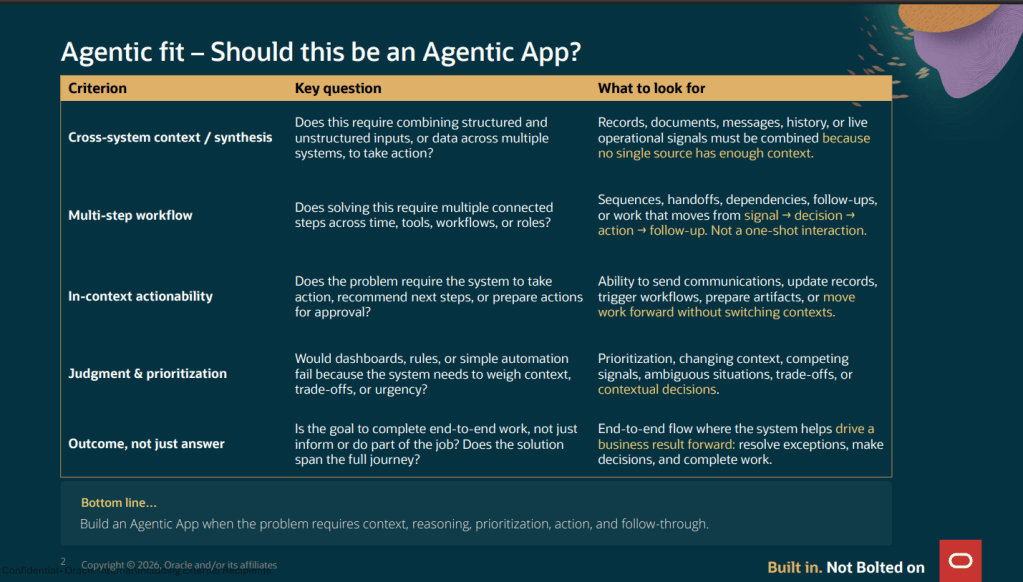
This might sound strange coming from someone writing a series about Agentic Apps, but not every business challenge requires an Agent. Sometimes a report is enough. Sometimes an alert is enough. Sometimes a workflow already works perfectly well. I think one of the most important design principles is understanding where an Agent adds genuine value.
Generally speaking, I see Agentic Apps delivering the greatest benefits when people need to combine information from multiple sources, understand a situation, make a decision and take action. Those are activities that often involve context, judgement and prioritisation. By contrast, simple and highly structured processes are often better handled through traditional automation. If the answer is always the same and the outcome is completely predictable, an Agent may simply introduce unnecessary complexity. The goal shouldn’t be to build more Agents. The goal should be to solve more problems.
Most organisations don’t suffer from a lack of data. If anything, the opposite is true. The challenge is usually information overload. Managers have dashboards. Leaders have reports. Teams receive alerts. Yet people still struggle to know where to focus their attention. This is where I think many organisations can unlock the greatest value from Agentic Apps. A good Agentic App doesn’t simply surface more information. It helps users understand what matters.
Imagine two different approaches to workforce management. The first presents pages of employee data, engagement metrics, performance ratings, salary information and talent profiles. All the information is available, but the user still needs to interpret it and decide what to do next. The second identifies three employees who may require attention, explains why they have been highlighted and suggests possible next steps. The underlying data may be exactly the same. The experience is completely different. One focuses on information. The other focuses on decision-making. That’s where Agentic Apps should aim to deliver value.
Whenever AI becomes involved in business processes, governance inevitably becomes part of the conversation. And rightly so. The most successful implementations I’ve seen use AI to support decision-making rather than replace it. For example, if an Agent identifies that an employee’s visa is approaching expiry, it can highlight the issue, gather relevant information and even prepare a communication. But deciding whether to send that communication remains a human decision.
Similarly, if an Agent identifies a supplier risk, it can explain the concern and recommend an action, but accountability for the final decision remains with the person responsible for that supplier relationship. I think this balance is incredibly important. AI should help people make better decisions. It shouldn’t remove people from decisions that require judgement, accountability or context. The organisations that get this balance right are much more likely to build trust in their AI solutions.
One lesson I’ve learned from years of delivering technology projects is that users don’t adopt systems because they’re clever. They adopt systems because they’re useful and trustworthy. An Agent can generate incredibly sophisticated outputs, but if users don’t understand where the information came from or why a recommendation was made, trust quickly disappears. That’s why explainability matters. Users need confidence that recommendations are based on reliable information. They need to understand what data has been considered. They need to know when human review is required.
Most importantly, they need confidence that the system is helping them achieve better outcomes rather than creating additional work. A simple, transparent Agent that consistently provides useful guidance will almost always deliver more value than a complex Agent that nobody trusts.
One thing I’ve noticed when watching AI demonstrations is that they’re often designed to showcase what’s possible. Real business environments are different. The question isn’t whether an Agent can do something impressive. The question is whether people will use it on a busy Tuesday morning when they have ten competing priorities. That means designing experiences that fit naturally into the way people work. It means presenting recommendations in context. It means minimising unnecessary complexity. And it means ensuring users can act on insights quickly and confidently. The most successful Agentic Apps won’t necessarily be the most innovative. They’ll be the ones that people actually use.
Traditionally, technology projects have often been measured using delivery metrics. Did the system go live? Was it delivered on budget? Were the requirements completed? Whilst those measures remain important, I think Agentic Apps need additional measures of success. Are decisions being made more quickly? Are managers identifying issues earlier? Are employees receiving better support? Are risks being addressed before they become problems? Are users spending less time searching for information?
Ultimately, the value of an Agentic App isn’t determined by how many features it contains or how many AI models sit behind it. It’s determined by whether it helps people achieve better outcomes. That’s the measure that really matters.
As organisations continue exploring Agentic Apps, I believe the conversation will gradually move away from technology and towards design. The organisations that achieve the greatest success won’t necessarily have the most advanced AI. They’ll be the ones that understand the problems they’re trying to solve, focus on outcomes rather than processes and place people at the centre of the experience. Good Agentic Apps don’t exist because AI is available. They exist because there are business challenges worth solving. And that’s where every design conversation should begin.
In the final article in this series, I’ll look beyond today’s capabilities and explore where Agentic Apps could take Oracle Fusion next, along with some of the opportunities and challenges organisations should be thinking about as this technology continues to evolve.
Please note that all screenshots are the property of Oracle and are used in accordance with Oracle’s Copyright Guidelines.


