
In the previous article, I talked about the importance of trust in enterprise AI and why capabilities such as human approvals and deterministic policy controls may ultimately prove just as important as the intelligence of the agents themselves. But even if an organisation is comfortable with how decisions are governed, another challenge remains. How do you know an agent will behave as expected when it reaches production? That’s where things become interesting.
Building an AI-powered prototype has become relatively straightforward. Building something that can operate reliably, safely and consistently within a complex enterprise environment is considerably harder. Traditional software development teams have spent decades refining processes for testing, quality assurance, security and governance. Those disciplines don’t disappear simply because AI is involved. If anything, they become even more important.
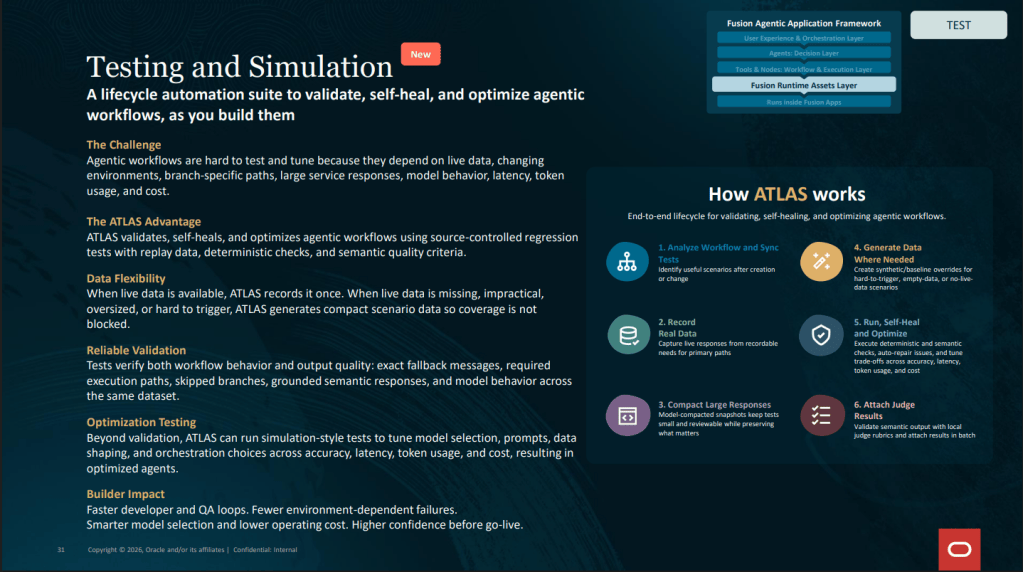
One of the things that has impressed me most about Oracle’s vision for AI Agent Studio is the amount of attention being given to the practical realities of operating enterprise AI at scale. The focus isn’t just on building agents. It’s on testing, validating, securing and improving them throughout their lifecycle.
When we think about testing traditional applications, the process is usually fairly straightforward. If I enter a specific value into a field, I expect a predictable result. If I click a button, I know which process should execute. If something changes unexpectedly, it’s usually possible to identify the source of the issue reasonably quickly.
Agentic applications are different. They may involve multiple agents, connectors, data sources, workflows and models. They may depend on information that changes daily, external services that evolve over time and AI responses that aren’t always identical from one execution to the next. This creates a new challenge. It’s no longer enough to test whether a workflow executes successfully. You also need confidence that the outcome remains appropriate.
Oracle describes this as one of the key challenges facing agentic applications and has introduced ATLAS, the Agentic Testing and Lifecycle Automation Suite, to address it. ATLAS is designed to validate workflow behaviour, generate and maintain test scenarios, assess output quality and support optimisation throughout the development lifecycle.
One of the limitations of traditional testing approaches is that they often assume a predictable environment. Enterprise AI doesn’t always operate in one. Data changes. Business processes change. Models improve. Users behave differently. Without effective testing, organisations can quickly lose confidence in the outputs being generated.
What I find particularly interesting about Oracle’s approach is that testing isn’t positioned as something you do at the end of a project. It’s presented as an ongoing discipline that supports the entire lifecycle of an agentic application. ATLAS can generate scenarios, replay real business data, evaluate workflow paths and assess whether outcomes remain aligned with expectations. It can also help organisations compare models, optimise performance and identify areas where improvements may be required. That feels less like traditional software testing and more like continuous validation. Given the pace at which AI technologies evolve, I think that’s exactly the right mindset.
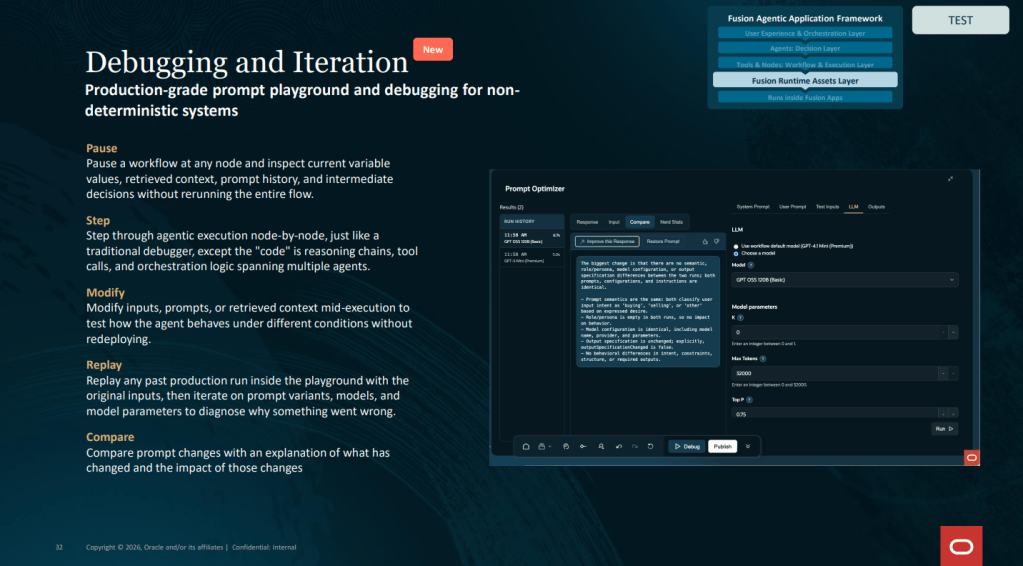
Trust is difficult to establish when nobody understands how a system reached a particular conclusion. This has been one of the most common concerns surrounding AI since the earliest machine learning solutions. People are often willing to accept recommendations. They are far less willing to accept recommendations they cannot understand. This is where debugging and observability become incredibly important.
Oracle’s debugging capabilities allow builders to inspect workflow execution, pause processes, review variables, replay previous executions and compare the impact of changes made to prompts or configuration settings. Previous runs can be analysed and replayed, allowing organisations to investigate why a particular outcome occurred.
Whilst this might initially sound like a feature aimed at developers, its significance extends much further. If an employee questions a recommendation, you need to understand how it was generated. If a customer challenges an outcome, you need to explain the reasoning. If a process isn’t producing the expected results, you need to identify why. You can’t improve what you can’t see. And you can’t build trust in something that behaves like a black box.
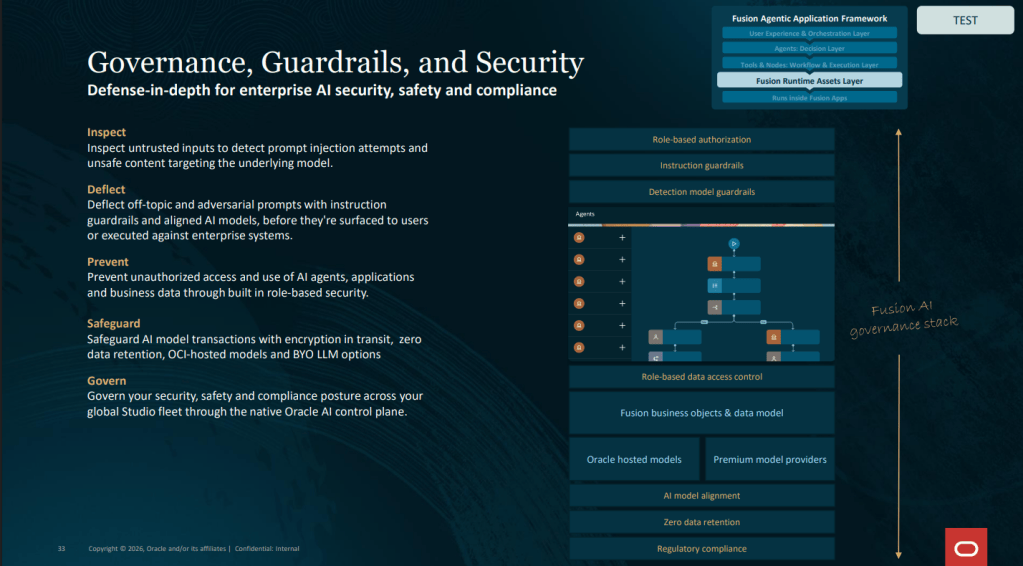
Whenever I discuss AI with customers, security inevitably enters the conversation. And rightly so. AI systems frequently require access to business data, enterprise systems and organisational processes. The more valuable the AI becomes, the more important it is to ensure access remains appropriately controlled.
Oracle’s approach incorporates multiple layers of security and governance, including role-based access controls, instruction guardrails, detection mechanisms designed to identify unsafe inputs, encryption and enterprise identity management. Access to connectors, enterprise data and AI capabilities sits within the wider security model provided by Fusion Applications.
I think this is one of the biggest differences between consumer AI and enterprise AI. Consumer AI often focuses on capability. Enterprise AI must focus equally on control. The most useful AI in the world becomes a liability if organisations cannot manage who can access it, what it can see or how it behaves.
The word governance often sounds bureaucratic. It conjures images of policies, committees and governance meetings. In practice, good governance is simply about ensuring technology behaves in a way that organisations are comfortable with.
Oracle’s governance framework includes guardrails, policy enforcement, role-based security controls and centralised management capabilities designed to help organisations maintain oversight of their AI estate. AI can be constrained by rules, escalation paths, approved tools and runtime controls defined by the organisation.
What I particularly like about this approach is that governance isn’t being added after the fact. It’s part of the architecture. As organisations move from isolated AI experiments to broader adoption, I suspect governance will become one of the most important differentiators between successful and unsuccessful implementations. Not because it’s exciting. But because it enables scale.
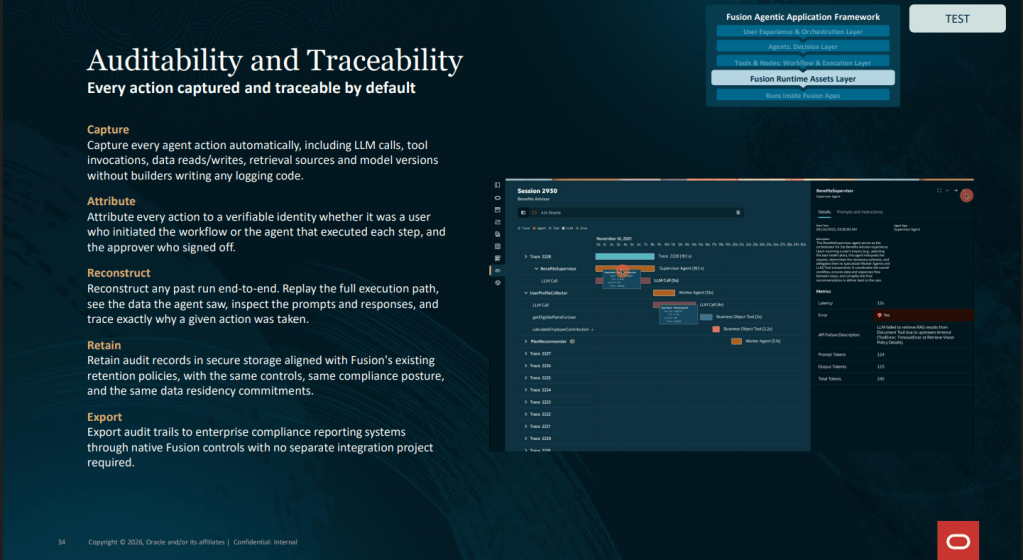
One of the questions organisations increasingly ask is not just what happened, but how did it happen? If an AI recommendation influenced a business decision, could somebody review that decision six months later? If an agent triggered an action, can the organisation identify who initiated it, what information was used and what approvals were obtained? These questions are becoming increasingly important, particularly in regulated industries.
Oracle’s auditability and traceability capabilities are designed to address this challenge. Agent actions, tool invocations, data access, approvals and execution paths are captured automatically, allowing organisations to reconstruct historical activity and understand exactly how outcomes were reached. Audit information aligns with existing Fusion governance and retention approaches. For many organisations, this level of transparency will be essential. Trust isn’t simply about accuracy. It’s about accountability.
When AI demonstrations are shown at conferences or webinars, it’s easy to focus on the intelligence. The recommendations. The conversations. The automation. But real-world deployment requires something more. It requires confidence. Confidence that the solution behaves consistently. Confidence that it can be secured. Confidence that it can be governed. Confidence that it can be tested, monitored and improved over time.
That’s why I think capabilities such as testing, debugging, security, governance and auditability deserve far more attention than they often receive. They’re not the features that generate the loudest applause. They’re the features that make long-term adoption possible.
As AI Agent Studio continues to evolve, I think we’ll see increasing focus on the operational realities of enterprise AI. Not just how quickly agents can be built. But how effectively they can be managed. Not just how intelligent the outcome is. But how confidently organisations can depend upon it. Because ultimately, enterprise AI isn’t simply about creating capabilities. It’s about creating confidence. And in many cases, confidence will prove far more valuable than intelligence alone.
In the next article, I’ll return to the design of Agentic Apps themselves and explore what separates a genuinely useful Agentic App from one that simply showcases impressive technology.
Please note that all screenshots are the property of Oracle and are used in accordance with Oracle’s Copyright Guidelines.


