Oracle AI World Day 2: The AI Is Only Part of the Story

I’ve been following Oracle AI World remotely from the UK this year rather than being out in Las Vegas, but there has certainly been no shortage of announcements to digest. After Day 1, I wrote about what felt like a clear shift in the conversation: from AI helping people work to AI getting work done.

Day 2 built on that, but from a different angle. If AI is going to do more of the work, what needs to sit underneath it to make that possible? The data. The context. The infrastructure. The compute. The security. And the wider ecosystem that brings all of those things together. For me, that was the story running through Day 2.

One of the comments from Clay Magouyrk’s keynote that really stood out to me was a simple change in language. A year ago: “AI changes everything.” Today: “AI changed everything.”

It might only be one word, but I think it captures where we are rather well. We’re moving beyond talking about AI as something that’s coming. The focus now is increasingly on what happens when AI becomes part of the way organisations actually operate.
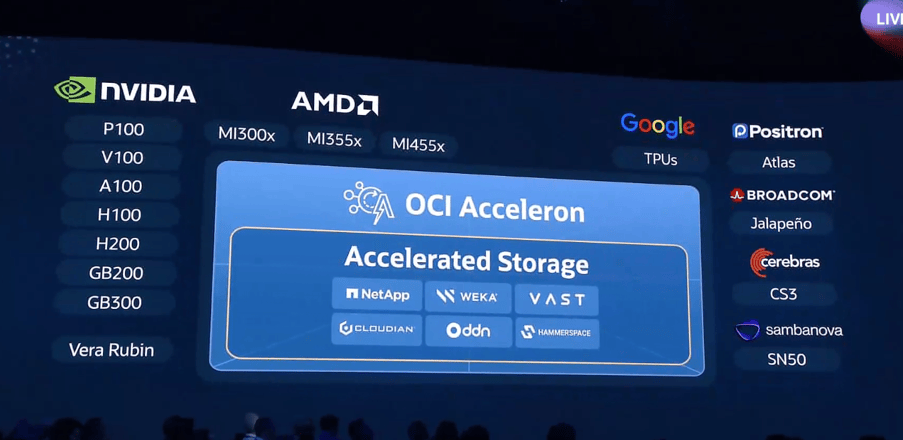
The keynote covered advances across media, security, infrastructure and data, alongside the choice of AI accelerators available on Oracle Cloud Infrastructure. Another phrase I noted was “Think of it as one big computer.” That sense of scale is important. This isn’t just about adding more AI features to the applications we already use. The foundations of enterprise technology are evolving to support an increasingly AI-driven world.

A number of the announcements from Day 2 caught my attention. Oracle’s work with OpenAI. The expansion of native AI and data services on OCI with Snowflake. Google TPUs coming to OCI. And the Oracle AI Data Platform. It would be easy to look at those as separate announcements. I think there’s a bigger theme here. Choice.

Enterprise AI isn’t going to be built around a single model, a single source of data or a single technology. Different organisations, workloads and use cases will need different things. And as AI continues to evolve at its current pace, being able to bring those things together becomes increasingly important. For customers, I don’t think this is really about wanting more technology or more complexity. It’s about having the flexibility to choose the right technology for the job.

I’ve written before that every AI conversation eventually becomes a data conversation. Nothing I heard on Day 2 changed my mind about that. If anything, it reinforced it.
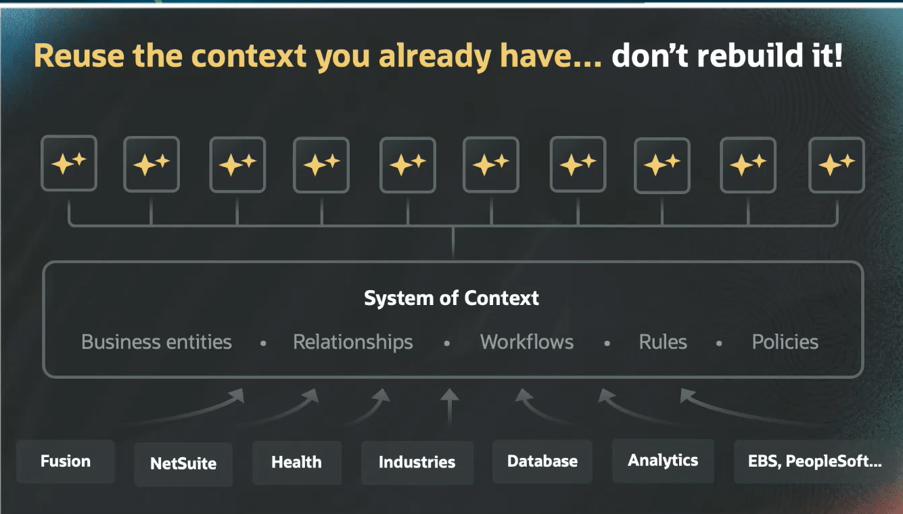
One of the sessions I found particularly interesting was Oracle AI Data Platform: Enterprise Context for Agentic AI at Scale. Even the title gets to something I think is going to become increasingly important: context.

For years we’ve talked about the importance of getting enterprise data into the right place, in the right format and at the right quality. AI doesn’t make that problem disappear. And as AI becomes more agentic, the importance of context only grows. It’s no longer just about having access to data.

The bigger question is whether AI has the information and enterprise context it needs to support useful outcomes. That’s an important distinction. Giving an AI assistant information so that it can help somebody make a decision is one thing. As we move towards AI doing more of the work itself, the foundations around it become much more important too.

Something else that stood out to me across Day 2 was just how important infrastructure has become to the AI story. The Powering the Next Era of Enterprise AI keynote reflected that broader infrastructure conversation, including references to renewable energy such as wind and solar.

It’s easy to get excited about what an AI agent can do. But enterprise adoption quickly introduces a different set of questions. Where does the data come from? Where do AI workloads run? How are they secured? What controls need to sit around them? How do organisations manage cost and capacity as the use of AI grows?

These might not be the announcements that generate the most eye-catching demos, but they’re increasingly important enterprise questions. The infrastructure underneath AI matters.
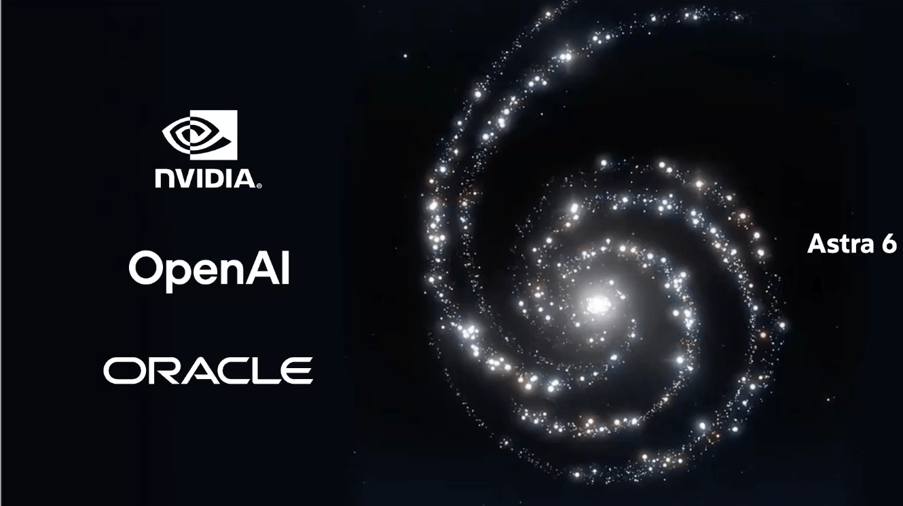
Another announcement that caught my attention was Oracle’s AI services practice powered by OpenAI technology. Again, what interested me wasn’t the individual announcement as much as what it says about the direction of travel. Think about how quickly the enterprise AI conversation has developed.

Initially, much of the excitement was around the models themselves. Then came copilots and assistants. More recently we’ve seen the conversation move towards agents and agentic applications. Now we’re talking increasingly about data platforms, enterprise context, AI infrastructure and the services needed to put all of those pieces together. To me, that’s a sign of a market growing up. Because having increasingly powerful AI isn’t enough. It still needs to solve real business problems.

So, after following Day 2 remotely, what am I taking away from it? Day 1 was about AI moving from helping people work to getting work done. Day 2, for me, was about the foundations that allow that to happen.

We’ve spent the last few years asking what AI can do. Can it summarise this? Can it create that? Can it answer this question? Can we build an agent to handle that process? Those questions aren’t going away. But I think the next questions are potentially much more interesting. What data does the AI have access to? Does it have the right business context? Where does it run? What controls sit around it? And can we scale all of that without simply creating a new generation of enterprise silos?

That’s where I think the conversation is heading. The organisations that get the most value from AI won’t necessarily be the ones that adopt the most AI. They’ll be the ones that build the right foundations around it.

Because if Day 1 showed us where enterprise AI is heading, Day 2 was a useful reminder of what we need underneath it to get there. The AI is only part of the story.

Please note all screenshots are the property of Oracle and are used according to their Copyright Guidelines.
Oracle AI World Day 1: From Helping People Work to Getting Work Done

I wasn’t in Las Vegas for Oracle AI World this year. Like many Oracle customers and partners around the world, I followed the event remotely using Oracle’s free On Air pass, catching up with the keynotes from the UK rather than from the conference floor. While watching remotely means missing some of the atmosphere and conversations that happen between sessions, it does give you the opportunity to focus entirely on the messages being delivered.

Having watched both Mike Sicilia’s opening keynote and Chris Leone’s product keynote, one theme stood out above everything else. Oracle is no longer talking about helping people work faster. Oracle is talking about getting the work done. At first glance, that might sound like a subtle distinction. I don’t think it is. In fact, I think it represents one of the biggest shifts we’ve seen in enterprise applications for years.

For the last couple of years, most AI conversations have been centred around productivity. How can AI draft content faster? How can AI summarise meetings? How can AI help employees find information more quickly? All of those things matter. They deliver value. But fundamentally, the human remains responsible for completing the task.

What struck me during the Day 1 session was how little time Oracle spent talking about AI as an assistant and how much time it spent talking about AI as an executor. Across both keynotes, the discussion repeatedly returned to outcomes. Not generating insights. Not producing recommendations. Delivering results. That feels like an important evolution in enterprise AI.

One of the things I liked most about Mike Sicilia’s keynote was that the focus wasn’t really technology. It was people. The message wasn’t that AI should replace people. It was that organisations should be able to remove the repetitive, burdensome activities that consume time and energy, allowing people to focus on higher-value work.

For years we’ve accepted certain activities as simply being part of work. Reconciling data. Chasing approvals. Managing exceptions. Navigating complex processes. Collecting information from multiple systems. What if those activities become the responsibility of software instead? That was the question I kept coming back to throughout the keynote. The vision wasn’t more intelligent software. It was more capable organisations. That’s a subtle but important difference.

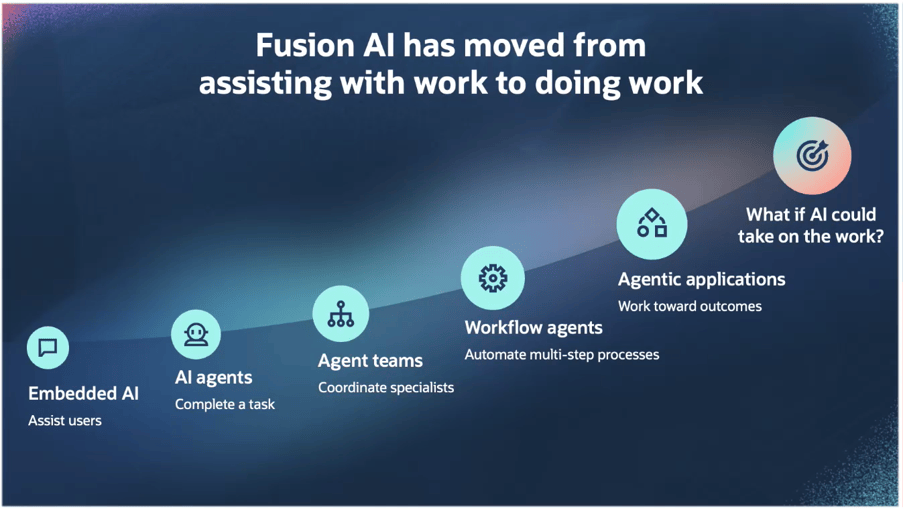
If Mike Sicilia explained the vision, Chris Leone demonstrated how Oracle intends to deliver it. The progression shown during the keynote was fascinating. We have already seen Oracle introduce embedded AI capabilities across Fusion. We have seen AI agents emerge. Now Oracle is talking about agent teams, workflow agents, agentic applications and autonomous execution.

The key message was that AI is evolving from supporting processes to actively participating in them. That shift matters. Historically, enterprise software has recorded work. Increasingly, Oracle appears to be building software that performs work. Not without governance. Not without controls. But certainly with a higher degree of autonomy than most organisations are accustomed to today.

There were plenty of announcements during the keynote, but Fusion Claw was the one that immediately stood out to me. Not because it was the most futuristic. Actually, quite the opposite. What interested me was the emphasis on governance.

Most organisations are no longer questioning whether AI can generate content, identify patterns or make recommendations. The real question is whether AI can be trusted to execute business processes. That is where many current AI discussions begin to stall. The answer is rarely a technology problem. It is a governance problem.

Throughout the demonstrations, Oracle repeatedly emphasised operating boundaries, permissions, policies, approvals and organisational controls. In other words, autonomy with accountability. That feels much more relevant to enterprise customers than unrestricted AI experimentation. The organisations I speak to rarely say, “We need AI to make decisions independently.” What they actually say is, “We need AI to help us achieve outcomes without introducing risk.” Fusion Claw feels like Oracle’s response to that challenge.

Another concept that caught my attention was Oracle’s discussion around systems of outcomes. For decades, enterprise applications have been systems of record. They store information. Track transactions. Enforce processes. Maintain business truth. Those capabilities remain essential.

Oracle’s argument is that organisations increasingly need something more. A layer focused on achieving business outcomes rather than simply recording business activity. The more I think about it, the more significant that feels. After all, organisations don’t exist to process invoices. They don’t exist to approve purchase orders. They don’t exist to complete workflow transactions. Those activities support the real objectives. Better customer experiences. Stronger financial performance. Improved workforce productivity. Increased organisational agility. More resilient supply chains. Those are the outcomes that matter. If AI can continuously coordinate activity towards those outcomes, then we are moving into genuinely new territory.

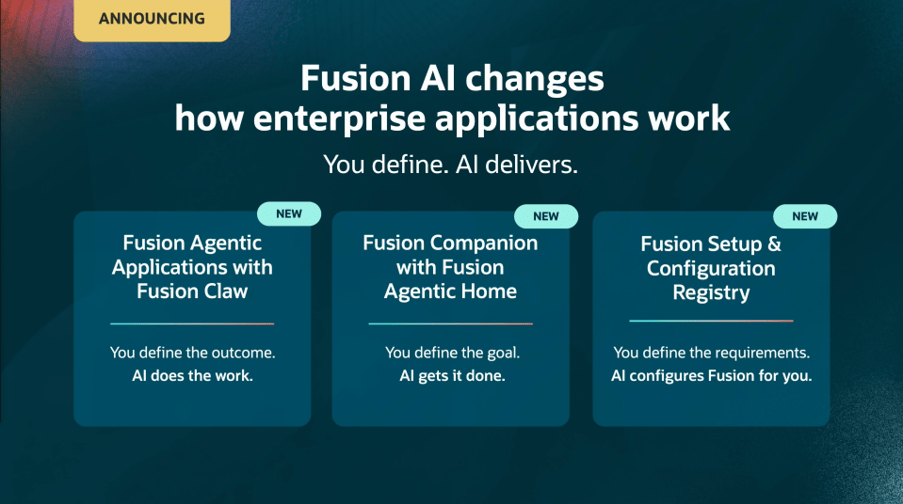
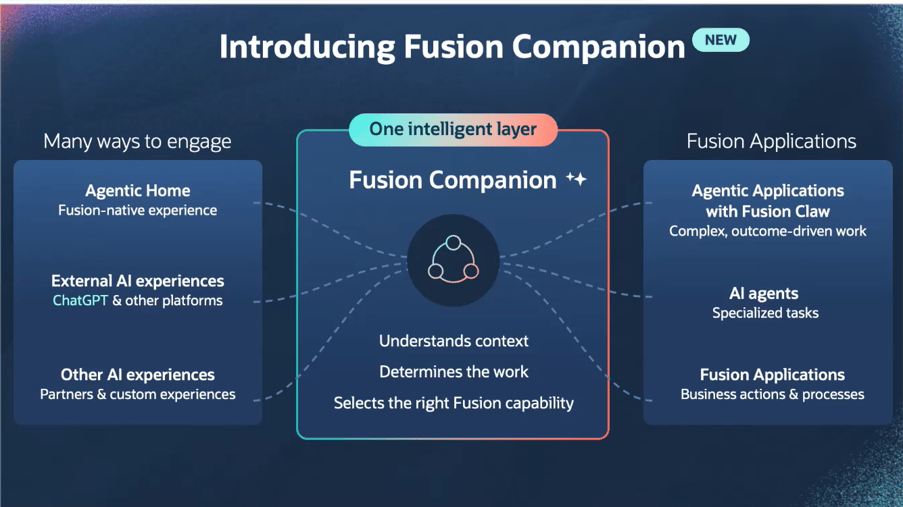
Fusion Claw will probably attract most of the headlines. However, I suspect Fusion Companion could prove just as important over time. As enterprise landscapes become increasingly complex, users don’t think in terms of applications anymore. They think in terms of work. They move between systems, channels, data sources and processes. The value increasingly comes from connecting those experiences together.

The vision Oracle presented for Fusion Companion suggests a future where intelligence follows the user rather than remaining confined within individual applications. If delivered successfully, that could become one of the most practical and impactful developments announced during the keynote.

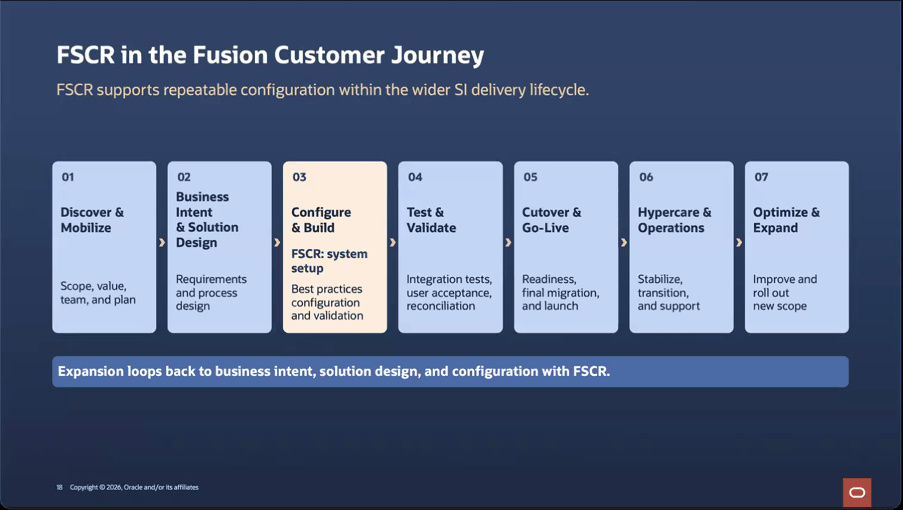
Anyone who has read my recent blogs will know I’ve already posted about Fusion Setup and Configuration Registry (FSCR). Seeing it formally announced during the keynote only reinforced my belief that this could become one of the most important long-term developments for the Oracle ecosystem.

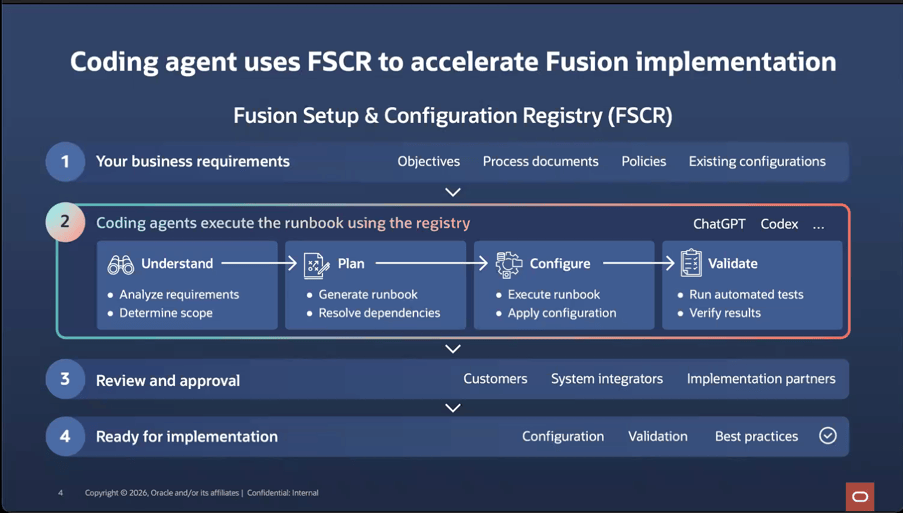
For years, implementation partners have built methodologies, accelerators, templates and frameworks to help customers configure Fusion applications. FSCR has the potential to fundamentally change that model. If Oracle can successfully connect requirements, process design, configuration and AI-driven implementation, then the way organisations deploy Fusion could look very different in the future. It is still early days. But of all the announcements made on Day 1, FSCR may ultimately have one of the biggest impacts on how Oracle projects are delivered.

When I finished watching the keynotes, I kept coming back to one simple thought. For the last two years, the industry has largely been asking: “How can AI help people do their jobs faster?” Oracle now seems to be asking: “How can AI help organisations achieve outcomes with less human effort?” That is a much bigger question. And potentially a much more transformative one.

Whether discussing agentic applications, Fusion Claw, Fusion Companion or FSCR, the underlying message felt remarkably consistent. The goal is no longer simply helping people work. The goal is getting the work done. That doesn’t mean removing people from the process. It means allowing people to spend less time managing the mechanics of work and more time focusing on the decisions, creativity, relationships and innovation that humans are uniquely positioned to provide.

Watching remotely, that was my overwhelming impression of Oracle AI World Day 1. The conversation has moved beyond AI assistance. Oracle is now focusing on AI execution. And that feels like the start of a very different chapter for enterprise applications.

Please note all screenshots are the property of Oracle and are used according to their Copyright Guidelines.
Why Oracle FSCR Could Change How Fusion Is Implemented

At Oracle AI World, there has been and will be plenty of attention on AI agents, autonomous workflows and the future of enterprise applications. Those announcements will undoubtedly generate the headlines. But one announcement caught my attention for a different reason.

Oracle introduced the Fusion Setup and Configuration Registry (FSCR), and while it may not be as immediately eye-catching as some of the AI announcements, it could prove to be one of the most important foundations Oracle has put in place for the future of Fusion applications. Because before AI can intelligently configure Oracle Fusion, it first needs to understand Oracle Fusion. FSCR appears to be Oracle’s answer to that challenge.

When organisations implement Oracle Fusion, a huge amount of knowledge sits outside the application itself. Configuration decisions are made during workshops. Dependencies are captured in design documents. Best practice is spread across implementation guides, project artefacts, customer experience and consultant expertise. Some of that knowledge is documented. Some lives in spreadsheets. Some exists purely in the heads of the people delivering the project. Over time, this creates an interesting situation.

The technology becomes more intelligent, but the knowledge needed to implement and configure it often remains fragmented. As Oracle continues its journey towards agentic applications and autonomous business processes, that fragmentation becomes increasingly important. After all, how can an AI agent configure a system if it doesn’t have access to the knowledge required to make those decisions?

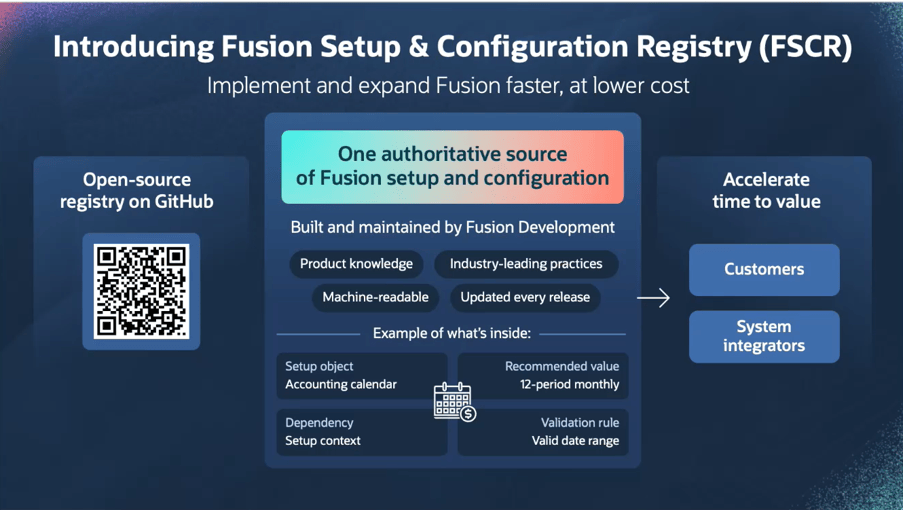
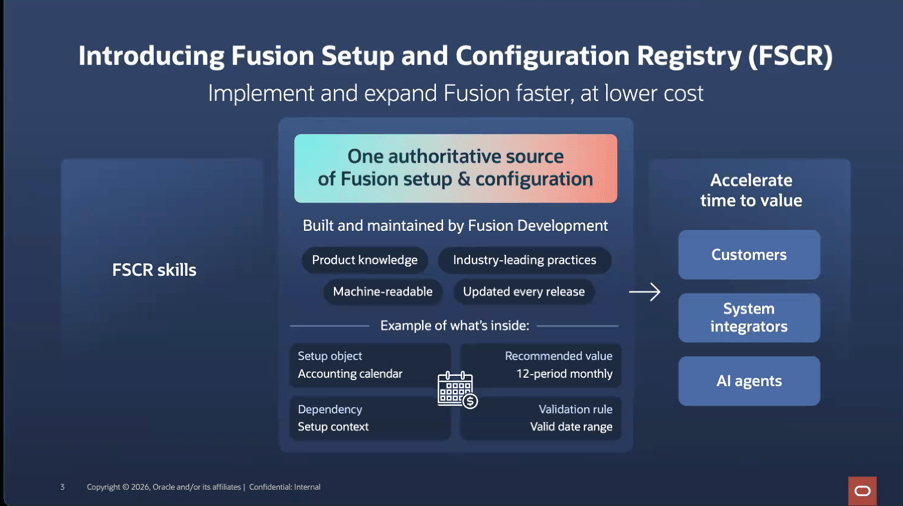
At its core, FSCR is Oracle’s central repository of Fusion setup and configuration knowledge. It brings together setup tasks, dependencies, validation rules, best practices and implementation knowledge into a structured, machine-readable framework. The phrase “machine-readable” is important here. This isn’t simply another set of implementation documents.

Oracle is creating a knowledge layer that can be consumed not only by people, but also by AI-powered services, agents and automation tools. In effect, Oracle is moving implementation knowledge closer to the product itself. That feels like a significant shift.

Most customers don’t wake up in the morning thinking about configuration registries. They care about delivering projects faster, reducing risk and getting value from their Oracle investment. That’s where FSCR becomes interesting.

By capturing implementation knowledge in a structured way, Oracle creates the potential for a much more consistent approach to configuration and deployment. Instead of repeatedly recreating the same implementation knowledge across multiple projects, that knowledge can become reusable, governed and accessible. The obvious benefit is efficiency. The bigger benefit may be consistency.

Anyone who has worked on multiple Oracle Fusion programmes knows how much time is typically spent checking dependencies, validating setup choices and understanding the impact of changes across different areas of the application. A central knowledge framework has the potential to reduce much of that effort.

I’ve written quite a lot recently about Agentic Applications and the broader move from automation to autonomy. Most conversations focus on the visible layer. The agent. The user experience. The conversational interface. The outcome. What receives far less attention is the knowledge framework that sits underneath.

Enterprise AI becomes significantly more powerful when it can move beyond making recommendations and start executing trusted actions. But trusted execution only happens when there is confidence in the underlying knowledge. That’s why FSCR feels important.

It provides the structured understanding of Fusion configuration that future AI capabilities will need if they are going to do more than simply answer questions. In many ways, it feels like Oracle is putting the foundations in place before building the next floor of the house.

The interesting thing about FSCR is that its potential value isn’t limited to new implementations. Most organisations spend far longer running Oracle Fusion than they do implementing it. Over time they introduce new functionality, adopt new releases, optimise processes, expand into new business areas and respond to changing organisational priorities.

Every one of those activities requires knowledge of how the system has been configured and how different setup decisions interact with each other. If Oracle can maintain that knowledge as a living framework, the opportunities extend well beyond implementation projects. It could support ongoing optimisation, change management, governance and continuous improvement throughout the lifecycle of a Fusion environment. For many organisations, that’s where the real value may emerge. This functionality isn’t there yet though, the initial focus is on new implementations, but Oracle have been plans on expanding it’s functionality.

You might be saying, so what? It’s still early days, and like any significant innovation, the true impact will depend on how Oracle develops the capability over the coming releases. But the direction of travel is clear. Oracle is looking to move implementation knowledge from documents and individuals into a trusted, structured framework that can support both people and AI. For customers, that could ultimately mean:

  • Faster implementations
  • Greater consistency across projects
  • Reduced dependency on individual expertise
  • Improved validation and governance
  • Better support for future AI-driven configuration and optimisation

None of these benefits happen overnight. Organisations will still need experienced teams, strong governance and informed decision-making. But if Oracle’s vision becomes reality, FSCR could help remove much of the repetitive effort that currently surrounds system configuration and implementation.

I’ve often said that the most important developments in enterprise AI are usually the ones people notice the least. Everyone notices the chatbot. Everyone notices the agent. Everyone notices the flashy demo. Far fewer people pay attention to the infrastructure that makes those capabilities possible.

FSCR feels like one of those foundational innovations. On its own, a setup and configuration registry isn’t particularly exciting. But viewed in the context of Oracle’s wider AI strategy, it starts to look much more significant. Because before Oracle can deliver truly autonomous implementation and optimisation capabilities, it first needs a way for AI to understand how Oracle Fusion works. FSCR might not be the announcement that generates the most headlines from AI World. But in a few months’ time, it may prove to be one of the most important.

Please note all screenshots are the property of Oracle and are used according to their Copyright Guidelines.
Is RODS the Future of Oracle Fusion Data Extraction?

If you’ve been working with Oracle Fusion for any length of time, you’ll know that getting data out of Fusion is often just as important as getting data into it. Whether it’s feeding a data warehouse, supporting reporting requirements, populating a data lake, or increasingly providing the data needed to power AI initiatives, organisations are extracting more Fusion data than ever before.

Traditionally we’ve had a number of options available to us, including HCM Extracts, BI Publisher and BICC. They all have their place and continue to solve different business challenges. But Oracle has recently introduced something new that could become a significant part of its long-term data extraction strategy: the Read Optimised Data Store (RODS).

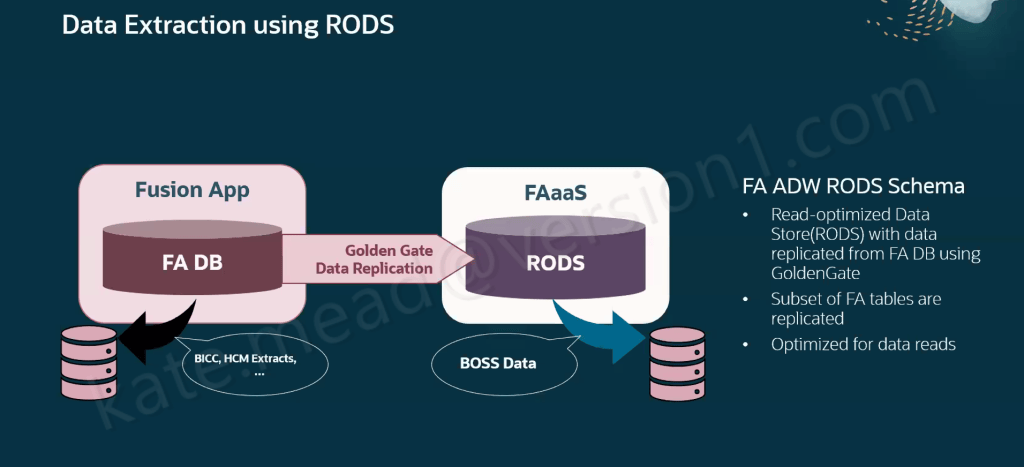
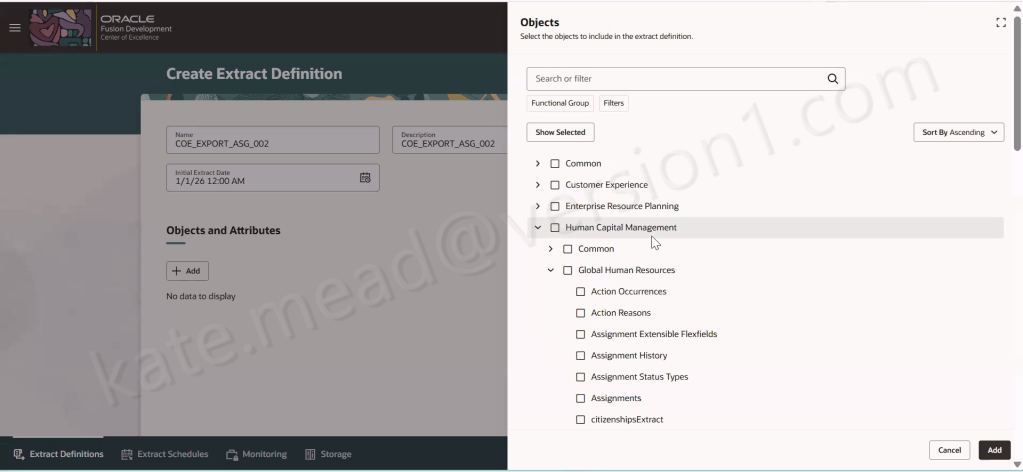
So, what is RODS? At a high level, RODS is exactly what the name suggests: a read-optimised copy of Fusion data designed specifically for extraction and reporting workloads. Instead of running large extraction jobs against the live transactional database, Oracle replicates selected Fusion data into a separate environment using GoldenGate technology. Extraction processes then run against this replicated data store rather than the core application database. The goal is simple. Make high-volume data extraction faster while reducing the impact on day-to-day Fusion operations.

For many organisations, extraction volumes continue to grow. Data is no longer only being extracted overnight for a monthly report. Today’s integrations, analytics platforms, AI services and operational reporting solutions often require much larger volumes of data and much greater frequency.

Historically, there has always been a balance between extracting the data you need and consuming resources that could otherwise be used by the application itself. RODS changes that dynamic. Because extraction workloads are separated from the transactional environment, organisations can run large-scale extracts without placing the same demand on the Fusion application database. That could be particularly valuable for customers with significant reporting requirements or complex integration landscapes.

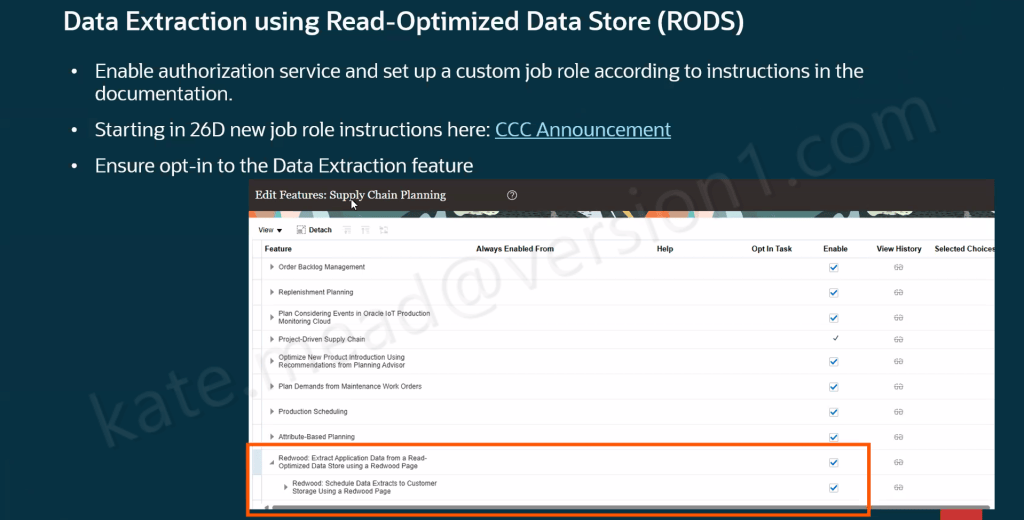
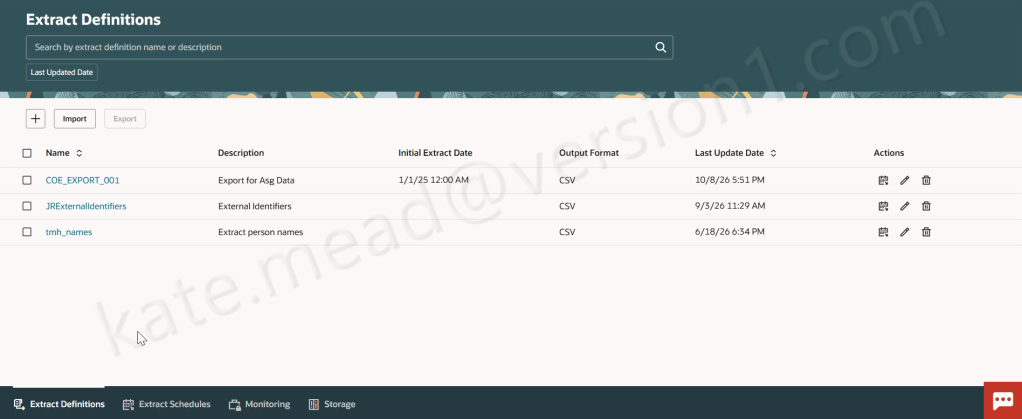
RODS is supported by Oracle’s new Data Extraction Tool (DET), which provides the framework for defining, scheduling and managing extracts. The Data Extraction Tool supports both full and incremental extracts and can output data in either CSV or JSON format. For organisations building modern data platforms, that’s likely to be exactly what they need. Clean, structured data delivered quickly and efficiently.

Does this replace HCM Extracts? No. And I think that’s an important point to understand. Whenever Oracle introduces a new capability, one of the first questions customers ask is whether it replaces what’s already there. The answer, at least today, is no.

HCM Extracts remain incredibly powerful, particularly where organisations require complex formatting, business logic, Fast Formula processing or highly tailored output files. RODS isn’t trying to solve those problems. Instead, it is focused on extracting large volumes of data efficiently and making that data available for downstream consumption. In reality, I suspect most organisations will continue to use a combination of technologies depending on the requirement.

The most interesting aspect for me isn’t necessarily the technology itself. It’s Oracle’s direction of travel. Oracle has openly discussed RODS as the long-term strategic direction for high-volume extraction and replication workloads, with many seeing it as the natural successor to BICC. That doesn’t mean existing extraction methods are going away anytime soon, but it does suggest where Oracle’s investment and innovation are likely to be focused moving forward. For customers making long-term architectural decisions, that’s worth paying attention to.

One area where I think RODS could become increasingly important is AI. As organisations start deploying more AI services, AI agents and autonomous processes, access to timely, high-quality operational data becomes critical. Oracle has confirmed that data replication into RODS occurs in near real-time, creating opportunities for more responsive analytics, automation and AI-driven decision making. Whilst we’re still at the early stages of seeing how customers will use this in practice, the link between modern data architectures and enterprise AI is becoming increasingly obvious.

RODS probably isn’t a feature that will get end users excited. Most employees will never know it exists. But for technical teams, data teams, integration specialists and architects, it could become a very important capability. The ability to extract large volumes of Fusion data quickly, without impacting transactional workloads, addresses a challenge many organisations have wrestled with for years.

I don’t see RODS replacing every extraction method. HCM Extracts, BI Publisher and other tools still have an important role to play. What I do see is Oracle laying the foundations for the next generation of Fusion data extraction, one that is built around scale, performance and increasingly the data demands of analytics and AI. If you’re currently using BICC extensively or are designing your future Fusion integration architecture, RODS is definitely something I’d be taking a closer look at.

Please note all screenshots are the property of Oracle and are used according to their Copyright Guidelines.
Fusion Claw: Is This Oracle’s Most Important AI Announcement Yet?

Over the past couple of years, we’ve seen Oracle steadily evolve its AI story. It began with AI capabilities embedded within Fusion Applications. Then came AI Agents, followed by AI Agent Studio, giving customers the ability to build, extend and govern their own AI-powered processes. Oracle has unveiled the next piece of the puzzle: Fusion Claw.

I’ll admit that when I first heard the name, I wasn’t entirely sure what to make of it. Another AI agent? A new orchestration framework? Perhaps just another acronym to add to the ever-growing AI dictionary? Having sat through the recent webinar, I came away thinking this may actually be one of the most significant Oracle AI announcements we’ve seen so far.

Not because it introduces more AI. But because Oracle appears to be addressing one of the biggest challenges organisations face today: how do you move from AI recommendations to AI-driven outcomes whilst maintaining governance, accountability and human oversight?

Most enterprise AI today is still fundamentally assistive. Whether it’s generating content, summarising information, analysing data or helping users complete transactions, AI is primarily helping people do their jobs more efficiently. Even many AI agents stop at recommendations. They identify an issue, gather information, analyse options and suggest a course of action. A human then reviews the output and decides what happens next. Fusion Claw appears to be Oracle’s answer to that gap.

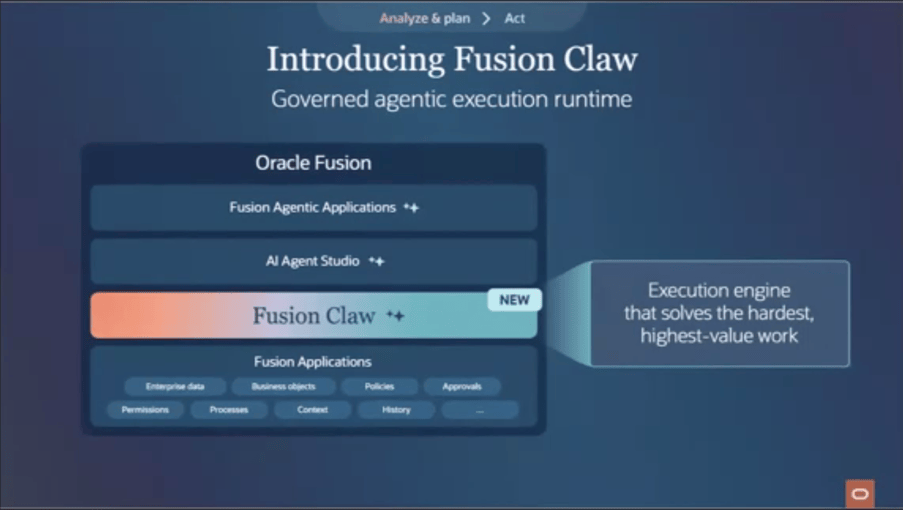
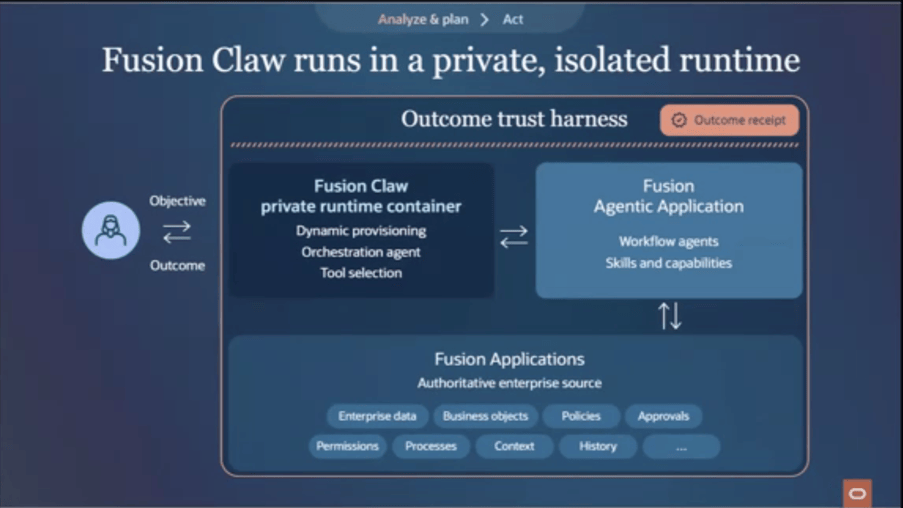
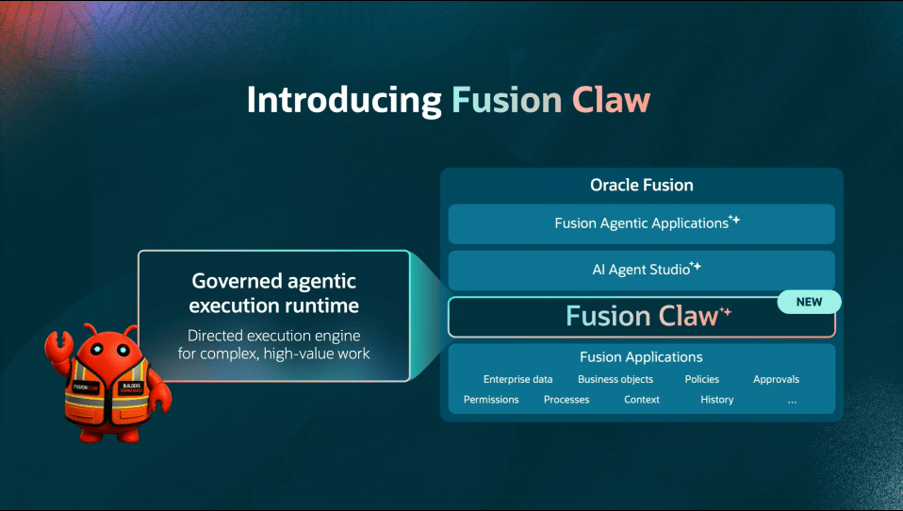
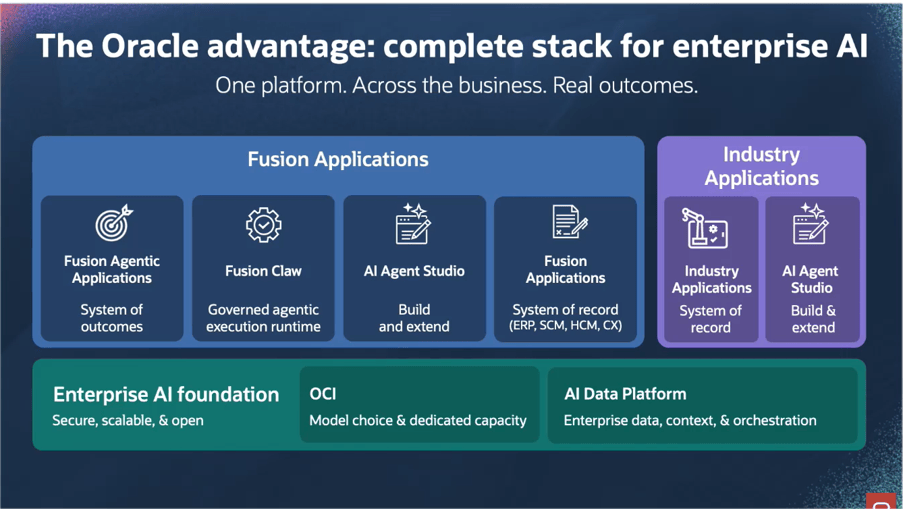
Oracle positions Fusion Claw as a governed execution runtime that sits between AI planning and enterprise execution. People define objectives, policies and desired outcomes. Agentic Applications orchestrate business processes. Fusion Claw plans and executes activities. Fusion Applications remain the system of record. That distinction is important.

Oracle is not proposing a future where AI operates outside enterprise controls or invents its own ways of working. Instead, Fusion Claw operates against the same business objects, security model and governance framework that organisations already trust. In simple terms, Oracle is creating a mechanism for translating business outcomes into governed action.

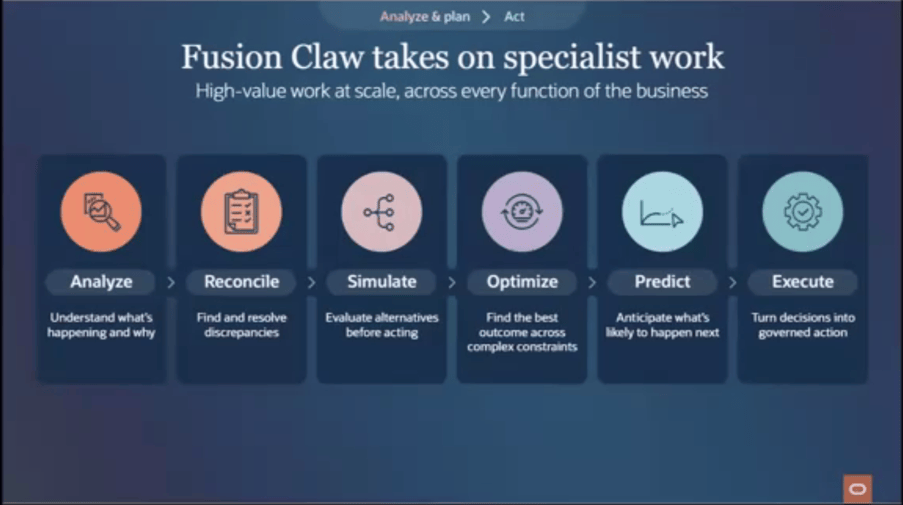
Fusion Claw is designed for complex, high-value work rather than simple transactional activities. Its core capabilities are Analyse; Reconcile; Simulate; Optimise; Predict; and Execute. Those first five capabilities are becoming increasingly common across enterprise AI platforms. The sixth is what makes Fusion Claw different. Execution has traditionally been the point where AI recommendations hand off to humans. Oracle is now seeking to close that gap.

Imagine an organisation identifying a workforce issue, supply chain disruption, financial variance or operational risk. A traditional AI capability might identify the problem. An AI agent might recommend a solution. Fusion Claw is designed to take things further by evaluating multiple options, simulating outcomes, optimising the approach and, where authorised, executing approved actions. That feels like a notable evolution in Oracle’s AI strategy.

The focus is no longer: “How can AI help me complete this task?” Instead, the question becomes: “How can AI help achieve this business outcome?”

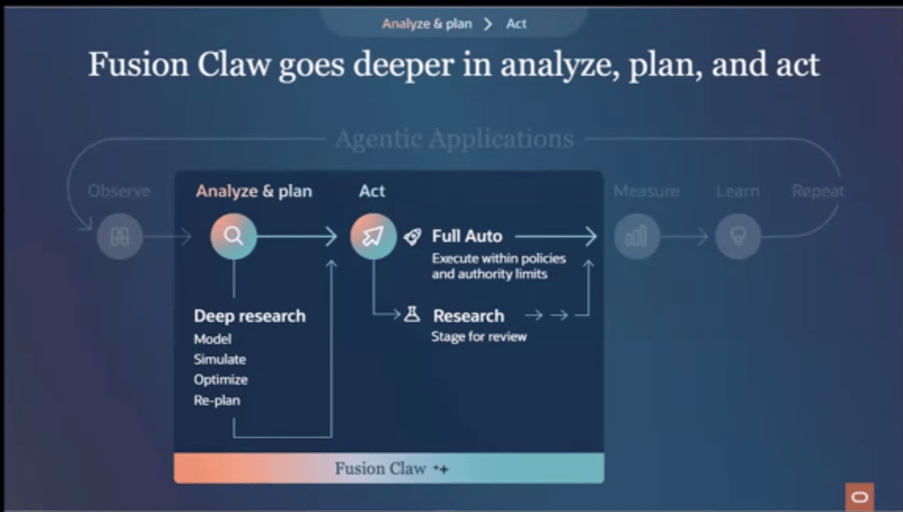
One of the most interesting concepts introduced during the session was the distinction between two the operational models Deep Research vs Full Auto. In Deep Research mode, Fusion Claw investigates, analyses and simulates. It evaluates scenarios, compares potential outcomes, surfaces recommendations and presents options for human review.

Importantly, the human remains responsible for making the decision. For many organisations, particularly those operating in highly regulated environments, this will likely be the most comfortable starting point. The value comes from faster analysis and better decision support, whilst maintaining a clear human approval process.

Full Auto mode is where things become significantly more transformative. In this model, Fusion Claw can plan and execute authorised activities automatically in pursuit of a defined business outcome. That naturally raises questions. Who controls it? Who is accountable? What prevents unintended actions?

Anyone who has read my blogs over the past year will know that governance is often the first question that I and customers ask. The technology itself is rarely the challenge. Trust is. The encouraging aspect of Fusion Claw is that governance appears to have been designed into the platform from the outset rather than added afterwards.

Fusion Claw operates inside a private runtime container within the customer’s Fusion environment and works directly with authoritative Fusion business data. Perhaps most importantly, Fusion Claw does not grant itself authority. Organisations decide what actions can be taken, under which circumstances and with what level of oversight. Human accountability remains in place. For customers concerned about explainability, risk and compliance, that message will be every bit as important as the AI capabilities themselves.

One feature that particularly caught my attention was the concept of an Outcome Receipt. Every execution performed by Fusion Claw generates a detailed record that explains: What happened? Why it happened? What information was used? Which controls were applied? Which actions were executed?

At first glance, this sounds like an audit feature. In reality, it could become one of the most important capabilities in the platform. As AI becomes responsible for increasingly valuable business activities, organisations will need evidence. They’ll need to demonstrate how decisions were reached, what data was considered and who authorised the action. For public sector organisations, financial institutions and heavily regulated industries, this level of transparency could prove essential. Many organisations are no longer asking whether AI can make decisions. They’re asking whether they can prove how those decisions were made.

Most enterprise systems operate on a transaction basis. Users initiate activity, the system responds and the process ends. Fusion Claw appears designed to work differently. It is runtime that continuously monitors conditions, reassesses plans and adjusts activities in pursuit of an outcome. Execution can be triggered by user requests; scheduled activities or configured triggers. Rather than waiting for users to notice and react, Fusion Claw is designed to continuously work towards a defined objective. That’s a subtle but potentially significant shift in how we think about enterprise applications.

One other key point of note is Fusion Claw’s ability to work across business functions. Rather than being constrained to a single process or module, it is intended to support end-to-end activities spanning multiple Fusion pillars. This cross-functional capability is important because real business outcomes rarely exist within the boundaries of a single application module.

Most organisational challenges span departments, processes and data sources. Fusion Claw appears designed with that reality in mind. It should also be noted that whilst Fusion Claw is firmly rooted within Fusion Applications, it can interact with external services and other agents where appropriate access has been configured.

A practical concern for many customers will be whether existing investments become obsolete. Fortunately, Oracle’s answer appears to be no. They have confirmed that existing agents can be reused and enhanced rather than rebuilt from scratch. Given that many organisations are only just beginning their AI Agent Studio journey, that will be welcome news.

For those already thinking ahead to roadmap planning, there are a few key details you should know. Fusion Claw is currently targeted for the 26D timeframe. If you have already purchased the licence for the Agentic Applications, you will automatically be able to use Fusion Claw.

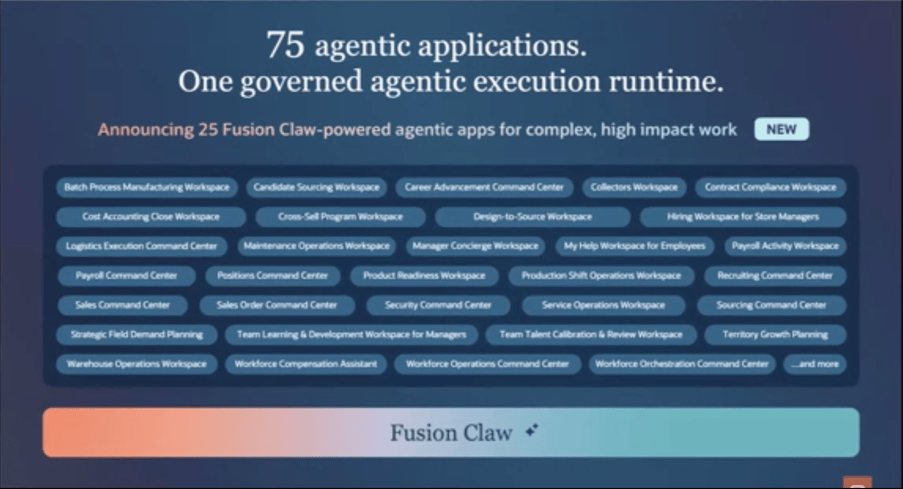
By the time you receive 26D, Oracle will have provided 75 Agentic Applications out of the box, of which 25 will be Fusion Claw-powered applications focused on more complex enterprise activities. You won’t be limited to just these 25 Fusion Claw applications, as with all AI Agents and Agentic Applications, you can build your own. This can be via the No Code methods in AI Agent Studio or the Low Code options using CLI.

So, Is This Oracle’s Most Important AI Announcement Yet? Maybe. It’s certainly one of the most ambitious. AI Assist features help users work faster. AI Agents help users make better decisions. Fusion Claw appears to be aiming for something larger: helping organisations achieve business outcomes through governed AI execution. Whether customers are ready to embrace that level of autonomy remains to be seen.

Some organisations will begin with Deep Research, keeping humans firmly in the decision-making loop. Others will be attracted by the possibility of allowing approved activities to execute automatically within carefully defined guardrails. Either way, the conversation is changing. We’re moving beyond asking how AI can assist users and starting to explore how AI can help organisations achieve measurable outcomes. For me, that’s the real significance of Fusion Claw.

The technology itself is impressive, but the bigger story is what it represents: Oracle’s vision for moving from AI that advises, to AI that acts, whilst still maintaining the governance, security and accountability that enterprises demand. And that may ultimately make Fusion Claw one of the most important steps yet in Oracle’s AI journey.

Please note all screenshots are the property of Oracle and are used according to their Copyright Guidelines.
Oracle Learning Paths, Offerings and Redwood: What’s Actually Changing?

Before we get started, a quick thank you to one of my blog readers. This article came about following a direct request from a customer who asked if I could explain what is happening with Oracle Learning Offerings and the new Learning Paths functionality. It’s the first time I’ve been specifically asked to write a blog on a particular Oracle Fusion topic, and after looking into it I realised they’re probably not alone in being confused.

If you’ve recently seen references to Learning Paths, heard that Offerings are going away, or wondered what Redwood means for Oracle Learning, you’re not the only one. Oracle is changing terminology, introducing new Redwood-native learning objects and modernising Learning administration at the same time. That makes it difficult to understand exactly what is changing and, more importantly, what it means for customers who have spent years building and managing learning content in Oracle Learning. So let’s unpack it.

One of the biggest sources of confusion is that two separate changes are happening at the same time. In Oracle Fusion Learning 26B, Oracle rebranded Specialisations as Learning Paths. Oracle states that the self-service learning experience now consistently presents Specialisations as Learning Paths, although administrators may still see the old terminology in some classic administration pages for the time being.

Learning Paths are therefore the new name for what many Learning administrators have known as Specialisations. They are designed to provide a structured learning journey containing multiple learning items, helping organisations create role-based, compliance-based or career-development learning programmes. They are not a direct replacement for a single Offering.

For many years, Oracle Learning followed a fairly structured hierarchy. A typical eLearning item might look something like this: Course → Offering → Activity. This provided flexibility but often resulted in multiple objects needing to be created and maintained for even relatively simple learning content. If you wanted to publish a straightforward self-paced training course, you typically found yourself creating several related objects before learners could access the content. It worked, but it wasn’t always intuitive.

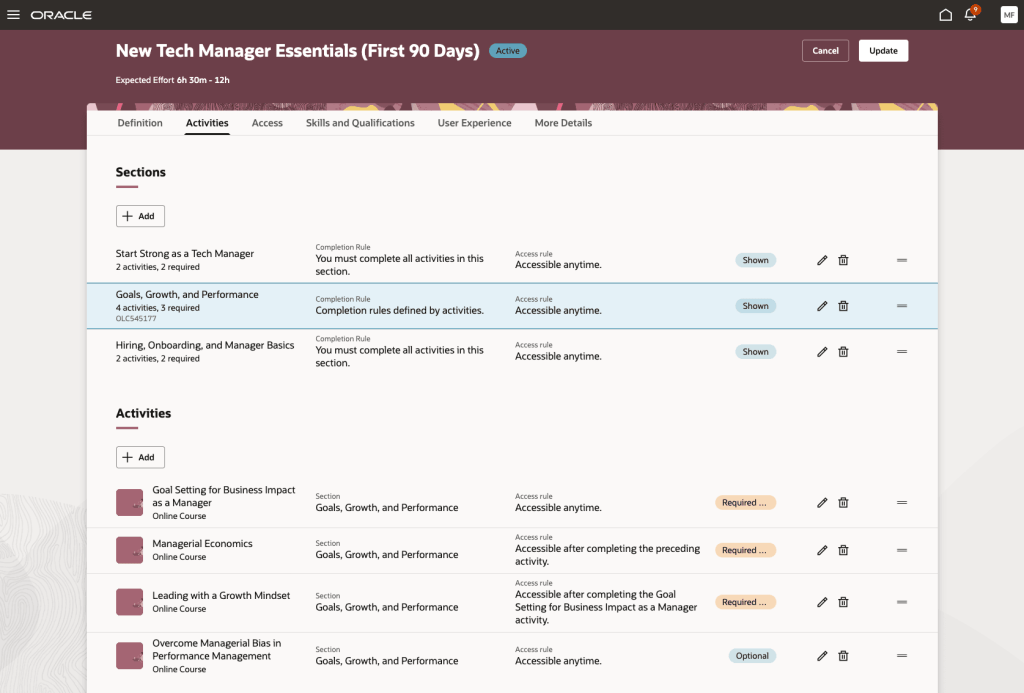
Oracle has been redesigning Learning as part of its broader Redwood strategy. One of the most significant developments arrived in 24D with the introduction of the new Redwood Self-Paced Learning experience. Oracle describes this as a redesigned process that combines what were previously separate activities into a single workflow, bringing together content, activities and learning publication within one experience.

The goal is simple: reduce complexity; simplify administration; improve usability and create a more modern learner experience. Rather than forcing administrators through multiple setup steps, Oracle is moving towards a more streamlined content creation model.

So are Offerings being removed? This is where things get interesting. There is a lot of discussion within the Oracle Learning community about Offerings becoming less central to the Learning architecture. Industry commentators have suggested Oracle’s long-term direction is towards Redwood-native learning objects rather than the traditional Offering-centred model. However, what is important is separating community interpretation from Oracle’s documented position.

What Oracle has clearly documented is:

  • Specialisations are becoming Learning Paths.
  • Redwood Self-Paced Learning introduces a simplified approach to managing self-paced learning content.
  • Oracle continues to invest heavily in Redwood Learning experiences.

What I have not yet found in Oracle readiness documentation is a statement saying: “Learning Paths replace Offerings.” In fact, these are different concepts serving different purposes. Think of a Learning Path as a curriculum rather than an individual training item. A Learning Path might include: multiple self-paced learning items; instructor-led training; assessments; recommended learning sequences or mandatory prerequisites. In other words, Learning Paths help define what learners should complete and in what order. They are ideal for: new starter onboarding; leadership programmes; compliance journeys; certification pathways and role-based development programmes. This is broadly the same purpose that Specialisations have always served, just under a new name.

For most organisations, I don’t think there is a need to panic. My advice would be: first, start becoming familiar with Redwood Learning administration if you haven’t already. Second, review how much you rely on traditional Course and Offering structures for new content creation. Third, start thinking about Learning Paths from a learner journey perspective rather than viewing them as a replacement for individual training content. Most importantly, don’t assume that every mention of Learning Paths is related to Offerings. In many cases Oracle is simply referring to the rebranding of Specialisations rather than introducing a direct replacement for existing Offerings.

Having worked with Oracle Learning for many years, I can understand why customers are asking questions. The terminology changes are significant, and because they are arriving alongside the wider Redwood transformation it’s easy to assume everything is changing at once. What I find encouraging is Oracle’s clear focus on simplifying Learning administration. The historic Course, Offering and Activity model could be powerful, but it could also feel overly complex for straightforward learning scenarios. Redwood Self-Paced Learning is a good example of Oracle reducing that complexity and making content easier to create and maintain.

For now, my advice is simple: treat Learning Paths as the evolution of Specialisations, keep an eye on Oracle’s Redwood Learning roadmap, and avoid assuming that Learning Paths are a direct one-for-one replacement for Offerings. The reality is a little more nuanced than that.

And finally, thank you again to the customer who suggested this topic. If there are other areas of Oracle Fusion you’d like me to explore in a future blog, feel free to get in touch. It seems I’ve accidentally opened the suggestions box.

Please note all screenshots are the property of Oracle and are used according to their Copyright Guidelines.
Could AI Be the Missing Piece in the Redwood Migration Puzzle?

I’ll admit it. This is probably the first time I’ve written a blog focused on Oracle CX. Most of my content tends to centre around HCM, ERP, SCM, AI Agent Studio, or the wider Oracle Fusion platform. However, over the last few months I’ve been spending a lot more time working with Oracle Helpdesk. As Helpdesk sits within the Oracle CX product suite, that has naturally led me to take a closer look at some of the innovation happening within CX.

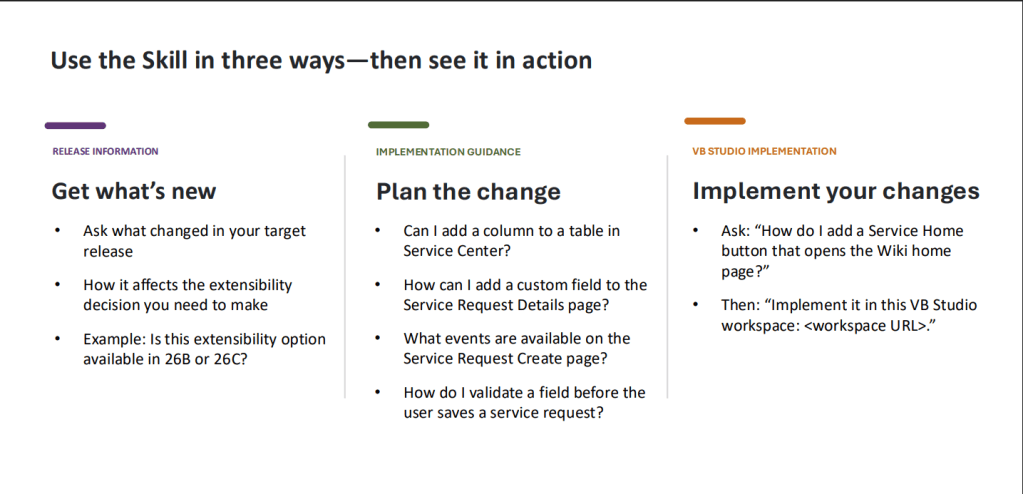
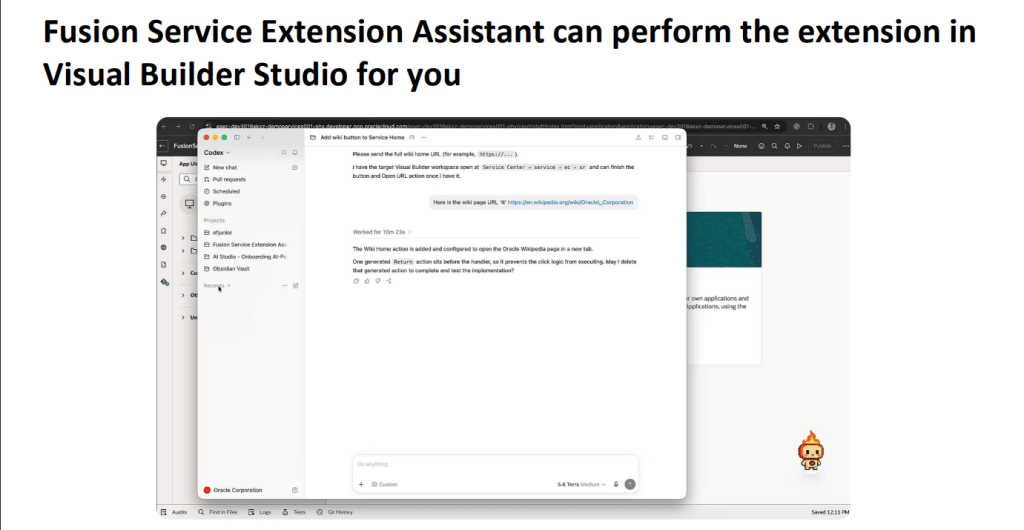
When I discovered that Oracle had developed an AI-powered assistant specifically designed to help organisations accelerate their move from the Classic user experience to Redwood, I was intrigued. Redwood migrations are a challenge that many Oracle customers are facing, and the idea of using AI not just to answer questions, but to actively guide and support that journey, felt like an interesting glimpse into where enterprise AI is heading.

It’s worth calling out an important caveat before I go any further. This particular capability is currently designed for Oracle CX Service and its associated extensibility framework. It is not available for HCM, ERP or SCM. However, what interested me as much as the solution itself was the fact that the CX product team is actively exploring and proving patterns that could potentially influence future AI-assisted implementation and configuration experiences across other Oracle product areas.

One of the biggest challenges with Redwood adoption is not usually understanding why you should move. Oracle has been clear about the benefits for some time. Redwood provides a more modern user experience, improved efficiency, greater flexibility through Visual Builder Studio, intelligent recommendations, and access to functionality that is only available within the Redwood user interface.

The real challenge is often understanding how to get there. Customers frequently ask questions such as: How do I recreate an existing extension in Redwood? Is a particular extensibility option available in my target release? What is the supported way to add custom functionality to a specific page? How do I avoid building something that won’t survive the next quarterly update? These are exactly the types of questions implementation teams spend significant amounts of time researching.

What caught my attention was that Oracle’s approach isn’t simply to place a large language model in front of documentation and hope for the best. Instead, the assistant is designed to provide grounded guidance using curated, release-aware sources that are specific to Fusion Service extensibility. The aim is to help users understand supported approaches, identify limitations, and surface any missing information required to answer the question accurately. That distinction is important.

One of the biggest misconceptions about enterprise AI is that the value comes from the model itself. In reality, the value often comes from the quality of the information that sits behind it. A generic AI model may be incredibly capable, but if it doesn’t understand the specific product, release, extensibility framework, or support boundaries involved, its answers can quickly become unreliable.

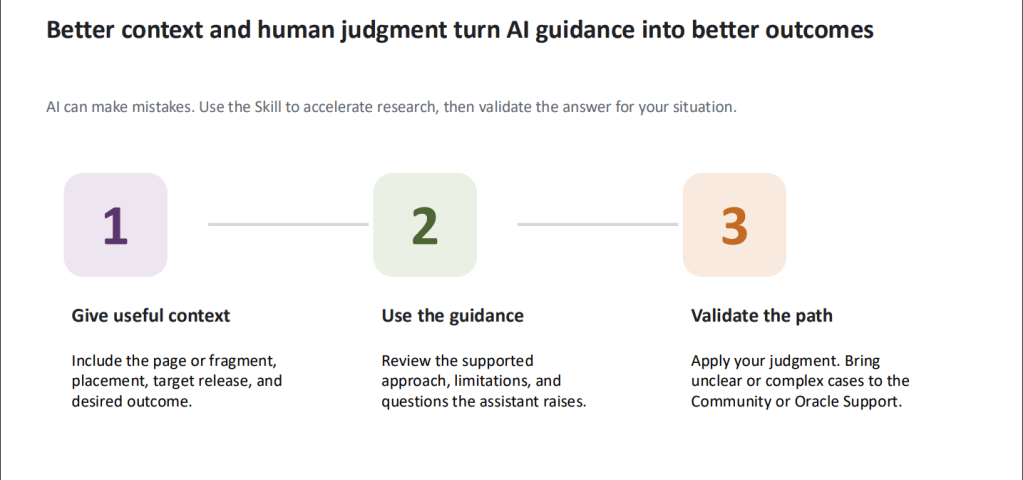
The CX team appears to have recognised this. The assistant routes questions to curated repositories of release-specific information and clearly highlights uncertainty or gaps where additional context is needed. Rather than positioning AI as an infallible expert, it is positioned as an accelerator for research and decision making. I also liked the emphasis on human judgement.

The guidance repeatedly reinforces that users should provide context, review the recommendations, and validate the proposed approach before implementation. In other words, AI helps you get to an answer faster, but it doesn’t remove the responsibility to apply experience and critical thinking. That’s a message I’ve been repeating in many of my recent AI-focused blogs, regardless of whether we’re talking about Agentic Apps, generative AI, or implementation accelerators.

Perhaps the most interesting aspect is where this could lead. Today, the capability focuses on Fusion Service extensibility and Redwood migration activities. It can help users understand new release functionality, identify supported implementation patterns, and even assist with Visual Builder Studio-related work.

Tomorrow, could we see similar experiences helping HCM administrators understand Redwood customisations? Could ERP teams receive guided support when adapting role-based pages? Could SCM implementation consultants get release-aware recommendations about supported configuration options?

Those are questions only Oracle can answer. But what seems clear is that the CX team is exploring a practical application of AI that goes beyond simply generating content. Instead, it aims to reduce implementation effort, improve confidence, and help customers reach the right outcome more quickly. For me, that’s where enterprise AI becomes genuinely interesting. Not when it replaces expertise, but when it helps organisations make better use of it.

Please note that all screenshots are the property of Oracle and are used in accordance with Oracle’s Copyright Guidelines.

Oracle Fusion Cloud Procurement 26D: Making Procurement Easier for Everyone

It’s quarterly release time again and Oracle has delivered a surprisingly practical set of updates for Procurement in 26D. There’s plenty of AI in this release, which won’t come as a surprise given Oracle’s recent direction. What I found interesting, though, is that many of these features aren’t about replacing procurement professionals or automating entire processes. Instead, they’re focused on removing friction. Making it easier to buy something. Easier to raise a request. Easier to manage contracts. Easier for suppliers to work with you. And honestly, that’s where I think the biggest value often comes from.

Most employees aren’t procurement experts. They don’t know the difference between a catalogue requisition, a non-catalogue request or an intake process. They simply need a laptop, a contractor, some software or a piece of equipment. The more effort they spend working out how to navigate procurement processes, the less time they’re spending on their actual job. That’s the theme that runs through Oracle Procurement 26D.

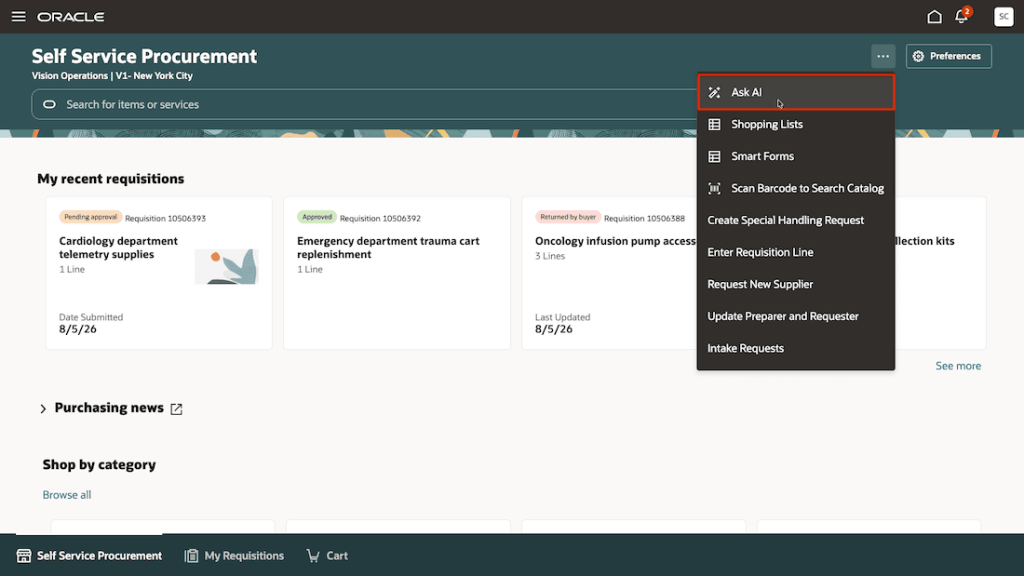
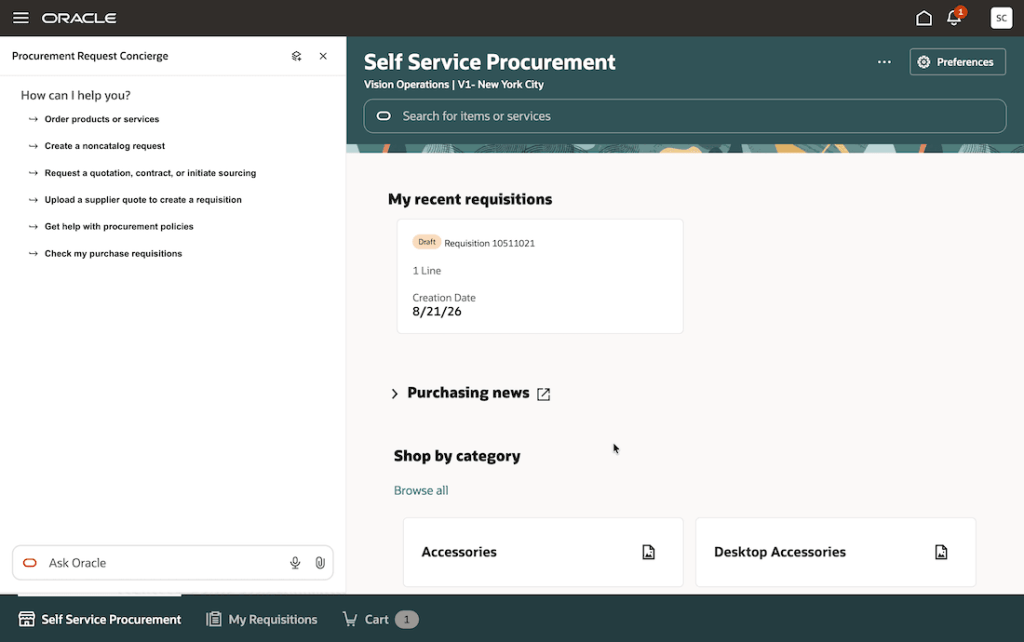
One of my favourite additions in this release is the new Procurement Request Concierge. If you’ve followed Oracle’s investment in AI across HCM, you’ll probably recognise the concept straight away. Rather than expecting users to understand which process they need, Oracle lets them start with a simple conversation.

An employee can describe what they’re trying to achieve and the Concierge works out the most appropriate route. Behind the scenes it might direct them to a catalogue purchase, an intake request, a procurement policy adviser or another specialised procurement assistant. I think this is an important shift.

For years, organisations have invested significant effort in training employees how to use procurement systems. Oracle is increasingly turning that around and teaching the system how to understand employees instead. That may seem like a subtle difference, but it has the potential to improve adoption, reduce incorrect requests and make procurement feel far less intimidating for occasional users.

Oracle has also continued enhancing the Intake Request Creation Assistant. The individual improvements are relatively small, but together they make the experience significantly more natural. The assistant can now understand units of measure, handle currencies more intelligently, capture supporting documents and retain information that doesn’t neatly fit into predefined fields. Oracle has also introduced AI-generated request summaries to help reviewers quickly understand what’s being requested.

What I like about these enhancements is that they’re focused on a real problem: people don’t speak in structured procurement forms. Users naturally describe what they need in their own words. Historically, procurement systems expected employees to translate those requirements into a format the system could understand. Increasingly, Oracle is teaching the system to do the translation instead. That’s exactly how AI should be used. The best AI isn’t always the most visible AI. Sometimes it’s simply the technology that quietly removes the annoying bits of a process.

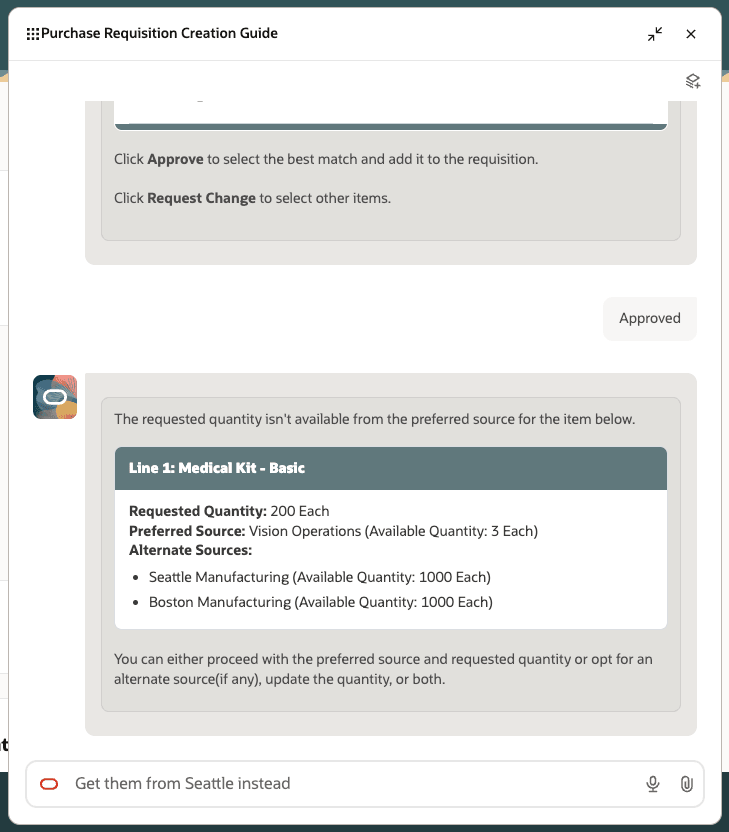
Two enhancements to the Purchase Requisition Creation Guide stood out for me because they address challenges many organisations face every day. The first is multilingual support. For global organisations, English often becomes the default language for business systems, even when it isn’t the first language of many employees. Allowing employees to interact with procurement assistants in their preferred language reduces barriers and makes the technology accessible to a much wider audience.

The second enhancement improves visibility into internal material sourcing. If stock isn’t available from a preferred internal source, requesters can now see alternative sourcing options immediately, rather than discovering availability issues later in the process. Neither feature is particularly flashy. Both are likely to save users frustration. And that’s often a much better measure of success.

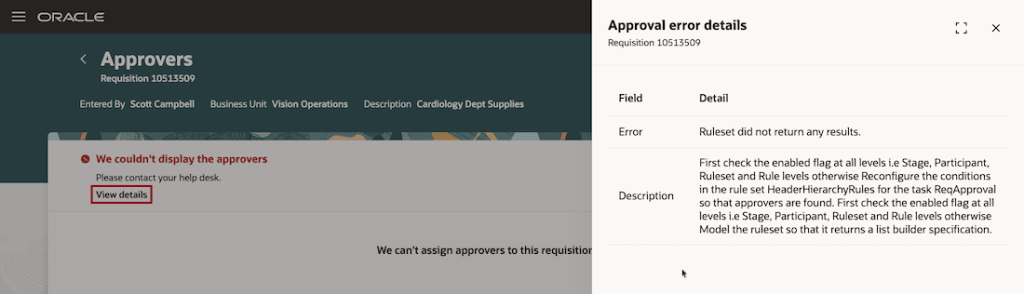
One of the updates that caught my attention has nothing to do with AI. Oracle has improved the way approval errors are communicated to users. Historically, requisitions could sometimes appear stuck with little indication of what had gone wrong. That inevitably leads to support calls, emails and frustration as users try to work out what happened. In 26D, error messages are clearer, more informative and provide better diagnostic information when something goes wrong. Whilst this isn’t ground breaking, improvements like this often have a disproportionate impact on user satisfaction because they address genuine everyday frustrations.

The biggest enhancements in 26D arguably sit within Enterprise Contracts. Both features focus on tasks that have traditionally required substantial manual effort. The first is AI-powered contract ingestion. Many organisations have large collections of contracts sitting in shared drives, document repositories and archive systems. Bringing those contracts into a structured contract management solution has often required significant manual effort and review. Oracle can now use AI to help classify those documents, extract key information and create contract records. If you’re undertaking a contract transformation programme, consolidating legacy systems or simply trying to improve contract visibility, this could significantly reduce the effort involved.

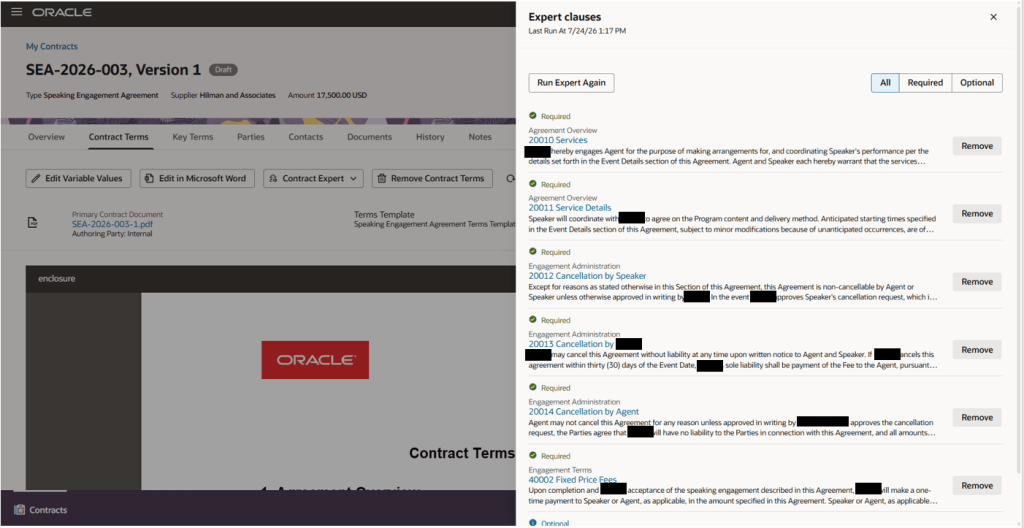
The second enhancement builds on Contract Expert. Rather than relying solely on traditional rules, Oracle can now evaluate contracts against policy guidance and recommend or automatically apply appropriate clauses. For me, the real value isn’t the AI itself. It’s consistency. As organisations grow, maintaining consistent contractual terms becomes increasingly difficult. Features that help ensure the right clauses are included at the right time can improve governance and reduce risk without creating additional work for contract authors. That’s the sort of practical AI adoption I like to see.

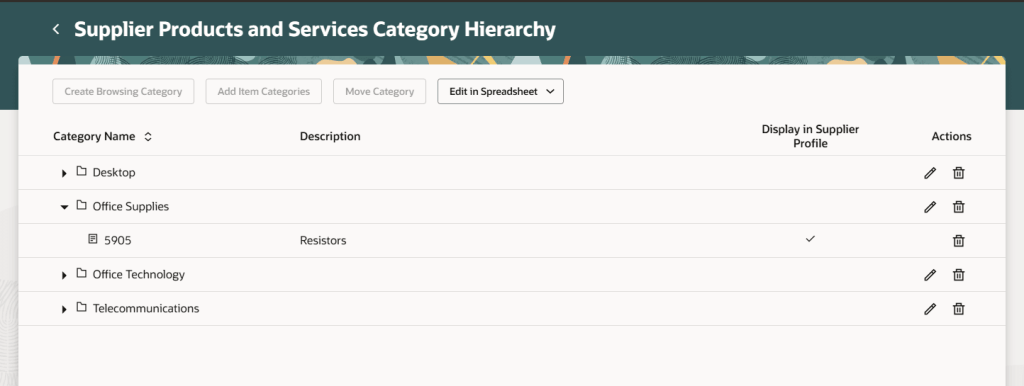
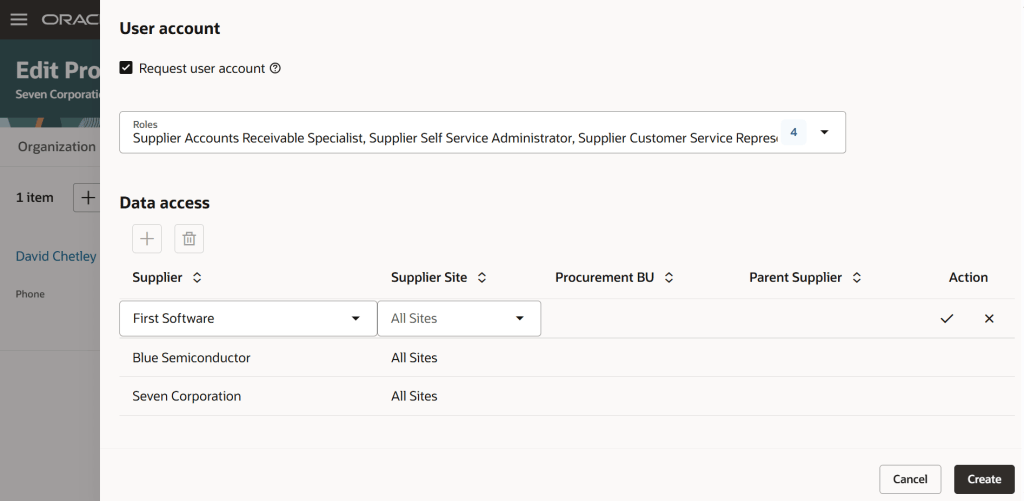
Several of the 26D enhancements focus on suppliers rather than internal users. Supplier contacts can now manage multiple supplier relationships using a single account, reducing the need for multiple logins and simplifying administration. Oracle has also introduced a new Redwood experience for supplier invoicing and payment management, creating a more modern and streamlined interface for suppliers submitting invoices and tracking payments. It’s easy to focus entirely on employee experience when reviewing release notes, but supplier experience matters too. The easier you make it for suppliers to do business with you, the smoother your procurement processes become overall.

Like almost every Oracle release at the moment, 26D also continues the wider Redwood journey. Additional Supplier Management setup pages are now available in Redwood, reducing the need for administrators to move between classic and Redwood experiences. It’s not the biggest story of the release, but it reflects Oracle’s continued progress towards delivering a more consistent user experience across the entire procurement suite.

What I like about Procurement 26D is that Oracle hasn’t tried to solve procurement with a single headline-grabbing feature. Instead, we’re seeing dozens of improvements that make procurement easier for everyone involved. Employees get a simpler starting point. Requesters receive more intelligent guidance. Contract managers gain tools that improve consistency. Suppliers benefit from a more streamlined experience.

Yes, AI is everywhere in this release. But the most valuable features aren’t necessarily the ones shouting about AI. They’re the ones quietly helping people complete tasks faster, make better decisions and spend less time fighting the system. That’s not always the most exciting story. For most procurement teams, though, it’s probably exactly the right one.

Please note all screenshots are the property of Oracle and are used according to their Copyright Guidelines.
Oracle ERP AI Agents in 26D: Less Processing, More Decision Making

If Release 26D tells us anything, it’s that Oracle’s vision for finance is no longer about giving users better screens. It’s about giving them less work to do in the first place. That might sound like marketing speak, but this quarter’s ERP updates genuinely feel different. Across Payables, Payments, Expenses, Billing, Fixed Assets and Budgetary Control, Oracle continues to move beyond AI assistance and deeper into agent-led execution. In many cases, the software isn’t just helping users do the work. It’s identifying issues, recommending actions and increasingly resolving routine tasks on their behalf. The common theme throughout 26D is simple: finance professionals spend less time chasing transactions and more time focusing on decisions that genuinely need human judgement.

If you’ve read any of my previous AI blogs, you’ll know I keep coming back to Payables. That’s because it’s one of the clearest examples of where agentic AI can deliver measurable business value. Invoice processing is still surprisingly manual in many organisations. Someone uploads an invoice, someone investigates an exception, someone releases a hold, and someone else spends time trying to understand why the same issue keeps appearing month after month. Oracle is steadily removing those touchpoints.

The Payables Agent now supports more of the invoice lifecycle than ever before. Invoice ingestion has been enhanced with broader document support and improved integration options, making it easier to bring invoices into Oracle regardless of the format or source system. For organisations dealing with different supplier standards, languages and document types, that’s a practical improvement that should reduce manual effort from day one.

The feature that stood out most to me, however, is Actionable Insights. Rather than finance teams having to trawl through reports looking for recurring issues, Oracle now highlights patterns automatically. If users are repeatedly overriding exceptions or releasing holds without addressing the root cause, the system identifies the behaviour and recommends corrective action. This is where AI starts becoming genuinely useful. Rather than simply helping users process invoices faster, it helps organisations understand why problems occur in the first place.

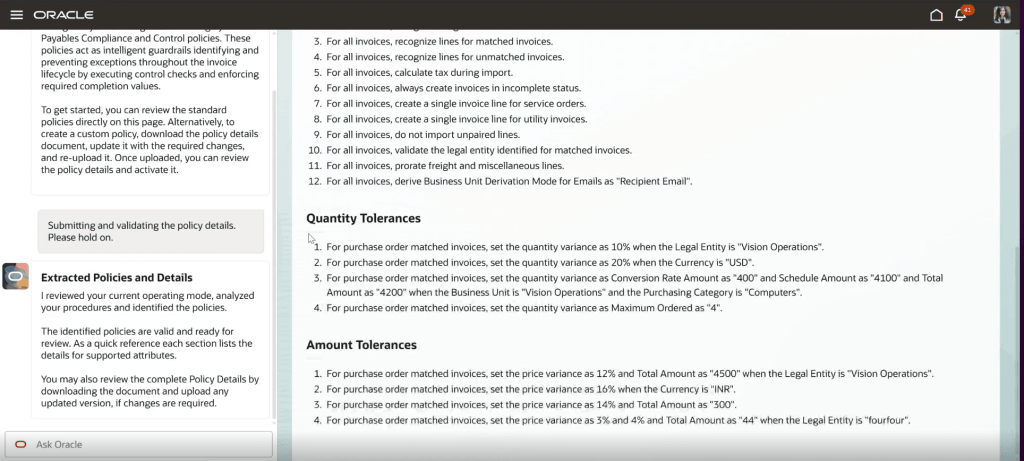
Oracle has also expanded automated exception resolution, allowing more invoice import errors to be addressed through predefined resolution paths rather than manual intervention. Combined with enhanced matching controls and business-specific tolerance rules, organisations have more flexibility to reduce unnecessary holds while still maintaining appropriate financial controls.

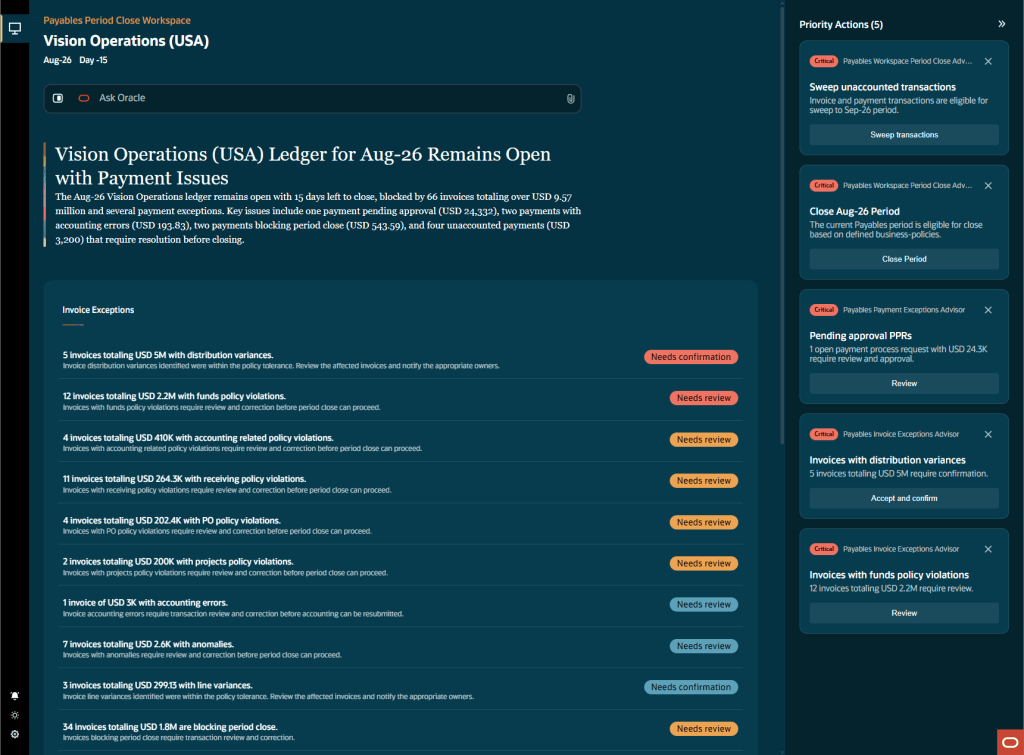
Another welcome addition is the new Payables Period Close Workspace. Month-end close is often less about processing transactions and more about coordinating people. Teams spend significant time identifying what still needs attention, chasing outstanding items and managing exceptions across multiple reports and spreadsheets. Oracle now brings those activities together into a single workspace that highlights priority actions, identifies high-value exceptions and guides users through the close process. For customers still relying on spreadsheets, email chains and manual status updates during close, this could make a significant difference.

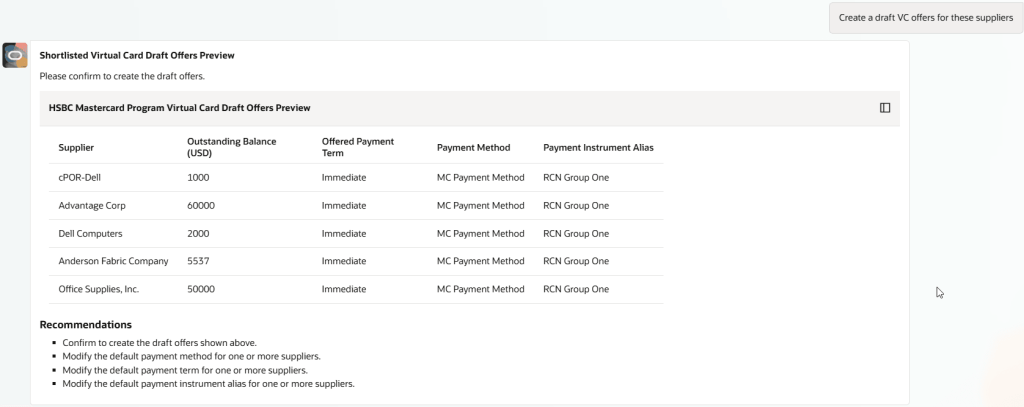
One of the criticisms I’ve had of some early AI assistants is that they often stop at telling users what they should do next. That’s useful, but it’s only half the journey. In 26D, Oracle is starting to close that gap. The Payments Agent can now support activities such as virtual card offers, dynamic discounting and supply chain financing, allowing payment specialists to move from opportunity identification into execution within the same experience.

What I find particularly interesting is Oracle’s focus on working capital optimisation. Rather than treating financing options as separate initiatives, the platform can compare multiple strategies and help users determine which approach is most appropriate for a particular supplier or payment population.

There’s also a practical enhancement that many finance teams will probably value more than the headline AI announcements. When payment processes fail, the agent can now explain the issue in business language and recommend a course of action. Anyone who has spent time trying to decipher technical process logs during a payment run will understand the value of that immediately.

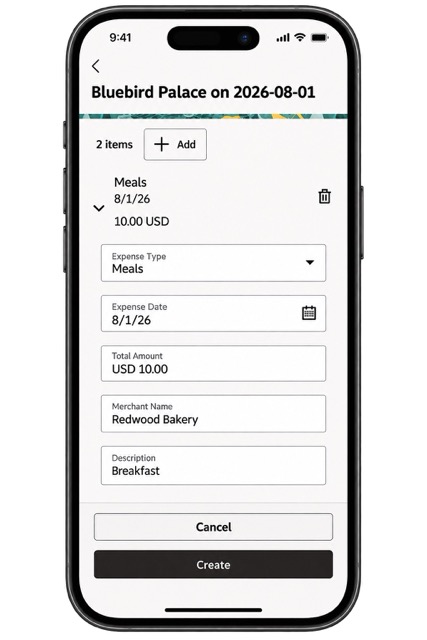
Let’s be honest. Expense management isn’t usually anyone’s favourite process. It’s one of those areas where frustration tends to come from lots of small inefficiencies rather than one major issue. Missing receipts, incomplete itemisation, attendee information, rejected claims and lengthy approval cycles all add up. Oracle is tackling several of those issues in 26D.

The Expenses Agent can now collect missing itemisation and attendee details through email interactions, allowing employees to provide information using natural language rather than navigating back into the application. That may sound like a small change, but anyone involved in expense administration knows that itemised expenses and entertainment claims often generate disproportionate amounts of back-and-forth communication. Capturing that information before the approval process begins should reduce delays and improve approval cycle times.

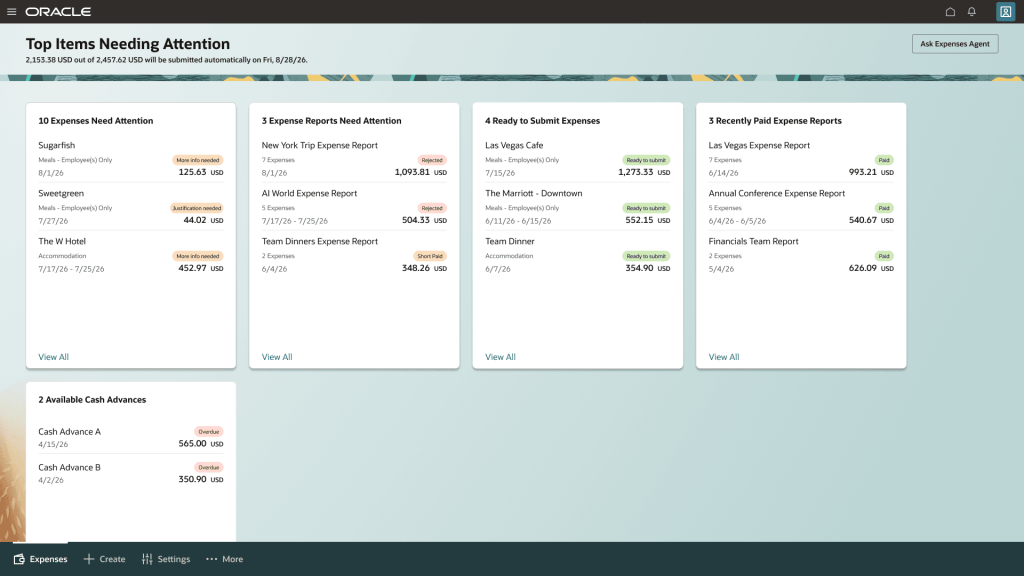
The new Expenses landing page is another welcome addition. Employees and delegates now have a single view showing reports requiring attention, reports ready for submission, recent payments and other key activities. For delegates managing expenses on behalf of multiple employees, this is particularly useful. Instead of jumping between multiple users and screens, they can manage activity from a single location and quickly identify where action is required. Oracle has already confirmed this will become the default experience in 27B, so now is probably a good time for organisations to start evaluating it.

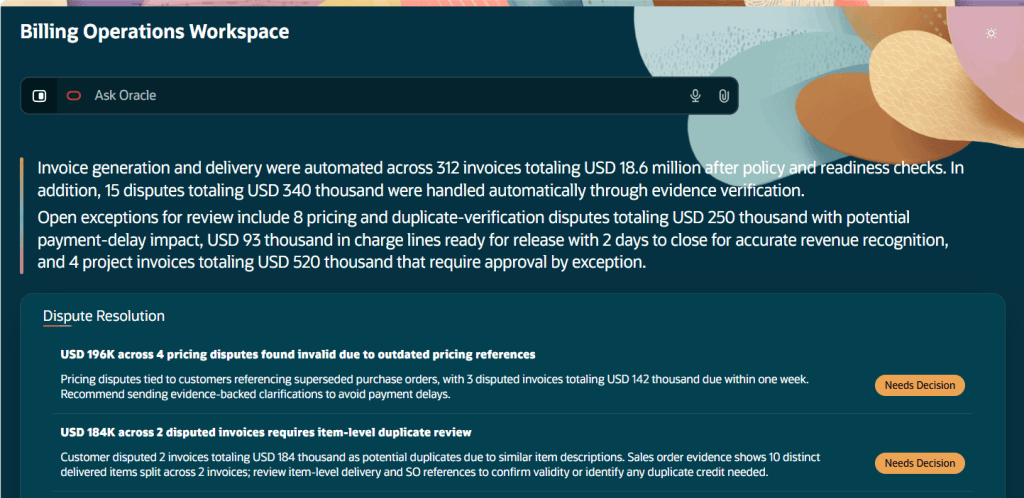
If there is one release area that genuinely feels different, it’s Billing. The new Billing Operations Workspace isn’t simply another dashboard. It’s built around the idea that agents should continuously perform routine work, while people focus on exceptions and decisions. The workspace covers project billing readiness, invoice generation and dispute resolution.

On the project billing side, the agent monitors overdue approvals, sends reminders and escalations according to defined procedures and identifies billing issues before they become month-end surprises. It can even update existing draft invoices when held transactions are released, eliminating manual rework that many project accounting teams know all too well.

For invoice generation and delivery, the agent handles qualifying activities automatically and surfaces only those situations requiring human review. Dispute management follows a similar pattern. Customer billing queries received by email can be converted into disputes, assessed by the agent and, where appropriate, resolved automatically or routed for review with supporting evidence. This is probably one of the strongest examples in 26D of Oracle’s broader vision for agent-led business processes.

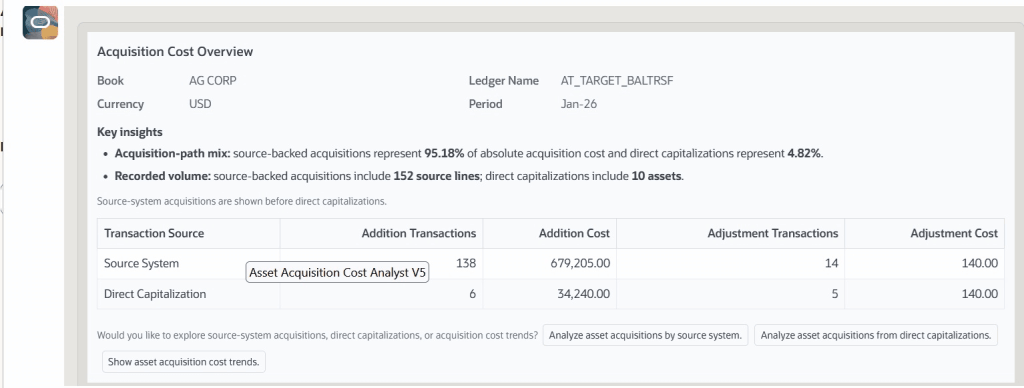
Fixed Assets rarely gets the same attention as Payables, Procurement or Financials, but Oracle has introduced several genuinely useful assistants in this area. New capabilities support asset additions, depreciation forecasting, acquisition cost analysis and capital expenditure planning. What’s interesting is that Oracle hasn’t focused on flashy demonstrations here. Instead, the emphasis is on reducing spreadsheet dependency.

The Asset Additions Assistant helps users create assets through a guided conversational experience. The Depreciation Projection Assistant provides on-demand forecasting from live data. Additional tools analyse acquisition costs and support capital expenditure planning activities. None of these capabilities are likely to dominate conversations, but they address real activities that finance teams perform every month. In my experience, that’s often where the biggest productivity gains come from.

The Budget Adjustment Assistant first appeared in 26C, but Oracle has continued to build on it in 26D. The most significant enhancement is policy validation. Budget transfers can now be validated against organisational policies before they enter the approval process, helping prevent invalid adjustments from progressing and creating unnecessary rework.

When validation issues are identified, the assistant explains the issue in plain language and provides guidance on how to resolve it. The approval process and audit trail are managed as part of the overall workflow. It’s worth noting that this enhanced capability is currently available through a controlled release, so customers interested in evaluating it will need to engage Oracle Support.

When Oracle first started talking about AI agents, I think many customers wondered whether they would be genuinely useful or simply another layer on top of existing processes. Release 26D provides some of the clearest evidence yet that Oracle is serious about changing how finance work gets done.

What stands out isn’t any single feature. It’s the number of areas where Oracle is systematically removing repetitive effort. Whether that’s invoice exceptions, payment investigations, expense administration, billing disputes, fixed asset analysis or budget adjustments, the goal is increasingly the same: let the system handle routine work and focus human attention where it adds the most value.

We’re still some distance away from a fully autonomous finance function, and frankly I don’t think most organisations would want that anyway. But we are moving closer to a world where finance professionals spend less time moving transactions between stages and more time applying judgement, managing risk and supporting the business. For me, that’s where the real value of AI sits. Not replacing finance teams, but helping them spend more time doing the work only they can do.

Oracle regularly introduces additional functionality throughout the quarter, so it’s worth keeping an eye on the What’s New documentation as Release 26D progresses. If any significant new ERP capabilities appear, I’ll be sure to cover them in a future update.

Please note all screenshots are the property of Oracle and are used in accordance with Oracle’s Copyright Guidelines.
Oracle Fusion Cloud 26D: Common Features Gets More Practical

When Oracle publishes its quarterly updates, most people head straight for HCM, ERP, Payroll or Learning. Common Features is usually the section that gets less attention. That’s understandable. Historically, it’s often been home to the more technical platform updates that only administrators and implementation teams get excited about. But every now and then a release comes along where the Common Features updates deserve a closer look. 26D is one of those releases.

This quarter brings a mixture of Redwood enhancements and AI Agent Studio improvements that focus less on flashy new functionality and more on solving some of the challenges organisations face when running Oracle Fusion at scale. Supportability, governance, testing, deployment, cost control and communication may not sound particularly exciting, but they’re often the difference between a successful implementation and a frustrating one.

Redwood has been Oracle’s strategic user experience for several years now, and most customers are either well into their migration journey or actively planning it. What caught my attention in 26D is that Oracle is continuing to address some of the operational gaps customers have identified along the way.

Organisations spend a lot of time trying to communicate important information to employees and managers. The problem is that emails get ignored, intranet posts go unread, and people rarely look in the places you’d like them to. Oracle’s answer in 26D is the introduction of contextual announcement banners for Redwood pages. Rather than displaying generic messages everywhere, organisations can now surface targeted information directly within specific business processes. Think payroll cut-off reminders, compliance notices, legislative updates, planned maintenance notifications or guidance for a particular transaction.

The real value here isn’t the banner itself. It’s the fact that the message can be contextual. You can display information when and where it’s actually relevant, rather than hoping users remember something they read in an email three weeks ago. For organisations operating across multiple countries or regulatory environments, this could become a simple but effective way to ensure users see the right information at the right time.

This is probably my favourite Redwood update in 26D: Built-In Issue Recording For Redwood Pages. Anyone who has ever raised a Service Request with Oracle knows the conversation often starts with exactly the same question: “Can you provide a recording of the issue?” Until now, that has usually meant reaching for external screen recording software, capturing screenshots, writing detailed reproduction steps and then trying to explain what the problem actually looks like. 26D makes that process much simpler.

Users can now record issues directly from Redwood pages and generate a recording identifier that can be attached to support requests. It isn’t a flashy feature. But it is exactly the sort of practical improvement that customers appreciate because it makes everyday support processes easier. Faster evidence gathering means faster diagnosis. Faster diagnosis means faster resolution. If you’re currently rolling out Redwood or supporting a large user community, this is one of those features you’ll probably start using immediately. It’s also worth noting that access is controlled through specific security privileges, so administrators will need to review role assignments before making the capability available to broader user groups.

I’ve written quite a few blogs about Oracle AI Agent Studio over the last year, and one thing has become increasingly clear. Oracle is moving beyond the “look what AI can do” phase and focusing on what organisations actually need to deploy AI responsibly and at scale. That’s exactly what we see in 26D. Rather than introducing lots of new AI capabilities, Oracle has concentrated on governance, testing, deployment controls and operational management. Frankly, that’s where the focus should be.

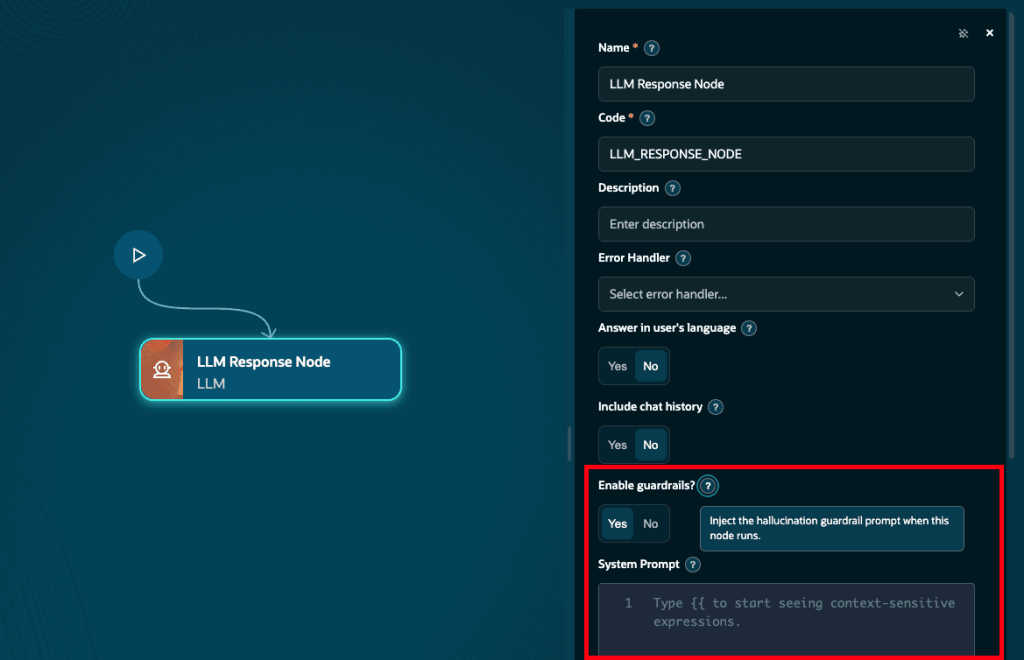
One of the biggest concerns organisations have when introducing AI is maintaining control over responses. Oracle has introduced prebuilt guardrails that can be applied to large language model workflow nodes within AI Agent Studio. The purpose is straightforward. Help keep responses grounded in approved enterprise content and reduce the risk of agents wandering into irrelevant, unsafe or inappropriate territory.

Let’s be clear: guardrails are not a silver bullet. They won’t eliminate every AI risk and they don’t replace broader governance controls. What they do provide is an additional layer of protection inside the workflow itself. For organisations looking at production AI deployments, that’s an important step forward. It is also encouraging to see Oracle making the guardrail instructions visible within debugging tools. Transparency is becoming increasingly important as organisations seek confidence in how AI agents are making decisions and generating responses.

Another welcome enhancement is greater control over model selection. Different models excel at different tasks. Some prioritise speed and efficiency, while others deliver stronger reasoning capabilities but at a higher cost. Until recently, model selection was often treated as a platform decision. Oracle is now giving organisations more flexibility to choose the model that best fits each use case. What I particularly like is the introduction of model lifecycle visibility.

The platform now flags deprecated models, helping organisations identify affected workflows before support is withdrawn. That might sound like a small change, but it removes the risk of discovering a model retirement after it’s already impacted a production process. Anyone responsible for AI governance will appreciate that level of visibility.

One of the challenges many organisations face with AI is that it often sits outside their established development lifecycle. Applications have deployment processes. Integrations have deployment processes. Reports have deployment processes. AI solutions frequently end up managed separately. 26D begins to change that.

Oracle has introduced CI/CD integration for AI Agent Studio workflows and applications, allowing organisations to incorporate AI artefacts into the same controlled release processes they already use elsewhere. For enterprise customers, this matters far more than a shiny new AI feature. It means AI development can follow the same approval processes, audit controls and change management practices as every other critical component within the Oracle landscape. That is exactly what many governance teams have been asking for.

If you’ve spoken to colleagues about AI over the last year, you’ll know that the conversation quickly moves beyond capabilities. Eventually someone asks: “How much is this going to cost?” That’s why I think AI budget management could prove to be one of the most important additions in this release.

Organisations can now allocate AI unit budgets, monitor consumption, set warning thresholds and automatically stop activity when budgets are exhausted. What this really delivers is visibility. Finance teams gain insight into usage patterns. IT teams gain operational control. Business leaders gain confidence that AI spending won’t suddenly spiral beyond expectations. As organisations move from pilot projects into large-scale adoption, this kind of governance capability becomes essential.

If I had to choose the single most important AI Agent Studio enhancement in 26D, it would be ATLAS. Traditional software testing is relatively straightforward. Given the same input, you expect the same output every time. AI doesn’t work like that. Testing AI systems has always been significantly more complex because quality can’t always be measured through traditional pass-or-fail criteria.

ATLAS gives organisations a structured framework for testing, validating and comparing AI workflows before they reach production. Teams can replay scenarios, validate expected workflow routes, measure quality, compare models and identify issues before users ever see them. That may not sound exciting. For organisations deploying AI into business-critical processes, it’s huge.

Good governance isn’t just about controlling access or managing budgets. It’s about ensuring solutions perform consistently and predictably. ATLAS helps bring that discipline to AI Agent Studio. Honestly, this feels like one of the strongest signals yet that Oracle is serious about supporting enterprise-grade AI adoption rather than simply delivering AI features.

Common Features may not be the first section of the release notes you read, but there is a surprising amount of value packed into 26D. The Redwood updates focus on solving real-world operational challenges. Contextual communications help organisations reach users more effectively, while built-in issue recording should make support processes noticeably smoother.

The AI Agent Studio enhancements are arguably even more significant. Oracle is investing heavily in the less glamorous side of AI; governance, testing, cost management, lifecycle control and deployment processes. Those capabilities might not generate headlines, but they’re exactly what organisations need before they can confidently scale AI across the business. None of these updates are likely to be described as revolutionary. But together they make Oracle Fusion easier to govern, easier to support and easier to scale. And in many organisations, that’s exactly the kind of innovation that delivers the greatest value.

Please note all screenshots are the property of Oracle and are used in accordance with Oracle’s copyright guidelines.
Provide your feedback on BizChat