
Whenever I speak to customers about AI, the conversation often follows a familiar pattern. We start by discussing possibilities. We explore use cases. We talk about the potential benefits. We look at how AI might streamline processes, surface insights or improve decision making. Then, sooner or later, somebody asks the question that matters most. “How do we know we can trust it?” It’s a fair question.
In fact, I would argue it’s the question organisations should be asking before they worry about models, prompts or agents. Because whilst intelligent systems can generate excitement, trust is what determines whether they ever make it into production.
Over the past few years, we’ve seen organisations experiment extensively with AI. Many have built prototypes. Others have run proofs of concept or adopted individual AI-powered features. The challenge isn’t generating interest. The challenge is moving from experimentation to everyday business use. That’s where Oracle’s approach to AI Agent Studio becomes particularly interesting.
The more time I spend exploring the platform, the more convinced I am that Oracle’s biggest investment isn’t in creating more intelligent agents. It’s in creating an environment where organisations can trust those agents to operate safely, consistently and responsibly. Trust, governance and enterprise controls are built into the platform from the outset rather than being treated as optional extras.
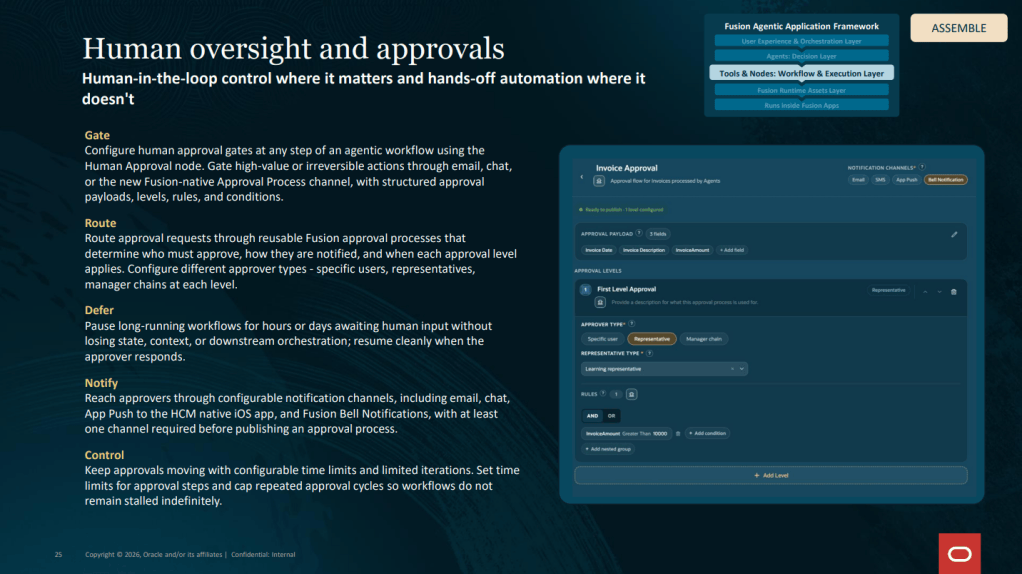
One of the misconceptions surrounding AI is that success means removing people from the process entirely. Personally, I don’t think that’s what most organisations want. There are certainly activities that can be automated. Administrative tasks, repetitive actions and routine processes are all obvious candidates. But many business decisions still require accountability, judgement and context. Approving a significant payment. Making a hiring decision. Authorising a contract change. Managing a supplier dispute. These are decisions people are expected to own.
Oracle’s Human Approval capability reflects that reality by allowing approval stages to be introduced directly into agentic workflows. Approvals can be routed through established business processes, delivered through multiple notification channels and paused until a decision has been made. Once approval is received, the workflow can continue without losing context or progress.
I see this less as a restriction and more as a confidence-building mechanism. The goal isn’t to remove people. The goal is to ensure people focus on the decisions that genuinely require human judgement whilst allowing automation to handle everything else. That’s a much more realistic vision of enterprise AI.
One of the challenges with generative AI is that it isn’t designed to be deterministic. Ask a large language model to summarise a document and you may receive slightly different wording each time. That’s perfectly acceptable in many situations. But not all business decisions fall into that category.
There are areas where organisations expect exactly the same answer every time. Benefits eligibility. Compensation calculations. Compliance rules. Financial policies. Contractual obligations. These are not decisions where approximation is acceptable.
This is where Oracle’s Policy Models become particularly interesting. Rather than relying solely on AI reasoning, organisations can define policies that execute as deterministic functions. These policies can be generated from business documents, validated through testing and reused across multiple workflows, helping ensure critical business rules are applied consistently.
I think this is one of the most important capabilities within AI Agent Studio. Not because it’s particularly exciting. But because it addresses one of the biggest concerns organisations have about AI. Consistency. Most business leaders are comfortable allowing AI to generate recommendations. They’re far less comfortable allowing AI to interpret policy differently from one situation to the next. Policy Models create a clear separation between reasoning and rules. The AI can help understand the situation. The policy ensures the organisation’s rules are applied correctly.
If there’s one theme that runs through almost every successful technology implementation I’ve experienced, it’s predictability. People trust systems when they understand how they behave. They trust systems when outcomes are consistent. And they trust systems when they know there are controls in place if something goes wrong. That’s why I find Oracle’s approach to approvals and policy enforcement so interesting.
Together, they acknowledge a simple reality: not every decision should be automated, and not every decision should rely entirely on AI. Some decisions benefit from human judgement. Some decisions require strict adherence to business rules. The most effective enterprise AI environments understand the difference.
Rather than forcing organisations to choose between complete automation and complete human control, Oracle appears to be creating a middle ground where AI can assist, recommend and accelerate, whilst governance mechanisms ensure oversight remains where it’s needed. For many organisations, I suspect this balance will prove critical to adoption.
When conversations about AI take place in boardrooms, they’re rarely centred around prompts, models or workflows. They’re centred around risk. Can we trust the recommendations? Can we explain the decisions? Can we maintain control? Can we govern the process? These questions are entirely reasonable. In fact, they’re probably more important than the technology itself. An incredibly intelligent system that nobody trusts will never deliver value.
A well-governed system that people are confident using can transform the way decisions are made. That’s why I think human oversight and deterministic controls deserve more attention than they’re often given. They’re not barriers to innovation. They’re enablers of adoption.
As organisations continue moving from AI experimentation to AI deployment, I believe we’ll see increasing focus on trust alongside intelligence. The organisations that gain the greatest value from AI won’t necessarily be those with the most advanced models. They’ll be the ones that strike the right balance between automation, governance and human judgement. Because ultimately, enterprise AI isn’t really about replacing decisions. It’s about helping people make better ones.
In the next article, I’ll look at another essential piece of the puzzle: how organisations can test, validate and secure AI solutions before they reach production, and why capabilities such as simulation, debugging, auditability and governance may prove just as important as the intelligence itself.
Please note that all screenshots are the property of Oracle and are used in accordance with Oracle’s Copyright Guidelines.

 K8 Mead