
Oracle continues to reshape the HCM user experience, and one of the most significant innovations arriving in Release 26C might not be getting the attention it deserves. The new HCM Professional Activity Centre brings together worker search, employee information, HR transactions and AI-powered assistance into a single workspace designed specifically for HR professionals.
At first glance, it looks like another Redwood-enhanced page. In reality, it represents something much bigger. For years, Person Management has been the starting point for most HR administration activities within Oracle Fusion HCM. Whether updating assignments, reviewing employment information or managing employee records, HR teams have become accustomed to navigating in and out of multiple pages to get their work done.
The HCM Professional Activity Centre changes that approach completely. More importantly, Oracle has confirmed that Person Management will eventually be decommissioned, with the new Activity Centre becoming the strategic destination moving forward. While the retirement date is not yet immediate, organisations that rely heavily on Person Management should see 26C as an opportunity to start preparing for the future.
One of the biggest frustrations for HR teams is context switching. A typical HR task might involve searching for an employee, reviewing employment details, checking absence history, viewing compensation information and then processing a transaction. Individually these tasks are simple, but moving between multiple pages and menus can quickly become inefficient.
The HCM Professional Activity Centre brings these activities together into a single experience. Users can search for workers, review key information and launch transactions without continually navigating around the application. The result is a more streamlined way of working that keeps HR professionals focused on the employee rather than the system.
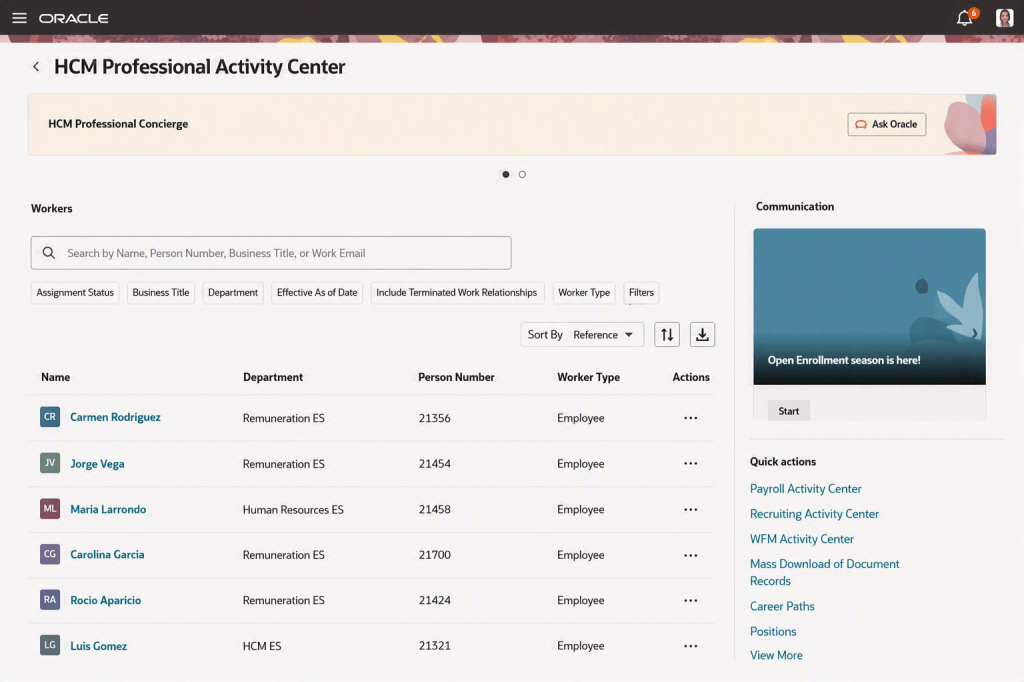
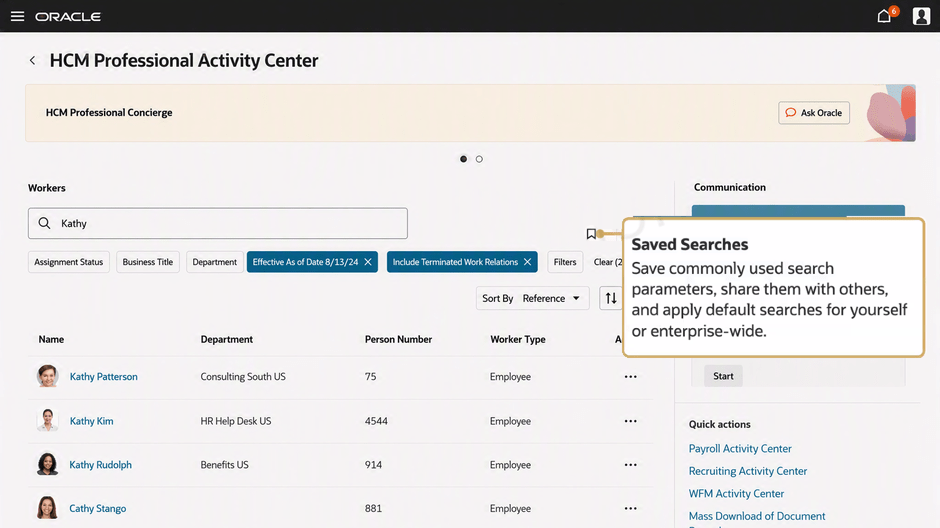
The first thing many users will notice is the search experience. Oracle has introduced a flexible worker search capability that supports names, person numbers, business titles and email addresses. It also includes fuzzy search functionality, making it far more forgiving when users do not enter exact values. For organisations with large workforces, this can remove a surprising amount of frustration from everyday HR administration.
Filters can be saved, shared and reused, allowing teams to create views tailored to particular business units, countries or employee populations. Search results are also configurable, ensuring users only see the information most relevant to their role. If required, results can be exported directly to Excel for further analysis or sharing. While these may appear to be small enhancements, they can significantly reduce the time spent performing routine HR activities.
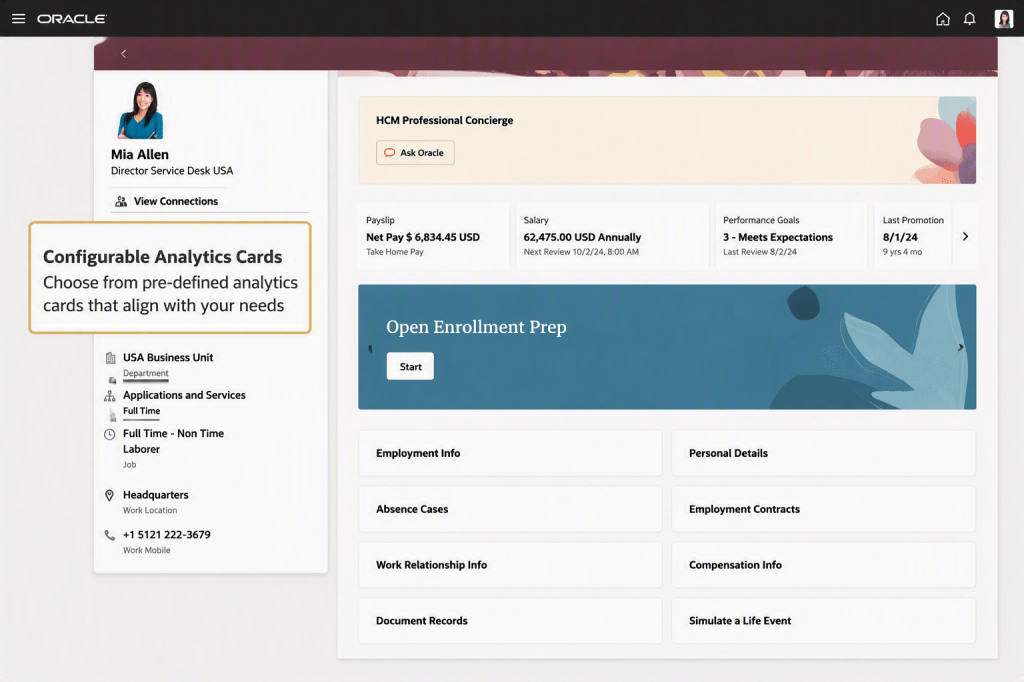
Once a worker has been selected, the real strength of the Activity Centre becomes apparent. Rather than opening separate pages for different areas of employee information, HR professionals are presented with a unified worker profile that consolidates key data in a single location. Employment details, absence information, compensation data, benefits and document records are all readily accessible, alongside a timeline view that helps users understand an employee’s history and changes over time.
Oracle has also introduced configurable insight cards, enabling organisations to surface the information most relevant to their HR processes. This could include salary information, performance ratings, recent promotions or other workforce metrics. The focus is clearly on helping HR teams access information faster and make decisions with greater confidence.
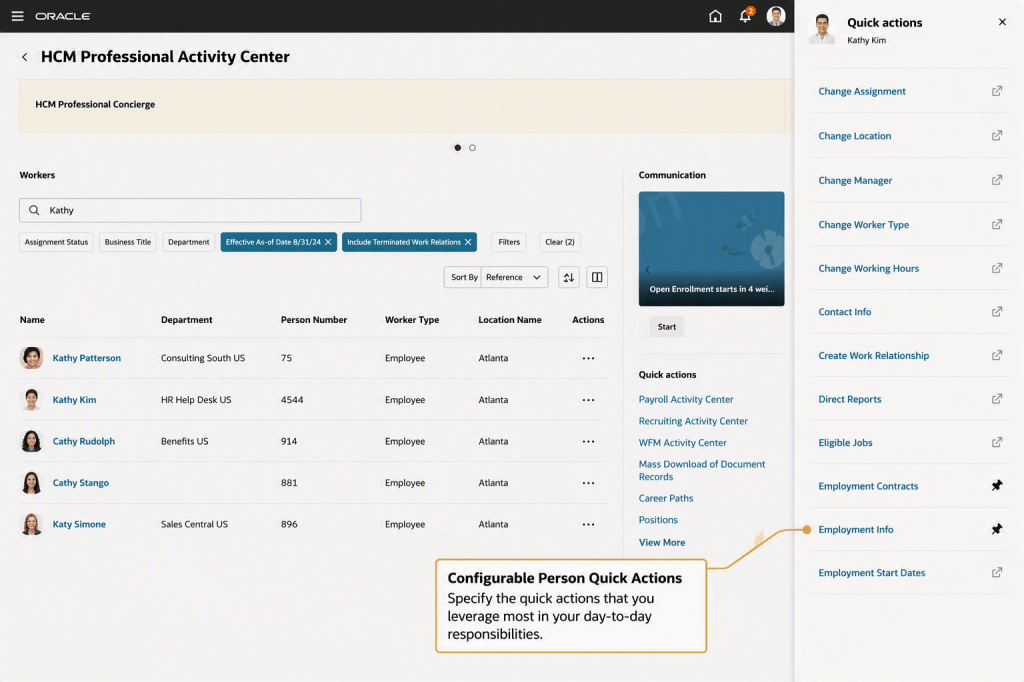
A key theme throughout the Activity Centre is reducing unnecessary navigation. HR users can initiate transactions directly from the worker profile or search results, allowing them to move seamlessly from reviewing information to taking action. Common tasks such as assignment changes, location updates and salary changes can be accessed through configurable quick actions, helping teams complete work more efficiently.
The Activity Centre also provides fast access to related workspaces such as Payroll, Recruiting and Workforce Management, creating a connected experience across Oracle HCM. The ability to open worker records in separate browser tabs may sound like a small enhancement, but anyone managing multiple cases simultaneously will appreciate the flexibility it brings. Taken together, these improvements create a more intuitive and productive way of working for HR teams.
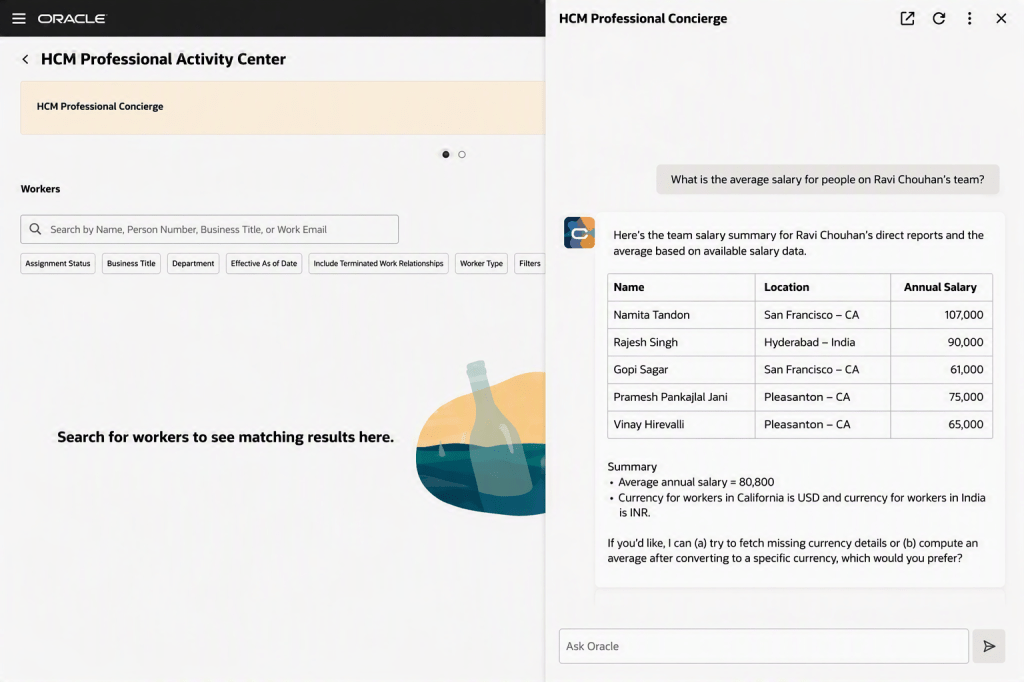
While the redesigned workspace is impressive, the most significant aspect of this announcement is what sits behind it. Oracle has embedded the new HCM Professional Concierge directly into the experience. Rather than searching through reports or navigating to analytics dashboards, HR professionals can ask questions in natural language and receive answers drawn directly from live HCM data.
Need to understand salary distribution within a team? Investigate performance ratings? Review an employee’s employment history? The Concierge can provide answers in seconds while respecting existing security roles and access controls. What makes this particularly interesting is that users can ask follow-up questions and continue the conversation naturally, without needing to start over or navigate elsewhere in the application.
Oracle has also made the Concierge available through Microsoft Teams, allowing HR professionals to access HCM insights from the collaboration tools they already use every day. This feels less like a traditional reporting tool and more like the beginning of a genuinely AI-assisted HR operating model.
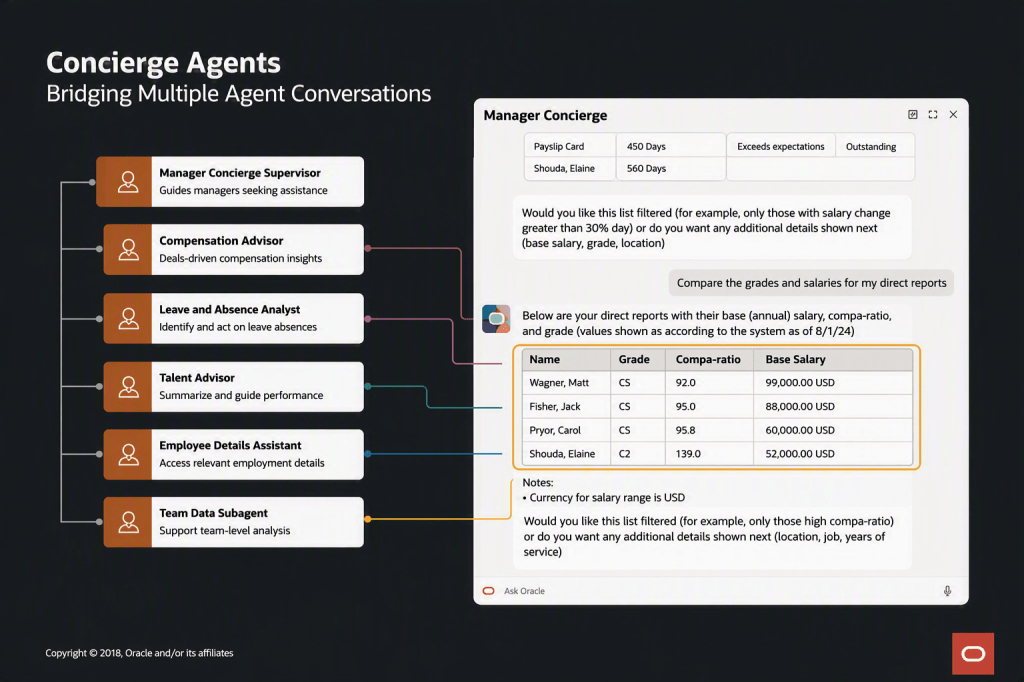
What’s particularly interesting is how Oracle has structured the solution behind the scenes. The Concierge does not rely on a single AI assistant. Instead, it orchestrates a collection of specialist agents covering areas such as compensation, absence management, reporting, employment information and HR policies. Users do not need to know which agent is responding. They simply ask a question and Oracle routes the request to the most appropriate specialist automatically.
This architecture mirrors Oracle’s wider strategy for agentic applications, where specialist AI agents collaborate behind the scenes to solve increasingly complex business problems.
The practical outcome is that HR professionals can ask richer, more contextual questions and receive consolidated answers without manually gathering information from multiple sources. For users, the technology behind the scenes matters less than the outcome: faster answers, less effort and easier access to information when it is needed.
The HCM Professional Activity Centre is not simply a replacement for Person Management. It is the foundation for a broader vision where AI does not just answer questions but actively assists HR professionals by identifying risks, surfacing recommendations and helping prioritise actions.
Future experiences such as the HR Specialist Workspace build on this concept by proactively highlighting compliance concerns, attrition risks and organisational changes that may require attention. Rather than spending time searching for information, HR teams can focus on decision-making, employee engagement and strategic workforce planning. That’s a subtle but significant shift.
It also provides a clear indication of Oracle’s direction of travel. Future innovation is increasingly centred around unified workspaces, AI-driven insights and agentic experiences rather than traditional menu-driven administration.

The HCM Professional Activity Centre is far more than a new page in Oracle Fusion HCM. It represents a significant shift in how Oracle is bringing together employee information, HR transactions, analytics and AI into a single, unified experience.
For HR professionals, the immediate benefits are easy to see. Less navigation, faster access to information, more intuitive search capabilities and the ability to complete common tasks without moving between multiple pages all have the potential to make day-to-day administration more efficient.
However, the bigger story is what this tells us about Oracle’s direction of travel. The introduction of the HCM Professional Concierge, the use of specialist AI agents and the roadmap towards proactive, agent-driven workspaces suggest Oracle is moving beyond simply modernising screens. The focus is increasingly on helping HR professionals find information, make decisions and take action more effectively.
The planned retirement of Person Management reinforces that message. While many organisations will continue to use Person Management for some time, the HCM Professional Activity Centre is clearly where Oracle is concentrating future investment and innovation.
If you’re preparing for Release 26C, this is certainly a feature worth exploring. Even if you’re not planning an immediate move away from Person Management, taking the time to understand how the Activity Centre works and how it fits into Oracle’s wider HCM strategy will help you prepare for what’s coming next.
For me, this is one of the most important HCM enhancements in 26C. Not because of any single feature, but because it provides perhaps the clearest view yet of how Oracle expects HR professionals to interact with Fusion HCM in the years ahead.
Please note that all screenshots are the property of Oracle and are used in accordance with Oracle’s Copyright Guidelines.


