
When Oracle talks about the future of touchless Accounts Payable, most of the attention naturally goes to AI-powered invoice processing, anomaly detection and automation. What I’m finding in customer conversations, though, is that the first questions are rarely about functionality. They’re usually much more practical.
Is Payables Agent included in my existing licence? Do I need additional subscriptions for Document IO? Will this consume AI Units? How do I secure it? And how will all of this fit alongside the Agentic Apps Oracle keeps talking about?
The answers aren’t always obvious, particularly now that Oracle has introduced Document IO, Compliance and Control, new Redwood experiences and an expanding portfolio of AI services. In this article, I’ll walk through the areas that seem to generate the most confusion and explain what customers should understand before they start implementing Payables Agent.
One of the biggest misconceptions is that Payables Agent is somehow the same thing as Oracle’s broader Agentic AI strategy. It isn’t. Payables Agent is focused on invoice processing. Its purpose is to extract information from invoices, identify exceptions, apply controls and help AP teams move towards exception-based processing. The Agentic Apps Oracle has been demonstrating are designed to tackle a different problem, helping users make decisions and drive business outcomes rather than simply automating transaction processing.
That distinction matters because customers are often concerned that adopting Payables Agent today could mean investing in something that will soon be replaced. Oracle’s messaging has been fairly consistent here. Payables Agent remains part of the Fusion roadmap and sits alongside, rather than underneath, the broader Agentic Apps strategy.
The second area that causes confusion is Document IO. For organisations using invoice imaging, Document IO is now the default invoice recognition engine. The functionality itself is straightforward enough, but the licensing position is something worth validating before implementation begins.
I’ve already seen customers assume that because Payables Agent is part of their Fusion estate, everything associated with invoice recognition must be included too. That isn’t necessarily the case. Depending on your commercial arrangement and the services you’re using, additional subscriptions may be required for document recognition and imaging workloads.
My advice is simple: don’t leave this conversation until go-live. Confirm your position early, particularly if PDF invoice processing forms a significant part of your AP operation. It’s much easier to address licensing questions during design than during deployment.
Whenever Oracle introduces a new AI capability, the next question is almost always about consumption and cost. The good news is that Payables Agent isn’t currently positioned as a major AI Unit consumer. Document IO and invoice processing use Oracle’s basic AI capabilities rather than the enhanced models that drive some of Oracle’s more advanced AI services.
That’s reassuring for customers who are trying to understand and manage AI Unit consumption across multiple Fusion modules. However, Oracle’s licensing documentation continues to evolve, so it remains important to validate assumptions against the current service descriptions rather than relying on historic guidance.
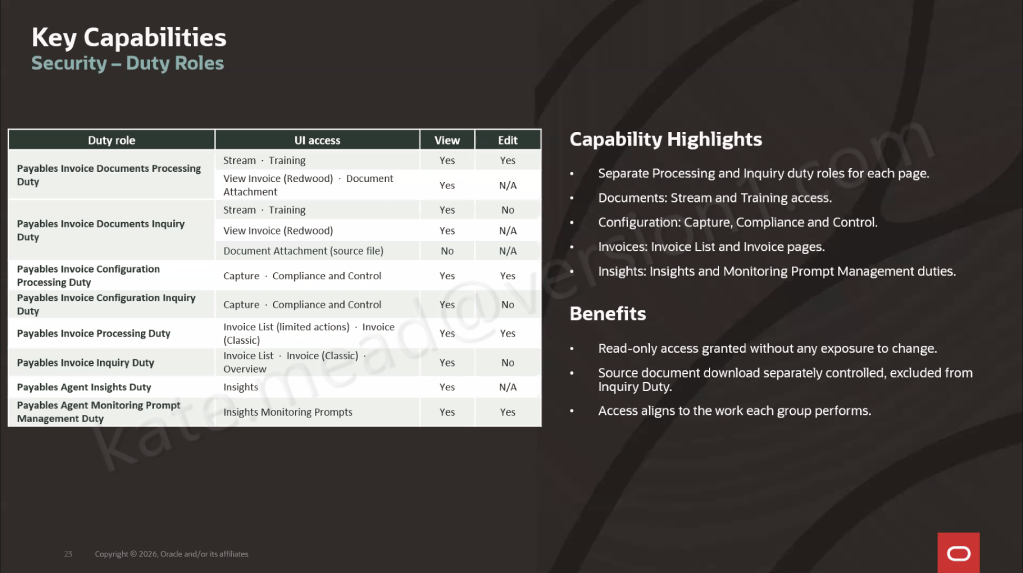
The most successful implementations I’ve seen tend to treat security as a design activity rather than a technical task completed at the end of a project. Payables Agent introduces new capabilities around document training, compliance configuration, exception management and operational monitoring. Not every user should have access to all of those functions.
For example, the people responsible for training document extraction models may not be the same people who maintain compliance policies. Similarly, those investigating invoice exceptions may not need access to the controls that govern how anomalies are detected in the first place. Oracle’s newer Redwood experience and consolidated duty roles make this easier than it has been in previous releases, but organisations still need to think carefully about who should own each responsibility.
What I find particularly interesting is that AI governance often becomes more important than technical configuration. Giving someone access to train extraction models sounds relatively harmless until you realise they’re influencing how future invoices will be interpreted. Allowing users to modify compliance policies sounds straightforward until those policies begin driving accounting decisions, tax determinations or project coding.
As organisations adopt more AI-enabled functionality within Fusion, governance becomes increasingly important. Who approves changes? Who reviews model performance? Who monitors recognition accuracy? And who is accountable when exceptions occur? Those questions are often more difficult than the technical implementation itself.
Another reason to get security right now is that Payables Agent is unlikely to be the final stop on Oracle’s AI journey. As Agentic Apps become available across Fusion, many organisations will find themselves managing multiple AI-enabled services with different responsibilities, different user communities and potentially different control requirements. Building a strong governance model today gives organisations a foundation they can reuse as those additional capabilities arrive.
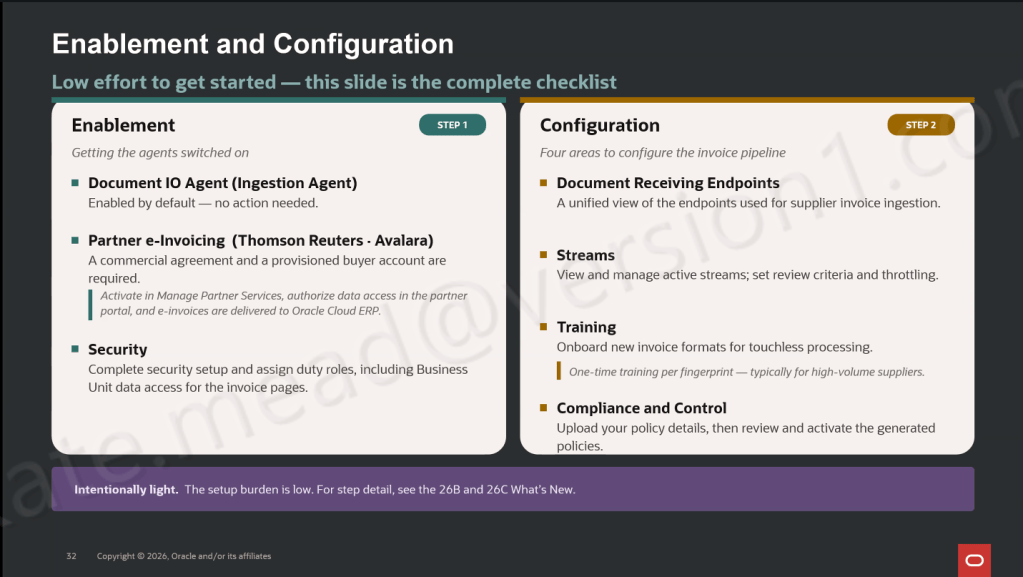
The technology behind Payables Agent is impressive, but most implementation challenges won’t come from invoice recognition or anomaly detection. They’ll come from licensing assumptions, security design and governance decisions. Customers that take the time to understand those areas early tend to have a smoother implementation experience and a clearer path towards the touchless AP model Oracle is aiming for.
If you’re planning a Payables Agent implementation, I would spend as much time understanding the licensing and security model as you do exploring the functionality itself. Both are essential if you want to move from a successful proof of concept to a production-ready solution.
Please note that all screenshots are the property of Oracle and are used in accordance with Oracle’s Copyright Guidelines.


