
One of the challenges with talking about AI Agent Studio is that the name can be slightly misleading. People hear the word agent and immediately picture a chatbot, a large language model, or an automated assistant. Whilst those are certainly part of the story, they’re only a small part of it. After spending time exploring Oracle’s latest AI Agent Studio capabilities, I’ve become increasingly convinced that the most important thing Oracle is building isn’t actually the agents themselves. It’s everything around them.
Enterprise AI isn’t difficult because AI models are difficult. Enterprise AI is difficult because organisations need systems that are secure, governed, reliable, testable and capable of operating at scale. Oracle’s latest vision for Agentic Applications reflects this, positioning agents as just one layer within a much broader framework that includes orchestration, security, governance, testing, approvals, connectors and enterprise context. That’s a very different proposition from simply deploying a chatbot.
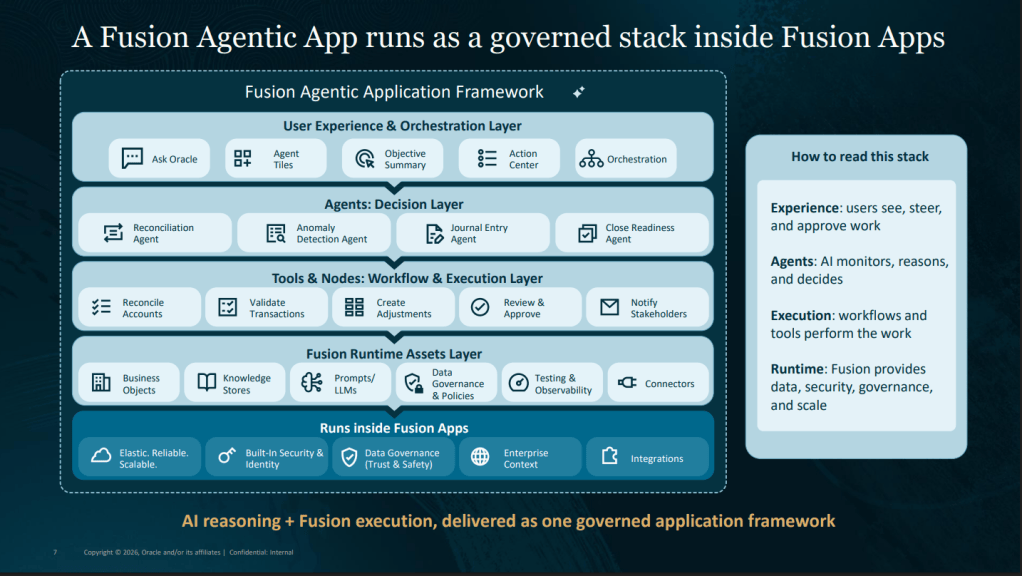
One of the concepts Oracle talks about repeatedly is the idea of Agentic Applications rather than individual agents. An individual agent can reason, recommend and generate content. An Agentic Application brings together agents, workflows, data, approvals, security controls and user experiences to deliver a specific business outcome. Oracle describes these applications as teams of specialised agents working together to achieve business objectives and deliver measurable outcomes. I think that’s an important distinction.
Most business challenges aren’t solved by a single person working alone. A recruitment process doesn’t rely entirely on HR. A supplier issue isn’t owned solely by Procurement. A financial review often involves multiple stakeholders bringing different expertise and perspectives. The same principle applies here.
Rather than building one all-knowing agent that attempts to handle everything, organisations can create specialist agents focused on particular domains, responsibilities or business processes. Oracle’s architecture explicitly supports specialised agents working as coordinated teams, allowing organisations to break complex business challenges into smaller, more manageable areas of expertise. That may sound like a technical design choice, but it’s actually a business one. The clearer an agent’s purpose, the easier it becomes to build trust, establish accountability and continuously improve performance.
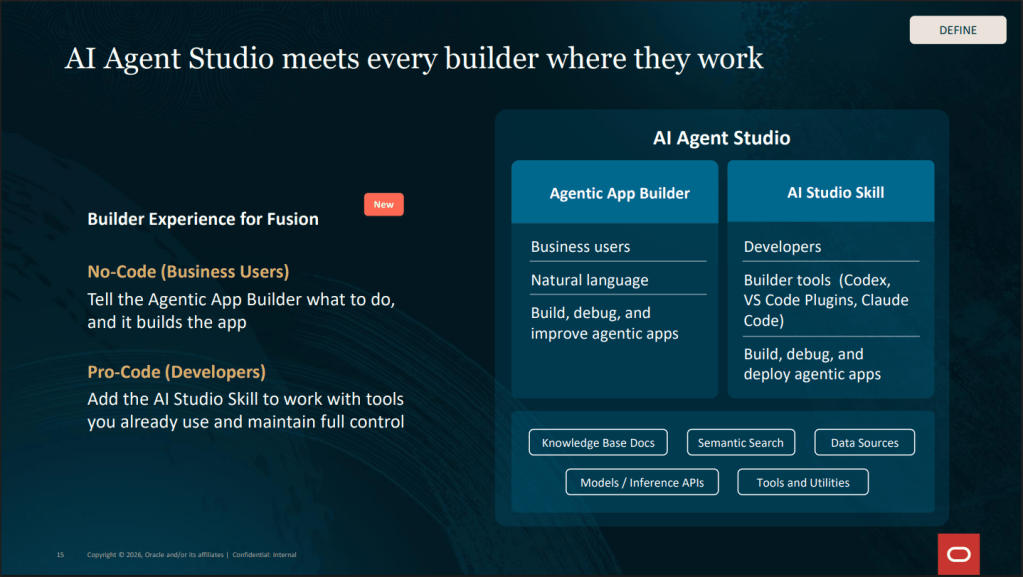
Whenever I speak to customers about AI, I often encounter the assumption that there are only two types of people involved: business users and developers. The reality is far more nuanced. Oracle’s latest AI Agent Studio experience recognises this by providing a spectrum of builder experiences, ranging from no-code and conversational design through to full pro-code development using tools such as VS Code, command-line interfaces and source-controlled development workflows.
Business users can describe outcomes in natural language, whilst developers retain full control when required. I think this approach reflects how successful transformation projects actually work. The people closest to a business challenge are often best positioned to understand the outcome they’re trying to achieve. The people responsible for architecture, security, integrations and governance are best positioned to ensure solutions can operate safely and reliably at enterprise scale. Neither group can solve the problem effectively in isolation. By supporting different types of builders, Oracle appears to be acknowledging that enterprise AI is as much about collaboration as it is about technology.
One of the biggest differences between consumer AI and enterprise AI is context. Public AI tools are incredibly capable, but they generally know very little about your organisation. They don’t understand your policies, your data, your approval processes or your business rules. Enterprise AI becomes valuable when it can work within the context of the organisation it serves.
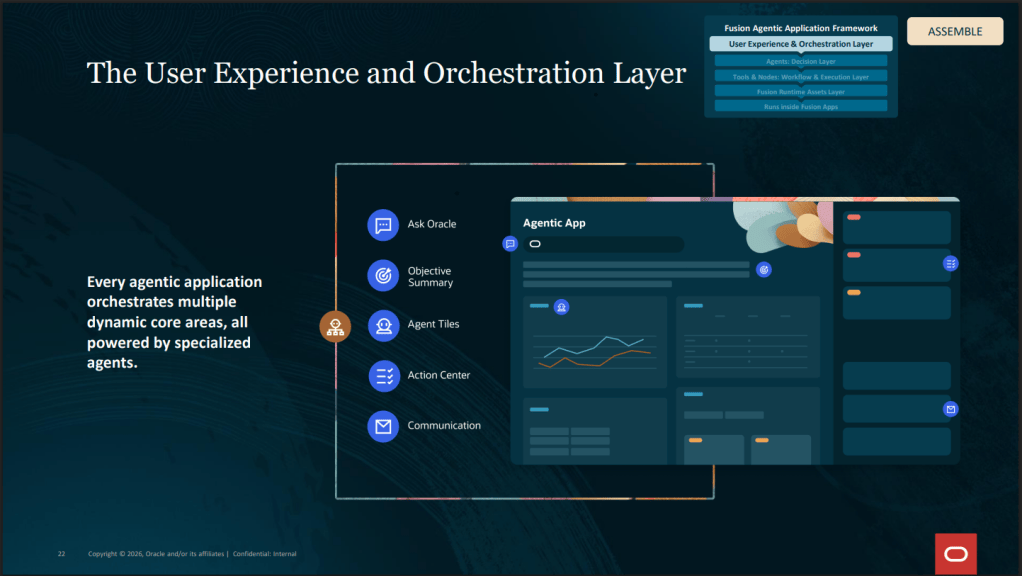
Oracle’s architecture places significant emphasis on enterprise knowledge, business objects, connectors, policies and organisational context. Agents can be grounded in enterprise content, connected to external systems, and informed by the processes and data that already exist within Fusion Applications.
Why does that matter? Because business decisions rarely rely on a single source of truth. An HR recommendation might depend on employee records, compensation history, learning activity and organisational policy. A procurement recommendation could depend on supplier performance, contract information, delivery schedules and financial exposure. A project management decision may require information from staffing, budget, risk and operational systems. The more context an agent can access responsibly, the more useful it becomes. Without context, intelligence quickly loses value.
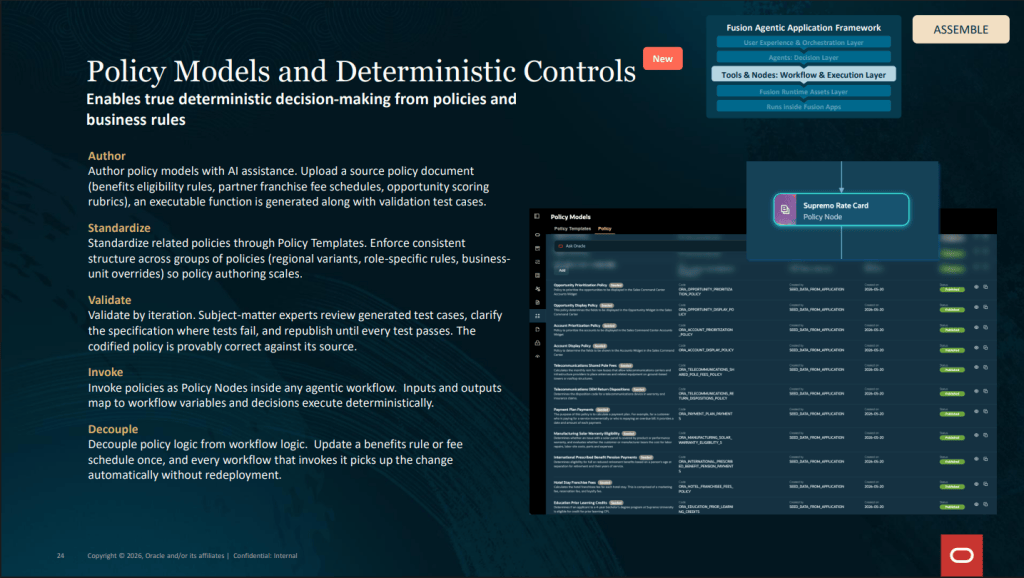
One of the most interesting additions to AI Agent Studio is the introduction of Policy Models. This capability addresses a challenge that many organisations have been struggling with since generative AI entered the mainstream. What happens when a decision must be correct every single time? There are many situations where approximation simply isn’t acceptable. Benefits eligibility. Financial calculations. Regulatory compliance. Contractual obligations. Compensation rules.
Oracle’s answer is Policy Models. These allow organisations to upload source policy documents, generate executable policy functions, validate them using test cases and then invoke them within workflows as deterministic decision-making components. Policy logic becomes reusable, consistent and centrally managed rather than being recreated repeatedly across multiple workflows.
Personally, I think this is one of the most significant capabilities Oracle has introduced. Not because it’s particularly exciting. But because it addresses one of the most common concerns organisations have about AI. Trust. Many business leaders are comfortable allowing AI to summarise information or suggest recommendations. They’re less comfortable allowing AI to interpret regulatory rules or apply financial calculations inconsistently.
Policy Models create a clear separation between reasoning and rules. The AI can help understand the situation. The policy ensures the decision follows the organisation’s defined rules. I suspect that distinction will become increasingly important as organisations move from experimentation to production use cases.
One message came through strongly when reviewing Oracle’s latest direction for AI Agent Studio. Enterprise AI is moving beyond experimentation. Oracle talks about AI Agents becoming operational centres within deployable business applications, supported by trust, governance, integration, reliability and business context.
The focus is shifting from individual AI capabilities towards complete systems that can safely execute work and deliver outcomes. I think that’s exactly where the industry needs to go. Most organisations aren’t looking for another AI demonstration. They’re looking for solutions to real business problems. They want to improve employee experiences. Reduce risk. Accelerate decision-making. Increase efficiency. Improve service delivery. That’s not achieved through agents alone.
It’s achieved through combining intelligence, governance, data, approvals, security and business processes into a cohesive solution. And that’s what makes Oracle’s current direction particularly interesting. The conversation is no longer about whether AI can generate a response. It’s about whether AI can operate responsibly within the realities of an enterprise environment. For me, that’s where the real story begins.
In the next article, I’ll explore another critical aspect of enterprise AI: trust. Specifically, how testing, approvals, governance, security and auditability are helping organisations move from AI experimentation to AI they can confidently rely on every day.
Please note that all screenshots are the property of Oracle and are used in accordance with Oracle’s Copyright Guidelines.


