
In the first article in this series, I talked about how Oracle Fusion AI Agent Studio appears to be shifting the conversation away from technology and towards business outcomes. In the second article, I explored Oracle’s Builder Assistant and how it helps close the gap between an idea and a working solution. But at some point, it’s worth understanding what actually sits behind an Agentic App. Not because you need to become a developer or learn every technical detail. Quite the opposite. Understanding the building blocks helps explain why Agentic Apps have the potential to deliver value in a way that traditional dashboards, reports and workflows often struggle to achieve.
One of the biggest misconceptions I encounter is that an Agentic App is simply a chatbot with a different interface. After spending time working with Oracle AI Agent Studio, I don’t think that’s an accurate description at all. A well-designed Agentic App is more like a digital team. Different components contribute different capabilities, each performing a specific role whilst working together towards a common outcome. When you look at it through that lens, the architecture starts to make much more sense.
At the heart of every Agentic App are one or more agents. Oracle refers to these as workflow agents, but I think it’s easier to think of them as specialists. In any organisation, complex decisions rarely rely on a single person. Different experts contribute different perspectives. A manager dealing with an employee issue might seek input from HR, Payroll and Learning teams. A finance director reviewing project performance might need information from project managers, procurement specialists and budget owners. Agentic Apps work in a similar way.
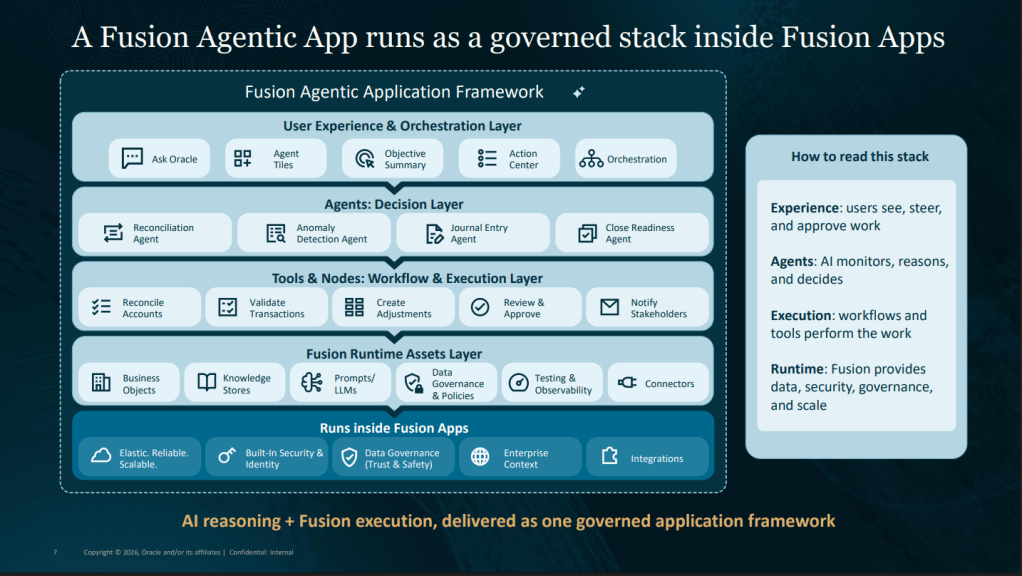
Instead of trying to create one agent that knows everything, Oracle encourages organisations to build focused agents with clearly defined responsibilities. One agent might specialise in workforce compliance, another in employee retention, another in supplier risk and another in project performance. That may sound like a technical decision, but it’s actually a business one. The clearer an agent’s purpose, the easier it becomes to trust its recommendations, govern its behaviour and improve its effectiveness over time.
Most people don’t open business applications because they enjoy looking at data. They open them because they need answers. This is why insights are such an important part of the Agentic App experience. Rather than requiring users to navigate through reports, dashboards and transactions, agents can analyse information from multiple sources and surface the things that genuinely matter.
Think about an HR manager responsible for hundreds of employees. What they typically need isn’t more data. They need help identifying which individuals require attention today. Perhaps a valued employee is showing signs of disengagement. Perhaps a professional certification is about to expire. Perhaps a new starter hasn’t completed mandatory onboarding activities. An insight helps bring those situations to the surface before they become bigger problems.
The same principle applies across Finance, Procurement, Supply Chain and Customer Operations. The objective isn’t simply to provide information. It’s to help people focus their limited time and attention where it will have the greatest impact. That’s where the real value starts to emerge.
One of the challenges with traditional reporting is that the report often becomes the end of the process. A manager discovers there’s a problem. They make a note. They send an email. They open another application. They create a task. Eventually, something happens. Agentic Apps are designed to shorten that journey.
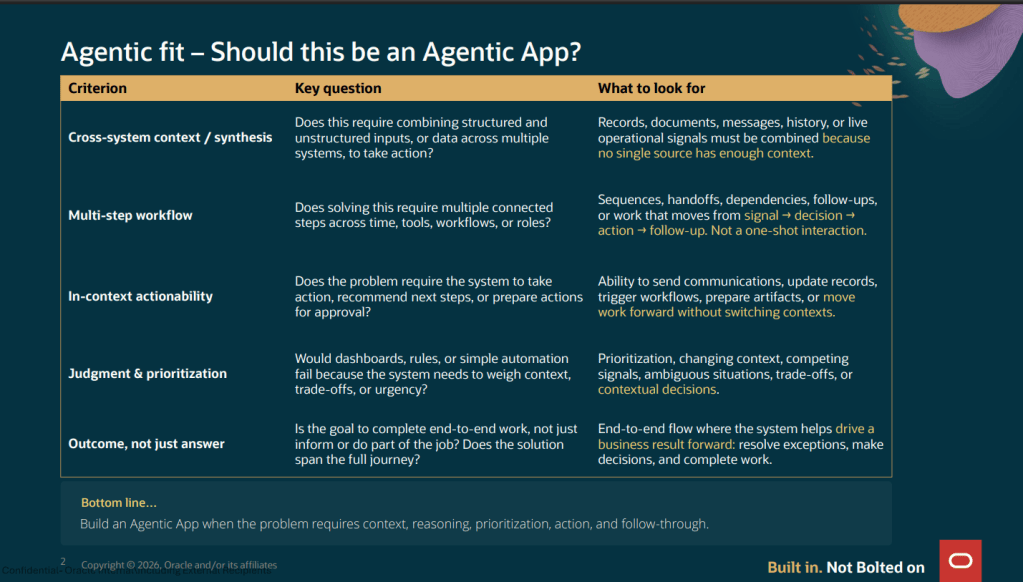
In Oracle’s architecture, agents can surface actions alongside the insights they generate. Rather than simply highlighting an issue, they can help the user decide what to do next and initiate the appropriate process. Imagine receiving an alert that an employee’s work permit is due to expire. The application could simply notify you. Or it could help initiate the follow-up activity, prepare communications, gather supporting information and guide you through the next steps.
Similarly, if a procurement agent identifies a supplier at risk of missing a key delivery commitment, the application could help trigger supplier engagement activities before the issue starts affecting customers. The outcome is the same. The difference is the amount of effort required to get there. I think that’s one of the most important distinctions between traditional productivity tools and agentic applications. They don’t just help people understand what needs attention. They help people move towards resolution.
Whenever I talk to customers about AI, one concern inevitably comes up. What happens when the system starts communicating on behalf of people? It’s a valid question. Most organisations want AI assistance, not AI acting independently without oversight.
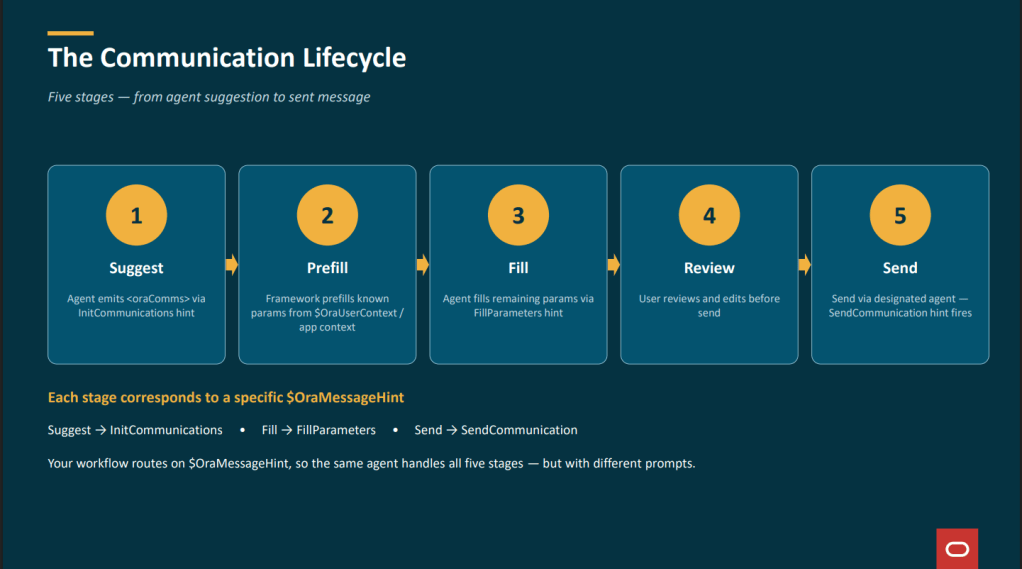
What I particularly like about Oracle’s approach is that communications are designed to support people rather than replace them. AI can help draft content, prepare messages and bring together relevant information, but the human remains responsible for reviewing, approving and ultimately deciding whether communication should be sent.
Think about an HR team responsible for monitoring expiring visas or certifications. Creating individual communications can be time-consuming, especially when managing large populations. An agent can help prepare that content using the information already available, allowing HR professionals to focus on quality and decision-making rather than administration. The same principle could apply to supplier communications, project updates, audit notifications or customer engagement activities. The technology handles the repetitive work. People retain ownership of the decision. That feels like the right balance.
Data Still Matters. None of this works without data. However sophisticated the AI might be, the quality of the outcome will always depend on the quality of the information available. This is where Oracle’s business objects, integrations and data access capabilities play such an important role. Agents need access to information before they can generate meaningful insights, recommendations or actions.
The good news for Oracle Fusion customers is that much of that information already exists within the applications they use every day. Employee data. Talent information. Financial transactions. Supplier records. Projects. Learning activities. Procurement spend. The opportunity isn’t necessarily creating new information. It’s bringing existing information together in a way that helps people make better decisions.
Individually, agents, insights, actions, communications and data capabilities are all useful. Collectively, they become something more powerful. An insight identifies an issue. An action helps drive resolution. A communication engages the right people. An agent orchestrates the process. Underlying data provides the necessary context. Together, they create an experience focused on outcomes rather than transactions. And I think that’s really the key message behind Agentic Apps.
They’re not trying to replace Oracle Fusion. They’re not trying to replace employees. They’re not even trying to replace existing processes. Instead, they’re helping organisations navigate increasing levels of complexity by bringing together information, recommendations and actions in a more intelligent way. That’s a challenge every organisation faces, regardless of industry.
As organisations begin experimenting with Agentic Apps, it can be tempting to focus on the technology itself. Which model should be used? Which integrations are required? Which features should be enabled? Those questions are important, but they’re not the first questions I would ask. I’d start with the business outcome. What decision are we trying to improve? What problem are we trying to solve? What experience are we trying to create? Once those answers are clear, the building blocks start to fall naturally into place.
By now, we have explored the core building blocks that make Agentic Apps possible. However, if you’ve ever wondered what separates an interesting AI demonstration from something that can genuinely be trusted in a production business environment, that’s where the story becomes even more interesting. In the next article, I’ll look beyond the agents themselves and explore the capabilities that make enterprise AI possible at scale, from policy models and human approvals to enterprise integrations, governance and control.
Please note that all screenshots are the property of Oracle and are used in accordance with Oracle’s Copyright Guidelines.


