
There is always something slightly unpredictable about a day at UKOUG Discover. You can start the morning talking about database recovery, spend the middle of the day discussing AI agents and MCP, and finish the afternoon with a whole new way of thinking about EPM consolidation.That was pretty much my Day 1!
I managed to attend two sessions, as well as swapping my seat in the audience for the stage to jointly present with fellow Oracle ACE Director Mia Urman on a topic that seems to become more complicated by the week: AI buzzwords. Three very different sessions, but actually with more connecting them than you might initially think.
My first session of the day was Zahid Anwar’s Zero Data Loss in Practice, looking at Oracle Zero Data Loss Recovery Appliance. What I particularly liked about this session was that it started with the problem rather than the technology. Traditional database backups can leave a potential window of exposure between scheduled backups. If something goes wrong during that window, changes made since the last backup could be at risk. Zahid Anwar talked through how Oracle Zero Data Loss Recovery Appliance helps address that by continuously capturing changes without adding that workload to production systems.
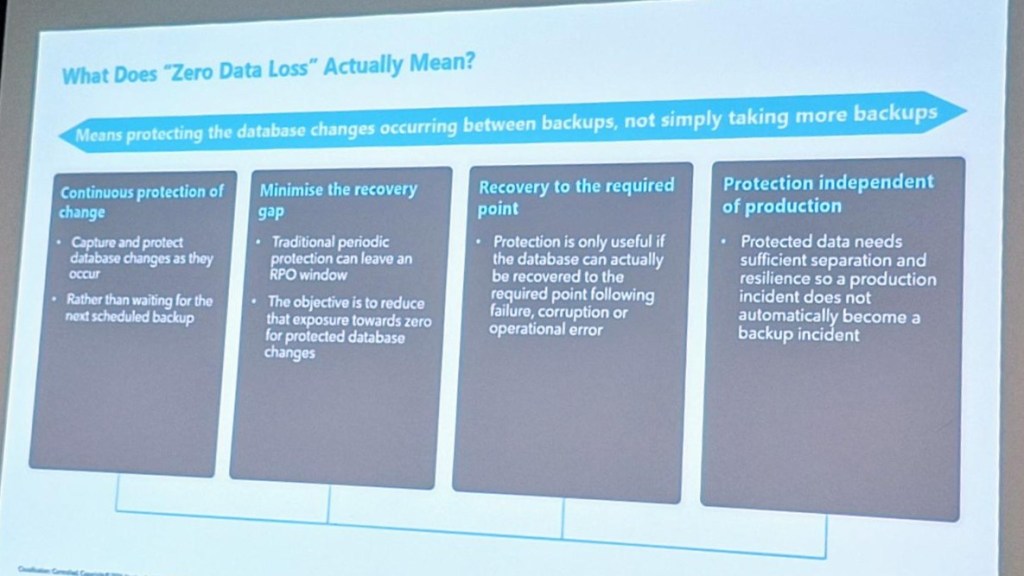
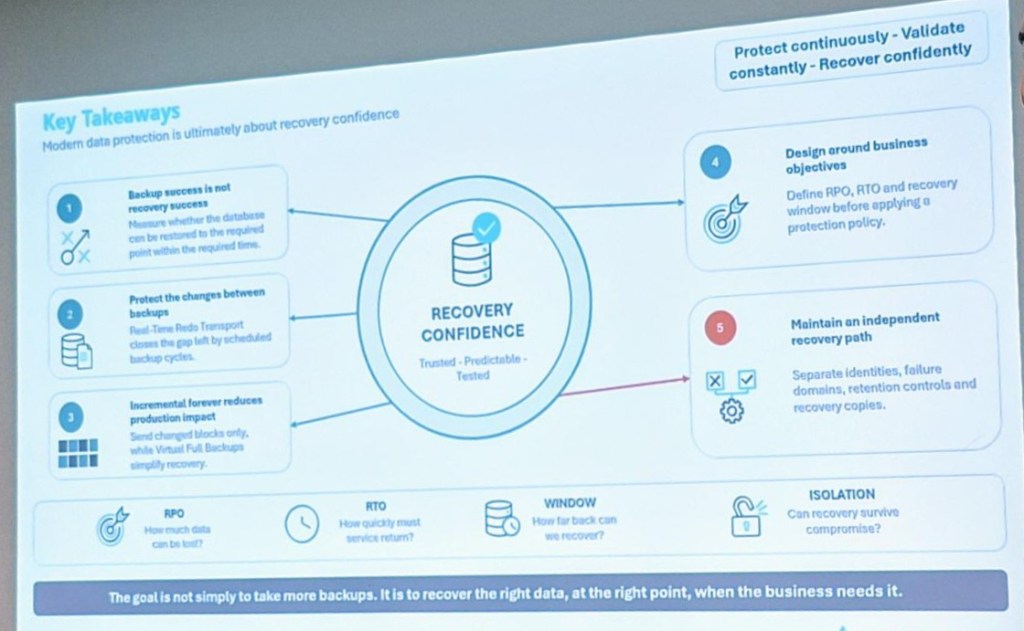
It was a useful reminder that resilience isn’t simply about being able to say you have backups. The more important questions are: How much data could you actually afford to lose? And how quickly could you recover if something went wrong? Those aren’t really technology questions. They’re business questions. You can have a perfectly good backup strategy on paper, but if your recovery point still means potentially losing critical transactions, you need to understand what that would actually mean for the organisation. A really practical start to the day.
After Zahid Anwar’s session, there wasn’t much opportunity to sit back because next on my agenda was taking to the stage myself. I joined fellow Oracle ACE Director Mia Urman to present AI Buzzwords: Decoding Enterprise Innovation. And there are certainly plenty of buzzwords to decode. AI. Machine Learning. Generative AI. LLMs. RAG. Vector Search. MCP. Agentic AI. AI Agents. Skills. Tools. Guardrails. The list seems to get longer every month.
Our starting point was something we’re both seeing more and more. AI has moved incredibly quickly from something organisations were experimenting with to something they’re almost expected to have a strategy for. It’s appearing on every roadmap, and leadership teams are asking what it means for their organisations. At the same time, moving beyond proofs of concept and turning all of that potential into something genuinely useful isn’t necessarily straightforward. That creates an interesting problem.
We’re trying to have serious conversations about how AI changes enterprise technology when we’re not always using the same language to describe it. So rather than talking about AI as one enormous concept, we broke down some of those terms and, importantly, tried to relate them back to real Oracle use cases. For example, RAG isn’t particularly interesting because of what the acronym stands for. What matters is what it lets us do: ground AI responses in relevant enterprise information rather than relying purely on what the model already knows.
Likewise, the difference between a copilot and an AI agent becomes much easier to understand when you think about who is actually doing the work. A copilot helps a person carry out a task. An agent can pursue an objective, work through the steps and use tools to carry them out within defined limits. That difference becomes really important when we start taking AI into enterprise applications.
One of the distinctions we discussed was between probabilistic AI and deterministic business systems. An LLM can be very good at interpreting language, understanding intent and determining what needs to happen next. But your enterprise system still contains the business rules, validations, security and workflow controls that determine whether that action can actually happen.
Our financials example was deliberately simple. Someone asks an agent to release an invoice hold. AI can interpret what the person is trying to achieve and potentially determine the appropriate action. The agent still applies the existing validations when that hold is released. AI interprets. Oracle enforces the rules. For me, that’s a much more useful way to think about enterprise AI than the idea that autonomous agents are somehow going to take over entire business processes with no controls around them.
And that naturally led us into human-in-the-loop design and guardrails. Least privilege. Appropriate approvals. Scope limits. Audit trails. The more autonomy we give AI, the more important those things become. The interesting question isn’t simply “Can AI do this?” Increasingly, it is: “Should AI be allowed to do this, under what circumstances, using what data, and where should a person remain accountable?”
We also wanted to bring the discussion firmly back into the Oracle world rather than leaving everyone with a collection of definitions. We looked at where these concepts are appearing across the Oracle ecosystem, including Oracle EBS, Fusion Applications, OCI, Oracle Integration and Oracle AI Success Navigator.
In EBS, for example, we talked about agents developing through Ask, Act and Analyse. An agent might initially find and explain information from EBS. The next step could be preparing or executing a transaction with appropriate human approval. Beyond that, AI can begin identifying patterns, anomalies and exceptions in the underlying data. We used examples across areas such as AP, inventory, journals, access requests and period close to show that AI doesn’t have to mean replacing an existing enterprise platform. It can equally mean finding new and more natural ways for people to interact with it.
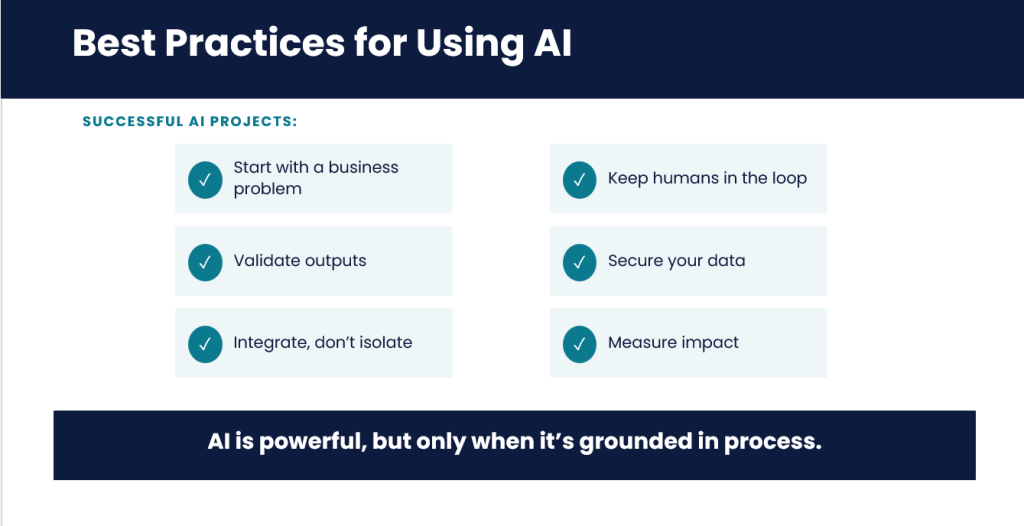
But perhaps my favourite message from our session came towards the end. Don’t start with AI. Start with friction. Find something in a business process that isn’t working as well as it could. Choose one focused use case. Connect AI to real data. Test it with the people who actually do the job. Measure whether it made a difference. Then grow from there. It might sound less exciting than announcing a huge AI transformation programme, but I suspect it has a considerably better chance of delivering something useful.
With our session finished, I could go back to being an attendee for my final session of the day, Sarah Dow’s brilliantly titled Taking Consolidation to a Whole New Cube. The session looked at multicube functionality in Oracle EPM and how the approach to consolidation changes when multiple cubes are available. Sarah Dow covered what EPM looked like before multicube, some of the prerequisites for using it, including raising an SR, and then moved into the practical use cases, configuration, integrations, dashboards and reports. And, always bravely at a conference, there was a live demo too.
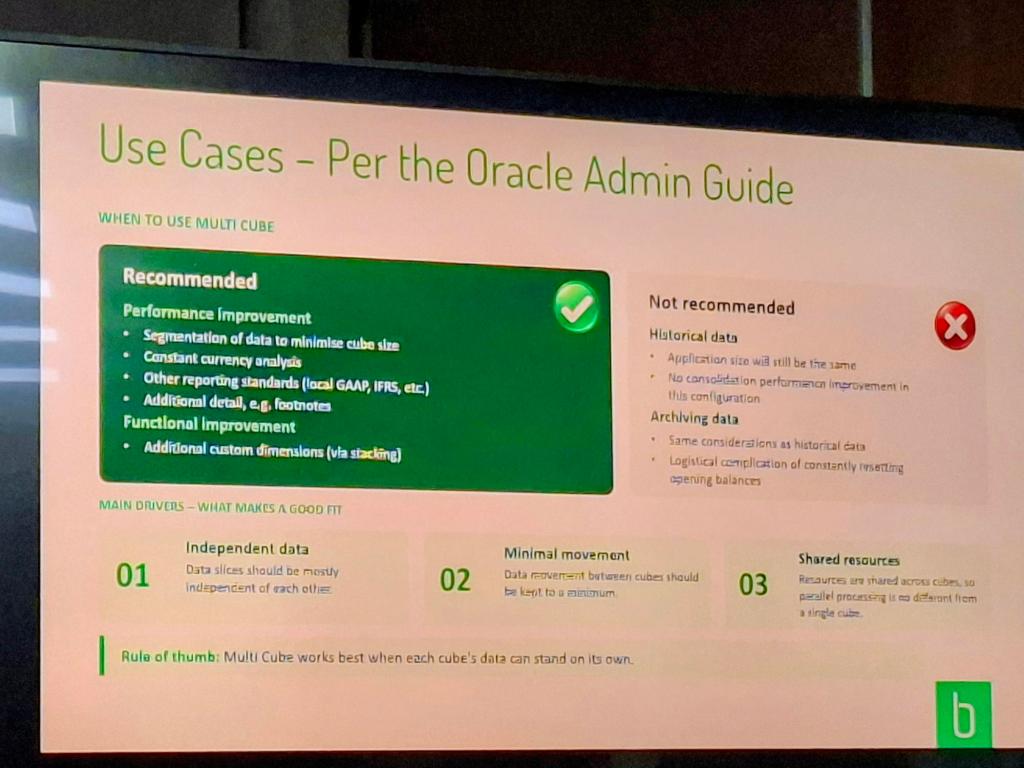
One of the use cases that particularly stood out to me was performance. Segmenting data to minimise cube size can improve performance, while scenarios such as changing the financial year end can be handled by creating a new cube. This feels like one of those capabilities where the technical description doesn’t necessarily convey the practical value. Greater flexibility in how consolidation data is separated and managed can have a very real impact on performance and on how organisations structure their EPM environment. And the live demo behaved, which is always a conference win.
As valuable as the sessions are, my favourite part of conferences like UKOUG Discover is always the networking. Catching up with Oracle users, fellow partners and people from across the wider Oracle community is so valuable. You get to hear different perspectives, find out what other organisations are actually experiencing and quite often end up having conversations that make you look at something differently. For me, those conversations between sessions can be every bit as useful as the sessions themselves.
It’s easy to get caught up in our own projects, customers and particular areas of Oracle. Events like Discover give us the opportunity to step outside of that for a while and hear what other people are seeing, what they’re struggling with and what they’re excited about. That exchange of experience is one of the things I’ve always valued about the Oracle community. The technology brings everyone together, but quite often it’s the conversations you remember.
And there was still one more bit of networking to come. Day 1 wrapped up with an ACE event next to the BBC, giving us another opportunity to catch up with friends and fellow members of the Oracle ACE community. It was a fab way to finish an equally fab first day.
Looking back, my three sessions couldn’t have been much more different. I started the day thinking about protecting critical Oracle database data, spent the middle of it talking about AI agents, RAG, MCP and why half the industry seems to have acquired an entirely new vocabulary, and finished with EPM multicube and a different way of thinking about consolidation. But there was a common theme underneath all three. None of this is really about technology for technology’s sake. Whether we’re reducing the risk of data loss, introducing AI into an established Oracle environment or changing how consolidation data is structured, the interesting part is what it allows organisations to do differently.
But perhaps my biggest takeaway from Day 1 wasn’t a piece of technology at all. It was the value of getting people together. The sessions give us the ideas and technical detail, but the conversations around them give us different perspectives. That’s one of the things I’ve always valued about the Oracle community and one of the main reasons I still enjoy attending events like UKOUG Discover. A great first day, some genuinely interesting sessions, plenty of conversations, the opportunity to share the stage with Mia Urman, and an ACE event to finish it all off.


