
I’ve spent quite a lot of time exploring Oracle Fusion AI Agent Studio over the past few months. Like many new Oracle capabilities, it’s evolved quickly. Features have appeared, interfaces have changed, and new possibilities seem to arrive with every release.
What struck me recently wasn’t a new large language model, agent type or connector. It was the user experience itself. The latest version of AI Agent Studio feels fundamentally different from where it started. That matters because one of the biggest challenges with enterprise AI has never really been the technology. It’s been accessibility.
For years, we’ve talked about empowering business users, citizen developers and functional consultants, yet many AI platforms still require specialist knowledge before you can create anything useful. Understanding prompts is one thing. Understanding workflows, orchestration, APIs and integrations is quite another. Oracle appears to be addressing that challenge head on.
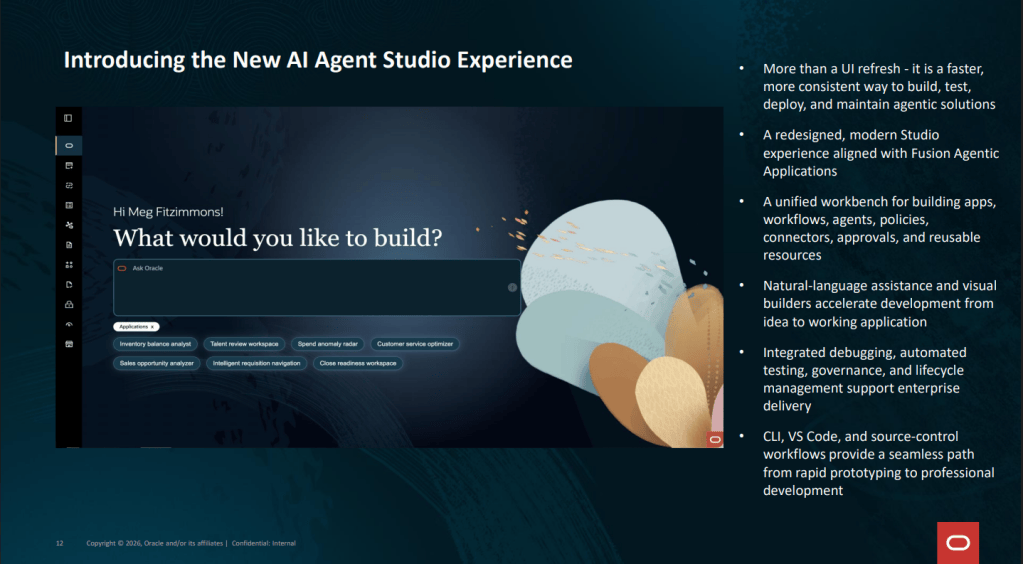
Historically, building applications has required people to translate business requirements into technical specifications. A business leader explains the problem, a consultant documents the requirements, and a developer builds the solution. The process works, but it introduces delays, complexity and the possibility that something gets lost in translation along the way.
What’s interesting about the latest AI Agent Studio experience is that Oracle is increasingly allowing people to describe what they want to achieve rather than focusing on how every component should be configured. Instead of starting with technical objects, workflows and integrations, users are encouraged to start with an outcome.
- What problem are you trying to solve?
- What decision are you trying to support?
- What action should happen next?
That might sound like a subtle change, but I think it’s one of the most significant developments we’ve seen in enterprise software for some time.
For example, an HR team might want to identify employees at risk of leaving and ensure managers take proactive action before valuable talent is lost. A procurement team might want to highlight suppliers that are showing signs of delivery risk before those issues impact customers. A finance team might want to focus attention on unusual transactions that warrant further investigation. The desired business outcome is clear, even if the technology required to achieve it is complex. The technology still matters, of course, but it increasingly sits behind the outcome rather than being the starting point.
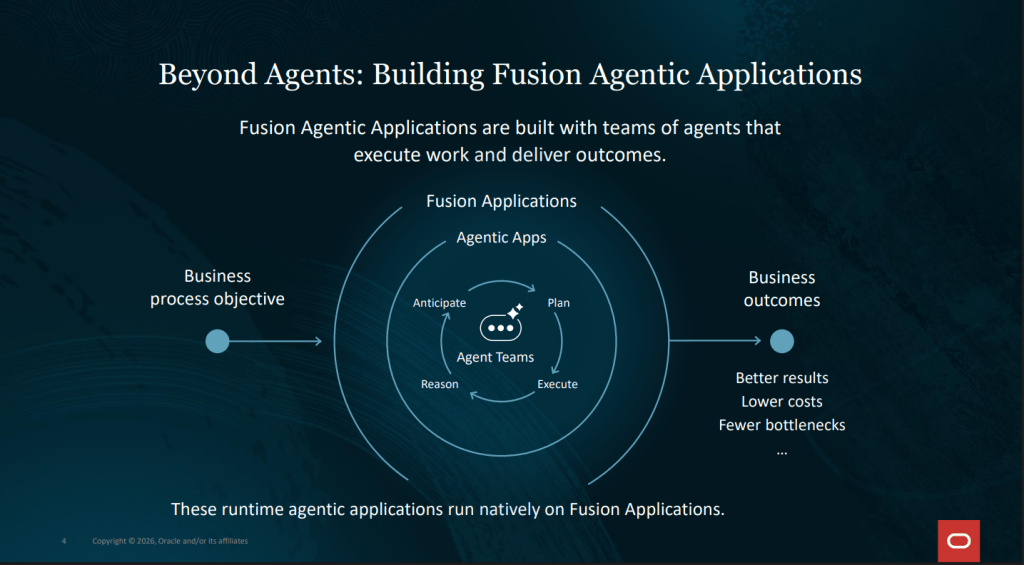
One of the themes I keep hearing from customers is that traditional applications were designed around processes. Employees complete forms, managers review transactions, reports provide information and dashboards highlight exceptions. While these tools are valuable, there is often a gap between understanding what requires attention and actually taking action. This is where agentic applications become interesting. Rather than simply presenting information, they can help identify issues, prioritise actions and guide users towards the next step.
Think about a manager reviewing their team. Traditionally, they might need to examine performance ratings, compensation information, employee engagement scores, absence trends and talent data separately before deciding where intervention is needed. An agentic application takes a different approach. It brings those signals together, highlights where attention may be required and presents recommendations in context.
Imagine opening an application and immediately seeing that a high-performing employee has received below-market compensation, has recently missed development opportunities and is showing signs of declining engagement. Instead of spending time gathering information from multiple sources, the manager can focus on deciding what action to take.
Similarly, a procurement leader could be alerted that a critical supplier has missed key milestones and may be putting future deliveries at risk. A finance manager might receive an early warning that project spending is trending above expectations long before budget thresholds are breached. An HR team could be notified about work permits, professional certifications or compliance training that are approaching expiry, giving them time to act before they become a business risk.
The value isn’t simply that AI has identified something unusual. It’s that the information has been brought together in a way that supports quicker, more informed decisions. The goal isn’t to replace human judgement. The goal is to reduce the effort required to reach an informed decision. That’s a very different proposition from simply adding AI to an existing screen.
Many organisations are already struggling with a familiar challenge. They have more data than ever before, but less time to interpret it. The problem isn’t access to information. The problem is finding the right information at the right moment and understanding what to do with it. This is particularly true across HR, Finance, Procurement and Supply Chain functions where managers are expected to make decisions quickly whilst balancing increasing levels of complexity. The promise of AI has always been to help address that challenge. The reality, however, is that many AI solutions still require significant effort to implement and maintain.
What I find encouraging about the direction Oracle is taking with AI Agent Studio is that it appears focused on practical business outcomes rather than technology for technology’s sake. The emphasis is increasingly on helping organisations build targeted applications that solve real business problems. Not generic AI. Not experimental pilots. Applications designed around specific outcomes.
That might mean reducing the time it takes to onboard a new employee. It might mean helping managers identify retention risks earlier, ensuring expiring certifications are proactively managed, accelerating supplier issue resolution or helping finance teams focus on the transactions that genuinely require attention. The common thread is that the technology becomes a means to an end rather than the end itself.
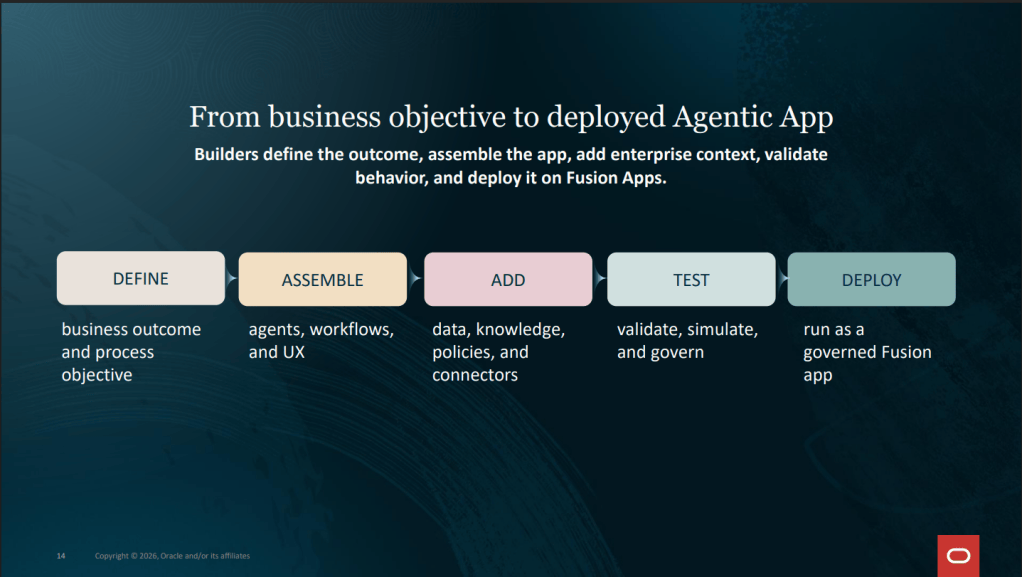
One of the misconceptions I still hear is that AI Agent Studio is aimed primarily at developers. Having spent time working with the latest experience, I don’t think that’s the case. Technical skills are still valuable. Understanding integrations, security, governance and architecture remains important. But the barriers to entry are reducing significantly. Functional consultants can contribute more directly. Business specialists can participate more actively in the design process. Subject matter experts can help shape solutions using the language of the business rather than the language of software development. I think that’s where the real opportunity lies. The people who understand organisational challenges are often best placed to identify opportunities for AI. Giving those people better tools to express their ideas is just as important as improving the underlying technology itself.
We’re still in the early stages of the agentic journey. Most organisations are exploring use cases, experimenting with ideas and trying to understand where AI can deliver genuine value. There will undoubtedly be lessons learned along the way. There will be successful projects and others that don’t deliver the expected outcomes. But when I look at the direction Oracle is taking with AI Agent Studio, what stands out is the shift from building technology to enabling outcomes. The conversation is gradually moving away from prompts, models and technical configuration. Instead, we’re starting to talk about decisions, actions and business value. For me, that’s the most important change of all.
In the next article in this series, I’ll take a closer look at Oracle’s Builder Assistant and explore what it tells us about the future of application design in Oracle Fusion. After all, if AI can help us describe what we want to achieve rather than how to build it, perhaps we’re closer than ever to closing the gap between business ideas and working solutions.
Please note that all screenshots are the property of Oracle and are used in accordance with Oracle’s Copyright Guidelines.


