
A lot has been said about AI agents in enterprise applications. They can answer questions, summarise information, recommend an action and increasingly help us navigate complicated business processes.
But I think the much more interesting question is: what happens when we want AI to go beyond helping someone do the work and actually coordinate the work itself? That is where Oracle’s new Fusion Claw starts to get interesting, particularly when you look at what Oracle is planning for Supply Chain Management.
I recently attended an Oracle session on Fusion Claw for Product Readiness and Risk Management, and for me it helped put some practical substance behind the announcements from AI World. This isn’t simply another AI agent. It is an attempt to tackle something much harder: how do you allow agentic AI to execute complex enterprise processes without losing the controls, policies, permissions and accountability that organisations already rely upon?
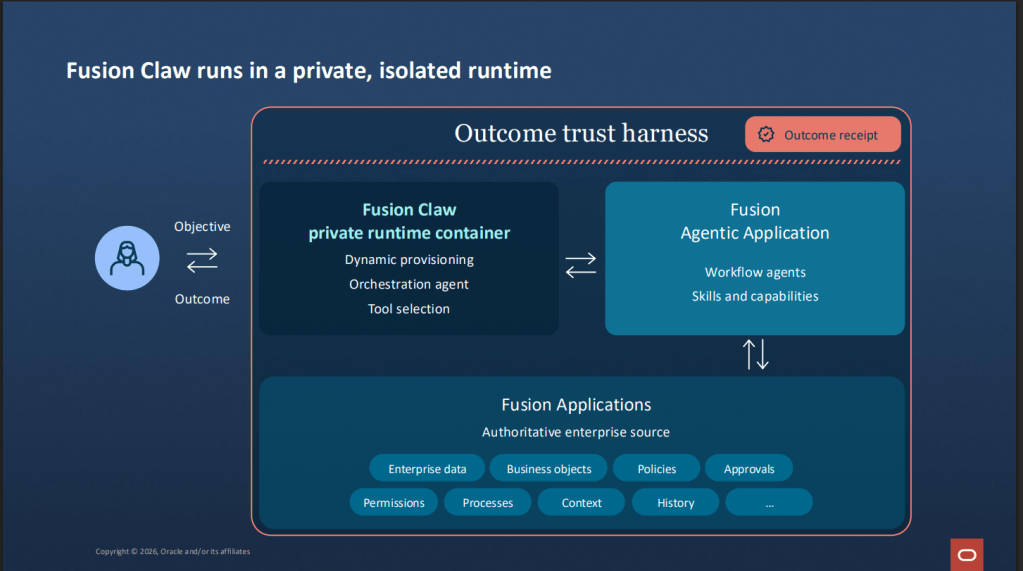
Oracle describes the change as moving from systems that predominantly record information and automate tasks towards systems that can monitor, plan, analyse, coordinate, decide and act. I actually think a better way of looking at it is this: Fusion Applications remain the system of record. Agentic Applications increasingly become the system of outcomes.
Fusion still contains the authoritative enterprise data, business objects, policies, approvals, permissions, processes, context and history. Agentic Applications sit above that foundation and coordinate work towards an outcome. That distinction matters.
One of my concerns whenever we talk about autonomous AI in enterprise applications is that we can make it sound as though we are simply handing an LLM access to ERP or SCM and telling it to get on with things. That clearly isn’t going to work.
Enterprise processes have approvals, segregation of duties, business rules, tolerances and exceptions for a reason. An AI model being confident about an answer doesn’t give it the authority to perform a transaction. And that is really the problem Fusion Claw appears designed to solve.
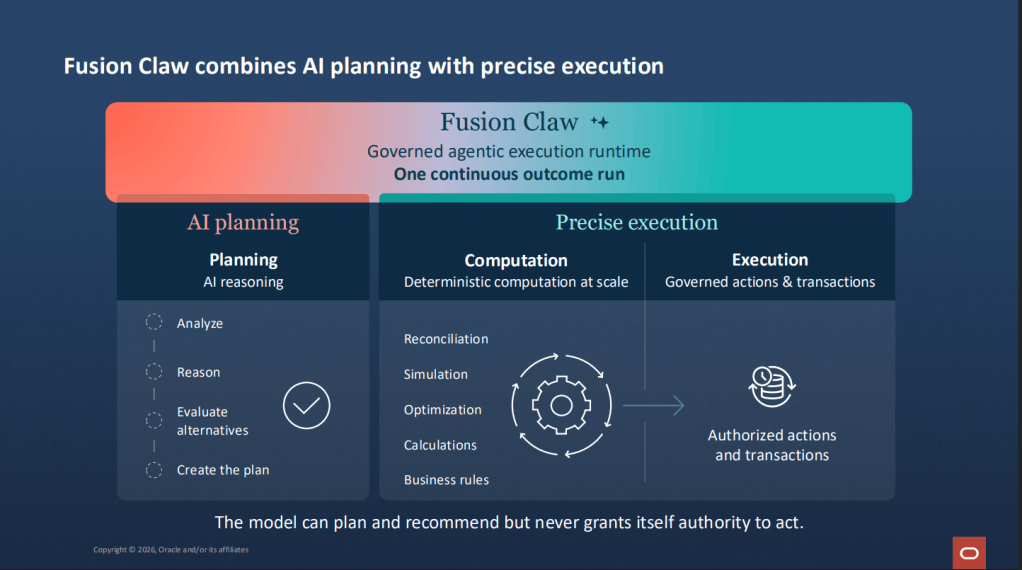
Fusion Claw is a governed agentic execution runtime and an execution engine for complex, high-value work. The principle is that AI handles the parts of a problem where reasoning is valuable, while the execution layer handles the things that need to be precise and governed.
In practice, there are three important elements working together. Planning uses AI reasoning to understand an objective, analyse the situation, evaluate alternatives and create a plan. Computation handles things such as reconciliation, simulation, optimisation, calculations and business rules deterministically and at scale. Execution then performs authorised actions and transactions within the controls of the enterprise application.
And there is one line in Oracle’s material that I think is probably more important than anything else: “The model can plan and recommend but never grants itself authority to act.” That, for me, is the difference between an interesting AI demonstration and something organisations could realistically contemplate putting into production.
Supply Chain is almost the perfect environment in which to demonstrate this. Think about a relatively straightforward question such as: Is this product actually ready to go into production?
The answer might depend upon information spread across Product Lifecycle Management and the BOM, suppliers and sourcing, regulatory declarations, quality records and financial information including pricing, tariffs and currency exposure.
Traditionally, people have to assemble that evidence, reconcile what it means and then coordinate whatever happens next. This isn’t necessarily because the underlying systems cannot store the information. The challenge is bringing the information together in context, understanding its significance and deciding what should happen next. That is where the Product Readiness use case starts to show the potential of an Agentic Application.
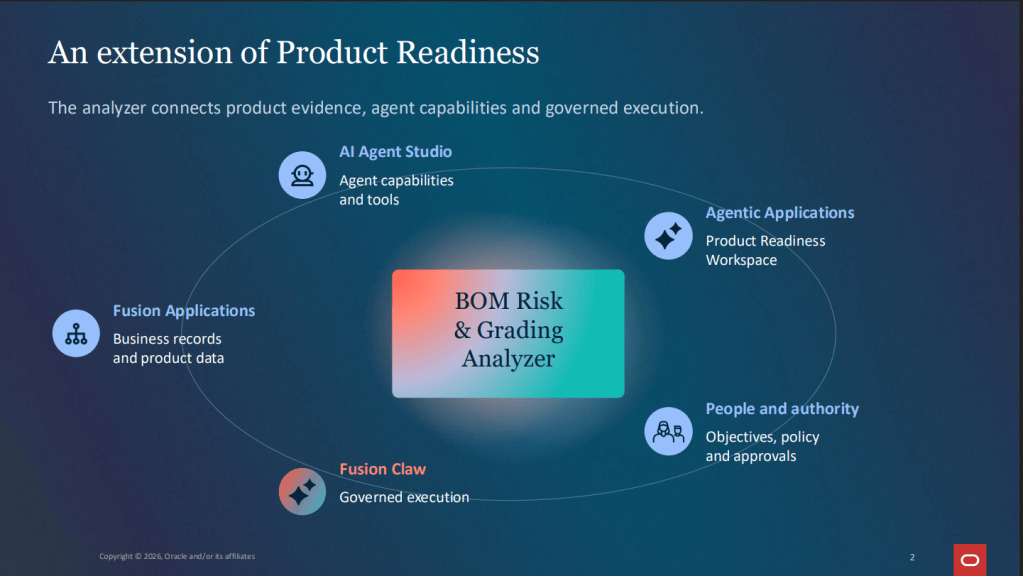
To resolve this, Oracle have introduced the BOM Design Risk and Grading Analyser, part of the Product Readiness Workspace. Its objective is to identify BOM risk earlier and establish a mitigation path before design freeze. The Analyzer can grade design risk, explain blockers, compare mitigation scenarios and prepare a governed readiness decision, with the intended outcome of getting to launch decisions faster while reducing late blockers. What I like about this example is that it isn’t really an AI chatbot use case.
What I like about this example is that it isn’t really an AI chatbot use case. The process connects the business and product records sitting within Fusion Applications with agent capabilities and tools from AI Agent Studio, the Product Readiness Agentic Application and, importantly, the people, policies, objectives and approval authorities that govern the business. Fusion Claw then provides the governed execution layer that brings those elements together.
That combination matters because an agent isn’t simply being asked“what do you think?” It is being asked to investigate a business outcome against actual enterprise evidence and policy.
Oracle breaks this down into three broad stages, but I think they are better understood as a continuous process rather than three separate capabilities. It starts by investigating. AI can understand the required BOM outcome, trace the available evidence, compare the available options and help plan recovery activity. The process then moves into assessment, where defined policy becomes critical. Evidence scope can be validated, scores and grades calculated and mandatory gates applied. Finally, it can follow through, comparing possible recovery options, preparing permitted work and tracking the evidence and resolution. Throughout that process, authority still governs what the system is actually allowed to do.
I think that’s an important pattern for enterprise AI because it acknowledges something we occasionally lose sight of when talking about generative AI: not everything should be probabilistic.
We might be perfectly comfortable asking an AI model to reason about possible ways of solving a problem. We are probably much less comfortable asking that same model to arbitrarily decide whether a mandatory compliance condition has been met. Fusion Claw appears to separate those responsibilities.
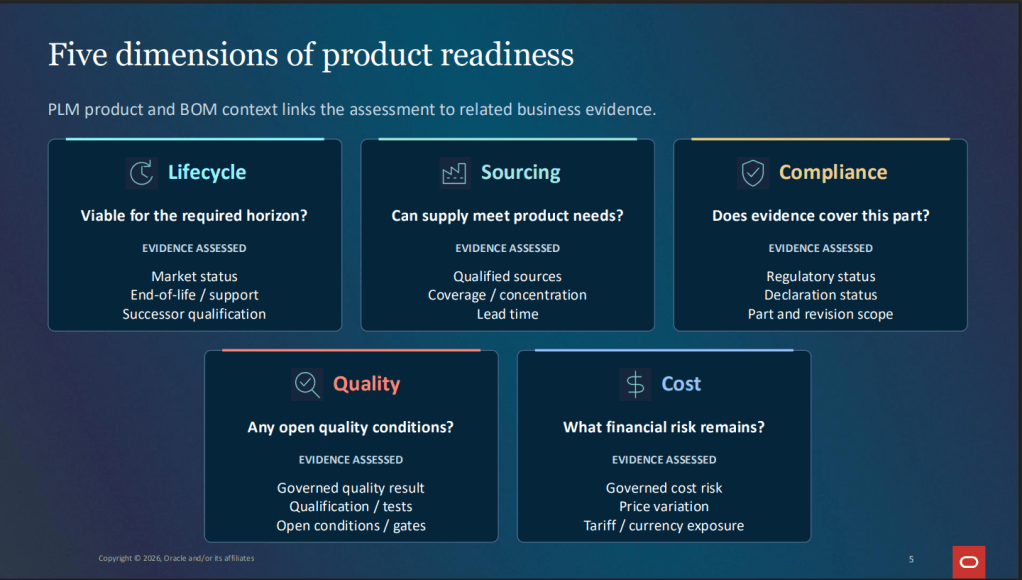
The Product Readiness component assesses risk across five dimensions, but what makes this interesting is how those dimensions come together rather than the fact that there are five of them. Lifecycle considers whether an item remains viable for the required horizon, taking into account things such as market status, end-of-life information, support and successor qualification. Sourcing looks at whether supply can actually meet the product’s requirements through areas such as qualified sources, supplier concentration, coverage and lead time. Compliance examines whether regulatory evidence genuinely covers the relevant part and revision, while Quality looks at unresolved conditions, qualification tests and gates. Cost then adds another perspective by considering exposure from price variation, tariffs and currency movement.
None of those questions is particularly unusual in its own right. Organisations already answer them today. What’s different is the possibility of evaluating them together as part of one continuously orchestrated business outcome, rather than somebody manually moving between different records, spreadsheets, reports, emails and application screens.
And this is where the value starts to become much clearer to me. The really clever bit: policy still belongs to you. Another element I particularly like is that Oracle isn’t suggesting that AI should decide what constitutes an acceptable risk. The customer defines that.
An organisation can configure its SOPs, evidence requirements, qualification rules, business rules, risk priorities and tolerances. Policy assessment can then combine evidence and scope with thresholds, weights, profiles, grade bands and mandatory gates to apply those criteria consistently. Crucially, Oracle also shows the policy version being retained so that the result remains traceable. That’s a subtle but really important distinction.
AI can help investigate the situation and develop a plan. The enterprise remains responsible for determining the rules of the game. And for organisations considering how they govern agentic AI, I think that model is more compelling than the idea of simply giving increasingly capable models more access.
That’s a completely different level of AI. And this is where it becomes agentic. Identifying the problem is useful. Resolving it is where the business value lives. We’re talking about a system that can help coordinate an outcome.
And importantly, that does not mean uncontrolled autonomy Depending on the authority provided, Fusion Claw can execute within that authority, recognise when approval is required or escalate when necessary, while maintaining audit and monitoring around the process.
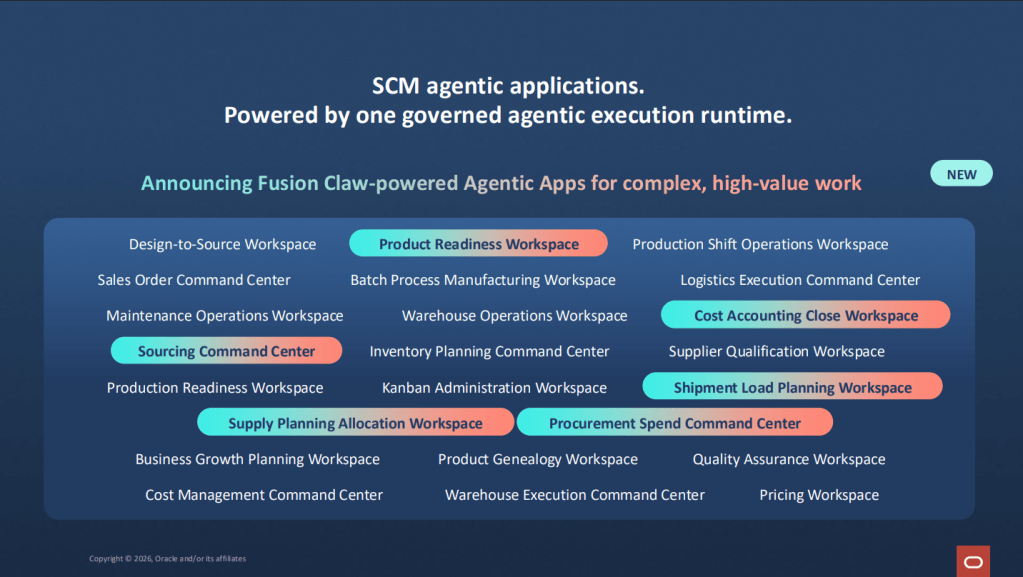
The SCM roadmap shown during the webinar covered Agentic Apps and workspaces across a significant proportion of supply chain. Alongside Product Readiness and Design-to-Source there are planned use cases around Maintenance Operations, Batch Process Manufacturing, Logistics Execution, Sourcing, Shipment Load Planning, Supply Planning Allocation, Procurement Spend, Warehouse Operations, Sales Orders, Cost Accounting Close, Inventory Planning, Supplier Qualification, Production Readiness, Kanban Administration, Business Growth Planning, Product Genealogy, Quality Assurance, Cost Management, Warehouse Execution and Pricing.
That’s quite a list. And it starts to reveal the bigger strategy. Fusion Claw isn’t the Agentic Application. It is the common governed execution runtime underneath them. That distinction is going to be important as we start to see these capabilities appearing across Fusion.
For the last couple of years, enterprise AI has largely been about making existing work easier: summarise this, generate that, answer my question or recommend what I should do next.
Useful? Absolutely. Transformational? Sometimes. But the Fusion Claw and Agentic Applications story points towards something different. The shift is from AI helping a user perform a process towards AI helping orchestrate the process around an outcome, while humans retain control of the objectives, policies and authority. For SCM in particular, that’s potentially significant.
Supply chains involve huge datasets, constantly changing conditions and numerous interconnected policies and controls. A decision in one area can quickly create consequences somewhere else. Product readiness is a great example because lifecycle, sourcing, compliance, quality and cost risk don’t exist independently.
If Agentic Applications can genuinely reason across those dimensions, apply deterministic policies where required, coordinate the resulting work and maintain the underlying governance and audit trail, we’re getting much closer to what enterprise agentic AI needs to look like.
Not autonomous AI doing whatever it thinks is best. Governed autonomy working towards an outcome the business has defined. For me, that distinction is what makes Fusion Claw one of the more interesting announcements to come out of Oracle AI World this year. And if Product Readiness is an indication of what Oracle intends to do across the rest of SCM, I’ll definitely be watching what comes next.
Please note all screenshots are the property of Oracle and are used according to their Copyright Guidelines.


