
In my previous article, I talked about how Oracle Fusion AI Agent Studio feels different from many of the AI platforms that have emerged over the last few years. The shift isn’t really about a new feature or a new model. It’s about moving away from technology-first thinking and focusing instead on business outcomes.
One capability in particular stands out as an example of that shift: the Builder Assistant. On the surface, the Builder Assistant looks like another AI-powered assistant. You describe what you want, it helps generate the building blocks, and you continue refining the solution through conversation. But I think the significance runs deeper than that.
For years, we’ve accepted that creating applications requires a detailed understanding of how technology works. We capture requirements, design workflows, build integrations and configure business logic, often translating the same business need several times before reaching a finished solution.
The Builder Assistant starts to challenge that assumption. Rather than asking users to begin with the technical design, it encourages them to start with what they are trying to achieve. That might seem obvious, but it’s a meaningful change in how applications are conceived and created.
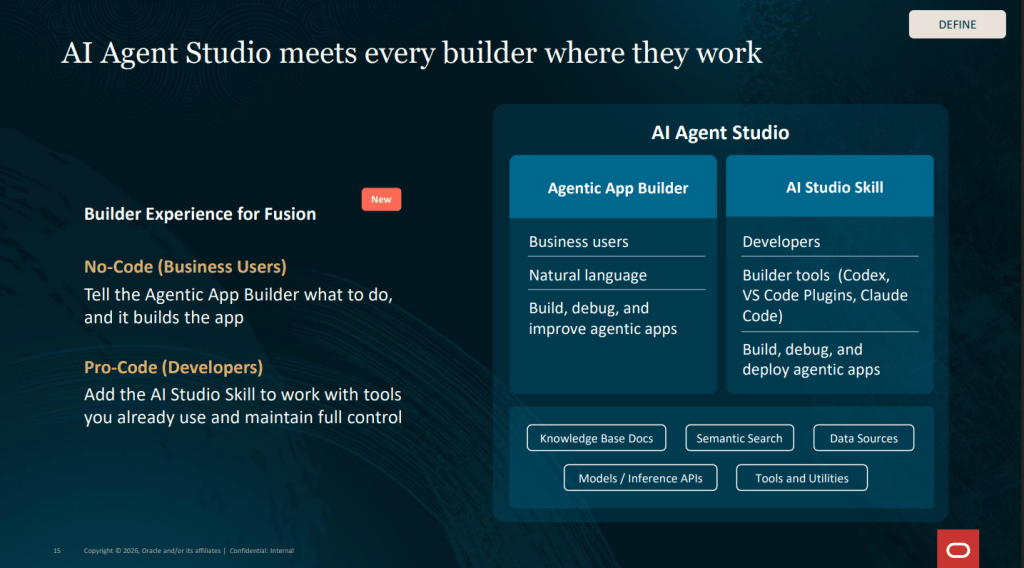
When organisations begin any transformation programme, they rarely describe their challenges in technical terms. An HR Director doesn’t typically ask for a workflow containing multiple nodes, integrations and business objects. They might say: “We need to identify employees who may be at risk of leaving.” A Procurement Manager might say: “We need earlier warning when suppliers are likely to miss critical deadlines.” A Finance Director might say: “We want to focus our team’s attention on unusual spending patterns before they become a problem.” These are business challenges, not technical requirements.
Traditionally, there has been a considerable gap between those conversations and the resulting application design. Someone has to translate the business need into technical specifications before any development can begin. What Oracle appears to be doing with the Builder Assistant is helping to narrow that gap. Instead of immediately thinking about workflows, integrations and data structures, users can start by describing the outcome they want to achieve. The platform then helps build the underlying components needed to support that outcome. The complexity hasn’t disappeared, but it has become less of a barrier to getting started.
A common misconception about AI is that its primary purpose is automation. Whilst automation is certainly part of the story, I think one of the biggest opportunities lies elsewhere. AI can help organisations capture expertise more effectively. Every organisation has people who understand its processes, challenges and priorities exceptionally well. They know which risks matter, which decisions take too long and where valuable time is lost. What they often lack is the ability to translate those ideas into working applications. Historically, that has required specialist technical skills.
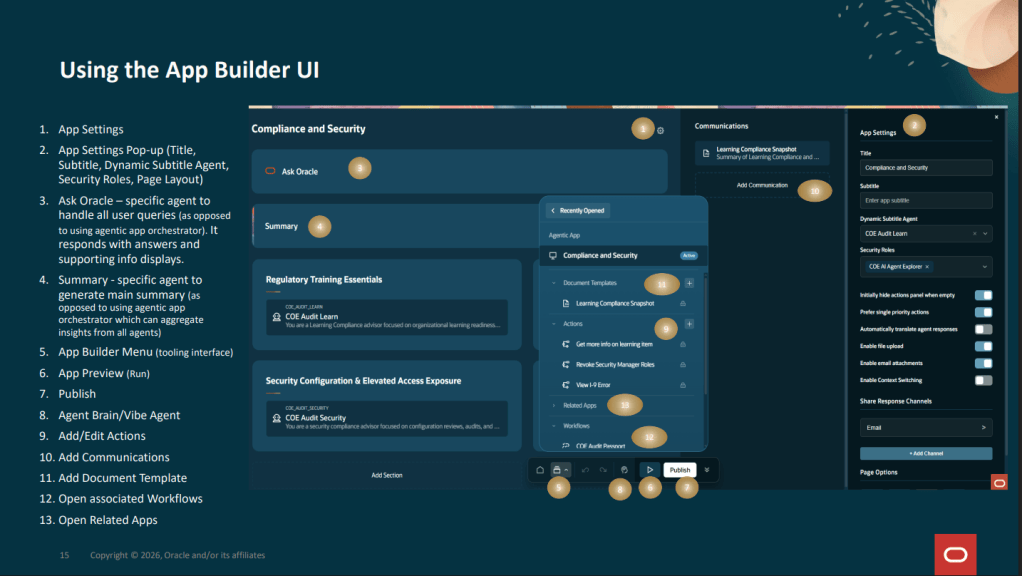
As tools like the Builder Assistant evolve, we’re starting to see a world where business experts can contribute much more directly to the solution design process. Imagine an HR specialist describing the characteristics of employees who may require additional support and seeing a prototype solution emerge. Imagine a compliance team defining the type of risks they need to monitor without having to understand every technical object behind the scenes. That doesn’t remove the need for governance, technical review or implementation expertise. But it does allow the people closest to the problem to become much more involved in shaping the solution. For many organisations, that could prove transformational.
One of the things that interests me most about Agentic Apps is that they encourage organisations to think differently about applications altogether. Traditionally, software has been designed around transactions and processes. Users navigate through screens. They search for information. They run reports. They review dashboards. Then they decide what action to take. Agentic applications take a different approach. They start with the question: “What does the user actually need to accomplish?”
A manager may not care about navigating between multiple screens to gather workforce information. They care about whether someone on their team requires support or intervention. A procurement leader may not care about reviewing dozens of supplier records. They care about understanding where the next potential supply chain issue is likely to emerge. A finance manager may not want another dashboard. They want confidence that significant risks or unusual patterns will be highlighted before they become larger problems. This shift from information-centred design to outcome-centred design is one of the most interesting aspects of the agentic journey. The Builder Assistant feels like an important step in enabling that change.
One challenge I hear repeatedly from customers is that they have far more ideas than they have capacity to deliver. Every organisation can identify opportunities to improve employee experiences, streamline processes or make better use of data. The difficulty is often turning those ideas into reality. Development backlogs grow. Priorities compete for attention. Useful ideas can remain stuck in planning documents for months or even years.
By reducing some of the complexity involved in creating solutions, tools like the Builder Assistant have the potential to accelerate innovation. That doesn’t mean every idea should become an application. Nor does it mean every solution should be built without proper governance or oversight. What it does mean is that organisations can spend more time evaluating whether an idea delivers value and less time struggling with the mechanics of getting started. That feels like a much healthier place to focus effort.
Whenever AI enters the conversation, there is often concern about replacing human expertise. Personally, I see the opposite happening here. The value of the Builder Assistant isn’t that it removes people from the process. It’s that it allows people to contribute in different ways. Business specialists can focus on outcomes. Functional consultants can focus on user experience, process design and governance. Technical teams can concentrate on architecture, security and enterprise integration. Each group can spend more time applying their expertise where it adds the greatest value. The technology becomes an enabler rather than the centre of attention. And that’s exactly how it should be.
We’re still at the beginning of this journey. The Builder Assistant is not going to eliminate the need for solution design, implementation expertise or governance. Complex enterprise applications will always require careful planning and oversight. But the direction of travel is becoming increasingly clear. The gap between having an idea and creating a working solution is reducing. The ability to express business intent is becoming just as important as technical skill. And organisations are starting to gain tools that help them focus on outcomes rather than implementation details. For me, that’s a far more interesting conversation than discussing individual AI features.
In the next article in this series, I’ll look at the building blocks that sit behind Agentic Apps and explore how agents, actions, communications and insights work together to deliver meaningful business outcomes.
Please note that all screenshots are the property of Oracle and are used in accordance with Oracle’s Copyright Guidelines.


